
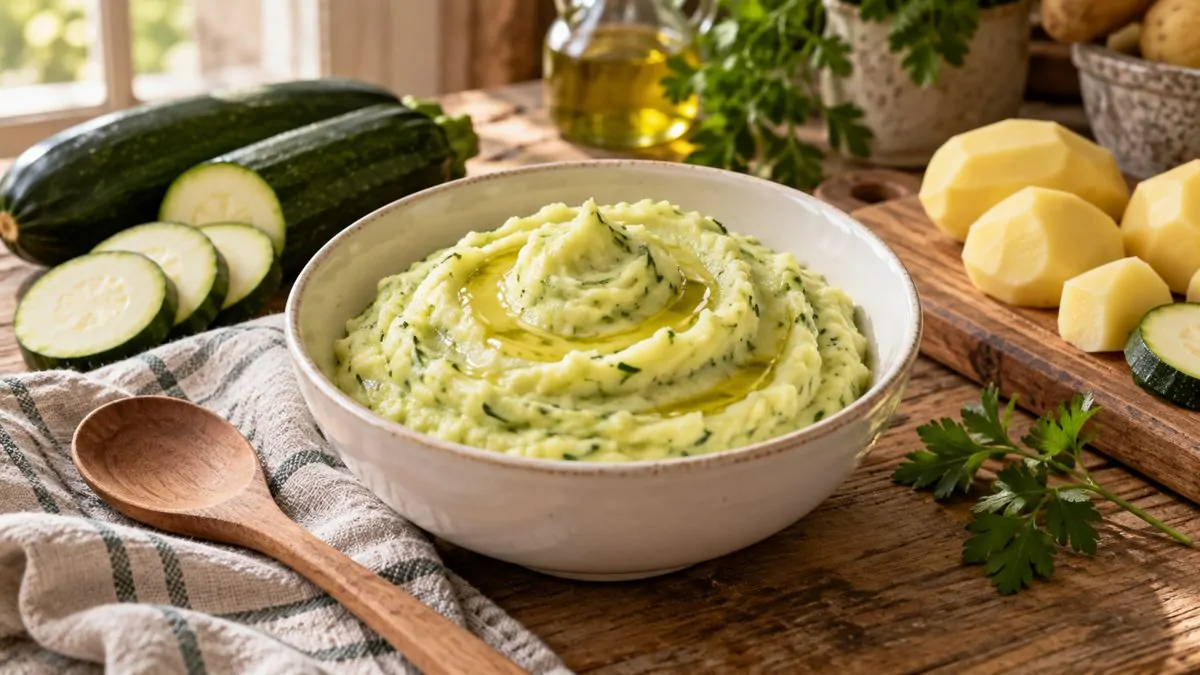
In short
A good mashed potato and courgette requires only three ingredients and good water management.
The potato provides the softness, the courgette the sweetness and a pretty pale green hue, the butter or olive oil finishes the job.
The risk is that the purée will collapse on the plate because the zucchini has released its water. This guide provides the correct proportions, a basic recipe for 4 people, and techniques to prevent the purée from becoming runny.
You will also find a baby version, separate from the family version, and the storage times to remember.
Proportions: how much courgette for a thick purée?
There's no single rule, and that's what makes online recipes so confusing. The amount of zucchini completely changes the result.
The restaurant Le Murier recommends two parts courgettes to one part potatoes (800 g to 400 g), resulting in a very light puree (restaurant Le Murier, updated September 2026).
Conversely, the 750g recipe (accessed in October 2026) calls for 8 potatoes for 3 courgettes, and Yumelise announces approximately 800g of potatoes for 300g of courgettes for 4 people.
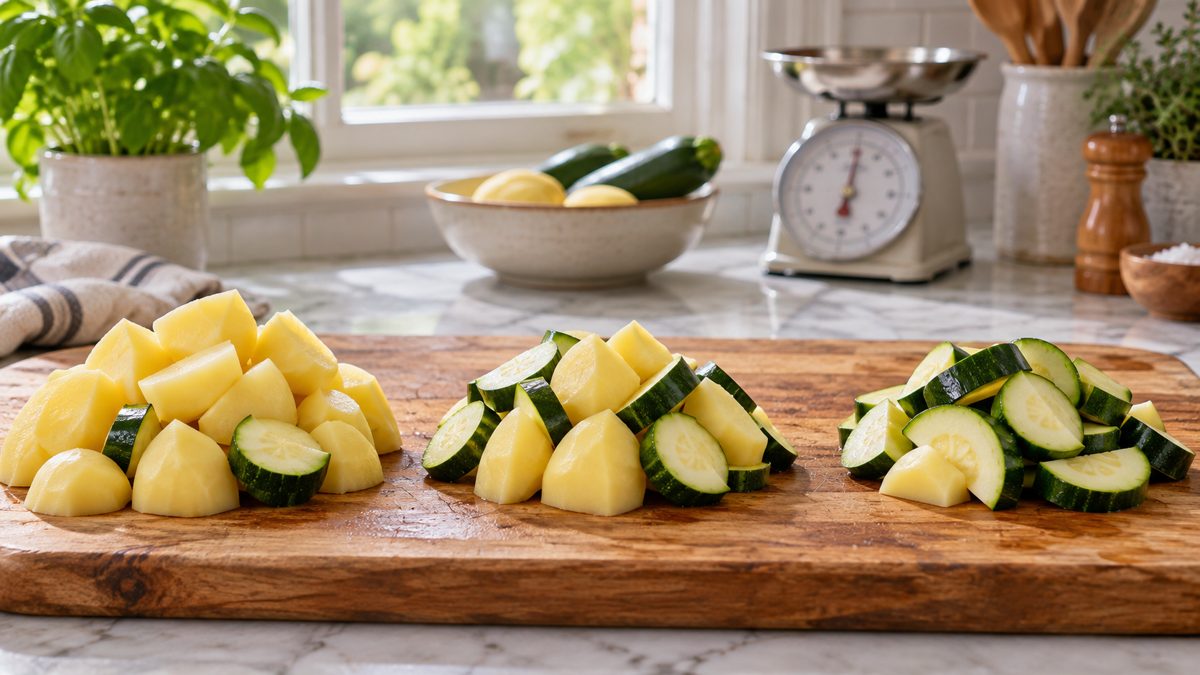
The ratio of potatoes and courgettes is therefore chosen according to the desired texture, as summarized in this table.
| Target texture | Potatoes | Courgettes | Serves 4 |
|---|---|---|---|
| Firm, similar to a classic mashed potato | 3 parts | 1 part | 675 g + 225 g |
| Creamy (our base) | 2 parts | 1 part | 600 g + 300 g |
| Light, like thick cream | 1 part | 1 part | 450 g + 450 g |
Our base recipe uses two parts potatoes to one part courgette. It retains enough starch for the purée to hold its shape on a spoon, while still allowing the courgette to express its flavor.
For a side dish served with meat in sauce, use the firm consistency. For a main course with a soft-boiled egg or fish, the light consistency is sufficient.
Quantity calculator for your mashed potatoes
This tool calculates the weights of potatoes, zucchini, and fat based on the number of servings and the chosen texture. It starts with the basic recipe in this guide, which calls for 225g of raw vegetables per person.
Basic recipe for 4 people
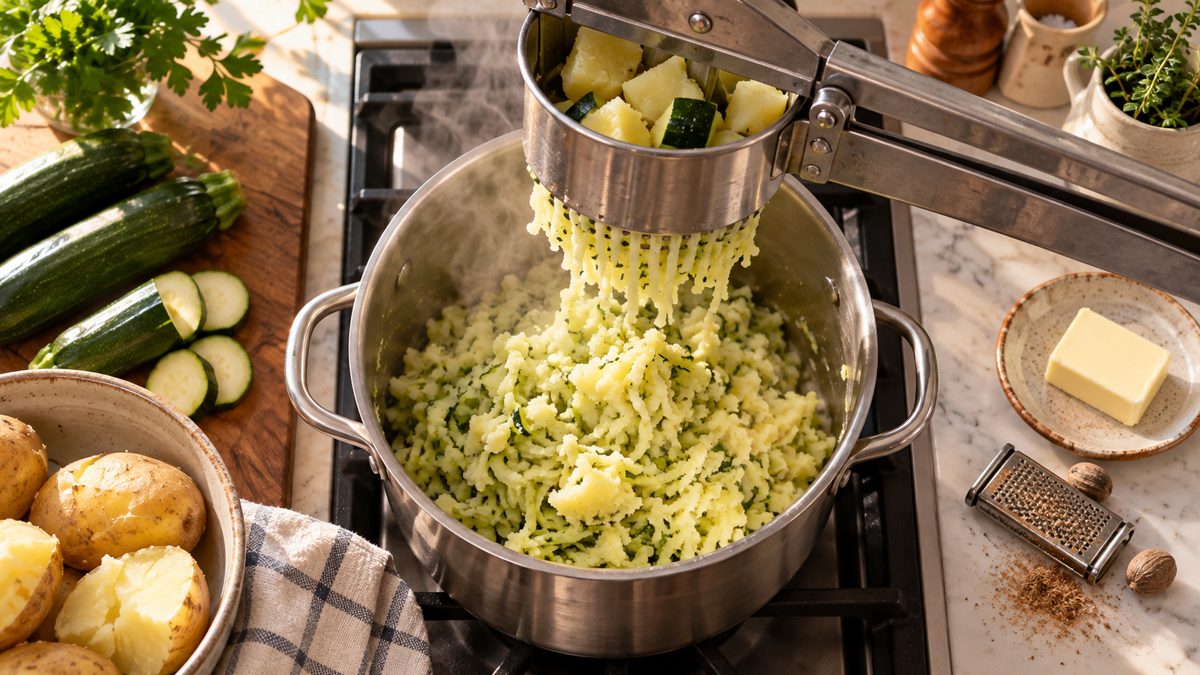
Allow 15 minutes for preparation and about 20 minutes for cooking. Steaming is a reliable method, as vegetables absorb very little water.
Ingredients
- 600g of floury or all-purpose potatoes
- 300g of courgettes
- 25g of butter or 2 tablespoons of olive oil
- 2 to 4 tablespoons of hot milk (or hot cooking water if you are boiling)
- Salt, pepper and a pinch of nutmeg
Preparation
- Peel the potatoes and cut them into 3cm cubes. Wash the courgettes and cut them into 1cm rounds, without peeling them if the skin is thin.
- Steam the potatoes for 15 to 20 minutes, until a knife blade pierces them without resistance.
- Add the courgettes to the basket after 8 minutes: they cook faster and only need about ten minutes.
- Drain well, then put all the vegetables back in the hot pan for a few moments, over low heat, to expel any remaining moisture.
- Mash with a potato masher, then stir in the butter or olive oil. Thin with warm milk, one spoonful at a time.
- Season, add the nutmeg and serve immediately.
A potato ricer gives a smoother texture than a blender. The P'tit Chef website explains that blending is faster but makes the mashed potatoes more elastic, which is generally due to the starch in the potatoes being damaged by the blades.
Typical example: for a weeknight dinner with chicken breasts, prepare the mashed potatoes while the meat cooks. Both dishes are ready in about 35 minutes, and the mashed potatoes don't need to wait: they taste best served immediately.
If you are looking for another family-style vegetable puree, carrot and potato puree is based on the same ratio principle.
How to avoid mashed potatoes that release water?
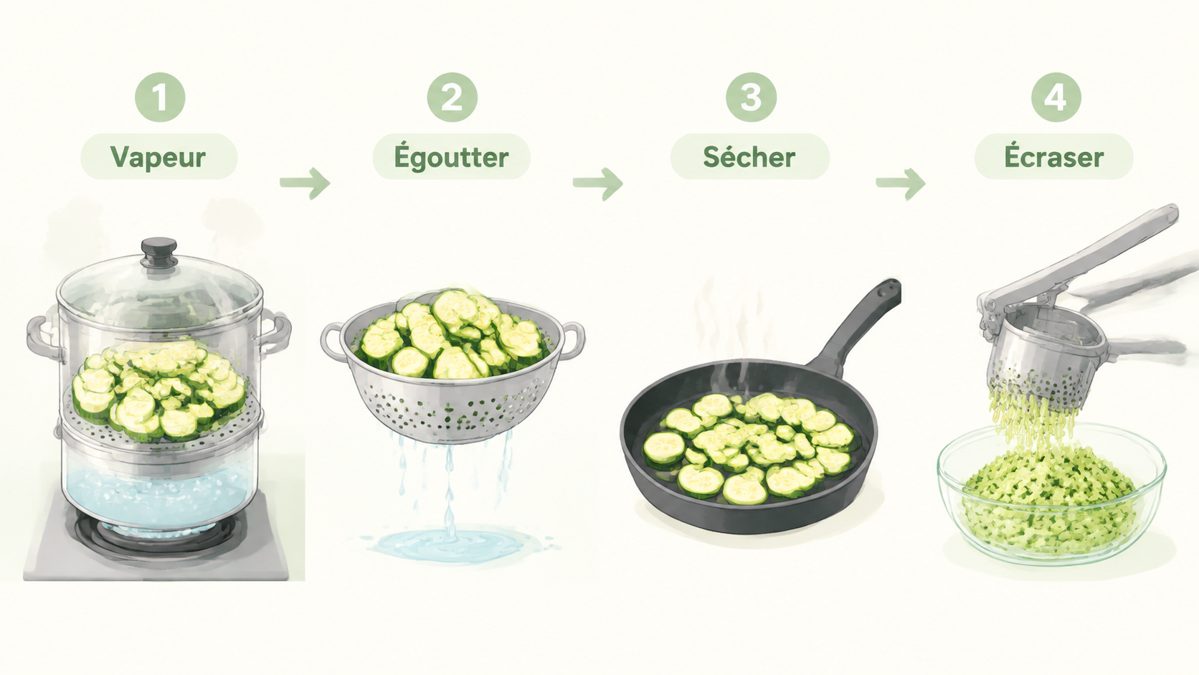
Courgettes contain a lot of water and release it when cooked. When placed in boiling water, they can absorb more water, and the purée becomes soggy, with mashing doing almost nothing to improve the situation.
Four actions solve the problem, and they are cumulative:
- Steam rather than boil, or, failing that, only plunge the courgette for the last 10 minutes.
- Drain thoroughly, then press the slices in a clean cloth.
- Dry the vegetables in the hot pan over low heat before crushing.
- Add the liquid last, one spoonful at a time, keeping some hot milk (orcooking water if you cooked in water) aside.
The editors at Le Murier restaurant also recommend removing the seeds and core from large, ripe zucchini, which tend to be the most watery. For the same reason, a small, firm zucchini generally produces a smoother purée than a large, late-season specimen.
Salting, useful for pan-fried or gratin zucchini, isn't necessary here: draining and drying after cooking already removes the water. It adds an extra step and extra salt, which should be avoided for the baby version.
What if the mashed potatoes are already too runny?
Return it to the saucepan, over low heat and uncovered, and stir for 2 to 3 minutes to evaporate the excess liquid. If it remains loose, mash a separately cooked potato and stir it in.
Conversely, a purée that is too firm can be loosened with a splash of warm milk or the reserved cooking water. Avoid cold milk, which cools the purée and can make it lumpy.
Heat the milk before adding it. If you cook the vegetables in water, keep a glass of the cooking water before draining: it contains a little starch and does not dilute the taste.
Baby version, variations and storage
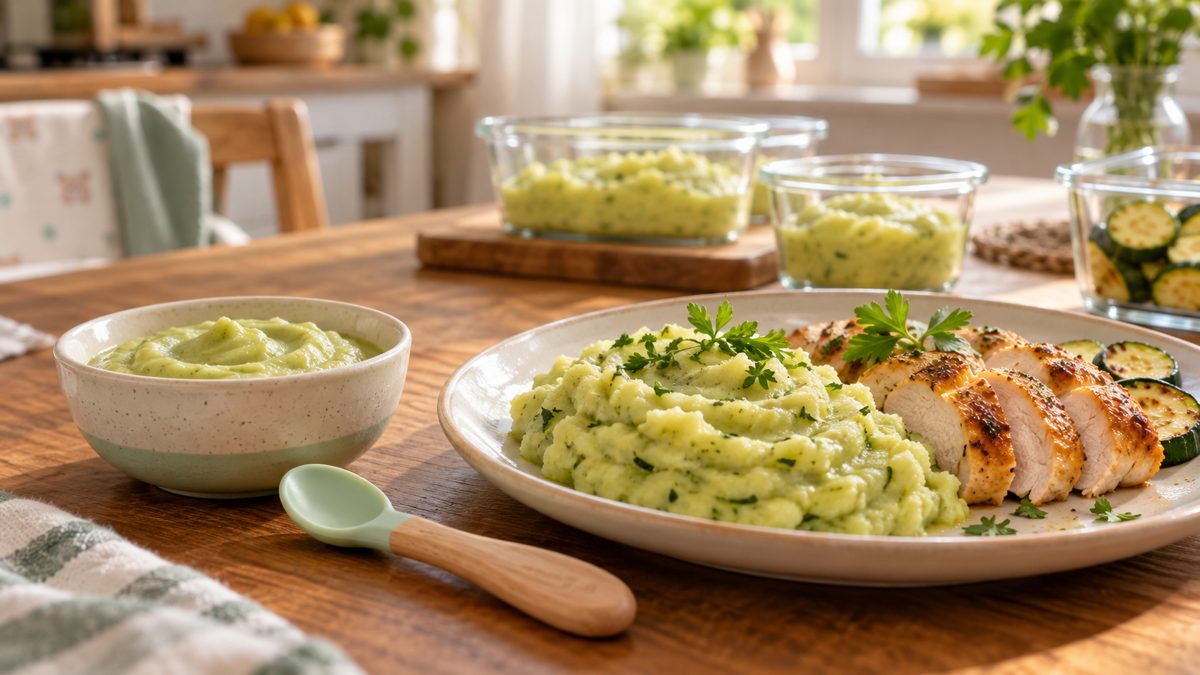
Adapting the puree for a baby
The baby food recipe is prepared separately, without salt or salted butter. According to the Manger Bouger diversification chart (accessed in October 2026), vegetables should be well cooked and smooth, and homemade preparations should not be salted.
Yooji suggests a version for babies 6 months and older, using a small zucchini and two small potatoes, cooked for 10 to 15 minutes (page published November 27, 2025). For the starting age and quantities, follow your pediatrician's advice, as guidelines vary from one website to another.
The simplest way is to take out the baby's portion before seasoning the family's puree, then blend this portion with a little water.
Baby food doesn't need cow's milk, salt, or bouillon cubes. Without consulting a pediatrician, do not simply reintroduce adult versions enriched with butter, cream, or cheese.
Variations for the family table
- Creamy version: 2 tablespoons of cream or spreadable cream cheese, added at the end of the recipe.
- Mediterranean version: olive oil, chopped basil and a lemon zest.
- Gourmet version: a little grated Gruyère cheese, as in the 750g recipe.
- Full version: a carrot cooked with the potatoes, as in carrot and potato puree.
Typical example: for a Sunday lunch, serve this purée with roast chicken or veal paupiette. Its sweetness balances the sauce and the meat.
Store and freeze
Let it cool quickly, then place the purée in an airtight container. Yooji recommends 2 to 3 days in the refrigerator for its zucchini and potato purée, and that it can be frozen in portions.
Freeze in small individual portions, thawing only what you'll eat. Reheat gently, stirring, with a spoonful of milk or stock to restore its soft texture.
In summary
A successful potato and zucchini mash relies on a good ratio—two parts potatoes to one part zucchini—and careful control of the water. Steaming, draining, and drying in a saucepan are all that's needed.
Mash with a potato masher, add the fat then the hot liquid at the end of preparation, and you get a smooth puree that goes well with both white meat and fish.
For a baby, take out their portion before seasoning and follow official recommendations. The rest can be kept for 2 to 3 days in the refrigerator or frozen in portions.
Practical questions
Do you need to peel courgettes for a purée?
It's not mandatory. The thin skin of a small, tender zucchini blends or mashes easily and gives the purée a lovely pale green color. Peel it if the zucchini is large, has thick skin, or if you're making a very smooth purée for a young child.
Can waxy potatoes be used for mashed potatoes?
Yes, but the mashed potatoes will be denser and less creamy than with a floury variety. Firm-fleshed potatoes hold their shape better during cooking and contain less starch, which prevents them from becoming sticky when mashed, at the cost of a slightly less airy texture. Yooji cites Charlotte or Amandine varieties as examples for its baby food version.
How to fix mashed potatoes that are too runny?
Return it to the saucepan over low heat and stir for 2 to 3 minutes to evaporate the excess liquid, uncovered. If that's not enough, add a cooked and mashed potato, or a spoonful of instant mashed potato flakes. Avoid flour, which leaves a raw taste.
Can you prepare a courgette and potato puree the day before?
Yes. Let it cool, put it in a sealed container, and store it in the refrigerator. When ready to serve, gently reheat it in a saucepan, adding a spoonful of hot milk or broth to restore a soft texture.
What should I serve with mashed potatoes and courgettes?
It pairs well with white meats (roast chicken, stuffed veal rolls, escalopes), baked white fish, or a soft-boiled egg. Its mildness contrasts nicely with meat in sauce or slightly spicy roasted vegetables.
