
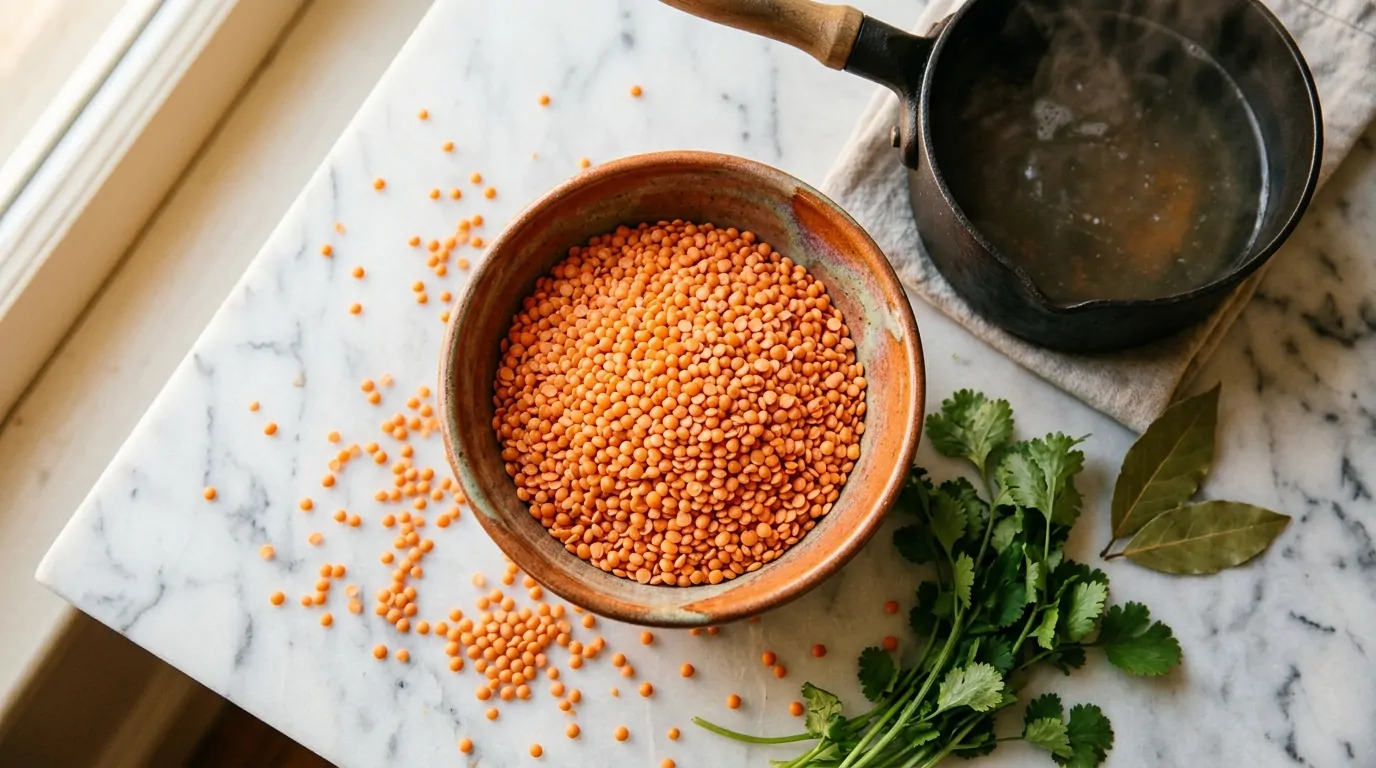
Red lentils are among the quickest legumes to prepare. Yet, overcooking them is surprisingly easy: overcooked, they turn into grey mush; undercooked, they remain grainy and indigestible.
This practical guide covers everything you need to know about cooking red lentils : the correct water/lentil ratio, different methods depending on your equipment, common mistakes to avoid, and tips for achieving exactly the desired texture…
Whether it's a creamy dahl or a light salad… we wanted to show you as many techniques as possible, in order to give you a better overall view.
Ready to explore them all? Then let's discover how to cook them better and consume them better, starting today!
In short
Cooking red lentils: some information to know
Definition and characteristics of coral lentils
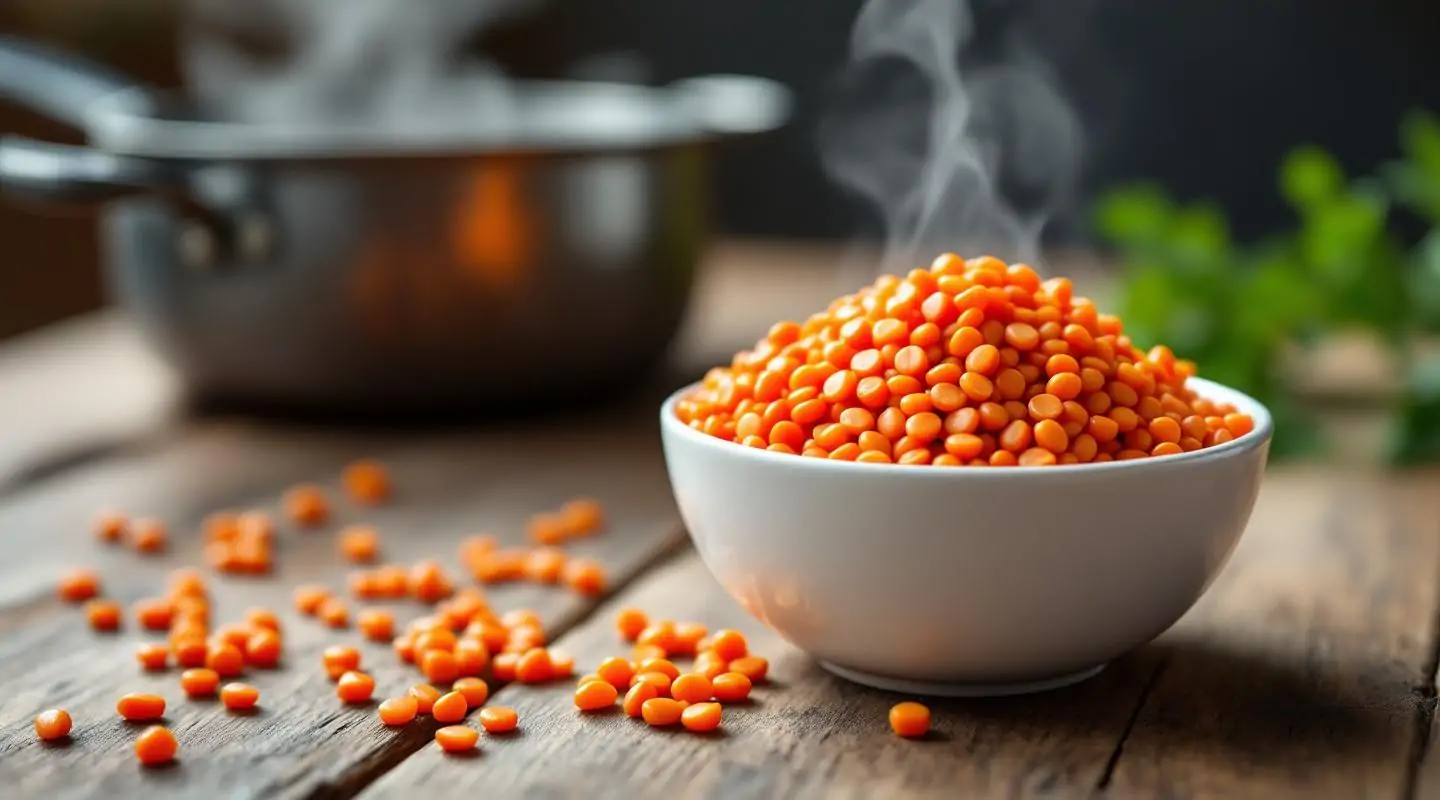
Coral lentils — also called red lentils — are hulled and hulled lentils. It is precisely this hulling process that gives them their characteristic orange color and explains their ultra-fast cooking time.
Unlike green or brown lentils, they do not require soaking. Without their hulls, they absorb water immediately and break down easily when cooked.
This is a great advantage for soups and dahls, but a trap if not carefully monitored. Their naturally melting texture makes them a perfect base for creamy dishes.
Table of times and proportions of water and coral lentils
Here is a small summary table of cooking times for red lentils and the proportions according to each of the methods used. These figures are indicative and are for 100g of dry lentils.
| Method | Water / broth | Cooking time | texture obtained |
|---|---|---|---|
| Saucepan (medium heat) | 250–300 ml | 10–15 min | Melting to creamy |
| Pressure cooker | 200–250 ml | 3–5 min under pressure | Very melt-in-your-mouth |
| Microwave | 300 ml | 10–12 min at 800W | Melting |
| Steam | — | 20–25 min | Farm (not recommended) |
| Simmering in broth | 300–350 ml | 15–20 min on low heat | Creamy, fragrant |
The golden rule: 1 part red lentils to 2.5 to 3 parts liquid. Adjust according to the desired texture — less water for a firm purée, more for a smooth soup.
Prepare the red lentils before cooking
Sorting and visual inspection for clean cooking
First of all, take thirty seconds to inspect your lentils. Pour them onto a clear surface and look for small pebbles, blackened grains or debris that sometimes get in there.
This sorting is quick on coral lentils because they are already hulled and their uniform size makes it easier to spot foreign bodies.
A damaged grain won't ruin the dish, but a small pebble can cause an unpleasant surprise. Two minutes of vigilance can prevent many problems.
Thorough rinsing: cleanliness, digestion and texture
Rinsing red lentils is a step that many people wrongly skip!
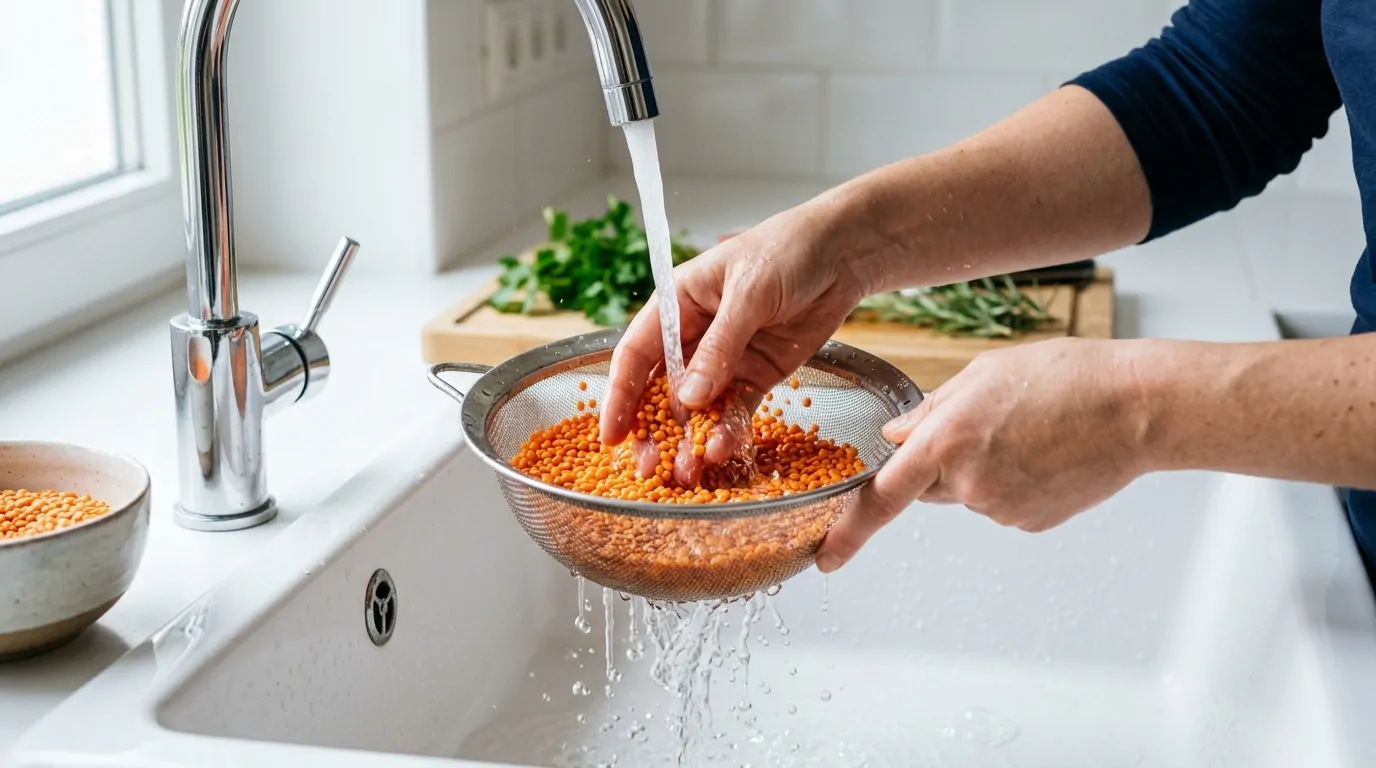
Place the lentils in a fine mesh sieve and pour cold water over them for a good minute, stirring with your hand.
The water that runs off is initially cloudy and slightly orange—this is the surface starch being washed away. This rinsing has two concrete effects:
- It reduces the amount of starch, which limits the formation of a greyish foam during cooking.
- It eliminates some of the compounds responsible for bloating, thus improving digestive comfort.
Once the water runs clear, your lentils are ready. Do not soak them in cold water between rinsing and cooking: they will begin to absorb water immediately, which would throw off your proportions.
If you use a metal colander, remember to dry it thoroughly after use to prevent oxidation. Our guide to cleaning your cookware provides simple and effective methods.
Do you need to soak red lentils?
The short answer: no, soaking red lentils is not necessary. And in most cases, it's even counterproductive.
Unlike dried beans or chickpeas which require 8 to 12 hours in water, red lentils do not have their outer husk.
This outer layer is precisely what slows down water absorption in other legumes. Without it, red lentils hydrate in just a few minutes.
If you soak them for several hours, they absorb a large amount of water even before being cooked. As a result, they fall apart even more quickly during cooking, and the texture becomes difficult to control.
A short soaking of 15 to 20 minutes may be beneficial if you wish to slightly reduce cooking times or if your digestion is particularly sensitive to legumes.
In this case only, rinse them well after soaking before cooking them.
Soaking for several hours followed by normal cooking risks turning your lentils into mush within minutes of cooking. Avoid this combination.
Quality and brands: what difference does it make to cooking
The quality of red lentils directly influences the cooking time of ingredients in general, and even more so for legumes.
Cheap lentils sold in bulk or in some supermarkets may be older, therefore drier, and sometimes require an extra 2 to 3 minutes.
Organic or certified origin brands (France, Canada) generally offer fresher lentils of uniform size, resulting in more even cooking.
A heterogeneous batch, however, cooked unevenly: some grains were meltingly soft, others still firm.
For recipes where texture matters, it's best to choose a reliable brand and check the harvest date if it is indicated.
🍲 Red lentil cooking calculator
Enter your parameters to get the proportions, cooking time and tips tailored to your recipe.
Comparison of Cooking Methods for Red Lentils
Cooking red lentils in a saucepan
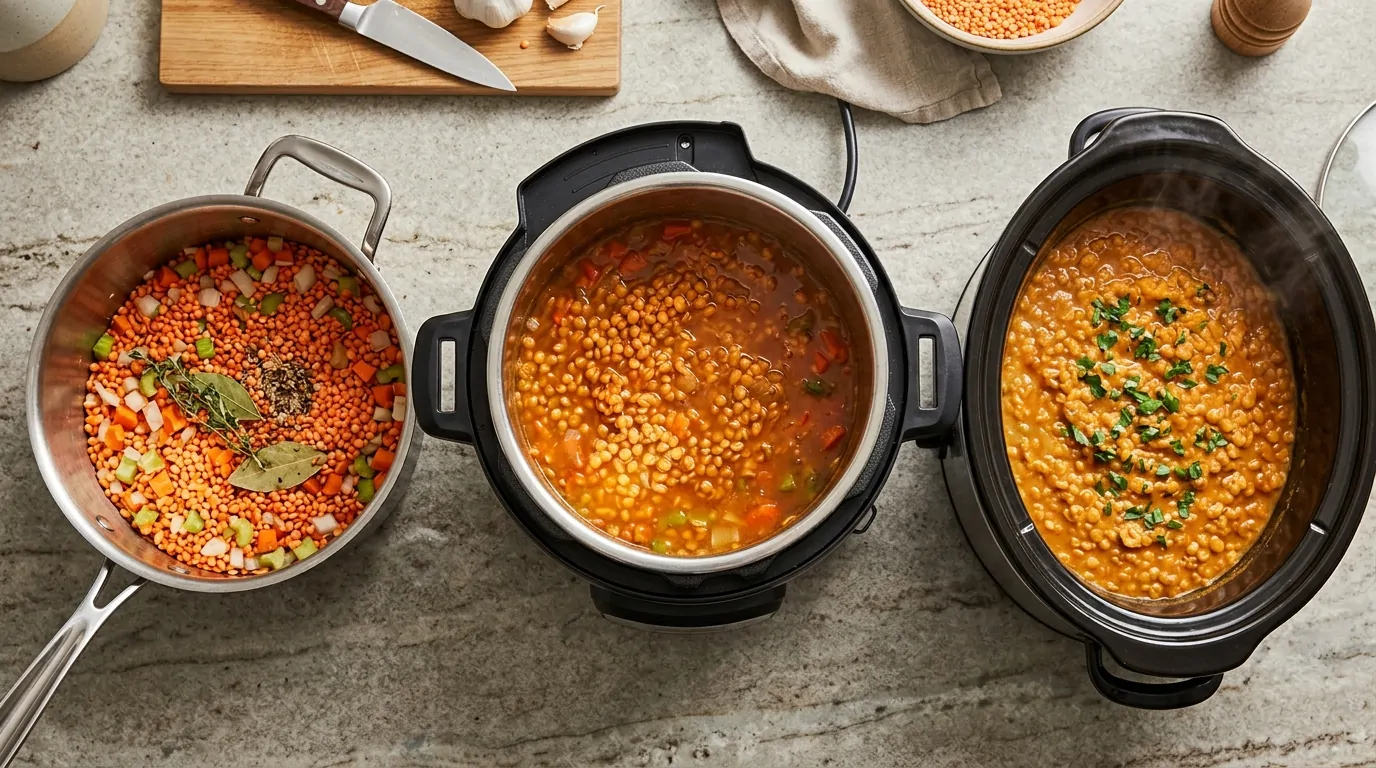
This is the most accessible and widespread method. Cooking red lentils in a saucepan requires a little attention but remains very easy to master.
Pour the rinsed lentils into a saucepan with 2.5 times their volume of cold water or stock. Bring to a boil over high heat, then immediately reduce to medium-low. Simmer uncovered.
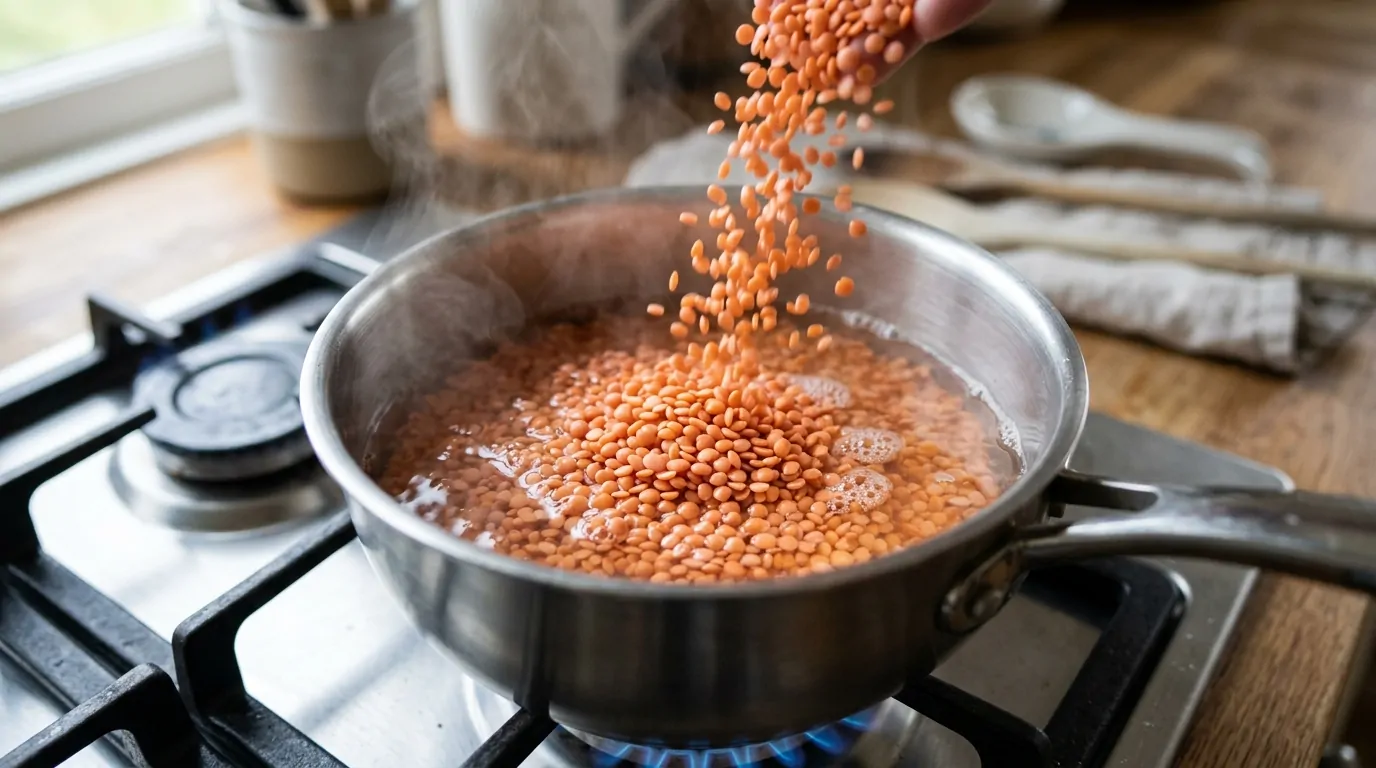
- For a firm texture (salad, side dish): 8 to 10 minutes.
- For a melt-in-your-mouth (dahl, soup): 12 to 15 minutes.
- For a smooth puree : 15 to 18 minutes with more water.
Stir regularly to prevent the lentils from sticking to the bottom. A greyish foam may form at the beginning of cooking—simply skim it off with a spoon. Add salt only at the very end of cooking, just before turning off the heat.
Keep an eye on the liquid level. If the lentils absorb all the liquid before they are cooked, add a little hot water — never cold water, which would stop the cooking process.
Cooking red lentils in a pressure cooker
Cooking red lentils in a pressure cooker is ideal when you're short on time. With the pressure, everything goes much faster — but mistakes are also harder to fix.
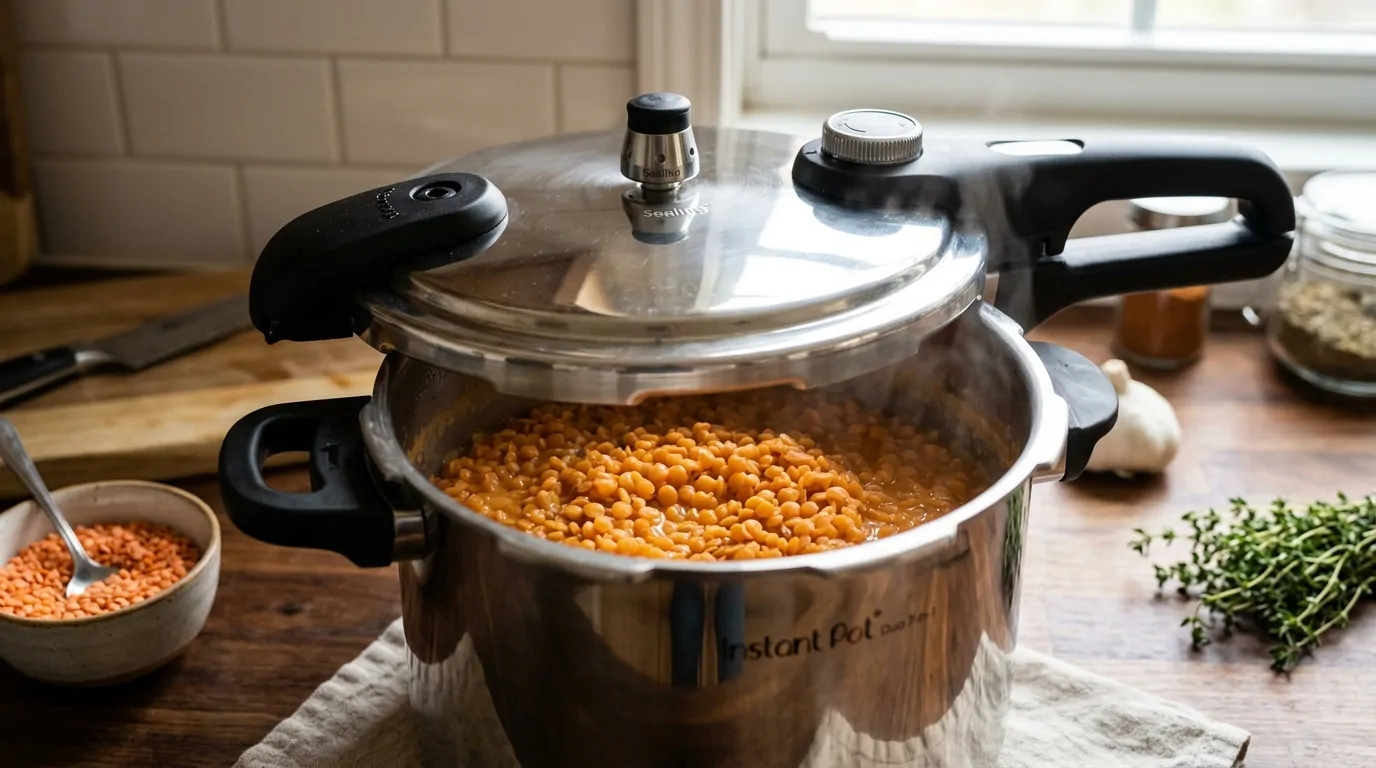
Place the rinsed lentils in the pressure cooker with 2 to 2.5 times their volume of water. Never exceed half the pressure cooker's capacity: the lentils will swell and their starch can clog the valve, which is dangerous.
Close the pressure cooker, bring to maximum pressure, then reduce the heat to maintain pressure:
- 3 minutes under pressure for a melting texture.
- 5 minutes for a consistency close to mashed potatoes.
Release the pressure quickly (valve) to stop the cooking process immediately. Wait until all the steam has escaped before opening. If the lentils still need a little more cooking, return them to low heat uncovered rather than putting them back under pressure.
Never fill the pressure cooker more than halfway with red lentils. The released starch can clog the safety valve.
Microwave and steam cooking
These two methods are less common for coral lenses, but they have their uses depending on the situation.
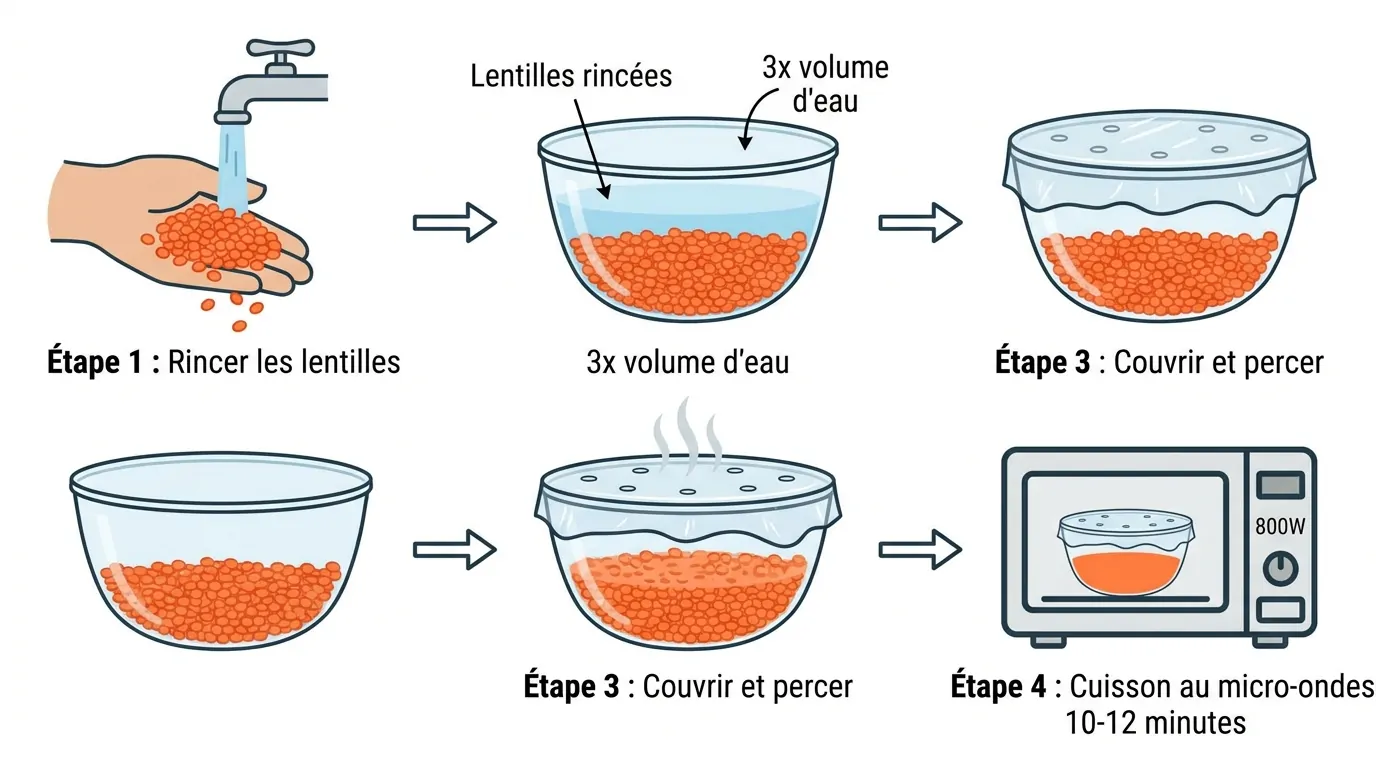
Microwave: Place the rinsed lentils in a microwave-safe container with three times their volume of water. Cover with a lid or perforated plastic wrap. Cook at 800W for 10 to 12 minutes, stirring halfway through. Let stand for 2 minutes before uncovering. The texture will be soft and smooth if you maintain the correct water-to-lentil ratio.
Steaming: Steaming alone isn't the best method for cooking red lentils. However, a stainless steel steamer can work if you place the lentils in a perforated container over boiling water for 20 to 25 minutes. They will remain firmer than when boiled, which is desirable if you want to avoid a mushy texture.
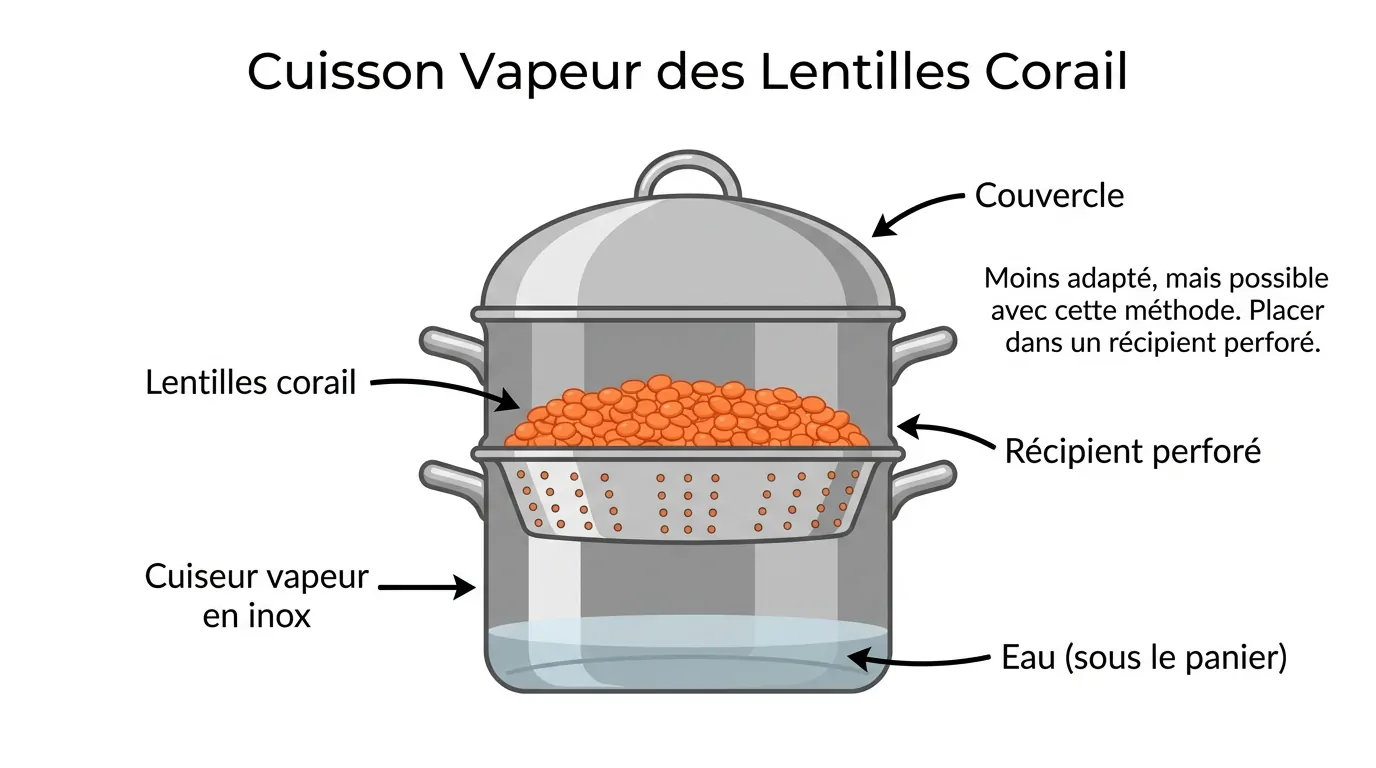
Pure steam cooking is longer, less precise, and yields inconsistent results. It remains a backup option rather than a standard method.
Achieving the right texture: firm, melting, or creamy
The texture of red lentils depends on three variables: the amount of water, the cooking time and the type of heat.
| Desired texture | Water ratio | Time (saucepan) | Ideal for |
|---|---|---|---|
| Farm | × 2 | 8–10 min | Salad, side dish |
| Melting | × 2,5 | 12–15 min | Dahl, curry, garnish |
| Creamy / puree | × 3 | 15–20 min | Soup, cream soup, spread |
For a perfect creamy texture in a dahl, let the lentils absorb all the liquid over low heat, then whisk lightly with a wooden spoon.
There's no need to get the blender out if the cooking has been carried out properly until the end.
Common mistakes and solutions for fixing overcooked food
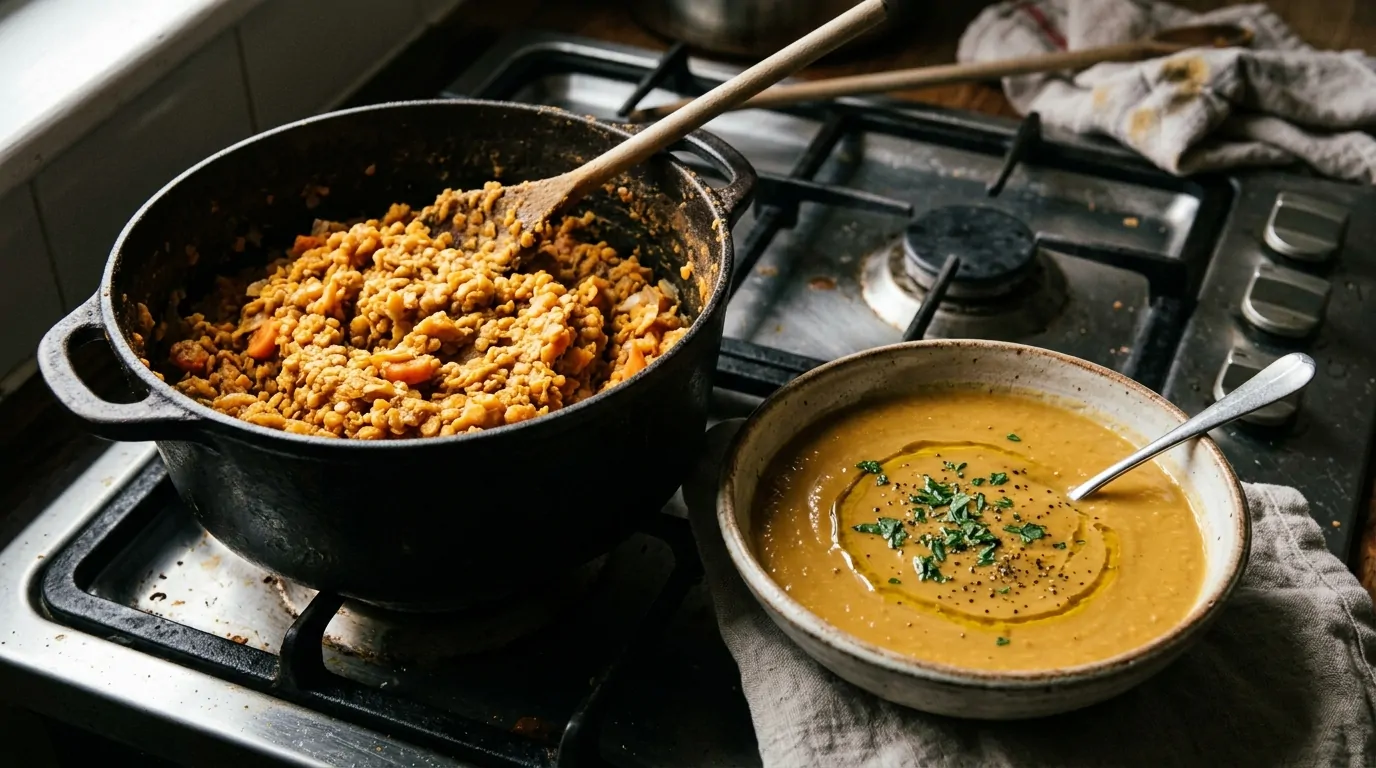
Overcooked red lentils: how to fix them?
Did you forget the pan on the stove and your red lentils are overcooked ? Don't panic — in most cases, they are still usable.
If they've turned into a thick mush, transform them into a smooth purée: blend them with a little hot stock, a spoonful of olive oil, and salt. You'll have a perfect base for a soup or spread.
- Too thick but still tasty → add coconut milk or hot broth, mix over low heat.
- Sticky and compact → blend, season, serve as a velvety soup.
- Bland taste and soft texture → compensate with bright spices (cumin, smoked paprika, lemon).
However, if the lentils have stuck to the bottom and taken on a burnt taste, there's not much you can do. Immediately transfer the top to another pan without scraping the burnt bottom.
How to avoid red lentil mush?
That's mistake number one!
Avoiding red lentil mush simply requires never taking your eyes off them during the last five minutes of cooking.
The rules that must be strictly followed:
- Do not exceed the time indicated according to the desired texture.
- Cook over medium-low heat, never at a rolling boil.
- Do not cover tightly — leave a space for steam to escape and for you to monitor the consistency.
- Taste after 8 minutes to adjust.
The main cause of overcooking is too high a heat. A gentle simmer is sufficient. At a rolling boil, lentils cook in less than 7 minutes and become uncontrollable. Make it a habit to reduce the heat as soon as they start boiling.
Salt, fire and a lid: the three things that change everything!
These three elements are responsible for the majority of failures when cooking red lentils.
Salt: Added at the beginning of cooking, salt hardens the outer layer of legumes. For hulled red lentils, the effect is less pronounced but still present. Always add salt at the end of cooking, once the heat has been turned off.
The heat: too high, and it causes chaotic and uneven cooking. Some grains will fall apart while others remain firm. A constant medium-low heat ensures even cooking.
The lid: a closed lid traps steam and speeds up cooking—sometimes too much. Without a lid, the water evaporates faster, giving you better control over the consistency. The best approach: partially cover for the first few minutes, then uncover to finish cooking and adjust the texture.
🎯 Are you an expert on cooking red lentils?
5 questions to check if you have all the secrets before you start cooking.
1. Do red lentils need to be soaked before cooking?
2. What is the recommended water/red lentil ratio for cooking in a saucepan?
3. What is the average cooking time for red lentils in a saucepan over medium heat?
4. What common mistake causes red lentils to become too hard after cooking?
5. Which of these spices is particularly associated with red lentil dishes in traditional cuisine?
The seasonings and spices that enhance the red lentils
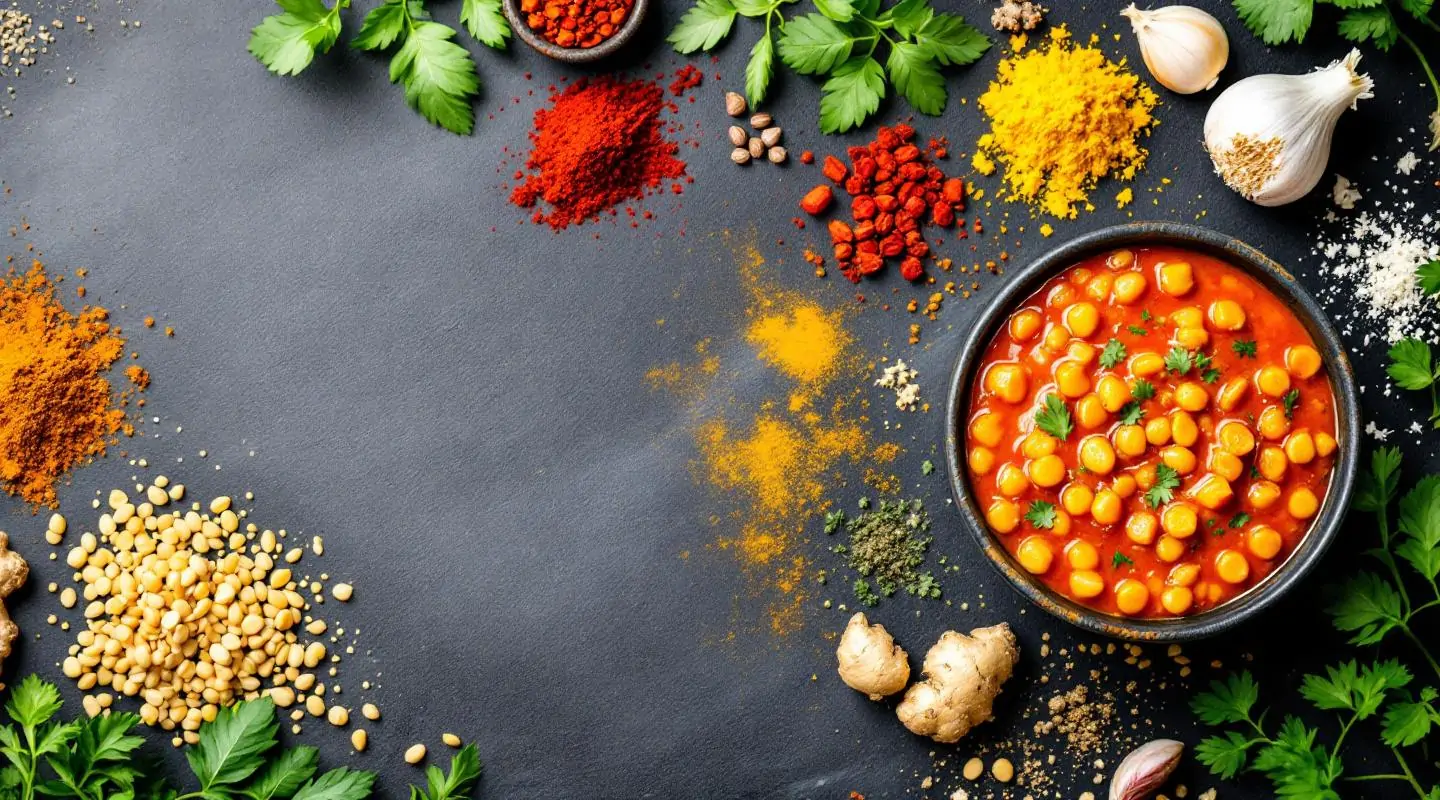
Spices that work every time!
Red lentils have a mild, slightly earthy flavor that pairs beautifully with warm spices. A few combinations work perfectly every time.
- Cumin (seeds or powder): to be sautéed in oil at the beginning of the recipe to release its aromas.
- Turmeric : gives the dahl its characteristic golden-yellow color, with a slightly bitter flavor that balances the sweetness of the lentils.
- Ground coriander : adds a fresh and slightly lemony note.
- Smoked paprika : a pinch at the end of cooking completely transforms the aromatic profile.
- Freshly grated ginger : a few grams are enough to enhance the dish and aid digestion.
The cooks' trick: sauté the spices for 30 to 60 seconds in a fat (coconut oil, ghee, olive oil) before adding the lentils. This technique, known as "tarka," concentrates the aromas and diffuses them evenly throughout the dish.
Herbs, acids and fats to balance the dish
Theseasoning of red lentils is not limited to spices. Fresh herbs, acidic elements, and fats play an equally important role in balancing the dish.
Fresh herbs are always added at the end of cooking or when serving:
- Freshly chopped coriander — the most classic accompaniment to dahl.
- Flat-leaf parsley — milder, for versions without coriander.
- Fresh mint — surprising but effective in cold or summer versions.
Acidity is often overlooked, yet it makes all the difference. A squeeze of lemon or lime juice just before serving awakens all the flavors. A spoonful of cider vinegar also works very well.
Fats add richness: coconut milk for sweetness, ghee for authentic Indian flavor, olive oil for a light Mediterranean version. A knob of butter at the end of cooking makes the lentils shiny and creamy.
Recipe for red lentil dahl with exact quantities
Here is a red lentil dahl recipe , for 4 people.
Ingredients :
- 250g of red lentils (rinsed)
- 750 ml of vegetable broth
- 1 can of 400 ml coconut milk
- 1 medium onion, chopped
- 3 cloves of chopped garlic
- 1 piece of fresh ginger, 2 cm long (grated)
- 1 tsp ground cumin
- 1 teaspoon of turmeric
- 1 tsp ground coriander
- 2 tablespoons of coconut oil (or neutral oil)
- Salt, juice of half a lemon, fresh coriander
Preparation: Sauté the onion in oil for 5 minutes over medium heat. Add the garlic, ginger, and spices, and sauté for 1 minute. Pour in the lentils, stock, and coconut milk.
Bring to a boil, then reduce to a simmer. Cook for 15 to 18 minutes, stirring regularly. Season with salt, add the lemon, and serve with fresh cilantro.
Nutritional values and benefits of red lentils

Proteins, fibers and minerals: what they really provide
Red lentils are among the most nutritionally valuable legumes. Here's approximately what 100g of dried lentils provide:
| Nutrient | Per 100g (dry) | Interest |
|---|---|---|
| Proteins | ~24 g | Important plant source |
| Fibers | ~11 g | Satiety, transit |
| Iron | ~7 mg | Better absorbed with vitamin C |
| Zinc | ~3.5 mg | Immunity, skin — see benefits of zinc |
| Magnesium | ~47 mg | Muscles, nerves, energy |
Red lentils also provide complex carbohydrates with a moderate glycemic index, making them a sustainable source of energy.
Their amino acid profile is incomplete (like all legumes) but complements perfectly with cereals — such as when served with rice or wholemeal bread.
For comparison, a similar line of reasoning can be found when discussing the cooking time of cereals and their complementarity with legumes.
Red lentils and digestion: what you need to know!
Red lentils are generally better tolerated than other legumes. Hulling removes a large portion of the oligosaccharides (the complex sugars responsible for flatulence).
To further aid digestion:
- Always rinse the lentils before cooking.
- Add a pinch of asafoetida (Indian spice) or cumin during cooking.
- Avoid large portions if you are not used to legumes.
- Accompany the meal with fresh ginger or a fennel infusion after the meal.
People sensitive to legumes generally tolerate red lentils without problems, provided they are introduced gradually into the diet and cooked thoroughly (not al dente).
- Ultra-fast cooking (8 to 15 min)
- No soaking required
- Rich in plant-based protein
- Well tolerated by the digestive system
- Versatile (soup, dahl, mashed potatoes, salad)
- Affordable and accessible everywhere
- It quickly turns to mush if you don't keep an eye on it
- Texture difficult to maintain "al dente"
- Incomplete proteins (to be combined with cereals)
- Less tasty on its own, it needs spices
- Quality varies depending on the brand and batch
Preservation and reuse of cooked red lentils
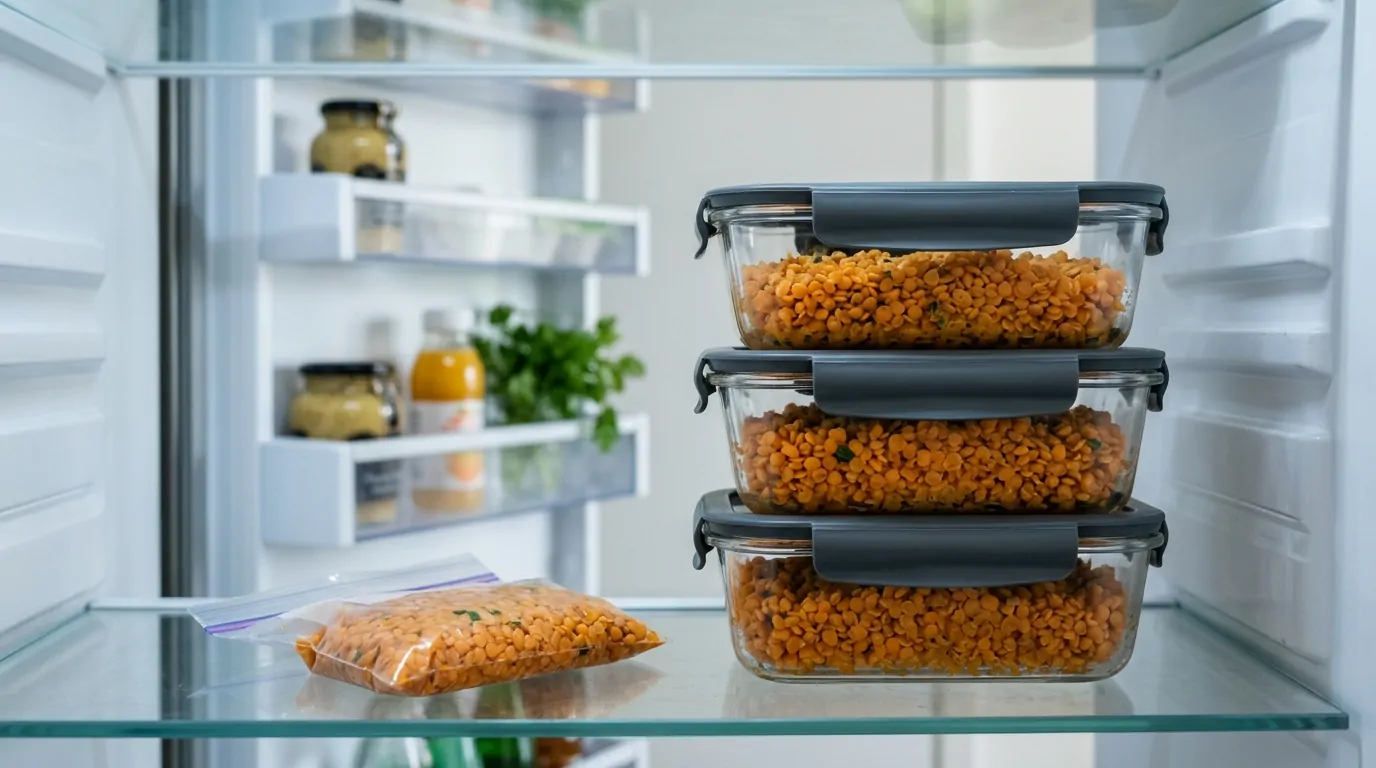
How long can cooked red lentils be stored?
Storing cooked red lentils is simple, provided you follow a few basic rules.
In the refrigerator, in an airtight container, cooked lentils can be kept for a maximum of 3 days.
Let them cool completely before closing and placing them in the refrigerator — never put them still hot in a closed container, as this can create condensation and accelerate spoilage.
- Glass container preferred (no residual odor).
- Always store them separately if mixed with a sauce — the sauce thickens in the fridge and the texture changes.
- Check visually before consuming: if they give off an acidic smell or if their color turns dark grey-brown, throw them away.
Freezing and reheating without losing texture
Cooked red lentils freeze perfectly, especially in the form of dahl or soup. Freezing red lentils allows you to prepare portions in advance without losing any flavor.
As for tips for organizing your freezer efficiently, always label your portions with the date and contents.
Red lentils can be kept in the freezer for up to 3 months without any noticeable loss of quality!
For reheating:
- Defrost in the refrigerator overnight or directly over very low heat in a saucepan.
- Add a splash of water or stock to prevent sticking and to achieve the right consistency.
- Do not microwave without a lid — the lentils release steam and dry out quickly.
Some ideas for reusing leftover red lentils
Leftover cooked red lentils don't necessarily have to end up as reheated soup. Here are some practical ideas for transforming them.
- Vegetable patties : mix lentils with chickpea flour, an egg, spices and cook like thick pancakes in a pan.
- Spread : blend with roasted garlic, lemon and olive oil — serve on toast.
- Pasta sauce : add chopped tomatoes and basil, and simmer for 5 minutes. Pour over spaghetti.
- Enriched soup base : Stir in 2 or 3 tablespoons of lentils into any vegetable soup to thicken it naturally and increase the protein content.
- Light stuffing : mixed with herbs and cooked rice, they stuff peppers or courgettes very well.
Leftover red lentils keep best when left plain, without sauce. Add seasoning when you're ready to use them again—you'll have much more flexibility.
Practical questions
How long do you need to cook red lentils?
In a saucepan, red lentils cook in 8 to 15 minutes depending on the desired texture: 8 to 10 minutes for a firm texture, 12 to 15 minutes for a soft or creamy consistency. In a pressure cooker, 3 to 5 minutes under pressure is sufficient. There is no need to soak them beforehand.
What is the correct ratio of water to red lentils?
The basic ratio is 1 part red lentils to 2.5 to 3 parts water or stock. Use less water (x2) for a firmer texture, and more (x3) for a creamy consistency or velvety soup.
Should red lentils be soaked before cooking?
No, soaking red lentils is not necessary. Unlike beans or chickpeas, they are already hulled and absorb water very quickly. Prolonged soaking can actually make them too mushy when cooked. A simple rinse in cold water is sufficient.
Why have my red lentils turned into mush?
Overcooking is the main culprit. Red lentils are very sensitive to heat because they are hulled. Too high a heat or just a few minutes too long is enough to turn them into mush. To avoid this, cook them over medium-low heat, uncovered, and taste them after 8 minutes of cooking.
How to store cooked red lentils?
Cooked red lentils can be kept for up to 3 days in the refrigerator in an airtight container. For longer storage, freeze them in portions for up to 3 months. Let them cool completely before sealing and freezing.
Thanks for the guide, super clear! One more tip: rinse them very thoroughly (even twice) to remove the starch, and add the salt or acid (lemon/tomato) only at the end of cooking, otherwise they harden.
Thanks for the tip! Do you rinse until the water runs clear? And do you recommend soaking it as well?
Thanks for the guide, but I'm still skeptical about the idea that you can avoid mush just by using the right water-to-lentil ratio. Adding salt at the beginning or simmering it for too long changes everything, doesn't it? Have you tried timing it?
You're right: salt and cooking time are very important. I tested it with a timer, cooking gently for 18–22 minutes.
Great article! It reminds me of when I cook basmati rice: one minute too long and it all becomes mushy. Your water/lentil ratio chart and the reminders about their texture will help me make perfect dahl without ending up with mush.
So true! Remember to rinse the lentils and add salt at the end of cooking.
Thanks for the guide, super clear! One more tip: I always rinse the red lentils in cold water until it's almost clear, this limits the foam and avoids the "mudy" look when cooking.
Good tip! I do the same, and sometimes I roast them for 1 minute for more flavor.
Thanks for this guide! It reminds me of my early days with quinoa: one minute too long and it's mushy. Your water/time chart would have saved me from ending up with a mush-like red lentil stew in my Sunday dahl.
So true! To avoid mush, rinse well and stop cooking, then cover for 5 minutes.
Last night, I wanted to make a quick dahl and I often end up with a gray mush… With your water/lentil ratio chart and the reminder that it cooks very quickly, I'm finally going to time it and adjust the texture. Thank you!
Yes, check it after 8–10 minutes and add salt at the end. A touch of turmeric helps preserve the color.
The article is super clear, thank you! One more tip: I usually add the salt towards the end of cooking, otherwise the lentils can harden and cook less evenly. And a pinch of baking soda really speeds up the cooking if the water is very hard.
Thanks for the tips! How much baking soda do you use without altering the texture?
Thanks for the guide! However, I'm a little skeptical about the "correct" water-to-lentil ratio: depending on the brand and age of the lentils, it varies enormously for me. Is your chart also valid for gentle cooking or only for vigorous boiling?
You're right: it varies. The chart is a starting point, valid for soft products too; adjust according to absorbency.
Thanks for the water/lentil chart, it's very helpful! Quick practical question: for a really smooth dahl that doesn't end up as a grey mush, what exact ratio do you recommend and at what point should I add salt or tomatoes/coconut?
For a creamy dahl: 1 part lentils/2.5 parts water. Add salt at the end of cooking; add tomatoes/coconut halfway through cooking.
Thanks for the time/proportions chart, it's very helpful. I want to try making dahl this weekend: for a smooth texture without it turning to mush, do you recommend cooking it over low heat, covered or uncovered, and should the lentils be rinsed beforehand?
Cook over low heat, covered, stirring occasionally; uncover at the end to thicken. Yes, rinse the lentils well.