
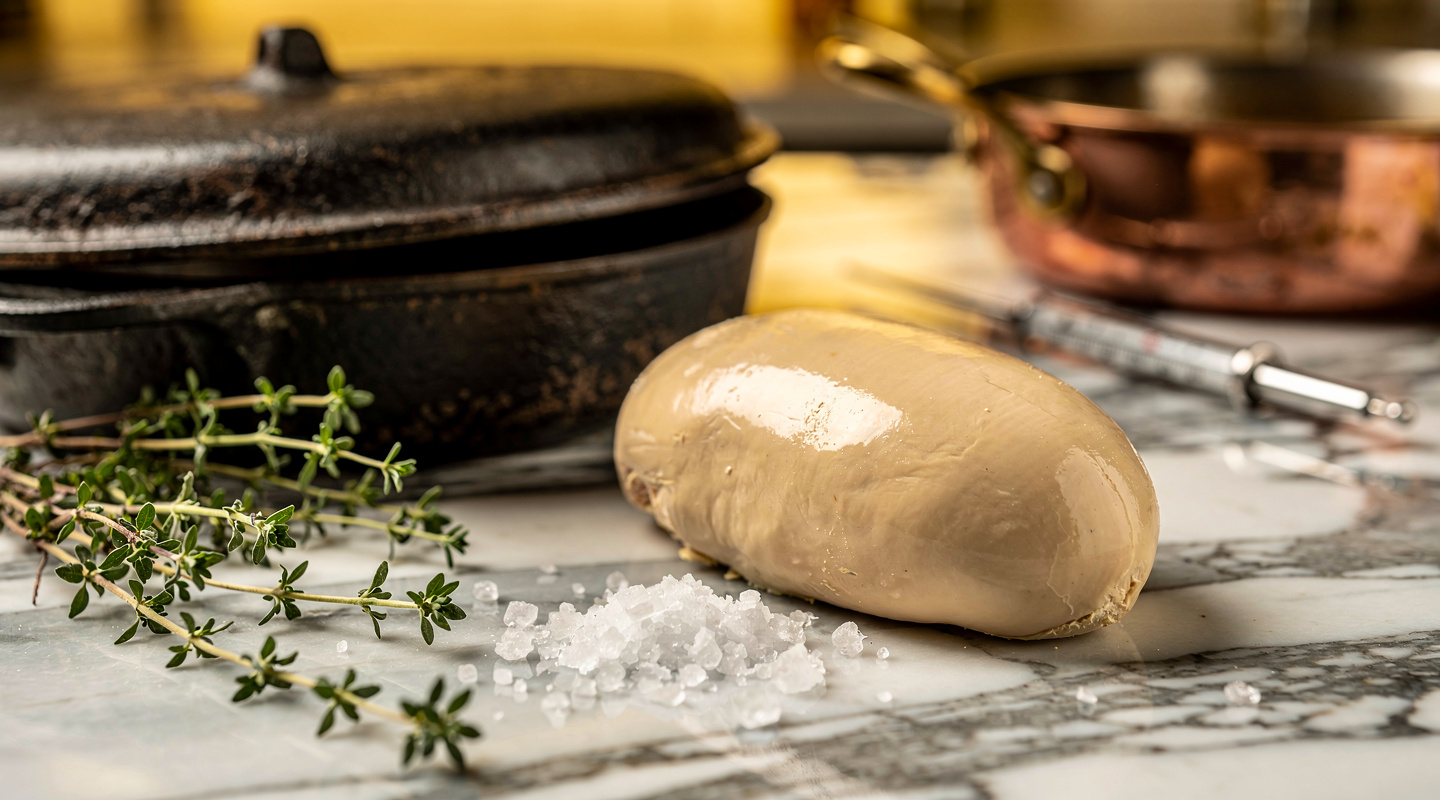
In short
Cooking foie gras at home is intimidating! Fear of messing it up, of melting it, of ending up with an oily terrine or a raw liver in the center.
However, with the right guidelines, it's quite achievable — even for an amateur cook!
This practical article gives you the precise temperatures, clear steps and concrete signs that distinguish a successful cooking from a ruined foie gras.
Five methods are detailed, from the simplest to the most technical. Choose the one that best suits your equipment and preferences!
Prepare your foie gras properly before cooking
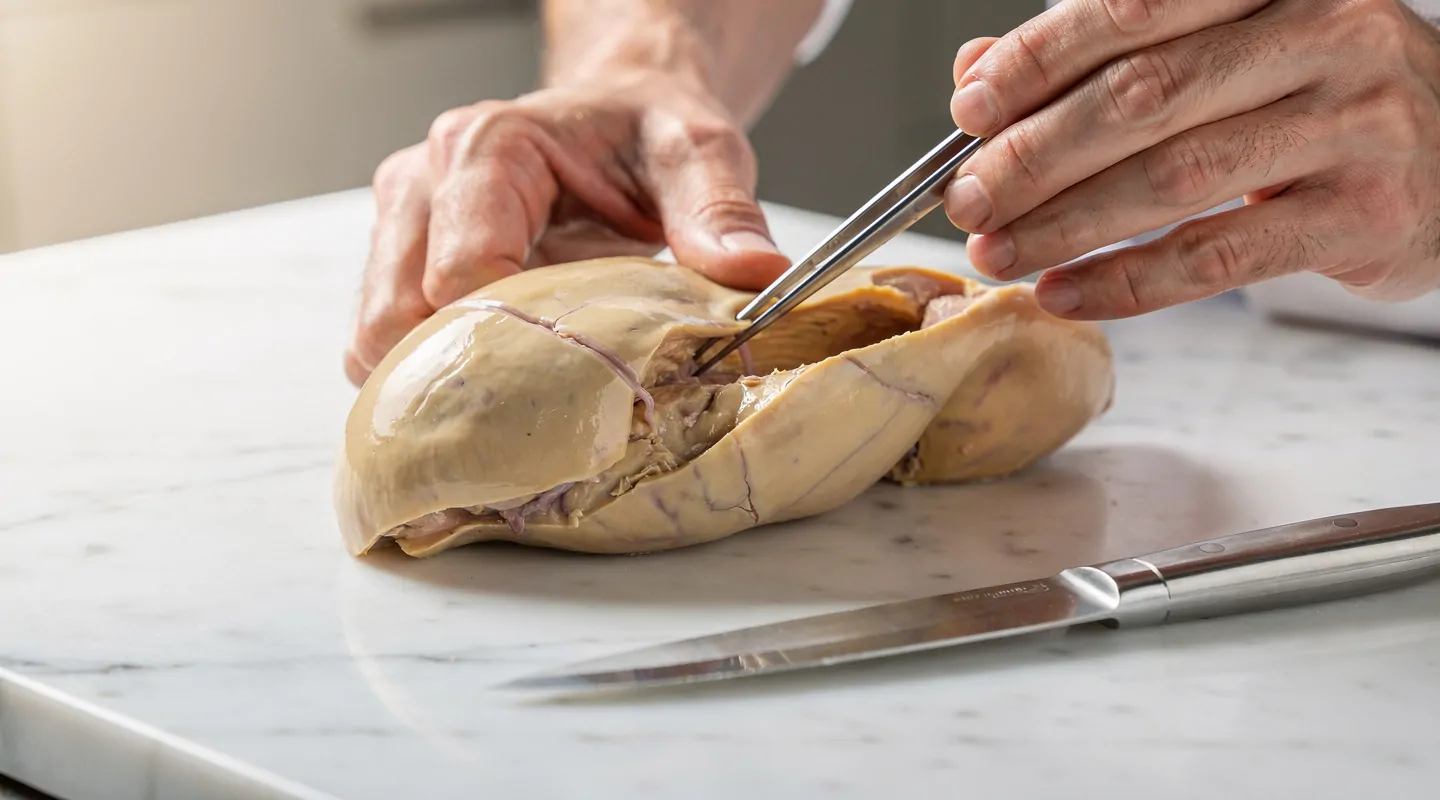
Cooking only reveals what the preparation has built up. A liver that is poorly deveined, poorly seasoned, or cooked too cold will give a disappointing result — regardless of the method chosen!
The steps preceding the heating deserve as much attention as the cooking itself. This is where the texture, taste, and consistency of the foie gras are determined.
How to identify fresh foie gras step by step?
Deveining fresh foie gras is a step that many people dread. However, it's simple if done methodically, without striving for 100% perfection.
To help you see things more clearly, here are the main steps to follow:
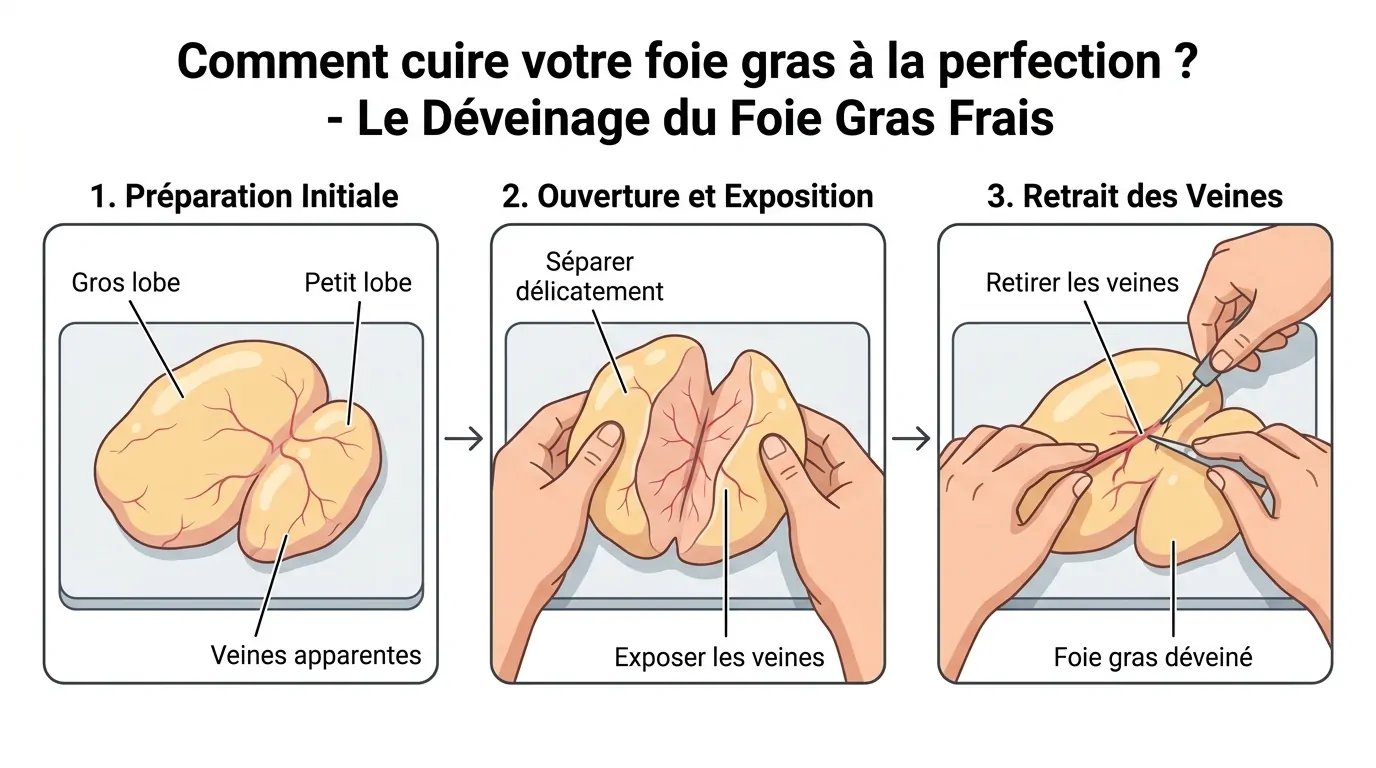
- Remove the foie gras from the refrigerator 30 minutes before working with it. Foie gras at room temperature will be more pliable and will devein without breaking.
- Lay it flat on a board. Gently separate the two lobes with your thumbs.
- On the main lobe (the largest), locate the central nerve visible on the surface. Make a light incision with the tip of a knife, without going too deep.
- Slide your fingers under the main vein and gently pull along its path. It moves upwards towards the center of the lobe.
- Remove the small secondary veins in the same way, always pulling without forcing.
- Do the same on the smaller lobe, it's simpler because the veins are less branched.
- Reshape the lobes as best you can by pressing them lightly. The small marks will disappear during cooking.
If you'd like to learn more about the quality of the product you'll be working with, you can compare the price of raw foie gras on this reputable website before buying it. This will allow you to choose a quality foie gras that suits your budget and cooking method.
The ideal seasoning: salt, pepper and alcohol
A well-seasoned foie gras generally contains approximately 7 grams of salt and 2 grams of ground white pepper per kilogram of foie gras . Some add a pinch of sugar to sweeten it, others a touch of allspice.
Alcohol is optional but adds aromatic depth and, in principle, a dash of Sauternes, Cognac or Armagnac (about 2 to 3 cl per lobe) is enough.
Spread the seasoning over all sides of the liver, including inside the deveining incisions.
No need to do more! Restraint is a virtue here: the foie gras must remain the star ingredient and retain its taste.
The resting time in the refrigerator before cooking your foie gras
Once seasoned, the foie gras must rest for at least 12 hours in the refrigerator, ideally 24 hours. This resting time allows the aromas to penetrate deeply and the structure of the liver to firm up before being exposed to heat.
Wrap it in cling film or place it directly in the covered terrine.
Do not skip this step or you will end up with foie gras whose taste remains on the surface.
Don't confuse this resting period in a cool place with the long maturation process for canned goods. For fresh, raw foie gras that you're going to cook within 24 to 48 hours, 12 to 24 hours of resting is more than enough.
The 5 best ways to cook foie gras
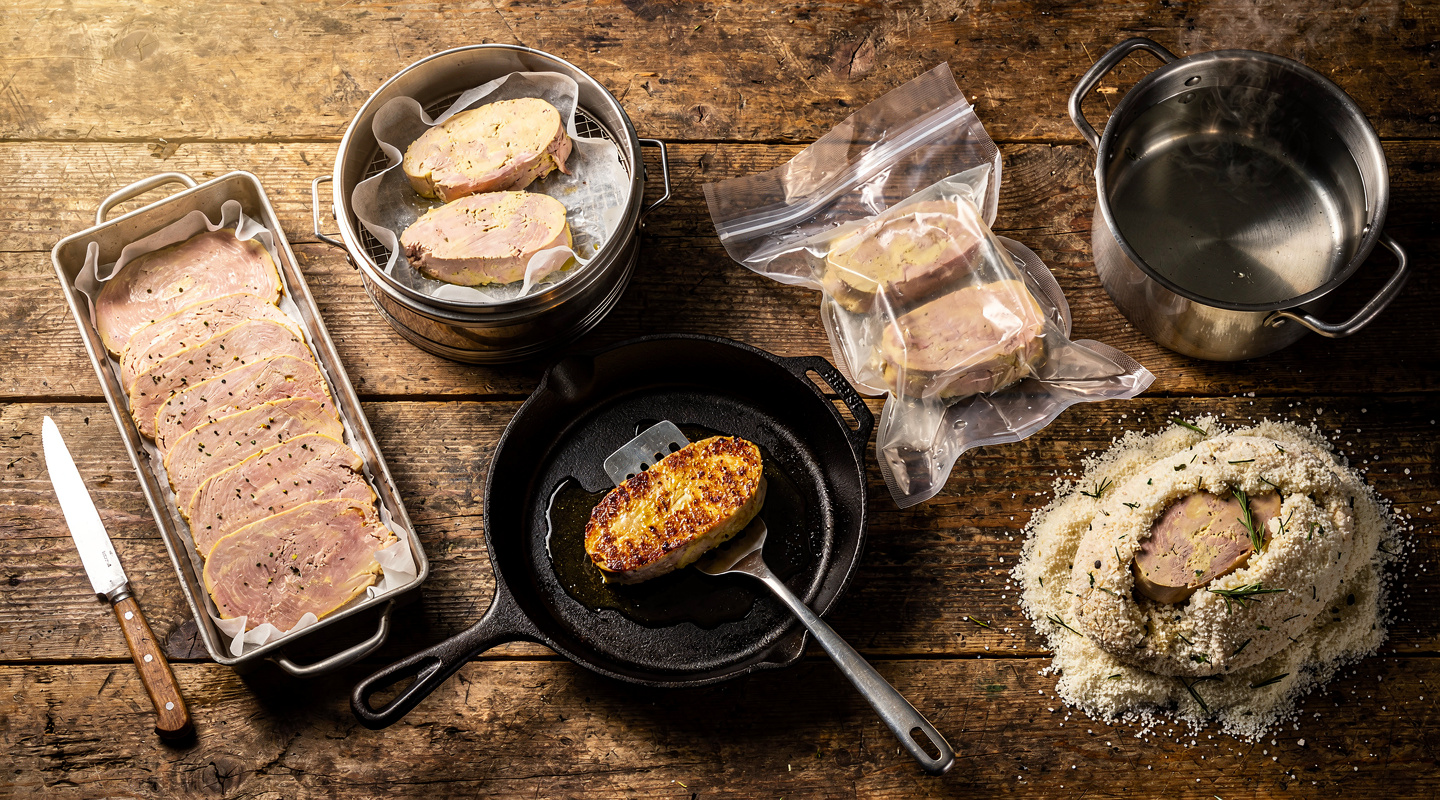
Each method corresponds to a different result, different equipment, and a different occasion.
Here is a comparison chart to help you choose yours at a glance.
| Method | Result | Temperature | Duration | Level |
|---|---|---|---|---|
| Stove | Golden escalope | Very hot pan | 1 to 2 min/side | Easy |
| Oven in a terrine | Semi-cooked terrine | 100 to 120 °C | 30 to 50 min | Intermediate |
| Low temperature | Silky texture | 60 to 70 °C | 1 to 1.5 hours | Intermediate |
| Dishcloth | Firm roll | Water at 80°C | 20 to 30 minutes | Advance |
| Steam | Smooth and even | Steam at 100°C | 15 to 20 minutes | Easy |
Pan-frying: a technique for escalopes
Pan-frying foie gras only applies to escalopes — slices 1.5 to 2 cm thick.
It's the fastest method, but also the least forgiving.
To do this, heat a stainless steel or cast iron pan dry over high heat until it is very hot — about 200°C surface temperature.
Place the escalopes in the pan without any added fat. Sear for 1 minute per side . The liver should be golden brown on the surface and still pink in the center.
Turn the slices over only once, then drain on absorbent paper, season lightly with salt and serve immediately.
To clean your cooking utensils after this type of high-temperature searing, specific techniques prevent damage to the stainless steel.
Baking in a terrine: times and temperatures
Cooking foie gras in a terrine in the oven is the classic method for obtaining homemade semi-cooked foie gras. It requires a little more patience but is more forgiving of imperfections.
Preheat the oven to 150°C, then place the terrine in a bain-marie (hot water halfway up).
Bake at 120°C using conventional heat — never fan-assisted, which dries it out. Allow 30 to 50 minutes depending on the weight of the liver : approximately 20 minutes for 300g, 40 to 45 minutes for 600g.
Check the internal temperature with a thermometer and remove the liver at an internal temperature of 45°C for a medium-rare finish.
Press lightly with a weight and let cool before refrigerating for at least 24 hours.
Low-temperature cooking with a cloth
Cooking foie gras at low temperature involves maintaining a constant and gentle heat, around 60 to 70 °C, for a longer period of time.
It preserves the texture and reduces the fat output, and it can be prepared in the oven, in a casserole dish or in a sous vide cooker.
Foie gras au torchon is a chef's technique, but it can be done at home!
The seasoned liver is rolled tightly in a clean cloth, tied at both ends, then poached in water maintained at 80°C — without boiling — for 20 to 30 minutes depending on the diameter.
It then needs to be refrigerated for 48 hours before tasting.
Professionals recommend this method for occasions where the presentation in regular slices matters almost as much as the taste of the product.
Steam cooking: advantages and limitations
- Gentle and even cooking
- Little grease rendering
- Easy to control
- Quick (15 to 20 min)
- Texture sometimes less firm
- No coloring possible
- Less distinctive result
- Requires a suitable steamer basket
A whole foie gras is steamed at 100°C, with the foie gras wrapped in heat-resistant cling film. The cooking time varies between 15 and 20 minutes for a lobe of approximately 400g.
It is an accessible method that gives a decent result, but without the gustatory complexity of the terrine or the torchon.
🍳 Foie gras cooking calculator
Get the cooking time, temperature and tips tailored to your method and your foie gras.
The perfect temperatures for successful cooking
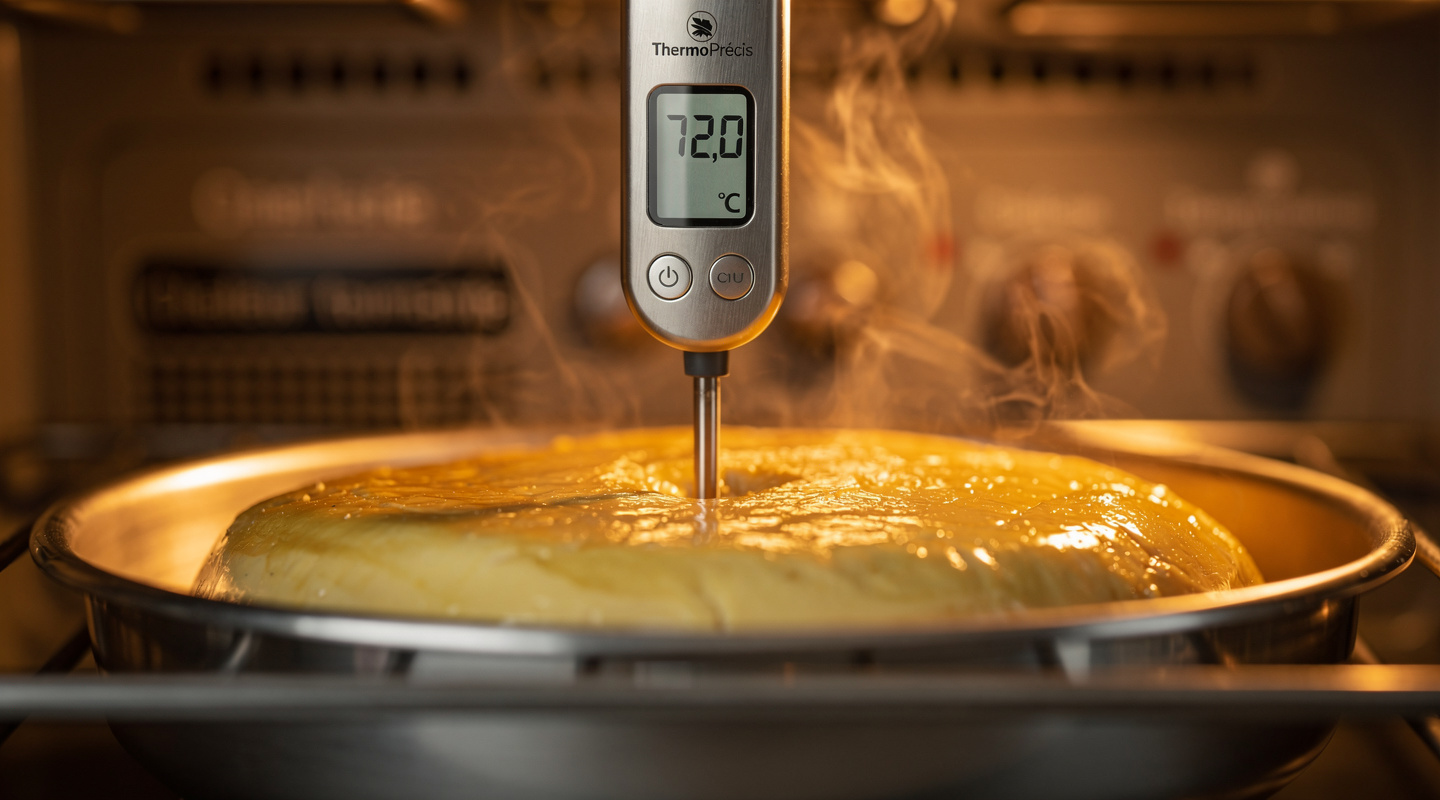
This is the point that scares everyone — and that also makes all the difference.
Forget about vague visual cues because core temperature is the only reliable indicator for cooking foie gras without making a mistake.
According to ANSES recommendations on good hygiene practices in the kitchen, controlling core temperatures is fundamental to guaranteeing the food safety of preparations based on fresh foie gras.
What is the ideal internal temperature for a semi-cooked foie gras?
Semi-cooked foie gras is the most popular preparation in France. It retains its melting texture, pink color, and intact aromas.
The core temperature of a semi-cooked foie gras should reach 45°C — no more!
At this temperature, the fat begins to liquefy slightly, but the liver remains firm and bound. It holds its shape when sliced, spreads easily, and melts perfectly in the mouth.
Below 43°C, the center remains raw. Above 48°C, it becomes fully cooked foie gras. The margin is narrow—hence the importance of a thermometer…
At an internal temperature of 45°C, semi-cooked foie gras can be kept for 5 to 7 days in the refrigerator.
It's much less than a sterilized can, but more than enough for the holidays!
What is the internal temperature for cooked foie gras?
A "cooked" foie gras — in the sense of preserved or jarred — reaches a core temperature of at least 55 to 60 °C and this level of cooking allows it to be partially sterilized and to be kept for several weeks, or even several months in an airtight jar.
The texture is firmer, less pink, with a slightly more pronounced taste.
This is the type of cooking that is applied when sterilizing in a water bath in a jar, with simmering water maintained at 90-95 °C for 45 minutes to 1 hour depending on the size.
For homemade preparations without long sterilization, the semi-cooked at 45°C remains the most frequently targeted.
The kitchen thermometer: why is it essential?
Without a thermometer, you're navigating blind! Foie gras is a complex fat whose structure changes in just a few degrees.
An instant probe thermometer is the most useful tool for perfect cooking every time!
Insert the probe into the center of the lobe or terrine, in the thickest part, then wait for the temperature to stabilize.
To help you with converting measurements in the kitchen or to check equivalencies during your preparations, practical tools are available online or on our website.
A good basic kitchen thermometer generally costs between 10 and 25 euros, and it's the most cost-effective investment you can make for anything that cooks thoroughly — foie gras, red meat, poultry…
Insert the thermometer probe, avoiding areas of rendered fat. Aim for the geometric center of the liver or terrine. Take the measurement 2 to 3 minutes before the theoretical end of cooking to adjust if necessary.
How to recognize a perfectly cooked foie gras
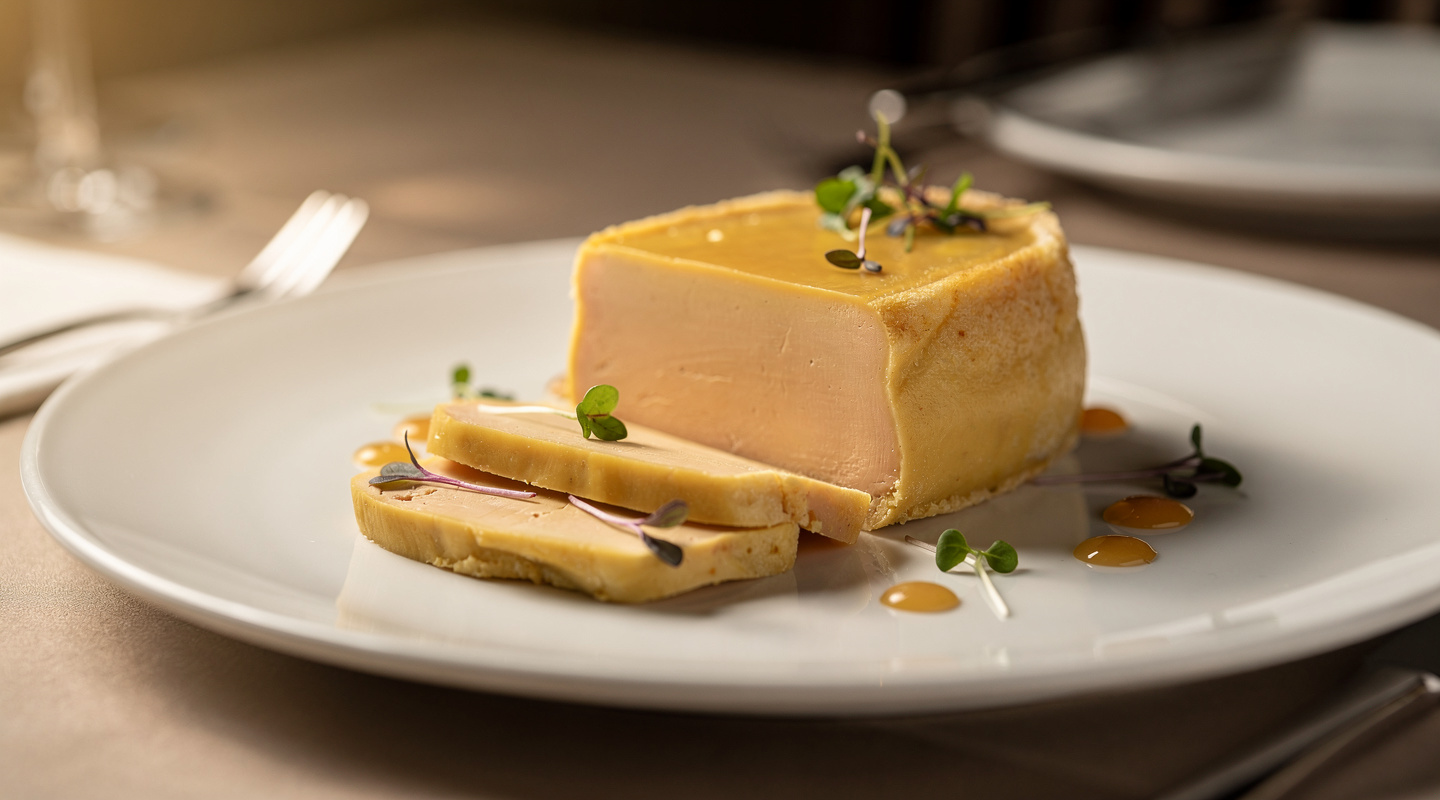
The thermometer gives the measurement, but you also need to know how to read the different visual and textural signs.
These guidelines are particularly useful for cooking foie gras in a pan, where everything happens very quickly!
The visual and textural signs of successful cooking
A perfectly cooked foie gras has these characteristics:
- A golden beige color on the surface , slightly colored without being brown.
- A pinkish to pale cream interior depending on the level of cooking (medium vs cooked).
- A texture that resists slightly the pressure of a finger without being hard or liquid.
- A cohesive look, not crumbly or oily.
- For the terrine: a clear and golden fat finish — normal and a sign of good cooking.
When sliced, a well-seared escalope reveals a still pink center with clean, firm edges. It doesn't fall apart on the plate.
Overcooked foie gras: how to identify it?
Overcooked foie gras is the most dreaded mistake and is immediately noticeable:
- The texture crumbles or falls apart when cut.
- The terrine or pan is swimming in abundant yellow fat — the liver has literally melted.
- The interior color leans towards beige-grey, without any residual pink.
- The taste is flat, greasy, lacking finesse.
A core temperature exceeding 60-65°C for a semi-cooked product invariably leads to this result and recovery is almost impossible at this stage.
The fat rendered from overcooked liver should not be thrown away: collect it, filter it, and use it to cook potatoes or vegetables. It is tasty.
Foie gras that isn't cooked enough: better to see the signs
An undercooked liver can also be recognized by specific signs:
- The interior is bright red to dark pink, reminiscent of the color of raw liver.
- The texture is soft and gelatinous in the center, not bound.
- In the pan, the cutlets sag and appear "limp".
- For the terrine: it doesn't hold its shape when cut, the center runs.
The solution to this type of problem is quite simple: put it back in the oven! For a terrine, a few extra minutes in the oven is enough. For a cutlet, 30 more seconds per side.
Some mistakes to avoid when cooking foie gras
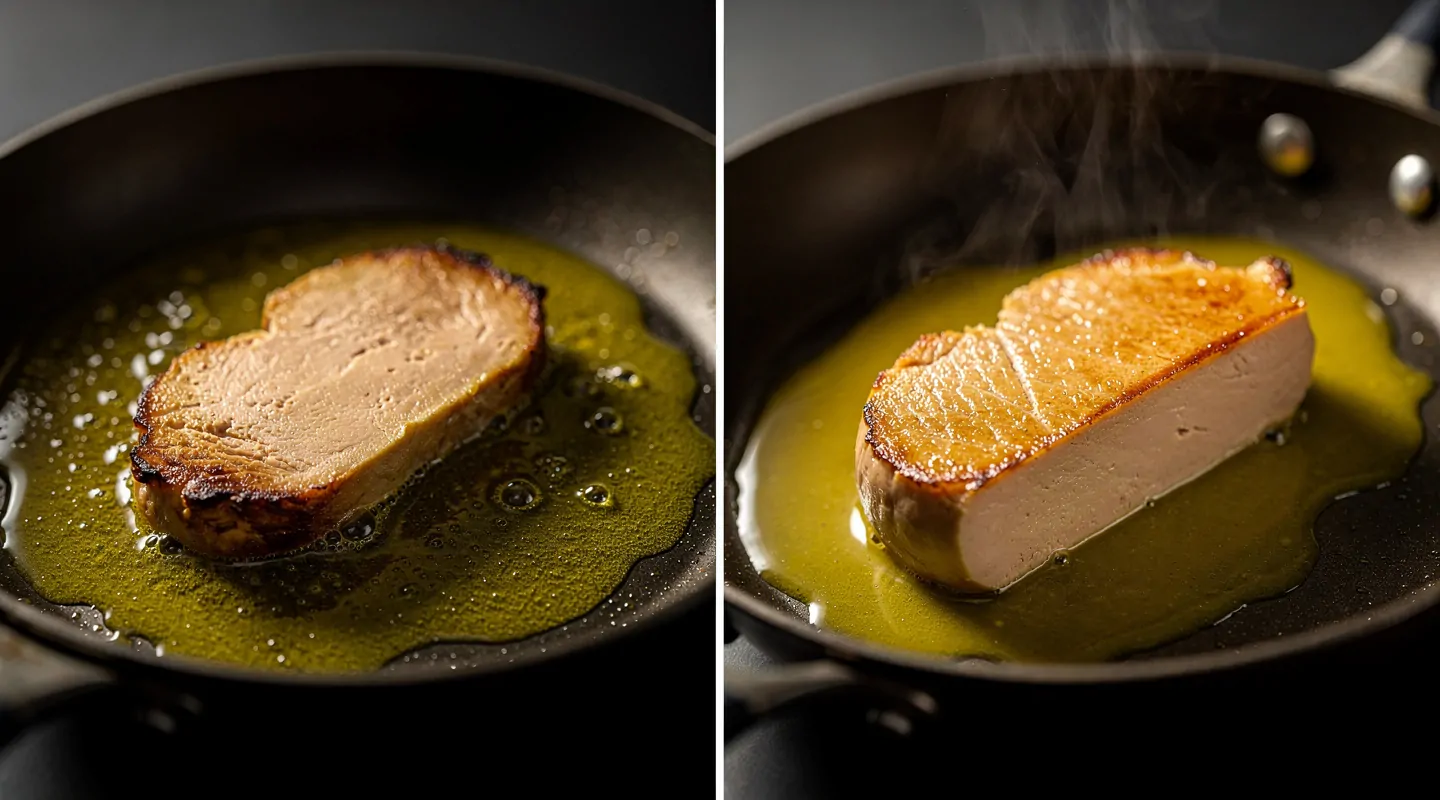
Feedback from the field shows that the same errors consistently recur. They are listed below, along with the corrections to be applied.
Why not cook foie gras that is too cold?
Cooking foie gras straight from the refrigerator is one of the most common mistakes.
The temperature difference between the core (4°C) and the outside creates a thermal shock: the outside cooks too quickly, the inside remains cold.
The result: a burnt or overly greasy surface and a still raw center.
Always take your foie gras out of the refrigerator 30 to 45 minutes before cooking so that it reaches a room temperature of approximately 15 to 18°C. This gradual temperature increase will ensure truly even cooking.
This precaution applies equally to cooking foie gras in a pan and to baking terrine in the oven.
Choosing a quality foie gras: grade A
Grade A is the highest quality level for fresh foie gras. It corresponds to a whole liver, without blemishes or bruising, with a uniform ivory to beige color, and a firm texture that yields slightly to finger pressure.
A grade B liver can certainly be cooked, but it will render more fat and its texture will be less good.
For a first time or an important occasion, always opt for grade A foie gras, whether it is duck or goose.
The ideal weight for a duck lobe is between 450 and 550 grams
Whether below or above the temperature, the cooking process will be more difficult to control.
Managing fat rendering during cooking
A moderate amount of rendered fat is normal and a sign of proper cooking. Excessive rendering generally indicates lower-quality liver, a temperature that was too high, or cooking time that was too long.
To limit fat rendering when cooking in a terrine, ensure you maintain a constant and low oven temperature (110-120 °C). Avoid sudden temperature changes.
The bain-marie also helps to regulate the temperature and to diffuse the heat more gently.
In a pan, a sufficiently hot utensil will quickly sear the liver and closethe surface pores before the fat escapes massively.
This is also why mastering the cooking of other delicate meats relies on the same principles for everything related to high-temperature searing.
Always collect the rendered fat from cooking the foie gras in an airtight jar. It will keep for two weeks in the refrigerator and beautifully flavors Sarlat-style potatoes or fried rice.
Storing and serving cooked foie gras
You've successfully cooked it. Now you just need to store it properly and serve it well. These last two steps are often rushed—and wrongly so!
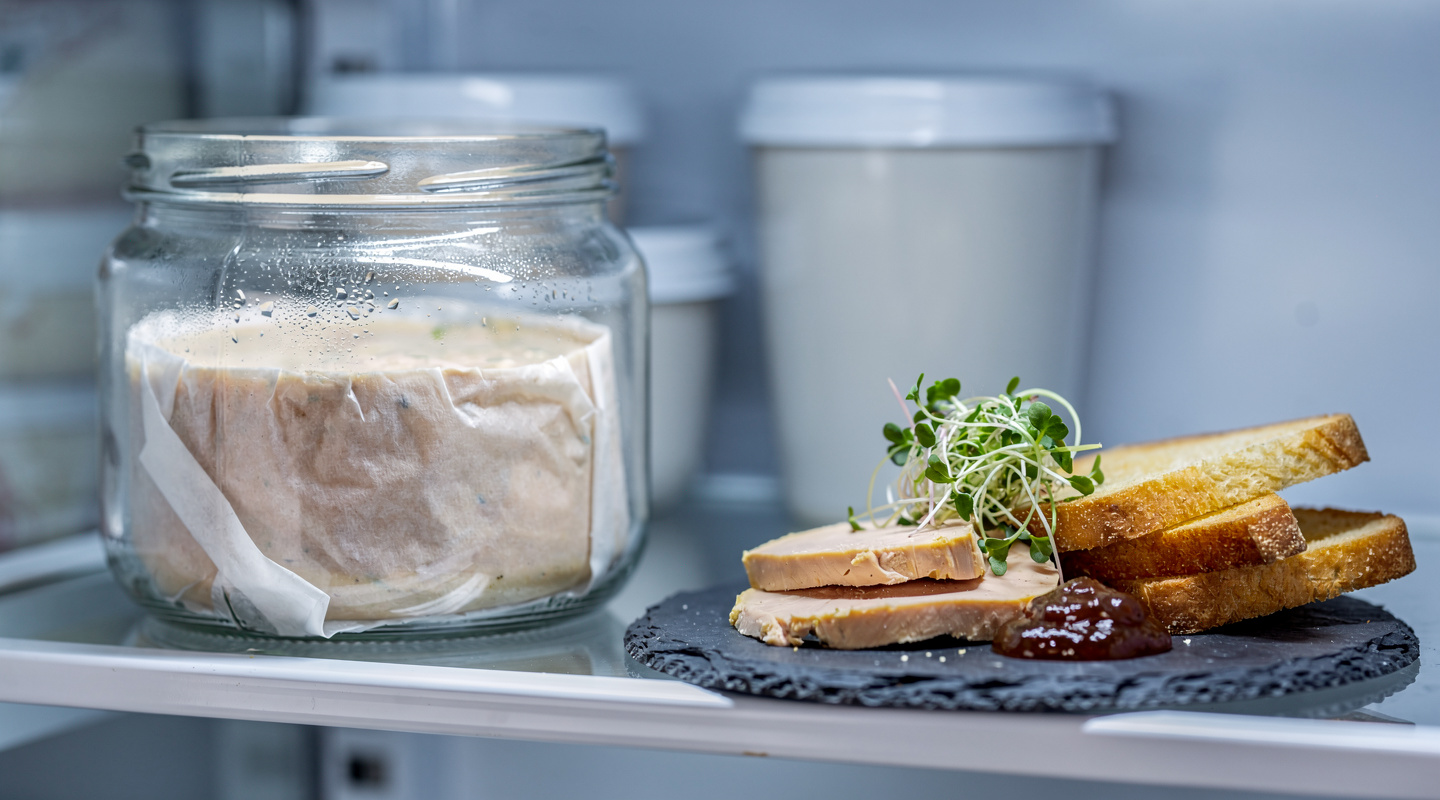
How long can you keep homemade foie gras?
Homemade semi-cooked foie gras can be kept for 5 to 7 days in the refrigerator, at a maximum of 4°C, covered with its cooking fat and wrapped in cling film or in a sealed terrine. This fat forms a natural protective barrier against oxidation.
If you wish to extend the preservation, sterilization in jars allows you to reach several weeks provided that the core temperature has been raised to 55-60 °C during cooking.
For everything concerning ingredients and well-cooked dishes that will keep for a long time, the principles of hot sterilization will apply to both terrines and stews.
When frozen, semi-cooked foie gras can be kept for up to 3 months, but the texture will be slightly altered upon thawing.
At what temperature should foie gras be served?
It's a detail that changes everything!
Foie gras taken directly from the refrigerator is too cold : its aromas are blocked and its texture is too firm to be truly enjoyable.
Remove the terrine or slices from the refrigerator 15 to 20 minutes before serving so that the ideal serving temperature is around 8 to 12 °C — cool but not icy.
The flavors open up, the texture becomes melting without being runny.
For pan-fried escalopes, serve immediately on a warm plate. Any excessive waiting will be costly, especially in terms of texture!
Classic accompaniments to enhance foie gras
Foie gras doesn't need much, and a few well-chosen accompaniments are enough:
- Lightly toasted brioche bread — soft, slightly sweet, it balances the fat in the liver without crushing it.
- Fig or onion chutney — the acidity and sugar create a contrast that awakens the taste buds.
- Sauternes or Monbazillac — sweet wines are the natural partners for foie gras. Serve them slightly chilled (8-10°C).
- A touch of fleur de sel and a few turns of Sichuan pepper — for those who like a spicy freshness as a finishing touch.
- A little cranberry confit or quince or fig jelly for those who prefer a fruitier touch.
Avoid overly strong or acidic accompaniments that would mask the delicacy of the foie gras.
Practical summary
How can I tell if my foie gras is cooked properly without a thermometer?
Without a thermometer, you can rely on visual cues: a semi-cooked foie gras terrine should have a light golden-brown sheen, a texture that offers slight resistance to pressure, and a pinkish-cream interior. Pan-fried, a well-cooked escalope will have a golden surface and a still-pink center. These guidelines are approximate—a thermometer is still highly recommended for consistent results.
What is the difference between semi-cooked foie gras and cooked foie gras?
Semi-cooked foie gras reaches an internal temperature of approximately 45°C. It is more meltingly tender, pinker, and has a fresher taste. It can be kept for 5 to 7 days in the refrigerator. Cooked foie gras is heated to a minimum of 55-60°C and can be preserved longer, often in a jar. Its texture is firmer and its flavor slightly more concentrated.
Can you cook frozen foie gras directly?
No. Frozen foie gras must be thawed slowly in the refrigerator for 24 to 48 hours before cooking. Rapid thawing at room temperature or in a microwave alters the liver's cellular structure and causes excessive fat to render during cooking. Plan ahead.
How long should you cook a whole foie gras in a terrine in the oven?
For a whole foie gras weighing approximately 500 to 600g, allow 35 to 45 minutes in a conventional oven at 110-120°C (230-248°F) with a water bath. The only reliable indicator is the internal temperature: remove the terrine from the oven as soon as the probe reads 45°C (113°F) for a semi-cooked foie gras. The cooking time will vary depending on the size of the foie gras and the oven used.
Why does my foie gras release too much fat when cooked?
Excessive fat rendering can have several causes: insufficient quality foie gras (grade B or too fatty), a cooking temperature that is too high, or foie gras cooked directly from the refrigerator without being brought to room temperature. Using grade A foie gras, cooking at a low temperature, and allowing it to reach 15-18°C before cooking significantly reduces this phenomenon.
