
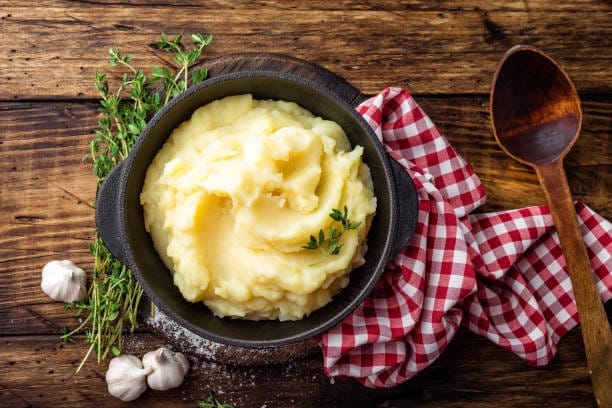
Mashed potato flakes (or any dehydrated flaked mashed potato) are a quick and convenient side dish. Traditionally, they are prepared with milk to achieve a creamy texture.
But what if you run out of milk, are lactose intolerant, or follow a vegan diet?
Don't panic! It is perfectly possible to make Mousseline mashed potatoes without milk while retaining their smooth and tasty texture.
In this article, we'll see how to make a good Mousseline mashed potato without milk, what to use instead of milk, and how to get a vegan or lactose-free mashed potato that's just as delicious!
You will also discover concrete alternatives to milk, tips for maintaining a good texture, as well as a simple and tested recipe for 100% milk-free Mousseline mashed potatoes.
How to make Mousseline mashed potatoes without milk?
Making Mousseline mashed potatoes without milk is really simple : just replace cow's milk with another suitable liquid. Follow the usual recipe on the package, but use one of the substitutes listed below instead of milk.
For example, the Mousline brand itself suggests replacing milk with water or a plant-based drink (such as almond or oat milk) for a dairy-free.
The rest of the preparation remains the same: bring the chosen liquid to a boil with water if necessary (if you are combining the two), pour in the potato flakes off the heat, then mix until you obtain a puree.
If you use the same total amount of liquid as recommended with milk, the consistency will remain similar. For example, if the standard recipe calls for 50% milk and 50% water, you can replace the milk portion with an equivalent amount of water, broth, or plant-based milk (keeping the same proportions).
The resulting purée will be slightly less creamy than with whole milk, but will still be perfectly delicious. Later, we'll look at some tips to compensate for this slight difference in texture.
What can I use to replace milk in Mousseline mashed potatoes?
Several alternatives to milk allow you to make a smooth, creamy mashed potato flakes without using animal milk. You can adjust the recipe based on what you have in your kitchen and your taste preferences. Here are the most common and effective substitutes:
Water
This is the most basic substitution. Use the same amount of hot water as the volume of milk called for. The purée will be more neutral in taste and a little less rich, so consider adding a knob of butter or margarine for fat and creaminess.
For example, one recipe suggests adding a measure of mashed potatoes to 650 ml of water with 20 g of butter to make a milk-free Mousseline. Water alone gives a good result as a substitute, especially if it is well seasoned (salt, pepper, nutmeg… and even a hint of garlic powder).
Plant-based milk (plant-based drink)
Unsweetened plant-based milks are excellent substitutes for cow's milk. You can use soy or oat milk for a very neutral flavor, close to the original taste, or almond milk for a mild and slightly sweet note, or even coconut milk for a more exotic touch.
Replace all or part of the milk with the same amount of plant-based milk (for example, half water, half oat milk).
Make sure to choose a plain plant-based drink (without added sugar or vanilla flavouring) so as not to alter the purée.
These alternatives allow you to keep the puree quite smooth while meeting the needs of people avoiding lactose.
Vegetable broth (or chicken broth for those who are not vegan)
Using stock instead of milk is a great way to add more flavor to your mashed potatoes. Hot vegetable stock (homemade or made from a dissolved stock cube) can replace all or part of the water used in the preparation.
For example, you can mix half vegetable stock and half water. The stock will infuse the purée with vegetable and herb aromas, making it very tasty without any milk.
Just be careful to adjust the seasoning: the broth is already salted, so taste before adding more salt.
Chicken stock also works (if you're not vegan) for a slightly richer flavor. It's a popular alternative for making a milk-free Mousseline mashed potato without it being bland.
Plant-based cream (soy, oat, coconut…)
Plant-based creams , also called "cooking creams," made from soy, oats, etc., are thicker than plant-based milks and very high in fat. They can replace milk or be added to water.
For example, incorporating a few spoonfuls of warm soy or almond cream into the puree gives a velvety texture comparable to fresh cream.
Coconut cream, on the other hand, will give a smooth texture and a light coconut scent.
You can therefore replace part of the liquid with vegetable cream (10 to 20% of the total volume) to recreate the deliciousness of a traditional mashed potato.
Tip : for even more creaminess, it is recommended to use vegetable margarine and/or vegetable cream rather than a very light vegetable milk.
In other words, do not hesitate to add a good vegetable fat (margarine, olive oil…) in addition to your replacement liquid, in order to mimic the contribution of milk.
As you can see, replacing milk in mashed potatoes is perfectly possible with water, broth, or plant-based alternatives.
Each of these substitutes can be used while respecting the same proportion of liquid as the milk in the original recipe.
Don't hesitate to try different combinations to discover the one you like best!
Comparative table of milk substitutes for your Mousseline mashed potatoes
To help you choose the best alternative for your needs, here is a detailed comparison of the main substitutes:
| Substitute | Texture | Taste | Strengths | Weak points |
|---|---|---|---|---|
| Water | Correct | Neutral | Economical, Always available, Compatible with all diets | Less creamy, requires added fat |
| Almond milk | Creamy | Slightly sweet | Texture similar to milk, pleasant taste, rich in vitamin E | More expensive, allergen (nuts) |
| Soy milk | Very creamy | Neutral | Milk-like texture, High in protein, Economical | Possible legume taste, Soy allergen |
| Oat milk | Creamy | Slightly sweet | Velvety texture, Milder taste, Source of fiber | Contains gluten, More expensive than water |
| Vegetable broth | Correct | Tasty | Adds flavor, Economical, Rich in flavor | Already salty, strong taste |
| Vegetable cream | Very creamy | Variable | Premium texture, very creamy, versatile | More expensive, more calories |
Our tips for a smooth and delicious milk-free mashed potato
Preparing mashed potatoes without milk does not mean sacrificing texture or taste.
Here are some tips to keep your mashed potatoes smooth and delicious even without milk:
Add a fat
The secret to a smooth mashed potato is partly fat. If you're not using milk (which contains fat when it's whole), compensate by adding a knob of butter (if you don't mind lactose) or vegetable margarine to keep it 100% vegan. A drizzle ofolive oil can also do the trick and will give it a pleasant, slightly fruity flavor.
This addition of fat will enrich the mashed potatoes and improve their velvety texture . For example, in mashed potatoes made with only water, a little melted margarine mixed with the oats makes all the difference in terms of flavor and creaminess.
Heat the liquid sufficiently
Whether you use water, broth, or plant-based milk, remember to heat it until it's simmering before adding the flakes (just as you would with regular milk). A hot liquid allows the potato flakes to rehydrate properly and prevents lumps.
Once boiling, remove from the heat and then gradually whisk in the oats (chef's technique!). This will give you a smooth, lump-free purée. This technique remains the same whether you use milk or not.
Season generously
Milk adds a certain natural sweetness to the mashed potatoes. To compensate for its absence, pay close attention to the seasoning.
Add salt (in moderation if using salted stock), pepper , and don't forget the nutmeg , which subtly enhances the taste of the potato.
You can also add a pinch of garlic powder or herbs (parsley, chives) according to your taste. Good seasoning will give your dairy-free purée character and prevent it from being too bland.
Adjust the consistency
If you find the milk-free purée a little too thick or dense, simply add a little more hot liquid (water, broth, or plant-based milk) and mix well to reach the desired consistency. The oats will continue to absorb it in a few moments.
Conversely, if your puree seems too runny, let it rest for another minute or stir in a teaspoon of extra flakes to thicken it.
These simple adjustments allow you to achieve the ideal consistency, even without dairy products, without compromising the taste.
Incorporate air by whisking
For a light and airy mashed potato, traditionally the aim is to incorporate air (which is where the name comes from). Don't hesitate to whisk the mashed potato vigorously for a few moments once all the ingredients are combined.
You can use a vigorous hand whisk or, if necessary, an electric mixer at low speed for a few seconds. This makes the purée lighter and airier. Be careful not to overmix, however, to avoid an elastic texture – a few strokes of the whisk are enough.
This tip is particularly useful if you have only used water, in order to properly emulsify the puree with the margarine/oil and obtain a nice lightness.
By following these tips, you'll see that a milk-free mashed potato flake can be just as creamy as a classic mashed potato!
The combination of a good milk substitute (water, plant-based milk or broth) and a few adjustments (added fat, seasoning, good mixing technique) gives a stunning result.
Our Recipe: Milk-Free Mousseline Mashed Potatoes (Vegan Version)

Let's get practical with a simple and tasty vegan recipe for Mousseline mashed potatoes without any trace of milk.
This version is 100% vegan and also suitable for those looking for a lactose-free purée. We'll be using vegetable stock for flavor and vegetable margarine for creaminess.
This recipe has been tested and approved: the resulting puree is creamy and no one would guess that it does not contain milk!
Moreover, according to France Assos Santé, approximately 20% of French people are lactose intolerant, which makes this type of recipe particularly useful.
Ingredients (for 4 people) :
- 200g of Mousseline mashed potato flakes (approximately 4 individual sachets)
- 500 ml of water
- 500 ml of vegetable stock (homemade or prepared with 1 stock cube)
- 50g of vegetable margarine (or vegetable butter)
- Salt, pepper
- 1 pinch of ground nutmeg (optional) (Optional: 4 tablespoons of soy or oat plant-based cream, for even more moistness)
Preparation :
- Heat the liquid – In a saucepan, pour the water and vegetable stock. Bring to a boil over medium heat. Once boiling, remove the saucepan from the heat (no need to continue boiling).
- Incorporate the flakes – Off the heat, gradually add the Mousseline mashed potato flakes to the hot liquid, whisking vigorously by hand. Sprinkle them in to avoid lumps. The puree will thicken almost instantly. Continue stirring until the texture is smooth.
- Add the margarine – Add the vegetable margarine in small pieces to the hot mashed potatoes. Mix well with a wooden spoon or whisk until the margarine melts completely and is incorporated into the mashed potatoes. This will give them a lovely smooth texture. (If you want an even creamier mashed potato, now is the time to add the plant-based cream, mixing it in quickly.)
- Season – Taste the purée and then season to your liking. Add a little salt if necessary (the stock is already salted, so you may not need to add any more), freshly ground pepper, and a pinch of nutmeg for flavor. Mix one last time.
- Serving – Your milk-free Mousseline mashed potatoes are ready! Serve them immediately, piping hot, alongside your dish. You can garnish with a twist of freshly ground pepper or a few sprigs of chopped chives on top for presentation.
Result and advice : You get a delicious-tasting puree thanks to the vegetable broth which subtly enhances it.
The texture is creamy and melts in your mouth, as margarine is a great substitute for butter and milk. If you use a flavorful stock, there's no need to add any sauce or gravy: the purée is delicious on its own.
No one will be able to say that it contains neither milk nor butter! This recipe shows that it is entirely possible to make a vegan Mousseline mashed potato without compromising its deliciousness (and it's tested and approved).
Note: Mousseline instant mashed potatoes are potato-based and do not contain dairy (although you should still check the packaging). The ingredient list for the original sachet of Mousseline is simply 99% potatoes, a vegetable-based emulsifier, and a little turmeric and rosemary for preservation, with no added lactose. It "may contain traces of milk" due to allergen concerns, but it is itself milk-free. Therefore, by using the appropriate substitutes as described above, you can confidently prepare lactose-free or 100% plant-based mashed potatoes
Can you make a vegan or lactose-free Mousseline mashed potato?
Yes, absolutely. In fact, Mousseline mashed potatoes can easily become vegan simply by replacing the animal-based ingredients with plant-based alternatives.
As we have seen, it is enough to use a non-dairy liquid (water, broth, plant-based milks…) and vegetable fat (margarine, oil) instead of milk and butter.
Since the base product (potato flakes) does not contain milk, the final preparation will contain neither lactose nor animal products if you choose your substitutes carefully.
In practice, for a lactose-free puree that doesn't need to be strictly vegan, you can simply use commercial lactose-free milk instead of regular milk (this type of milk, delactosed, tastes the same as regular milk) or a plant-based drink, and possibly clarified butter (ghee) or a small amount of sweet butter because butter contains very little lactose.
However, for a 100% vegan version , avoid all animal products: opt for plant-based milks and margarines. For example, a Mousseline or "Mousline" mashed potato made with almond milk and margarine will become entirely vegan and lactose-free.
The key is to maintain the correct proportions of liquid and fat to keep the mashed potatoes balanced. By making smart substitutions, you can create a vegan mashed potato that's just as creamy as a traditional dairy-based version.
Moreover, many cooks confirm that it is quite possible to make Mousseline mashed potatoes without milk by preparing them in the same way as the classic recipe, simply by substituting the milk with water, stock or a vegetable cream.
So you can easily enjoy a vegan or lactose-free mashed potato with Mousseline!
In conclusion, making Mousseline mashed potatoes without milk is not only possible, but also easy and delicious. Whether out of necessity (lactose-free diet, allergy, vegan lifestyle) or out of curiosity, don't hesitate to try these alternatives.
Water, plant-based milks, broths, plant-based creams – there are plenty of options for replacing milk in mashed potatoes. With the right proportions and our tips for maintaining a creamy texture, you won't notice the difference, or perhaps you'll even discover new flavors in this classic dish.
The next time you prepare a flake puree, remember that milk is just one possibility among many: it's up to you to play around and find the combination that suits you best for a smooth, delicious and 100% milk-free Mousseline puree!
Moreover, this technique can also be applied to prepare mashed potatoes without dairy products.
Testimonials: they tested Mousseline mashed potatoes without milk!
Here are the testimonials of three people who have adopted these lactose-free alternatives in their daily lives:
Marie, 34 years old, mother of two:
“Since discovering my 8-year-old daughter’s lactose intolerance, I’ve consistently used oat milk for our Mousseline purees. The result? No more stomach aches after meals, and even my husband, who wasn’t convinced at first, admits he can’t tell the difference anymore! As a bonus, our grocery bill has decreased because I no longer buy special milk. I highly recommend this tip to all families.”
Jean-Claude, 58 years old, retired:
“At my age, digestion becomes more delicate. My doctor advised me to reduce lactose, so I tried the recipe with vegetable broth instead of milk. Frankly, it’s even better! The purée has more flavor, and I no longer have those unpleasant bloating sensations after dinner. My wife has adopted the technique too. It’s become our new habit for all side dishes.”
Laura, 29, vegan athlete:
“As a vegan, I struggled for a long time to find simple and quick side dishes. This recipe with vegetable margarine and soy milk has revolutionized my post-workout meals! It’s super quick to prepare, it’s filling, and the texture is perfect. I’ve even converted my non-vegan roommates who find it easier to digest. A real game-changer in my eating routine.”
Frequently Asked Questions about Milk-Free Mousseline Mashed Potatoes
Can Mousseline mashed potatoes be prepared in advance without milk?
Yes, you can absolutely prepare your dairy-free purée in advance. It will keep for 2-3 days in the refrigerator in an airtight container. To reheat it, add a little hot liquid (water, broth, or plant-based milk) and stir over low heat. Avoid using a microwave, as this can cause lumps.
What milk alternative should we choose for children?
For children, choose plain oat milk or soy milk, which have a neutral taste and a texture similar to regular milk. Avoid sweetened versions. If your child refuses, start with a mixture of half water and half plant-based milk, then gradually increase the proportion of plant-based milk.
What should I do if my milk-free mashed potatoes are too runny or too thick?
If your purée is too runny: let it rest for 2-3 minutes to allow the flakes to fully absorb the liquid, or add an extra spoonful of flakes. If it's too thick: gradually stir in warm liquid (broth or plant-based milk) until you reach the desired consistency.
Is Mousseline mashed potatoes without milk just as nutritious?
The nutritional value remains similar because potato flakes make up 99% of the product. By using fortified plant-based milks (calcium, vitamins), you can further enhance the nutritional content. The vegetable margarine provides the necessary healthy fats, making this version as balanced as the original.
How much does a dairy-free mashed potato cost compared to the regular version?
The cost varies depending on the alternative chosen. Using water and margarine is much more economical than using milk. Plant-based milks generally cost slightly more than cow's milk, but they are healthier, and the difference remains minimal (around 20-30 cents per serving). Many families ultimately save money because they will buy fewer specialized dairy products.

Just a question… why don't they use almond milk for a creamier mousseline purée? It's far too bland with just water, I find
Almond milk does have a taste that isn't neutral and is sometimes sweet, but this could be interesting in a sweet and savory combination…
Is it really necessary to replace the milk? I tried it with water, and the texture wasn't the same at all!
But why make Mousseline mashed potatoes without milk? The real taste is with cow's milk, isn't it? #TeamCowMilk
To each their own, right? #TeamPlantMilk for a more sustainable world!
Honestly, why replace the milk in Mousseline mashed potatoes? Water doesn't give the same creamy taste. It's vegan nonsense, isn't it?
To each their own, right? Vegan Mousseline mashed potatoes have their charm too! I had my guests try them as part of a shepherd's pie and they loved them!
The table indicates that oat milk contains gluten; could rice milk also be a suitable option for those avoiding both lactose and gluten?
Hello, I haven't tested this specifically with rice milk, but the principle should work since it's also a neutral-tasting liquid. However, it's thinner than soy or oat milk, so consider adding a little more margarine to maintain the creamy texture.