
Updated on August 17, 2025
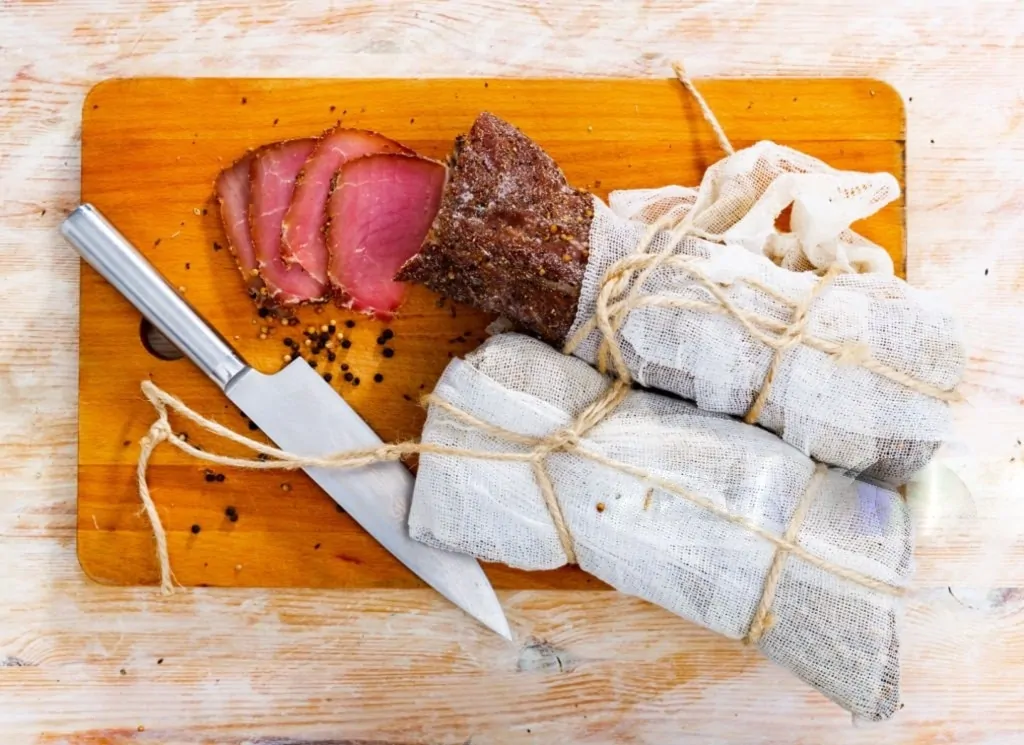
Do you dream of preparing your own homemade charcuterie to impress your guests at cocktail parties? Then dried pork tenderloin for appetizers is the perfect recipe to start with in the art of curing!
This artisanal specialty, simpler than it looks, will transform your humble pork fillet into a refined delicacy worthy of the finest charcuteries.
With just a few basic ingredients and a little patience, you can create delicious homemade charcuterie without preservatives or colorings, while remaining very economical.
The salting and drying process will concentrate the flavors of your filet mignon while ensuring natural preservation of the meat. The addition of aromatic herbs and berries will pair perfectly with many wines and aperitifs.
You can therefore bring it out and let your guests taste it at most of your events. Whether in summer, or even in winter.
Let's discover together the necessary ingredients and the steps to follow to make this traditional recipe that will transform your basic pork fillet into a real delicacy, just like fine charcuterie!
Table of Contents
Preliminary information
⏱️ Total time: 15 minutes prep + 12 hours salting + 2-3 weeks drying
📈 Difficulty: Easy
💰 Budget: Economical
🧊 Storage: 4-6 weeks in the refrigerator
Ingredients to use for your dried filet mignon
To make this traditional recipe (serves approximately 6), you will need few ingredients and equipment.
For the meat:
- 1 pork tenderloin weighing 500g (well trimmed)
- 1 kg of coarse salt (sea salt and clay salt, if possible)
For the seasoning:
- 3 tablespoons of dried thyme
- 2 tablespoons of pink peppercorns
- Ground black pepper
- Herbs of Provence (optional)
Materials needed:
- A cake tin or long dish
- Clean cotton dish towel (without fabric softener)
- Post-it note and pencil
- Kitchen scales
Step-by-step preparation
Step 1: Preparing the filet mignon
Start by carefully trimming your tenderloin. Remove any visible excess fat as well as the aponeurosis (that thin, transparent membrane).
This step, although optional, will make your final charcuterie much more enjoyable to eat.
Ideally, choose a filet mignon of French origin, from animals raised outdoors. The quality of the meat will be directly reflected in the final taste of your dish.
Step 2: Salting (crucial phase)
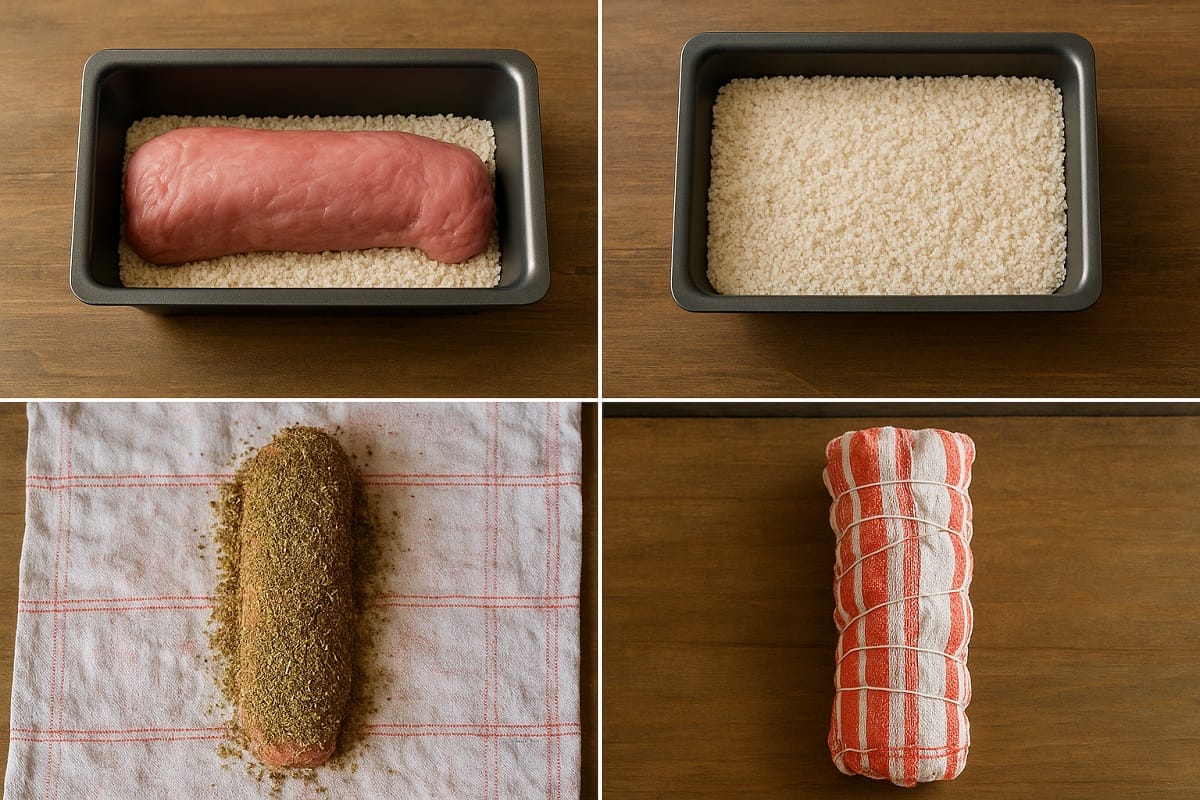
Pour a generous layer of coarse salt into your loaf tin. Sprinkle with thyme and pink peppercorns, then gently place the pork tenderloin on top. Cover completely with coarse salt – your meat should be entirely buried.
Salting time according to weight:
- 500g: 10 to 12 hours
- 400g: 8 hours
- 600g: 14 hours
To calculate precisely: (Weight in grams × 12) ÷ 500 = time in hours
Salting time calculator
🧮 Automatic salting time calculator
Next, place everything in the refrigerator.
This step will allow the moisture to be extracted from the meat while protecting it from bacteria. You're already well on your way to making successful artisanal charcuterie!
Step 3: Rinsing and preparing for drying
After the salting time has elapsed, take out your filet mignon and rinse it thoroughly under cold water to remove any remaining salt.
Dry it thoroughly with absorbent paper – this step is crucial to prevent the development of unwanted mold.
Lightly pepper the entire surface. Pepper, in addition to adding flavor, has natural antiseptic properties.
For more information on food safety when preparing homemade charcuterie, consult the recommendations of ANSES.
Step 4: Drying
Place the tenderloin in the center of a clean cotton cloth (never microfiber). Roll it up loosely to form a ballotine – the idea is to limit contact with the air while still allowing the meat to breathe.
Stick a Post-it note with today's date on the dish towel. This simple trick will prevent you from forgetting!
Place everything in the vegetable drawer of your refrigerator, in the coldest part.
How long does it take to dry a filet mignon?
Allow to dry for 2 to 3 weeks depending on the desired texture.
Check your filet mignon every 3-4 days:
- Rotate it to prevent one side from always remaining in contact with the shelf
- Check for any signs of suspicious mold
- The meat should gradually darken and harden
This timeframe may seem long, but it's the secret to homemade charcuterie . Your patience will be richly rewarded!
“I was skeptical at first about the three-week drying time, but I followed the recipe to the letter. The result was amazing! My guests thought I'd bought it from a local butcher. My 480g fillet was perfect after 18 days.” – Marie, Lyon
Drying progress chart, week by week
| Week | Expected appearance | Action to be performed |
|---|---|---|
| Week 1 | Meat still tender, color darkening slightly | Rotate every 3 days |
| Week 2 | Firmness sets in, weight loss of approximately 30% | Check for the absence of mold |
| Week 3 | Firm but not hard texture, 40% weight loss | Ready to eat or extend as desired |
Our tips for guaranteed success every time
Choosing a dish towel
Use only a cotton cloth, washed without scented fabric softener. Microfiber cloths or scented products will transfer their odors to your charcuterie.
Mold problems
If greenish mold appears, don't panic! Gently scrape the affected area, put it back in coarse salt for a few hours, then restart the drying process with a clean cloth.
“The first time, I got mold after 10 days. I thought it was ruined! But I followed the advice to scrape it off and put it back in the salt for 4 hours. In the end, my fillet was delicious. Since then, I religiously check it every 3 days.” – Pierre, Toulouse
Weight loss test
For perfectionists, weigh your tenderloin regularly. A weight loss of 35 to 40% indicates optimal texture. At 50% weight loss, your tenderloin will be very dry.
Ventilated refrigerator
If you have a fan-assisted refrigerator, drying will be more even and faster. Adjust the drying time accordingly.
"With my American-style ventilated refrigerator, my fillets are ready in 15 days instead of 3 weeks. I weigh them regularly and stop at 40% loss. It's become my specialty for appetizers!" – Catherine, Bordeaux
Tasting and storage
Aperitif service
Slice your dried pork tenderloin into thin strips using a sharp knife. This specialty will be a hit at your next get-together with friends or family!
Serve on a board with pickles, olives and toasted country bread.
Perfect accompaniments
- Characterful red wine (Côtes du Rhône, Bandol)
- Blonde craft beer
- Fresh goat cheeses
- Fresh figs or fig jam
optimal preservation
Once opened, your dried pork tenderloin will keep for a week in the refrigerator, wrapped in cling film. For longer storage, cut it in half and vacuum-seal one half.
Gourmet variations
Pork tenderloin with herbs de Provence
Add 2 tablespoons of herbs de Provence mixed with coarse salt when salting for a Mediterranean flavour.
Spicy version
Incorporate a teaspoon of Espelette pepper or smoked paprika during the drying phase to enhance the flavor.
Pork tenderloin with green peppercorns
After rinsing, generously roll your fillet in crushed green pepper before wrapping it in the cloth.
Why choose homemade charcuterie?
Beyond the pleasure of creating, making your own dried filet mignon for an aperitif has many advantages!
Indeed, you have complete control over the origin of your meat, you avoid industrial additives and you make substantial savings compared to artisanal charcuterie sold in stores.
This ancestral technique reconnects you with traditional know-how while guaranteeing you a tailor-made product, adapted to your personal tastes.
Mistakes to absolutely avoid!
Over-salting: Strictly adhere to the indicated times. Excessive salting will render your charcuterie inedible.
Moisture: Never seal your net tightly during drying. Moisture must be able to escape.
Rushing: Resist the temptation to taste too soon. Insufficient drying will result in an unpleasant texture.
Soiled cloth: Change the cloth if necessary, especially if it becomes damp or smelly.
The final word
Preparing your own dried filet mignon at home means reconnecting with ancestral preservation techniques while perfectly controlling the origin and quality of the ingredients.
This recipe, accessible to beginners, will give you results worthy of a professional charcutier.
Don't get discouraged if the first few weeks seem long! Each filet mignon is unique and the drying time may vary slightly depending on your refrigerator and the thickness of the cut.
Once you have mastered this artisanal charcuterie technique, you can venture into other cured meats: such as dried duck breast , beef bresaola, or even Bayonne ham , etc.
Your aperitifs will never be the same again!
Frequently asked questions about dried filet mignon
Can this dried filet mignon recipe be made with a frozen filet mignon?
No, use only fresh meat. Freezing promotes bacterial growth during thawing, which is incompatible with the long drying process.
ANSES recommends strictly adhering to the cold chain to avoid any health risks.
How long does it take to dry a filet mignon?
Between 2 and 3 weeks depending on the desired texture and the humidity of your refrigerator. Expect a 35 to 40% weight loss for optimal texture.
How to store homemade dried pork tenderloin?
Once opened, keep it in the refrigerator for one week. Whole and vacuum-sealed, it will easily keep for 4 to 6 weeks and will improve with age!
What should I do if mold appears during drying?
If greenish mold appears, don't panic. See our article explaining why this mold appears on dried meats.
Gently scrape the affected area, place it back in coarse salt for a few hours, then resume drying with a clean cloth. Check regularly every 3-4 days.