

In short
You come home from the market with a beautiful bunch of basil, and two days later the leaves are limp, spotted with black, and ready for the bin. The refrigerator reflex, which works for almost all herbs, risks damaging this one.
To keep basil fresh, the best method depends mainly on how long you want to keep it: a few days, two weeks or all winter.
This article compares the five common methods (glass of water, fridge, freezing, oil, drying), with the times announced by their sources and their actual limitations.
It also deals with the case of potted basil bought from the supermarket, and reviews the differing opinions about the fridge.
Which method should you choose depending on the time you have available?

The table below lists the shelf life published by each source, along with its date. They don't all agree, which is normal: fresh basil from the garden and a bouquet from the supermarket don't have the same freshness.
| Method | Announced duration | Which basil | Main limit |
|---|---|---|---|
| Glass of water, room temperature | Up to two weeks by changing the water (Demotivator, December 2021) | Bouquet with stems | The stems can rot if the water is not changed |
| Fridge | Not recommended: Basil is the only herb that should not be added (Health Canada, March 2026) | None, except in special cases | Leaves blackened by the cold |
| Freezing into water ice cubes | Up to three months (Health Canada, March 2026) | Leaves only, surplus harvest | It is cooked, no longer eaten raw |
| Jar of oil in the fridge | One week after preparation (Health Canada, 2013 page) | Small quantity, quick use | Risk of botulism outside of refrigeration |
| Drying (oven or hanging) | Oven at 75°C for 30 minutes, or about a week suspended (Health Canada, March 2026) | Surplus to be kept in a jar | A much more subtle fragrance |
The simulator: which method for your basil?
Choose the desired duration, the form of your basil and the intended use: the tool will tell you the most suitable method, according to the recommendations cited in this article.
The glass of water: the first week method
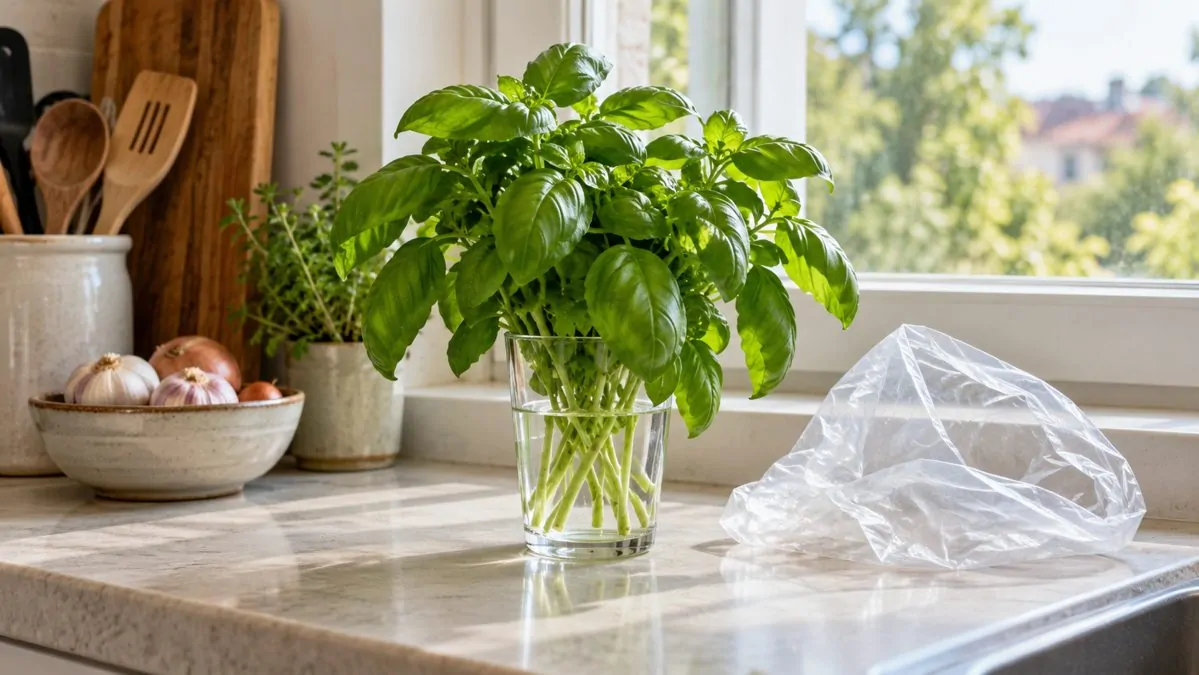
The principle is that of a bouquet of flowers: the bottom of the stems is cut at an angle, the leaves that are soaking are removed, and the whole thing is placed in a glass of water at room temperature, away from drafts.
The glass should be placed out of direct sunlight. The water should be changed regularly, and the stems should shorten slightly each time.
With this routine, a guide from Démotivateur (December 2021) suggests two weeks of preservation for a bouquet covered in a plastic bag, in a dark place, with regular water changes. Consider this timeframe as a guideline, not a guarantee.
Typical example: a bouquet of herbs bought on Saturday for a salad on Sunday and pasta on Wednesday. In water, on the worktop, it remains usable throughout the entire period, whereas in the fridge it would have risked turning black before the end of the weekend.
The method has its detractors. On a thread on the info.fr forum, a member wrote on March 16, 2026: "You don't put basil in a glass of water, it's the worst idea in the world," and suggested using damp paper instead. It's an isolated opinion, but it serves as a reminder that stagnant water causes the stems to rot: change it as soon as it becomes cloudy.
Potted basil from the supermarket
A potted plant is not treated like a bouquet. According to Hermie's blog (accessed in November 2026), a supermarket plant doesn't last more than a week in its plastic packaging, whereas one from a garden center withstands transfer better.
The advice from this source is to remove it from the plastic, repot it in a larger pot with soil that retains water, and water it from the bottom, twice a week, without wetting the leaves.
Potted basil should also be brought indoors at night as soon as temperatures drop: below 12°C, especially at night and over time, the plant will wither according to the same source.
Always pick the top leaves, and remove the stems that bear flowers: the plant branches out and remains fuller, according to Hermie's advice.
Why does the refrigerator turn basil black?
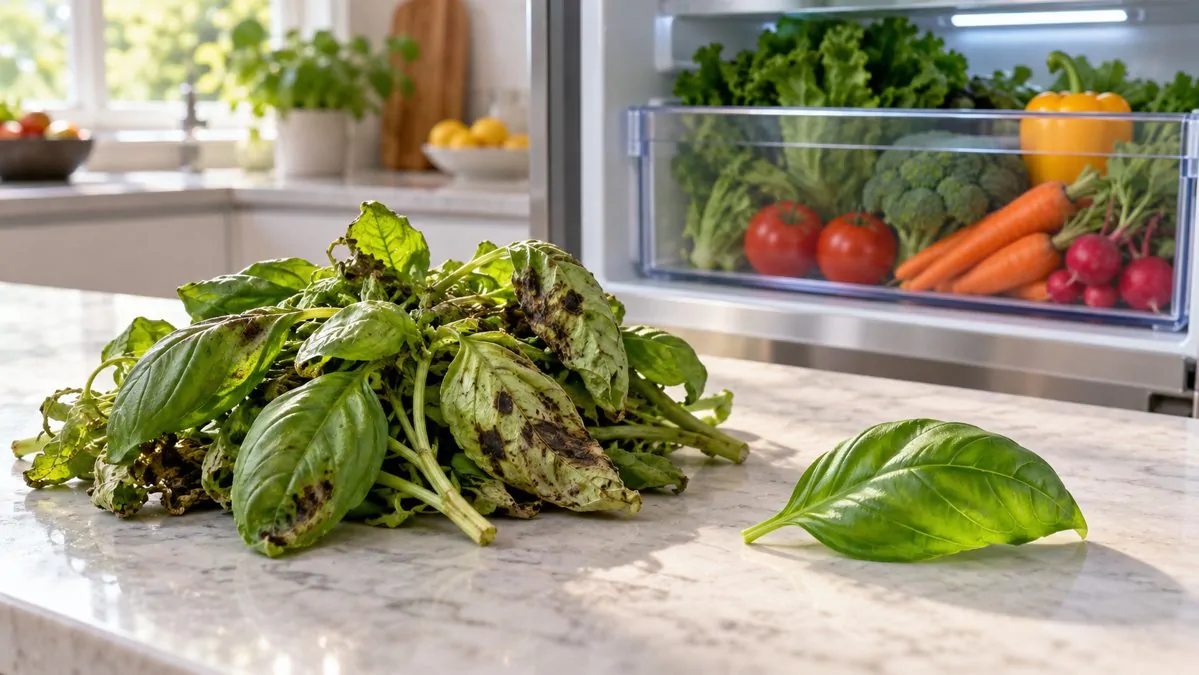
Basil originates from tropical regions, and its leaves do not tolerate cold well. Researchers report cold damage below 10 to 12°C, with blackening being a typical symptom.
This is what a thesis from Wageningen University (2022, accessed in November 2026) describes: the severity of the damage depends on the temperature and the time spent in the cold. However, a domestic refrigerator operates at around 4°C, well below this threshold.
Health Canada is more direct: in its food guide, updated on March 31, 2026, basil is "the only herb that should not be kept in the refrigerator."
The blackened leaves are not caused by mold: they have been damaged by the cold. They mainly lose their fragrance and firmness.
Not everyone follows this rule. On the same forum thread, another member wrote on March 13, 2026: "I put it in the fridge in a damp cloth and it works pretty well.".
This isolated testimony doesn't contradict the sources, it adds nuance: well-wrapped basil, refrigerated for a short time, might survive. But it's a gamble, whereas a glass of water poses no risk to the leaves.
In the freezer: ice cubes for several months
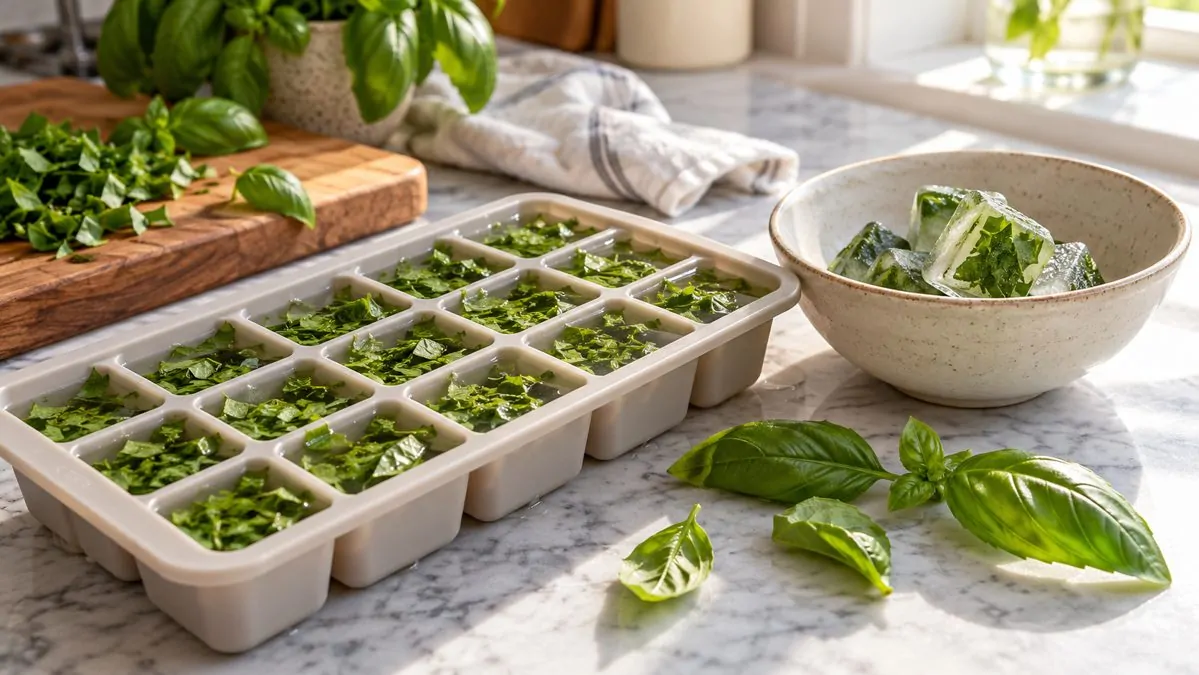
This is the method recommended by Health Canada for fresh herbs, with a maximum shelf life of three months in the freezer
Wash the leaves, chop them by hand or blend them, then pack them into an ice cube tray before covering them with water.
Thoroughly dry the washed leaves, fill each compartment three-quarters full with chopped basil, add water, then unmold the ice cubes into a bag once frozen. Label with the date.
Ice cubes are added to soup, tomato sauce or stew at the end of cooking to preserve color and flavor.
Frozen basil loses its texture: it can no longer be eaten raw in salads.
A guide from Demotivateur (December 2021) describes another method: blanch the sheets for one minute in boiling water, plunge them into ice water, dry them, and then store them in freezer bags. This version requires more steps, but the sheets remain intact.
A typical example: a surplus of basil from the garden before the first cool nights. It's better to harvest it all at once and freeze it than to leave it outside, since the cold would damage it anyway.
In oil or dried: two methods to be handled with care
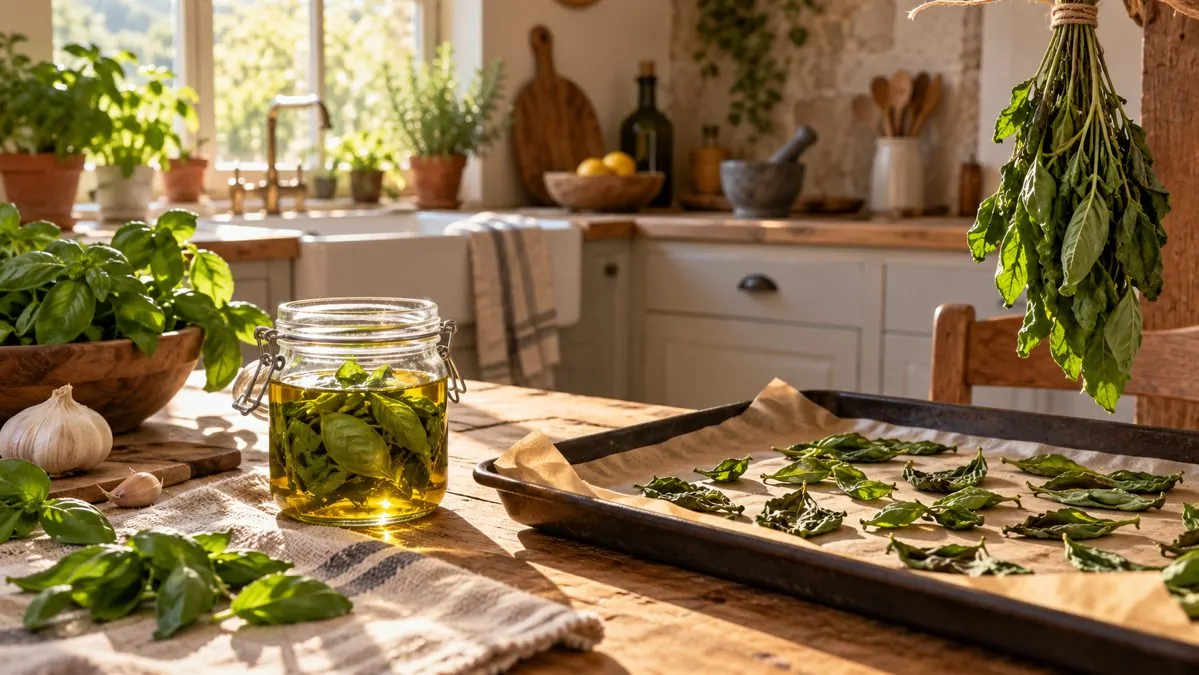
These two methods are appealing because of their rustic nature, but they are the most difficult to master. They are not equal: one carries a real health risk, the other a loss of flavor.
The oil jar: a short-term storage time, and always keep it cold
Leaves coated in olive oil create an oxygen-free environment where certain bacteria can grow. According to Health Canada's safety advice on herbs preserved in oil (page dated February 2013), herbs preserved in oil should always be kept refrigerated at 4°C or lower.
The same page recommends using the oil within a week of preparation, and discarding what remains afterwards.
The Demotivator guide cited above (December 2021) states that a jar of oil can be stored for six months if kept in a cool, dark place. This duration is inconsistent with Health Canada's recommendation, which limits storage to one week in the refrigerator: if in doubt, consult the official source.
Drying: possible, but the basil loses its flavor
Health Canada recommends three ways to dry herbs: hanging them upside down for about a week, baking them in the oven at 75°C for 30 minutes, or microwaving them between two sheets of absorbent paper. The information page specifies that drying is best suited for woody herbs such as thyme, rosemary, or sage.
Basil is not one of them: once dried, its aroma becomes much more subtle. Reserve this method for surplus basil that you want to keep in a sealed jar to flavor a stew.
- No special equipment
- The dried leaves are stored in a jar
- No space taken up in the freezer
- The fragrance and color are very muted
- Oil: health risk if the cold is broken
- Short lifespan for the oil jar
In summary
For a week, a glass of room-temperature water is the simplest solution. For several months, ice cubes in the freezer remain the safest and best-documented option.
The refrigerator remains the classic trap: basil turns black in it, and it is best reserved for the rare cases where there is no other choice.
Oil and drying are supplementary methods, to be chosen with full awareness of their limitations. When in doubt, divide your surplus between a glass of water for the week and a container of ice cubes for the following weeks.
Practical questions
Should you wash basil before storing it?
It depends on the method. For a bouquet in water, it's best not to wet the leaves before storing, as moisture can cause them to rot. For freezing, Health Canada recommends washing the herbs before chopping them (March 2026).
Can you cook basil whose leaves have turned black?
Leaves blackened by the cold have lost most of their aroma and texture. If they smell good and aren't slimy, they can be used in a sauce or soup, but they won't make a nice garnish. Slimy or foul-smelling basil should be discarded.
