

In short
Do you have kefir grains on your hands and are going on vacation next week? Or do you simply want to store the kefir grains between fermentations without losing everything? Good news: these little ferments are more robust than they seem!
Provided you know the right methods. Fridge, freezer or drying — each option has its rules.
This guide explains everything, step by step, to keep your grains alive and active regardless of the storage duration chosen.
Milk kefir or fruit kefir: what are the differences in preservation?

Before delving into storage techniques, it's essential to understand one thing: milk kefir and water kefir are not the same organisms. Their microbial composition differs, and so do their needs.
Milk kefir grains and their specific needs
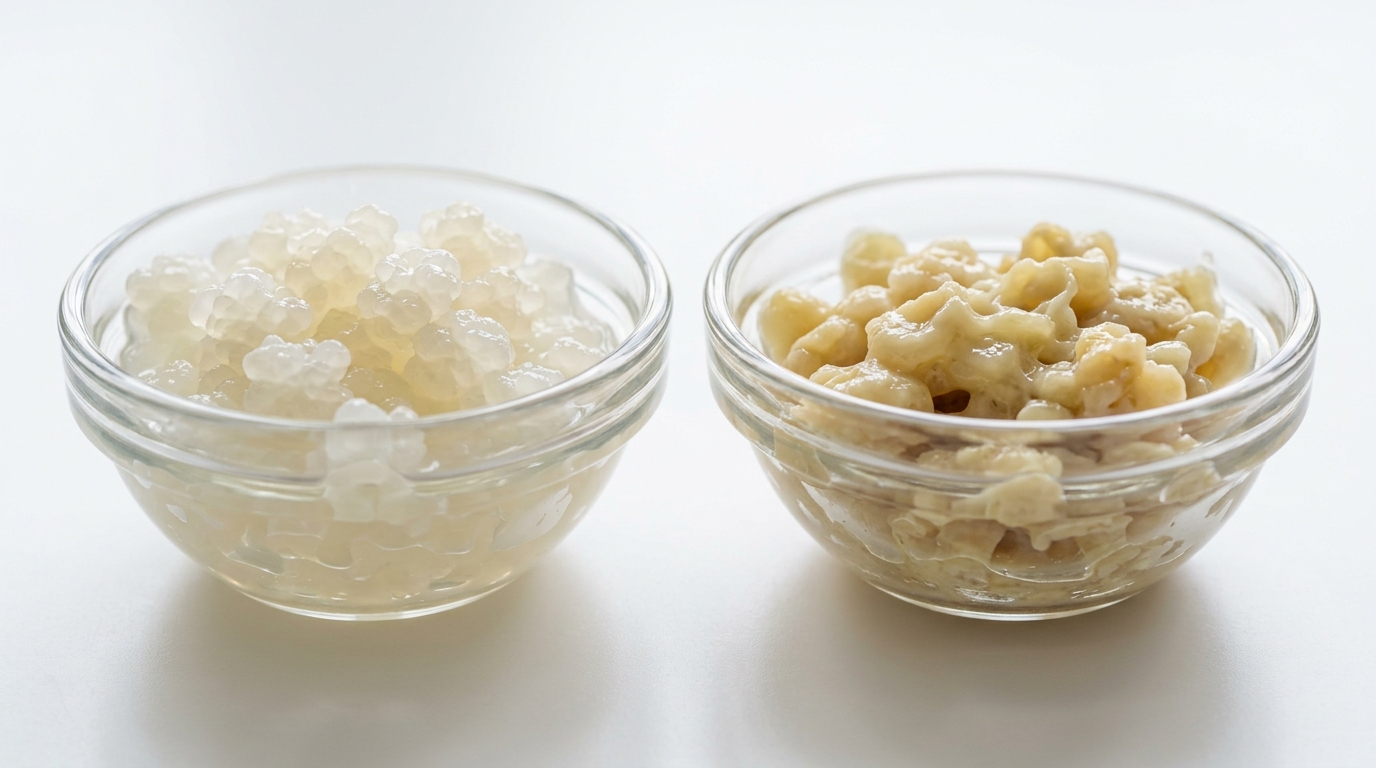
Milk kefir grains resemble small pieces of white or cream-colored cauliflower. They contain a mixture of lactic acid bacteria and yeasts, kept alive by the casein and lactose in milk.
What makes them a little delicate is their dependence on the dairy environment. Without their usual substrate, they weaken more quickly.
Preserving homemade milk kefir therefore requires keeping the grains in an environment close to their fermentation conditions.
In practical terms, if you leave them dry or in water, they spoil quickly. In the refrigerator, they should always be kept in a little fresh milk.
Their texture should remain soft and slightly gelatinous. As soon as they become crumbly or dry, it's a sign that something is wrong.
Fruit kefir grains: more resistant?
Fruit kefir grains — also called tibicos — are translucent, smaller, and resemble sugar crystals. They ferment in sweetened water with dried fruit, and their microbial composition is slightly different from that of milk kefir.
They tolerate periods of rest better.
Preserving fruit kefir is a little simpler: these grains can be stored in sweetened water in the refrigerator without spoiling as quickly.
That said, "more resilient" does not mean "invulnerable." Tibicos are still living organisms. Too long without food, without care, or in an unsuitable environment, and they will gradually lose their activity.
The basic principles remain the same for both types: freshness, cleanliness, and a minimum of food.
| Characteristic | Milk kefir | Fruit kefir |
|---|---|---|
| Appearance | White/cream, gelatinous | Translucent, crystalline |
| Storage substrate | Fresh milk | Sugar water |
| Resistance to breaks | Moderate | Good |
| Heat sensitivity | High | Moderate |
Store the kefir grains in the refrigerator
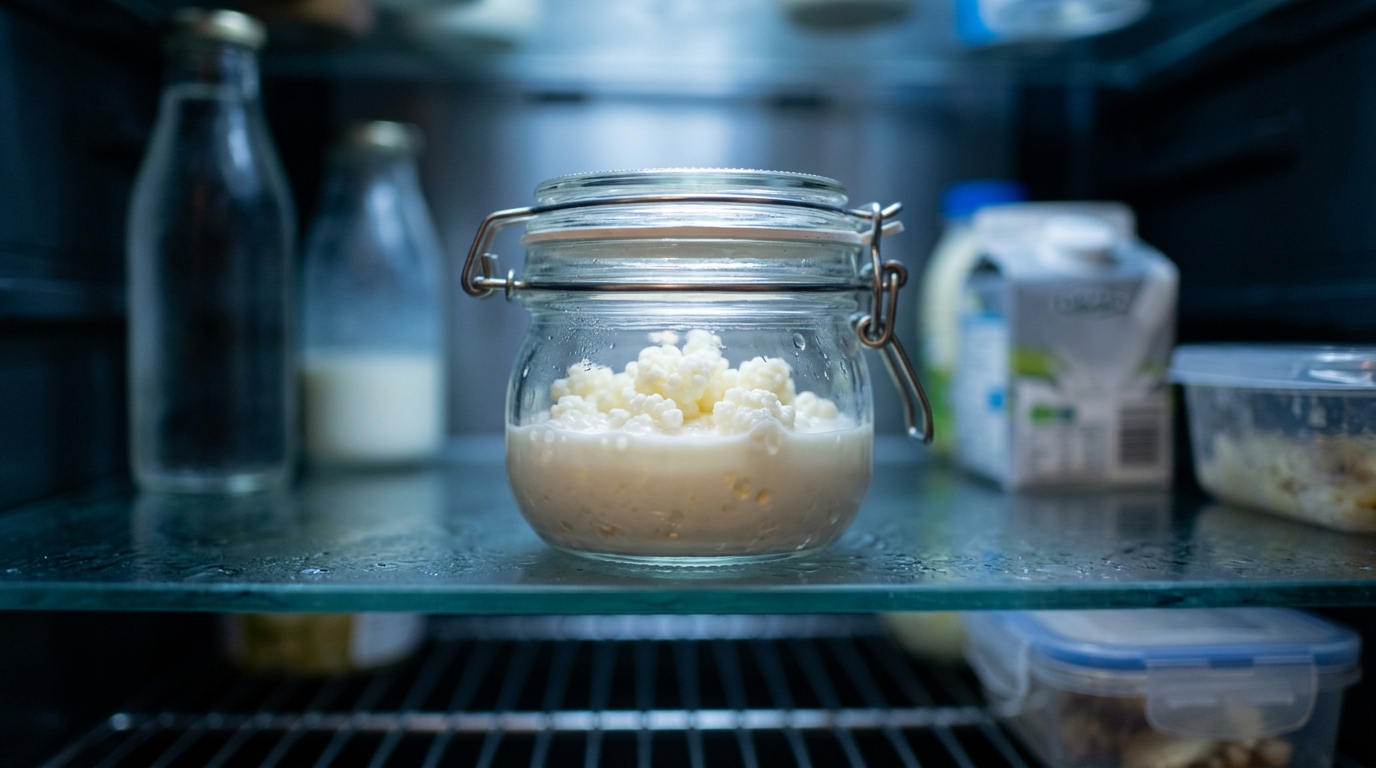
The refrigerator is the simplest solution for storing kefir grains for short to medium periods. No special equipment is needed, and the grains remain easily recoverable when you resume your fermentations.
The fridge method for milk kefir
Rinse your grains in cold, non-chlorinated water, then place them in a clean jar. Cover them completely with fresh whole or semi-skimmed milk of the best quality possible.
Then close the jar with a lid or a cloth, and put it at the bottom of the refrigerator, where the temperature is most stable (between 4 and 6 °C).
Change the milk every 5 to 7 days to prevent it from spoiling and the grains from weakening. This simple step makes all the difference.
The fridge method for fruit kefir
To store fruit kefir grains in the refrigerator, prepare a lightly sweetened water: approximately 1 teaspoon of unrefined sugar per 200 ml of filtered or spring water. Place the grains in this solution in a sealed jar.
Change this sugar water every 7 to 10 days. You can also add a small piece of dried fig or organic lemon to provide some minerals and keep the grains healthy.
Avoid tap water, which is too chlorinated: the chlorine will damage microorganisms.
What is the maximum time to store it in the refrigerator?
Kefir grains can be kept in the refrigerator for 2 to 3 weeks, provided their liquid is changed regularly. Beyond that, they can survive, but their activity gradually decreases.
For milk kefir, do not exceed 2 weeks without changing the milk. For water kefir, you can keep it for up to 3 weeks with a change of sweetened water.
If you need to store food for longer periods, consider freezing or drying. The refrigerator remains a convenient but limited short-term solution.
🌱 What storage method should I choose for my kefir grains?
Answer 3 questions to get the ideal method and precise instructions.
Store the kefir grains in the freezer
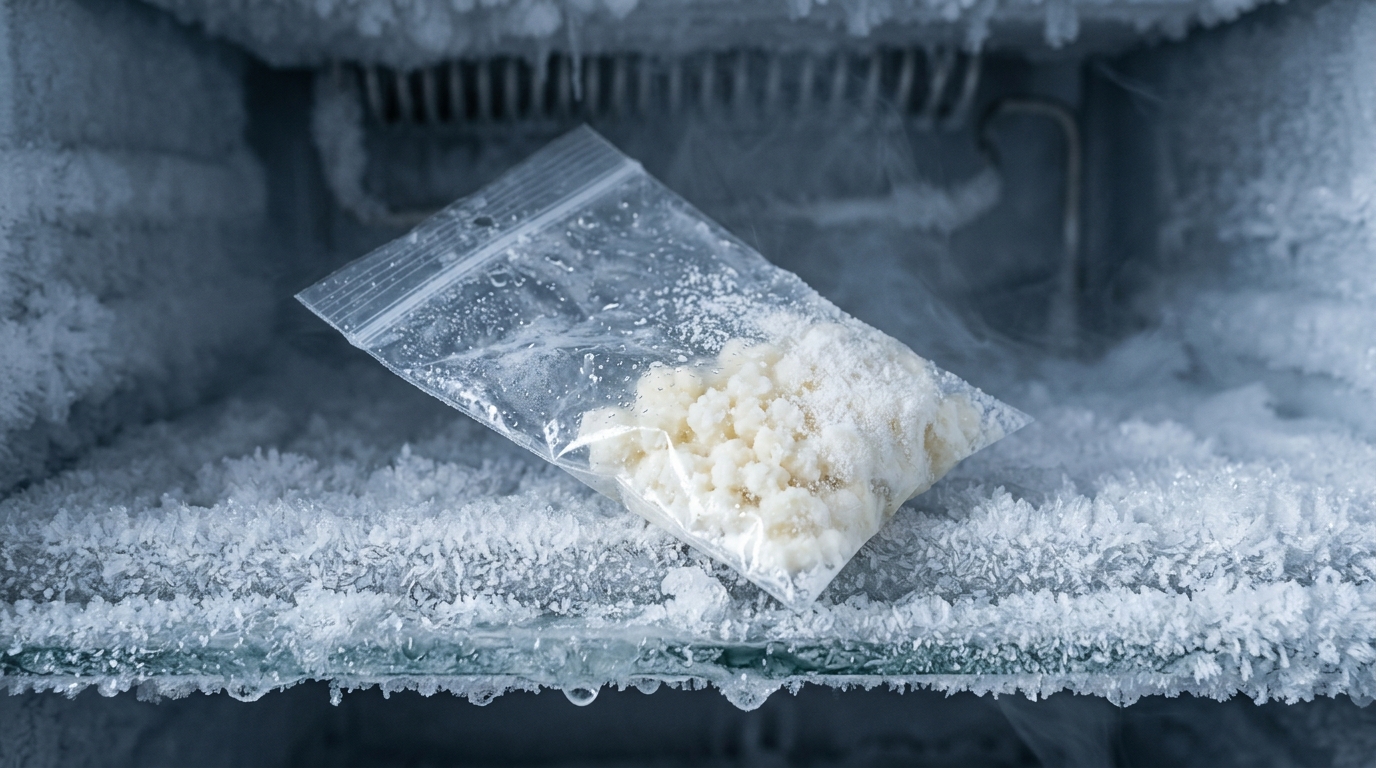
Storing kefir grains in the freezer is the best solution when you're going away for several months or want to keep a "reserve" in case of a problem. When done correctly, the deep cold preserves the microorganisms for 6 months to a year.
How to prepare the grains before freezing?
Preparation is the most important part. Start by rinsing the grains thoroughly in cold, non-chlorinated water. Then, gently pat them dry with a clean cloth or paper towel to remove excess moisture.
Then sprinkle them with skimmed milk powder (for milk kefir) or powdered sugar (for water kefir). This protective coating limits damage caused by the formation of ice crystals inside the grains.
Place them in a freezer bag or a small airtight container. Label with the date.
Precautions to take for proper freezing
Never freeze grains that are damp or still wet: the ice crystals will damage the structure of the microorganisms. Partial drying before freezing is a crucial step.
Remember to organize your freezer to prevent grains from being crushed by other foods or subjected to temperature fluctuations when opened frequently. A bottom drawer, which is rarely used, is ideal!
Never refreeze grains that have already thawed. Only one thawing is possible: afterwards, the grains must be reactivated and used.
Defrosting: Avoiding common mistakes
The main mistake is trying to go too fast. Never microwave the grains or put them under hot water: heat kills microorganisms.
The correct method for reactivating kefir grains after freezing begins with a 12-hour period in the refrigerator, followed by a return to room temperature for 1 to 2 hours.
Only then, place the grains in their usual substrate to reactivate them.
It's a bit like freezing chanterelle mushrooms; the quality of the final product depends as much on the thawing process as on the freezing itself. Patience is essential here.
Dry the kefir grains for long-term storage

Drying kefir grains is the best method for truly long-term storage—several months, or even up to 18 months under good conditions. It's also the ideal technique for sharing or sending them by mail.
Steps to properly dry the grains
Start by rinsing the grains thoroughly in cold, non-chlorinated water. Then spread them in a single layer on a clean sheet of parchment paper or a clean cotton cloth.
Let them dry at room temperature, away from direct sunlight and heat. Good natural ventilation is sufficient. Do not put them in the oven or in direct sunlight—the heat will destroy the bacteria and yeasts that keep them alive.
To make a fair comparison, the principle is similar to that of drying nuts, except that for kefir grains, any heat above 35°C is fatal.
Complete drying typically takes 24 to 72 hours, depending on the ambient humidity. The grains are ready when they are hard, dry to the touch, and have reduced in volume. Turn them occasionally for even drying.
The ideal conditions for storing dry grains
Once dry, place the grains in an airtight bag or a small glass jar with a lid. The aim is to prevent any residual moisture, which could cause mold growth.
Add a small sachet of silica gel to the container to absorb residual moisture and extend the shelf life of the dry grains.
Store the container in a cool, dry, and dark place: a kitchen cupboard away from heat sources works very well.
Storing kefir grains for a long time under these conditions allows them to be preserved for up to 12 to 18 months while maintaining a good part of their biological activity.
Always write the drying date on the container. It's a simple habit that will prevent you from having doubts when it comes time to reuse them.
How to reactivate kefir grains after storage?

This is often the most worrying question. But rest assured: reactivating kefir grains after storage is a fairly simple operation, provided you are patient and don't skip any steps.
Reactivating grains taken out of the refrigerator
Grains that have been kept in the fridge for less than 3 weeks are the easiest to revive. Rinse them, then place them directly into their usual substrate (fresh milk for milk kefir, sweetened water for fruit kefir) at room temperature.
The first fermentation may be less active than usual. That's perfectly normal!
Repeat once or twice with fresh substrate, and the grains will return to their usual rhythm in 24 to 48 hours.
Reactivating frozen or dried grains
For frozen grains, first defrost gently (see previous section), then start reactivation with fresh substrate renewed every 24 hours for 3 to 5 days.
For dried grains, first rehydrate them in cold, non-chlorinated water for 2 to 4 hours. Then, transfer them to their substrate.
The first fermentations will be slow — don't get discouraged. The microorganisms are gradually waking up, a bit like they're coming out of a long hibernation.
Renew the substrate every 24 hours during the reactivation phase, even if fermentation seems weak. Regularity is what restarts the activity.
How long before the grains become active?
For grains taken out of the fridge: 1 to 3 days is generally sufficient.
For frozen grains: allow 5 to 7 days for gradual reactivation.
For dried grains that have been stored for a long time: it can sometimes take 1 to 2 weeks to regain satisfactory activity. Patience is definitely required here!
If after 2 weeks the grains still do not ferment and do not grow, it is possible that they are no longer viable.
| Storage method | Shelf life | Reactivation time |
|---|---|---|
| Fridge | 2 to 3 weeks | 1 to 3 days |
| Freezer | 6 to 12 months | 5 to 7 days |
| Drying | 12 to 18 months | 7 to 14 days |
How to distinguish between healthy and damaged kefir grains
Knowing how to keep kefir grains alivealso means knowing how to recognize their condition. A few simple signs will help you check if your grains are doing well—or if it's time to replace them.
Signs that your grains are still alive
A healthy milk kefir grain is soft, slightly gelatinous, and whitish. It swells and grows gradually during fermentation. A slightly acidic, milky odor is normal—even pleasant.
For fruit kefir, the grains should be translucent, firm but not brittle. They produce gas bubbles during fermentation — this is a sign that the yeasts are active.
- The grains grow larger or multiply over time ✔
- Fermentation produces bubbles or gas ✔
- The liquid becomes acidic in 24 to 48 hours ✔
- The smell is slightly acidic, not nauseating ✔
- The texture remains soft or firm depending on the type ✔
When should you throw away your kefir grains?
Certain signs should raise alarm. Visible mold (green, black, or pink spots) on the grains or in the liquid means everything must be thrown away without hesitation. No exceptions.
A putrid, very strong cheese or chemical smell is also a bad sign.
Similarly, grains that remain completely inert after 2 weeks of active reactivation will probably never produce fermentation again.
- Visible mold on the grains or the jar ❌
- Foul or chemical odor ❌
- Grains completely dissolved or in a mushy consistency ❌
- No fermentation after 2 weeks of restarting ❌
- Abnormal pink, orange, or black color ❌
If in doubt about the condition of the grains, it is better to start again with new grains than to consume kefir prepared with questionable cultures.
🎯 Are you an expert on storing kefir grains?
5 questions to check that your starter cultures are in good hands!
1. How long can kefir grains be kept in the refrigerator in sweetened water or fresh milk?
2. What is the main difference in preservation between milk kefir grains and fruit kefir grains?
3. To freeze kefir grains, what step is essential before putting them in the freezer?
4. How long can dried kefir grains be stored at room temperature in a dry place away from light?
5. When reactivating kefir grains after long storage, what should be done if fermentation seems slow at first?
Hygiene rules for maintaining your kefir grains

Proper preservation of kefir grains does not depend solely on the method chosen.
The hygiene of equipment and hands plays an equally important role. It is the basis of food hygiene , even at home.
Equipment to use and equipment to absolutely avoid
Kefir grains are sensitive to metals, especially aluminum and copper, and sometimes silver. These materials release ions that disrupt or kill the microorganisms.
Here's what you should prioritize:
- Glass jars with airtight lids or caps: ideal for fermentation and storage
- Food-grade plastic or wooden utensils for handling grains
- Plastic or nylon strainers for filtering without metal contact
And what to avoid:
- Stainless steel or aluminum spoons and strainers
- Cheap plastic jars that trap odors
- Any container that has contained chemicals or perfumes
- Easy-to-sterilize glass
- No transfer of odors or chemical residues
- Long lifespan of the equipment
- Transparency to monitor fermentation
- Glass is fragile and heavy
- Plastic utensils age and scratch
- Requires thorough cleaning after each use
- Specific equipment to buy if you're a beginner
Clean and rinse the grains without damaging them
Maintaining kefir grains involves gentle rinsing, not harsh disinfection. Always rinse the grains in cold or lukewarm water, never hot. Heat quickly exceeds their tolerance threshold and destroys the bacteria.
Never use soap, bleach, or cleaning products on the grains themselves. These substances are bactericidal—which is precisely what we want to avoid here.
For the jars, wash them with hot water and dish soap, rinse thoroughly, then boil them or let them air dry. No traces of soap should remain before adding the grains.
Remember to wash your hands thoroughly before handling anything!
This may seem obvious, but it is one of the most frequently forgotten steps — just like when you want to preserve homemade gougères while keeping them fresh without cross-contamination.
Keep a set of jars and utensils dedicated exclusively to your kefir. This prevents cross-contamination with other fermented or odorous foods.
Practical questions
How to store kefir grains during the holidays?
For absences of 1 to 3 weeks, the refrigerator is sufficient: place the grains in fresh milk (milk kefir) or sweetened water (fruit kefir) and seal the jar tightly. For longer vacations, opt for freezing or drying the grains.
Can kefir grains die in the freezer?
Proper freezing does not kill the grains. However, freezing without prior preparation (grains that are too moist, lack of protective powder) can damage the microorganisms through the formation of ice crystals. Thawing too quickly or at room temperature is also fatal.
What is the difference between preserving milk kefir and fruit kefir?
Milk kefir is stored in fresh milk and is less resistant to long periods without food. Fruit kefir is stored in sweetened water and tolerates slightly longer breaks. Both benefit from the same methods (refrigeration, freezing, drying), but with a different substrate.
Can kefir grains be stored at room temperature?
No, not over a long period. At room temperature, fermentation continues actively and the grains quickly become depleted without regular feeding. Room temperature storage is only suitable for active fermentation cycles (every 24 to 48 hours), not for general storage.
How long can dried kefir grains be stored?
Properly dried grains, stored in an airtight container away from moisture and light, can be kept for 12 to 18 months. Beyond that, their microbial survival rate decreases and reactivation becomes difficult, if not impossible.
