
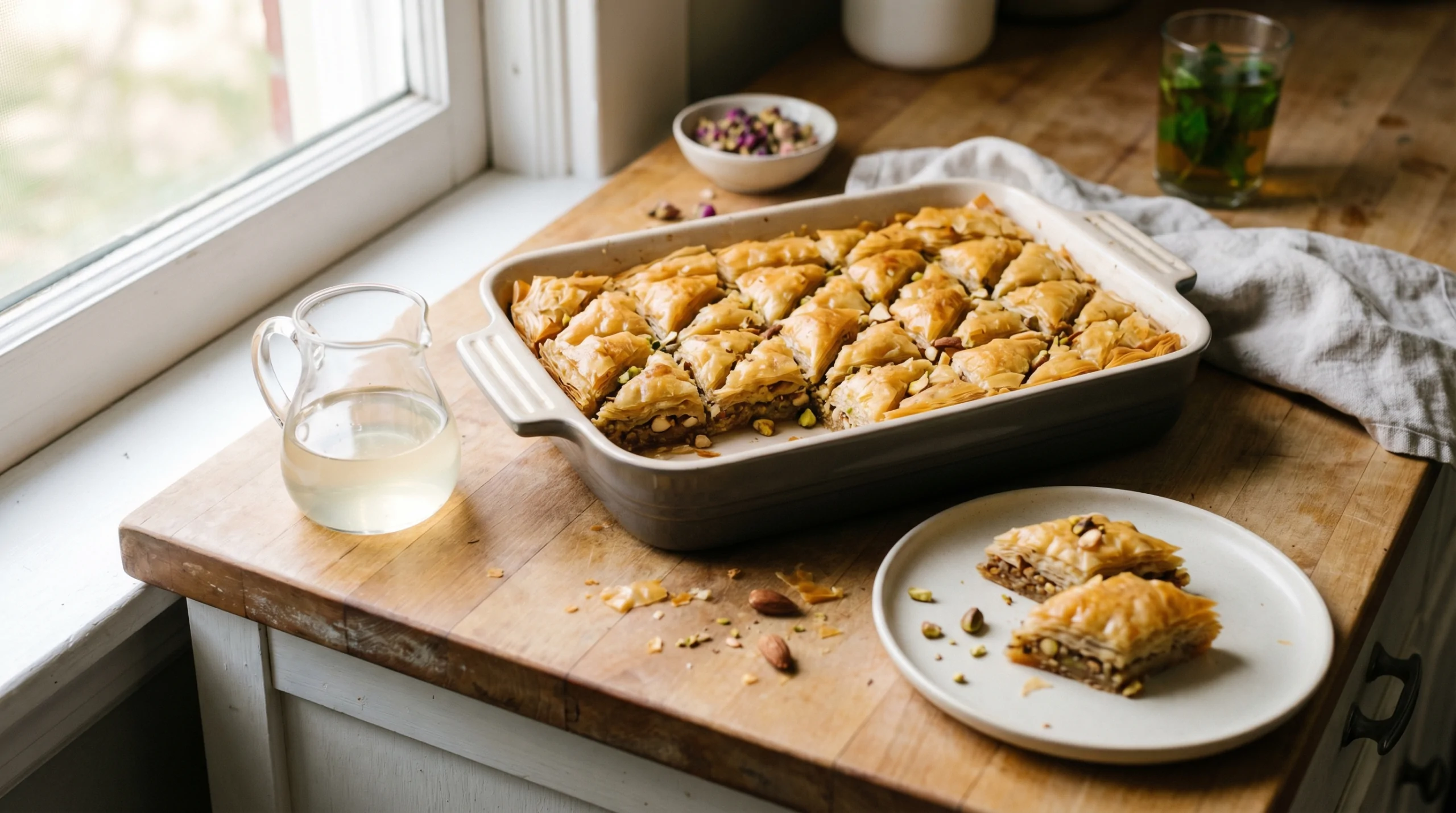
I truly understood Tunisian baklava the day I stopped seeing it as a simple "honey dessert" and started treating it as a play on textures: ultra-crispy layers, a generous filling, and then a syrup that's present but just enough to bind without making it soggy. It's this contrast that makes it so addictive!
In the classic Tunisian version, almonds are the main ingredient (often with a little pistachio), orange blossom is added for flavoring, and it is finished with a honey and lemon syrup.
The lemon is the little detail that makes all the difference: it cuts the sweetness and gives a fresher, lingering finish. I also add a little orange zest to the stuffing: it's subtle, but it really brings out the flavor of the dried fruit.
To make it work every time, there are two keys.
First, butter the baklava sheets properly: no need to drench them, but a thin, even layer is essential for them to flaky and brown. Next, the timing of the syrup: I pour it lukewarm over the hot baklava (or vice versa), never boiling on top of boiling, otherwise it will make it too soggy.
From a nutritional standpoint, it's clearly a fairly rich dessert, but it also has its good points: almonds and pistachios provide protein, fiber, vitamin E and magnesium.
A small portion is enough, especially with mint tea or a strong coffee!
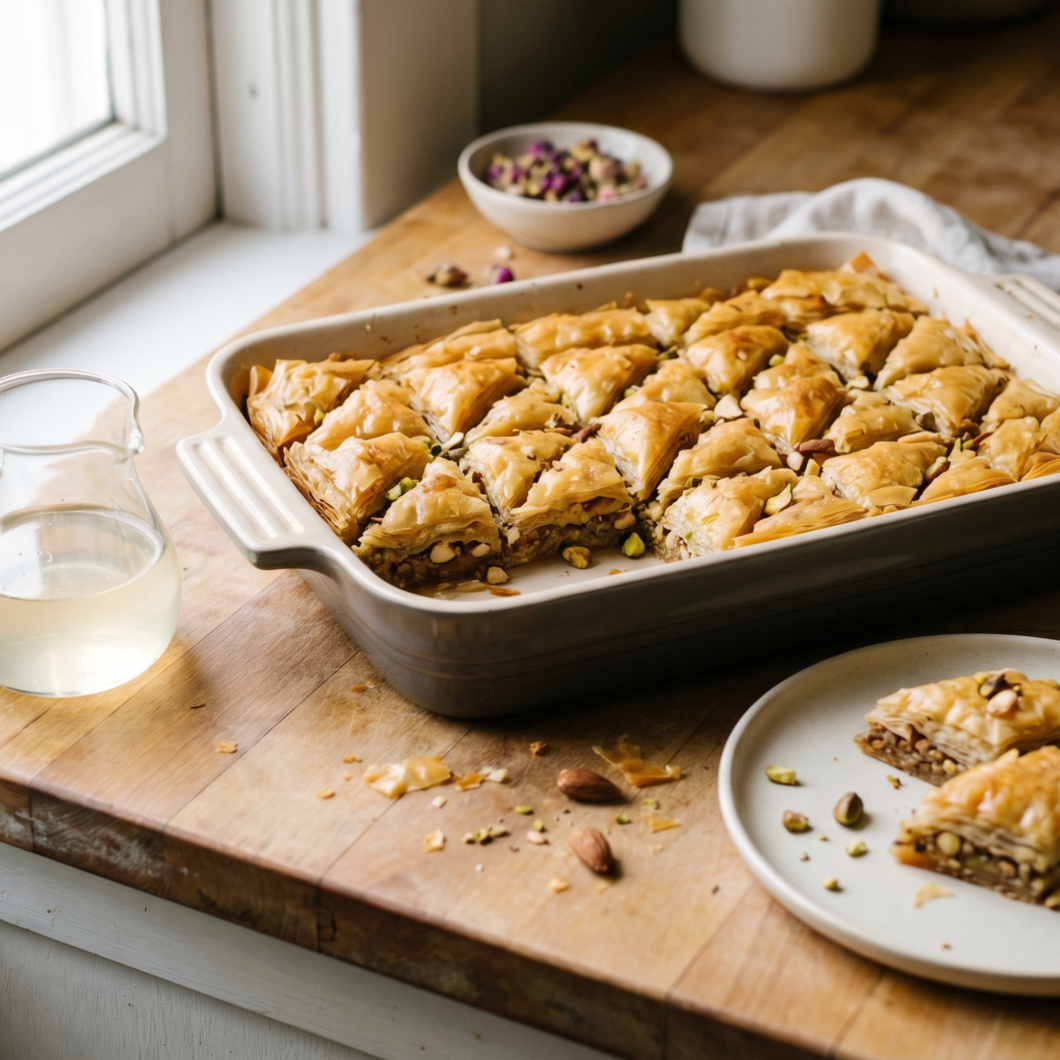

Tunisian Baklava
4
people22
minutes34
minutes670
kcal56
minutesMy version of the Tunisian baklava recipe , made with thin, buttery layers, a heart of almonds and pistachios, and flavored with orange blossom. I serve it with a lemon syrup that brings everything together. Crispy, melt-in-your-mouth, and perfectly balanced between honey and citrus.
Keep your device's screen on
Ingredients
10 brick pastry sheets (or malsouka sheets)
180g of whole almonds
60g of unsalted pistachios
70 g of sugar
1 level teaspoon of cinnamon
1 pinch of salt
1 orange (finely grated zest)
1 tablespoon of orange blossom water
90g of melted butter
120 g of honey
80 ml of water
1/2 lemon (juice)
1 small piece of lemon zest (optional)
Preparation steps
- Preheat the oven to 180°C. Lightly butter a small square or rectangular mold (approximately 18–20 cm on each side).
- Toast the almonds and pistachios for 6 to 8 minutes in the oven (or dry in a pan): they should smell good, without browning. Let them cool slightly.
- Pulse the dried fruit in a food processor to obtain a sandy texture with some small pieces (not a paste). Pour into a bowl.
- Add the sugar, cinnamon, salt, orange zest, and orange blossom water. Mix well: the filling should be fragrant and slightly moist.
- To assemble the baklava: place one sheet of filo pastry in the mold and brush with melted butter. Repeat with four sheets in total (brushing with butter between each layer). If your mold is smaller, let the pastry overhang slightly; you will fold it over later.
- Spread the stuffing evenly, pressing it down with the back of a spoon to create a uniform layer.
- Cover with the remaining 5 sheets, buttering between each layer. Fold over the excess edges neatly and butter the surface one last time.
- Cut into diamond or square shapes before cooking with a sharp knife (without tearing the leaves).
- Bake for 22 to 26 minutes at 180°C, until a nice, even golden color is achieved. Keep a close eye on it during the last few minutes: it browns quickly.
- While the meat is cooking, prepare the syrup: put the water, honey, lemon juice, and (if using) a little lemon zest in a small saucepan. Bring to a simmer and cook for 6 to 7 minutes at a gentle boil. Remove from the heat.
- Once out of the oven, wait 2 minutes, then drizzle the warm syrup over the entire surface, paying particular attention to the slits. You should hear a slight sizzling sound: that's a good sign.
- Let it rest for 20 minutes to allow the syrup to distribute, then re-iron the cuts if necessary. Serve at room temperature.
📊 Nutritional Information
1 serving (approx. 135g)
| Nutrient | Value |
|---|---|
| Calories | 670 kcal |
| Proteins | 13g |
| Carbohydrates | 63g |
| including sugars | 44g |
| Lipids | 42g |
| including saturated fatty acids | 16g |
| Fibers | 6g |
| Sodium | 220mg |
| Vitamins | |
| Vitamin E | 50% of the recommended daily allowance (RDA) |
| Vitamin B2 | 18% AJR |
| Vitamin B9 | 14% AJR |
| Minerals | |
| Magnesium | 35% AJR |
| Phosphorus | 32% AJR |
| Iron | 22% AJR |
* RDA = Recommended Daily Allowance
📝 Notes
Storage: 3 days at room temperature in a container lined with parchment paper. Avoid the refrigerator, as it will soften the layers of your pastry. If you want a crispier baklava the next day, bake it for 4 minutes at 160°C (without adding more syrup).
💡 Chef's Tips
The real trap is too much syrup: drizzle it over slowly and stop as soon as the surface is shiny and the cuts have absorbed it. If you prefer it softer, you can add 1 to 2 tablespoons of syrup, but no more! And for a crispy crust, leave the baklava at room temperature (not in the fridge) once it has cooled.
🔄 Variations
- Baklava plus pistachio: replace 30g of almonds with an additional 30g of pistachios.
- Baklava with a more citrusy flavor: also add a little lemon zest to the filling recipe (very fine, just 1/2 teaspoon).
