
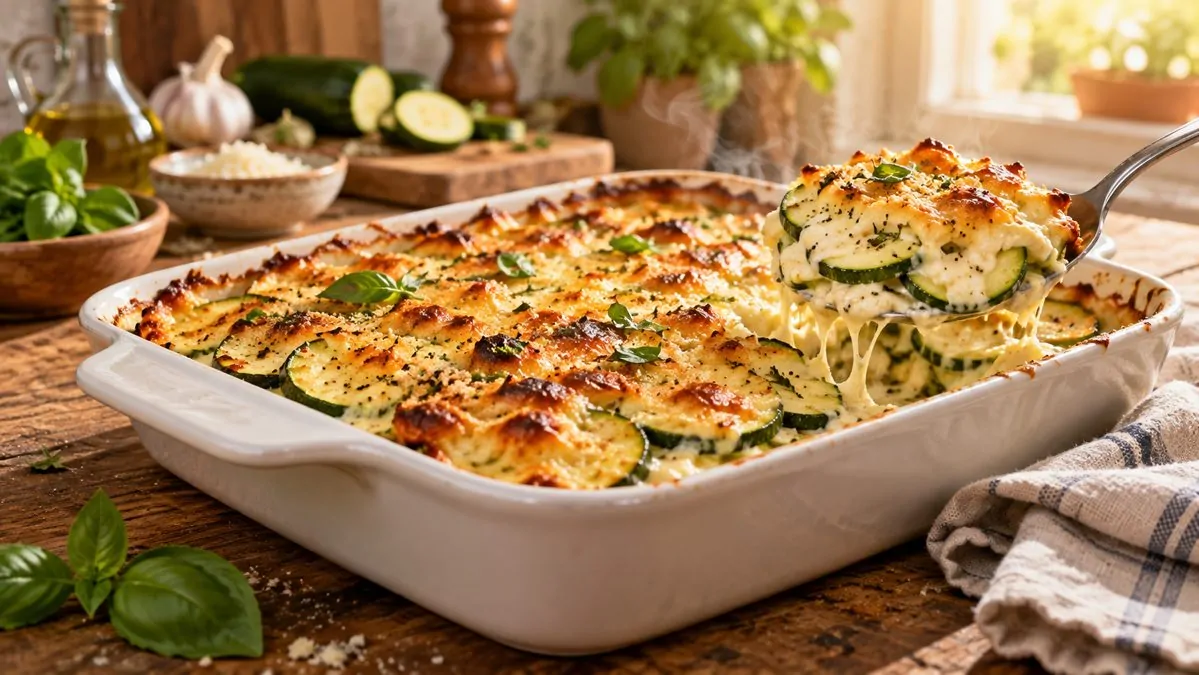
In short
A quick courgette gratin is often a promise that stops at the oven: the dish comes out golden brown, then a sheet of water appears at the bottom as soon as the first spoonful is taken.
The problem is not with the recipe, but with the order of the steps and the time we are willing to put into it.
Here is a version that manages the water before assembly, in about ten minutes in the pan, with realistic timing rather than a "30 minutes" which forgets cutting and resting.
You will also find a quantity calculator, a comparison of water-reduction methods, and instructions on how to store and reheat leftovers.
Ingredients and equipment for 4 people
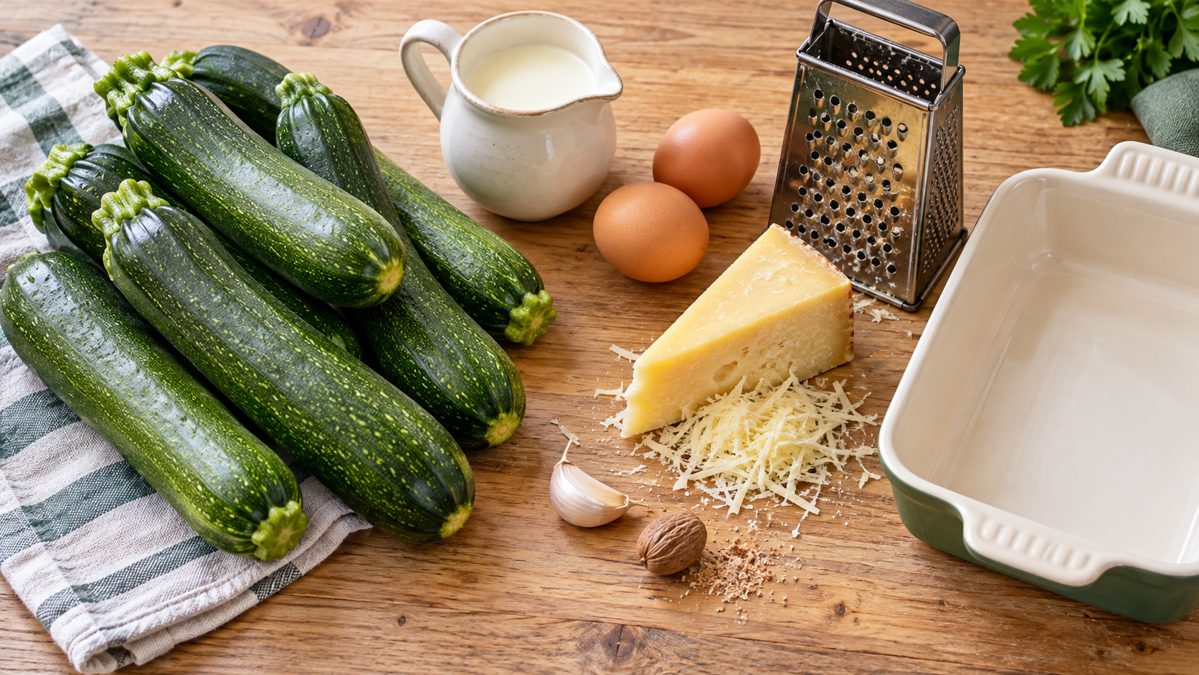
For a dish of approximately 24 x 18 cm, allow 1 kg of firm courgettes, 2 eggs, 20 cl of crème fraîche, 100 g of grated Gruyère cheese, 1 clove of garlic, 1 tablespoon of olive oil, nutmeg, salt and pepper.
- 1 kg of firm courgettes, small to medium in size
- 2 eggs
- 20 cl of fresh cream
- 100g of grated Gruyère cheese, including a handful for the top
- 1 clove of garlic, 1 tablespoon of olive oil, 1 pinch of nutmeg
- Salt, pepper and a little butter for the dish
In terms of equipment, a large frying pan, a colander, and a salad bowl are all you need. A large frying pan really matters: it's what determines whether the zucchini will char or steam.
Choose courgettes that are heavy for their size and have smooth skin.
Calculate your quantities and your time
This tool adapts the recipe ingredients to the number of guests and estimates the number of batches in the pan as well as the total time, based on the guidelines on this page.
Waterless gratin: what's the best method when you're in a hurry?
A raw courgette contains approximately 94.7 g of water per 100 g, according to the composition sheet published by Aprifel using Ciqual data (accessed in October 2026).
In 1 kg, this represents almost 950 g of water, a challenge that is also found in mashed potatoes and courgettes.
Once in the oven, the heat causes the cells to burst and a good portion of this liquid flows into the dish.
The only real question is therefore: where to dispose of this water, and how long will it take? Here are the four methods compared by Le Petit Grumeau (July 27, 2026), which I cross-referenced with advice from other cooking blogs.
| Method | Duration | Key point | Limit |
|---|---|---|---|
| Stove | 10 to 12 min | It evaporates the water and turns golden | A little monitoring and some fat |
| Boiling water | 5 min | Quick, fat-free | Less flavor, careful draining |
| Steam | 10 min | Gentle cooking, color preserved | Request a steamer |
| Salt soaking | 15 to 30 minutes | No cooking | Rinse off the salt in advance |
The draining time is shown to be 15 to 30 minutes in this comparison, but Autonomie Jardin (June 9, 2026) estimates that one hour gives a better result for a gratin.
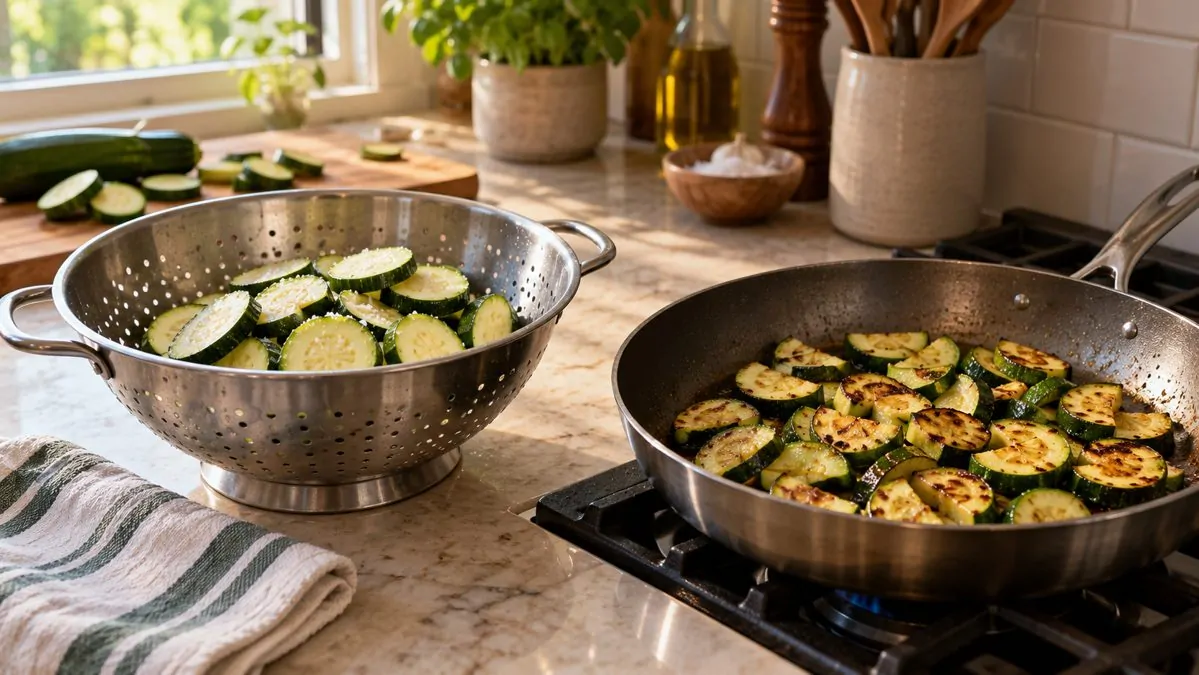
For a quick gratin, the frying pan wins: it removes the water and adds color in the same movement, without immobilizing your courgettes for half an hour.
Salting raw courgettes directly in the dish draws out the water at the wrong time. It's better to salt them after they've been partially cooked, as Mamma and Papa advise (July 30, 2026).
The recipe step by step, with timing
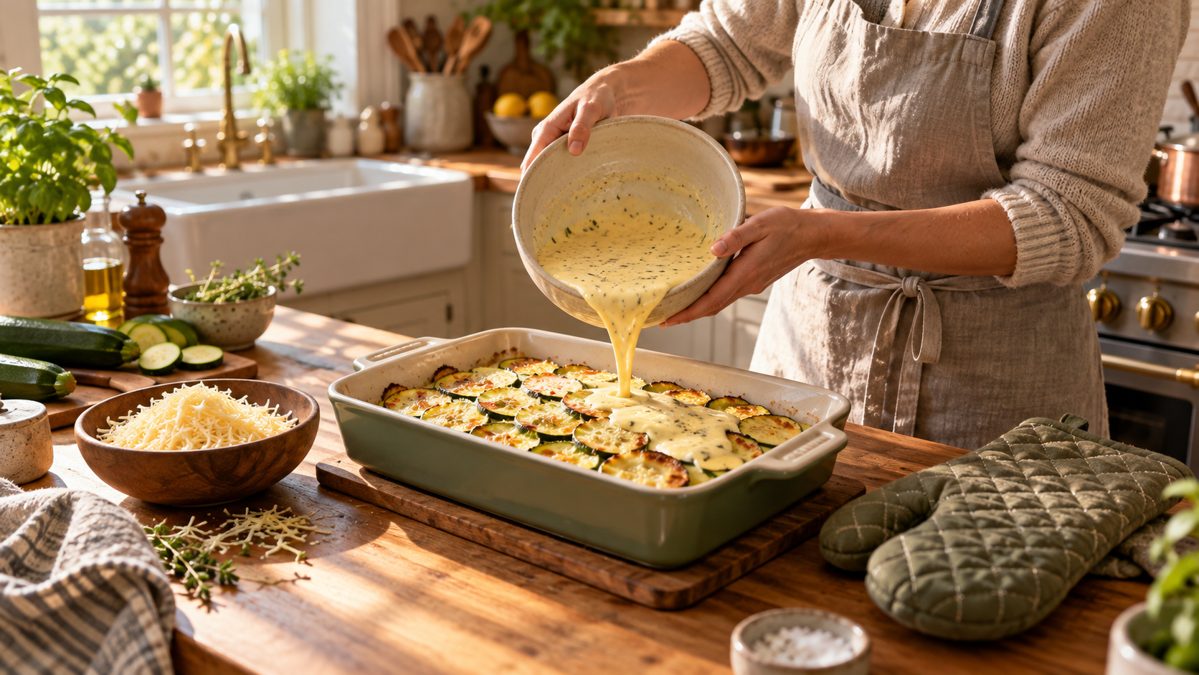
Here's the order that avoids downtime. The secret to "quick" is that you prepare the mixture while the zucchini are draining.
- 0 to 10 min: Preheat the oven to 200°C. Wash the courgettes and cut them into half-moons of about 5 mm.
- 10 to 20 min: Heat the oil in the large frying pan over medium-high heat. Cook the zucchini uncovered for 8 to 10 minutes in total, in batches if the pan is small.
- 20 to 25 min: Pour the courgettes into a colander. While they drain, beat the eggs with the cream, nutmeg, pepper and chopped garlic, then grate the Gruyère cheese.
- 25 to 30 min: lightly salt the drained courgettes, squeeze them gently, then mix them while still warm into the mixture with three-quarters of the Gruyère cheese.
- 30 to 55 min: Pour into the buttered dish, sprinkle with the remaining Gruyère cheese and bake for 20 to 25 minutes. Once baked, let it rest for 5 to 10 minutes before serving.
This timing is based on the pre-cooking times of Mamma and Papa and on the 200°C cooking time of Le Petit Grumeau, which I shortened while keeping the pre-cooking to avoid water.
Mix the warm, not hot, courgettes into the mixture: vegetables that are too hot cause the eggs to coagulate before the oven and the gratin loses its melt-in-your-mouth texture.
Typical example: It's 7:00 PM, the zucchini are in the refrigerator drawer. Following the order above, the dish goes in the oven around 7:30 PM and comes out around 7:55 PM, just enough time to set the table.
Another typical example: a vegetable garden overflowing with large courgettes, often more water-rich. Remove the spongy core with a spoon before cutting, then use the same method, but with a slightly longer colander.
If the top remains pale after 25 minutes, place the dish under the broiler for 2 to 3 minutes, keeping a close eye on it. Autonomie Jardin even suggests this final 3-minute broil for a crispier crust.
Variations, storage and reheating
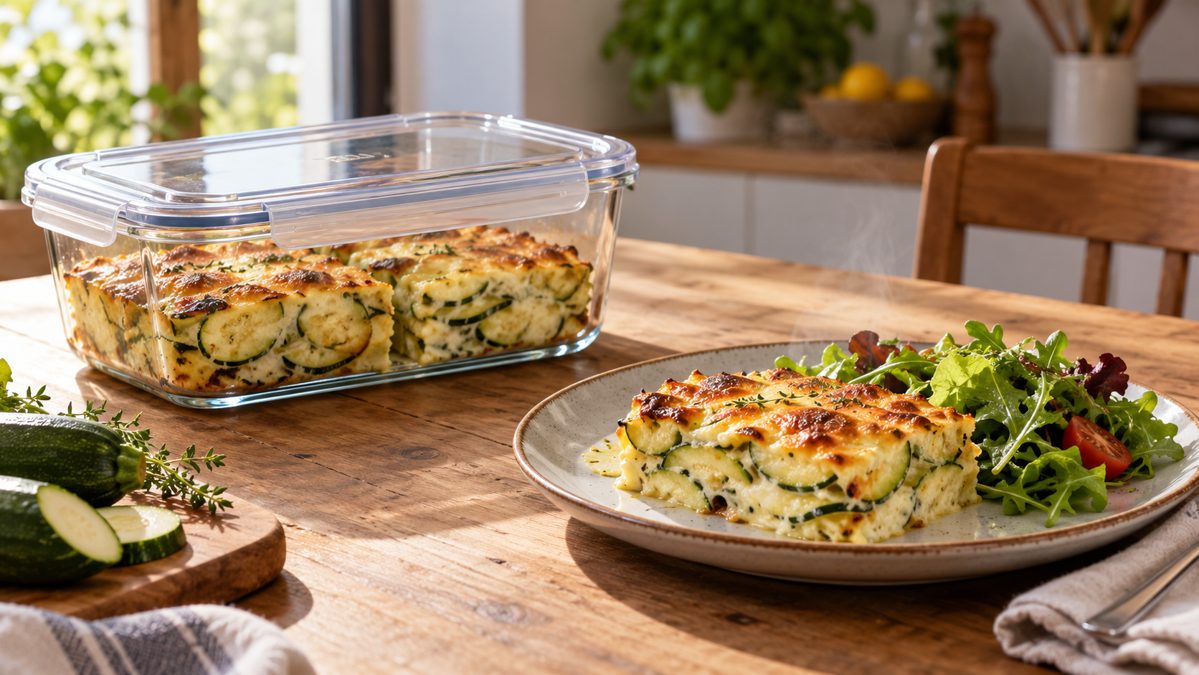
Three variations that retain the same method
- Without cream: replace the 20 cl of cream with 180 g of well-drained cottage cheese and add an egg, as suggested by Mamma and Papa.
- Goat cheese and honey: place a few slices of goat cheese on top before baking, with a drizzle of honey when it comes out of the oven.
- With potatoes: alternate a layer of about 300g of thinly sliced potatoes and allow about 10 minutes extra cooking time, an idea taken from Autonomie Jardin.
If zucchini from the garden are plentiful, a tian of zucchini, tomatoes and basil with goat cheese is another way to cook them.
Store and reheat leftovers
The gratin will keep for 3 days in the refrigerator in an airtight container, according to Mamma and Papa. Health Canada places the shelf life of prepared meals at 3 to 4 days (Health Canada, accessed October 2026).
To reheat it, the oven at 160°C for 15 to 20 minutes gives a better result than the microwave, which softens the top.
Regarding freezing, Le Petit Grumeau considers it possible before or after cooking, and Autonomie Jardin limits it to 2 months in portions.
Do not leave the dish at room temperature for more than 2 hours: divide the leftovers into portions in a closed container as soon as it has cooled down.
In summary
A quick courgette gratin comes down to one choice: drain the water before the oven, and cook it in a pan rather than with a prolonged draining process.
With a cut of about 5 mm, 8 to 10 minutes of pre-cooking and a mixture of eggs, cream and Gruyère cheese, you get a dish that is firm when cut, and comes out of the oven in about 55 minutes.
Keep the timing on this page as a guide, adjust according to your oven, and store leftovers in an airtight container within two hours.
Practical questions
Which spice goes best with courgettes?
Nutmeg remains the most classic choice with a cream-based sauce. Mamma and Papa also offer mild curry, especially with chicken, and sweet paprika with mozzarella.
How to add flavor to a courgette gratin?
First, sauté some onion, garlic, or shallot before adding the zucchini. A little Parmesan cheese in addition to the Gruyère and a pinch of herbes de Provence are then enough to enhance the dish without overpowering the zucchini.
Can the gratin be prepared the day before?
Yes. Autonomie Jardin suggests assembling the dish the day before and adding about 5 minutes of cooking time the next day. Keep it covered in the refrigerator.
Do you need to peel courgettes for a gratin?
No, the thin skin cooks very well and gives the fruit structure. Only remove it if it's thick or damaged, which happens mostly with very large courgettes.
