
In short
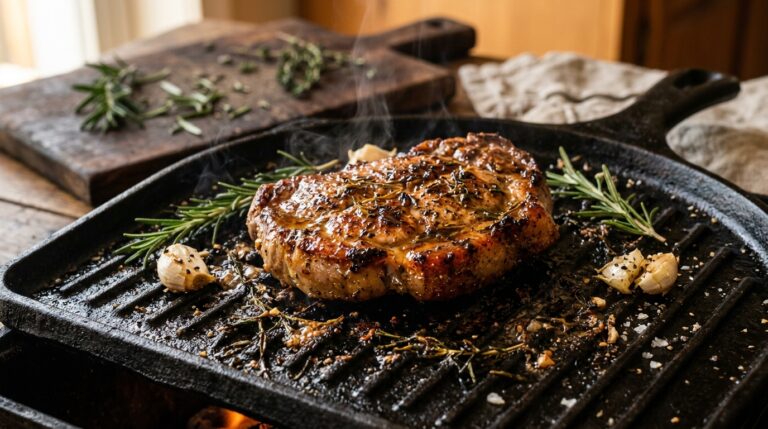
There are cuts of pork that everyone knows—the tenderloin, the rib, the ham—and then there's the spider steak. Rare, little-known, often reserved for connoisseurs, this exceptional cut nevertheless deserves a prominent place in your kitchen.
In this article, I guide you step by step to learn more and to successfully prepare a pork spider steak recipe worthy of a restaurant dish: choice of meat, marinade, precise cooking and gourmet sauce.
Everything you need to transform this confidential piece into an unforgettable taste experience!
Pork spider steak: what is this cut?
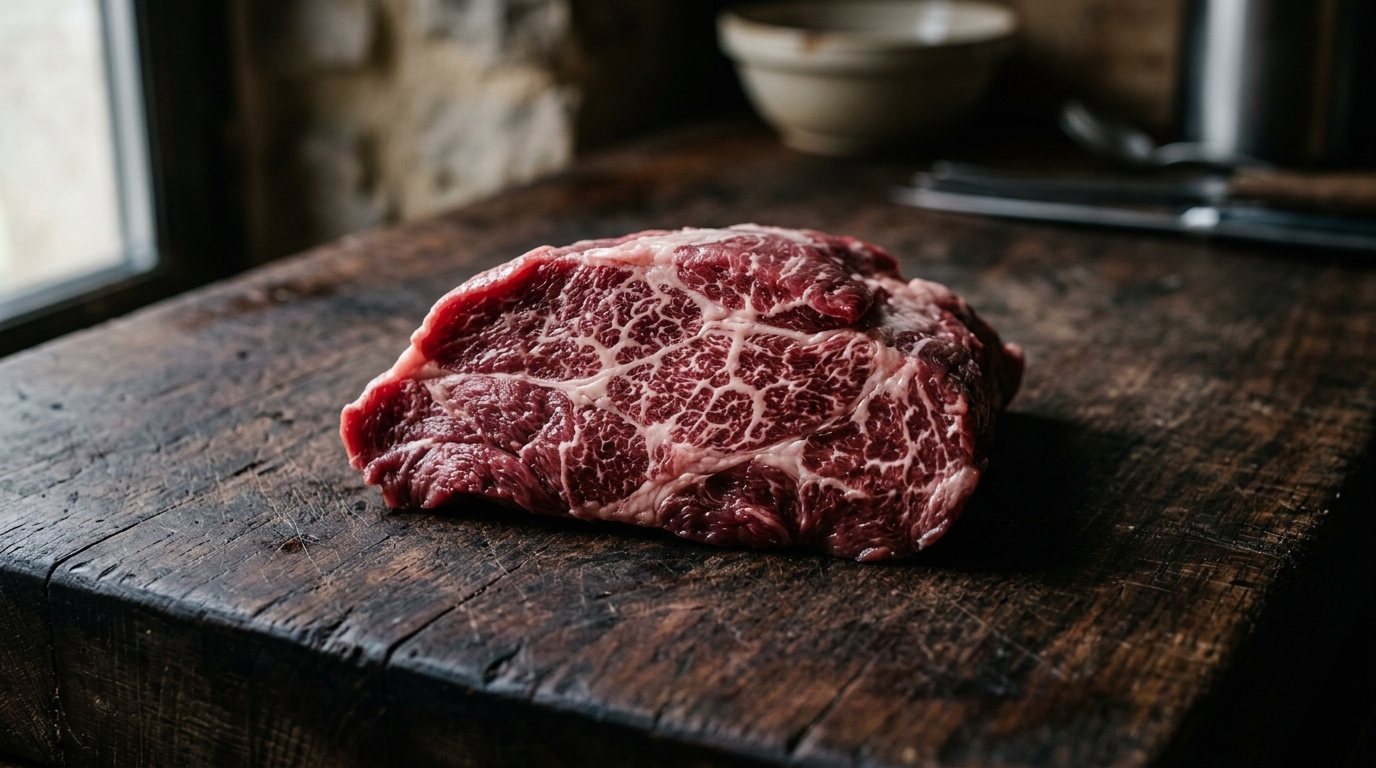
When people ask me what pork spider steak is, I always reply that it is one of the most confidential cuts of French butchery.
It is one of those hidden treasures, just like some of the French's favorite cuts of meat that are still too rarely cooked at home.
Its popularity is still limited among the general public, but it is growing rapidly. Meat lovers who discover it rarely go back to more conventional cuts.
Where is the pork spider located on the animal?
The pork spider muscle is located in the pelvic region, more precisely on the iliac bone of the pig. It is a flat, thin muscle that runs along the inside of the pelvis.
Its shape is distinctive: muscle fibers radiate outwards from a center, creating a pattern that does indeed resemble a spider web. That's where its name comes from.
There are only two spiders per pig, one on each side. This rarity explains why it's not readily available in supermarkets. It often needs to be ordered in advance from your butcher.
Its weight varies between 150 and 300 grams depending on the size of the animal and it is a thin cut, with little fat and a firm texture but surprisingly melting once well cooked.
Why is this cut so popular with chefs?
Professional chefs are often the first to embrace pork spider steak in a gourmet version , and the reason is simple: this muscle is not used much during the animal's life, which gives it a rare natural tenderness for a cut of pork.
Its flesh is fine, slightly marbled, with a mild and lean flavor. It absorbs marinades and juices perfectly, making it an ideal base for elaborate preparations.
Chefs also appreciate its responsiveness to heat. A quick cook over high heat is enough to obtain a golden crust and a pink, juicy center, so there's no need for long braising.
"The pork spider steak is the cut that butchers often keep for themselves. It concentrates everything we love in a good cut: tenderness, flavor, and perfect response to cooking."
According to specialists in the field, the pork spider steak is also valued for its versatility: it lends itself equally well to pan-frying, marinating on the barbecue, or preparing in the oven.
How to choose the right pork spider steak?
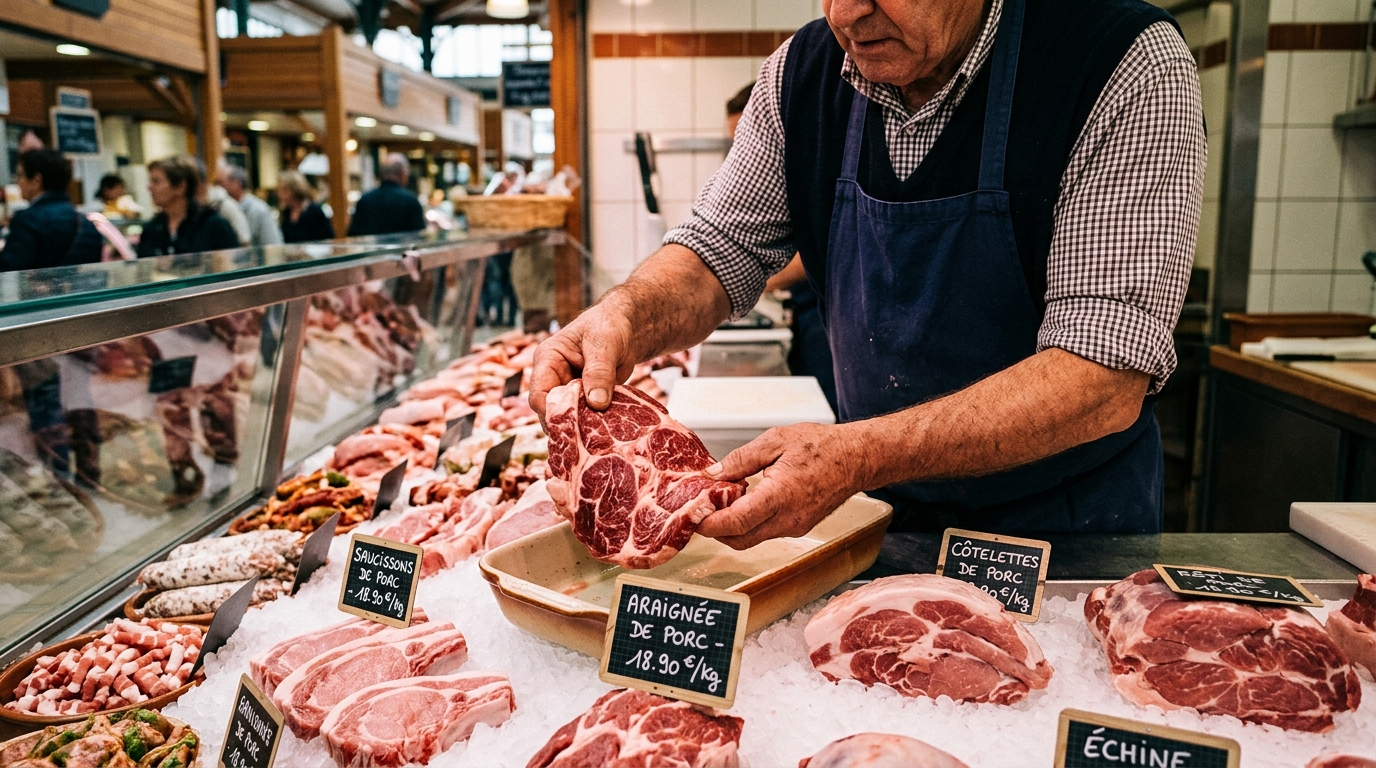
The quality of the meat determines the entire final result. There's no point in mastering the technique if the starting piece is disappointing.
Here's how I make sure I get the best!
Quality criteria to ask your butcher about
First rule: order your pork spider steak in advance from your butcher. This cut is never displayed in the window. You have to ask for it, often 24 to 48 hours beforehand!
Once I was in front of the piece, here's what I observed:
- The color : the flesh should be a deep, uniform pink, without grey or brownish areas.
- The texture : firm to the touch, not soft or sticky.
- The marbling : a few fine veins of fat are a good sign — they guarantee tenderness when cooked.
- Origin : opt for Label Rouge pork, raised outdoors or from ancient breeds such as Duroc or Mangalitza.
According to feedback from many meat lovers, the quality of the pig breed directly influences the flavor of the spider steak.
An industrially raised pig will produce paler and less tasty meat than an animal raised slowly.
According to Interbev, the livestock and meat interprofessional organization, animal welfare and pig feed have a direct and measurable impact on the organoleptic quality of their meat.
How much should I allow per person?
It's a question I ask myself every time, especially because the piece is naturally small.
| Guest profile | Recommended quantity |
|---|---|
| Light meal / starter | 120 to 140 g |
| Standard portion / main course | 150 to 180 g |
| Big appetite / festive meal | 200 to 220 g |
For a dinner for four people, I generally plan on between 700g and 800g of pork spider steak in total. So, if my butcher can't provide a single large piece, two medium-sized spider steaks will do perfectly.
Don't confuse pork spider steak with beef spider steak, which is a different cut from the hindquarter of the beef. They share the same name and characteristic shape, but cooking times and techniques differ.
🍖 Pork Spider Steak Cooking Calculator
Get the ideal cooking time, temperature and personalized advice for your room.
The ideal marinade to enhance the meat
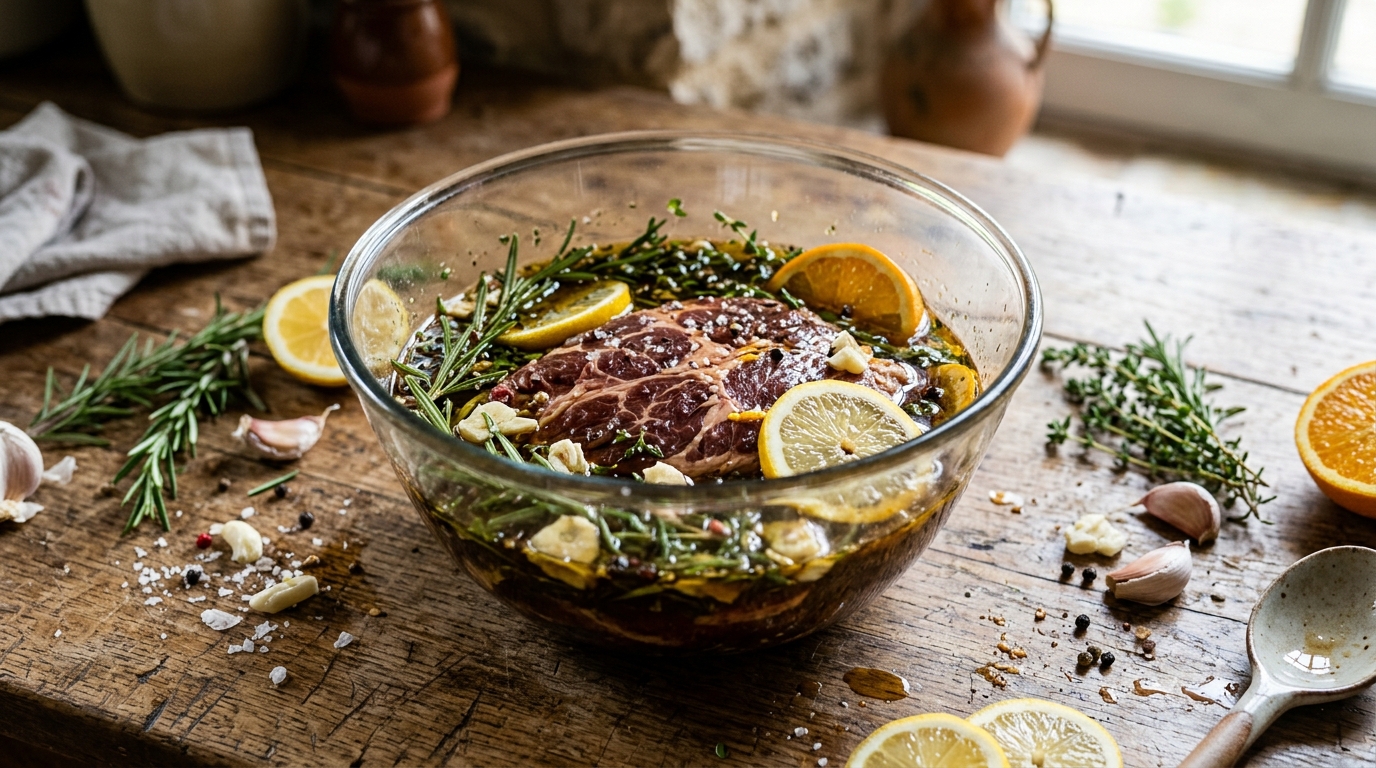
A good marinade doesn't mask the meat, it reveals it! That's the whole difference between a gourmet marinade and a simple maceration.
Here's how I build mine for marinated pork spider steak.
The ingredients of a gourmet marinade
For a truly effective pork spider steak marinade , I balance three components: acid, fat, and aromas.
- Olive oil (4 tablespoons) — a fatty base that carries the flavors into the fibers
- Dry white wine (10 cl) — the acidity slightly softens the muscle fibers
- Garlic (3 crushed cloves) — adds aromatic depth
- Freshly chopped parsley (1 small bunch) — freshness and color
- Fresh thyme (3 sprigs) and bay leaves (2 leaves)
- Dijon mustard (1 teaspoon) — binds the marinade and adds body
- Fine salt and freshly ground
This garlic and parsley base is the one I use most often. It's reminiscent of Mediterranean marinades and works perfectly with the natural sweetness of pork.
Add a teaspoon of honey or cane sugar to encourage caramelization in the pan. The golden crust that forms provides a very pleasant, slightly sweet and salty flavor.
If you're looking for a more summery version, I invite you to check out my simple recipe for spit-roasted pig, which offers interesting aromatic variations for pork marinades.
How long should the spider be left to marinate?
That's the question everyone is asking. And the answer isn't "for as long as possible"!
| Marinating time | Effect on meat |
|---|---|
| Less than 1 hour | Superficial aromas only |
| 2 to 4 hours | Ideal — aromatic penetration without altering the texture |
| 6 to 12 hours (one night) | Possible, but avoid excess acid |
| More than 24 hours | Risk of fiber denaturation — pasty texture |
I recommend marinating for 3 hours in the refrigerator, in a covered dish or freezer bag. The meat should be turned halfway through for even marinating.
Take the spider steak out of the refrigerator 30 minutes before cooking. Meat at room temperature cooks much more evenly than cold meat taken straight from the fridge.
The gourmet recipe for pork spider steak
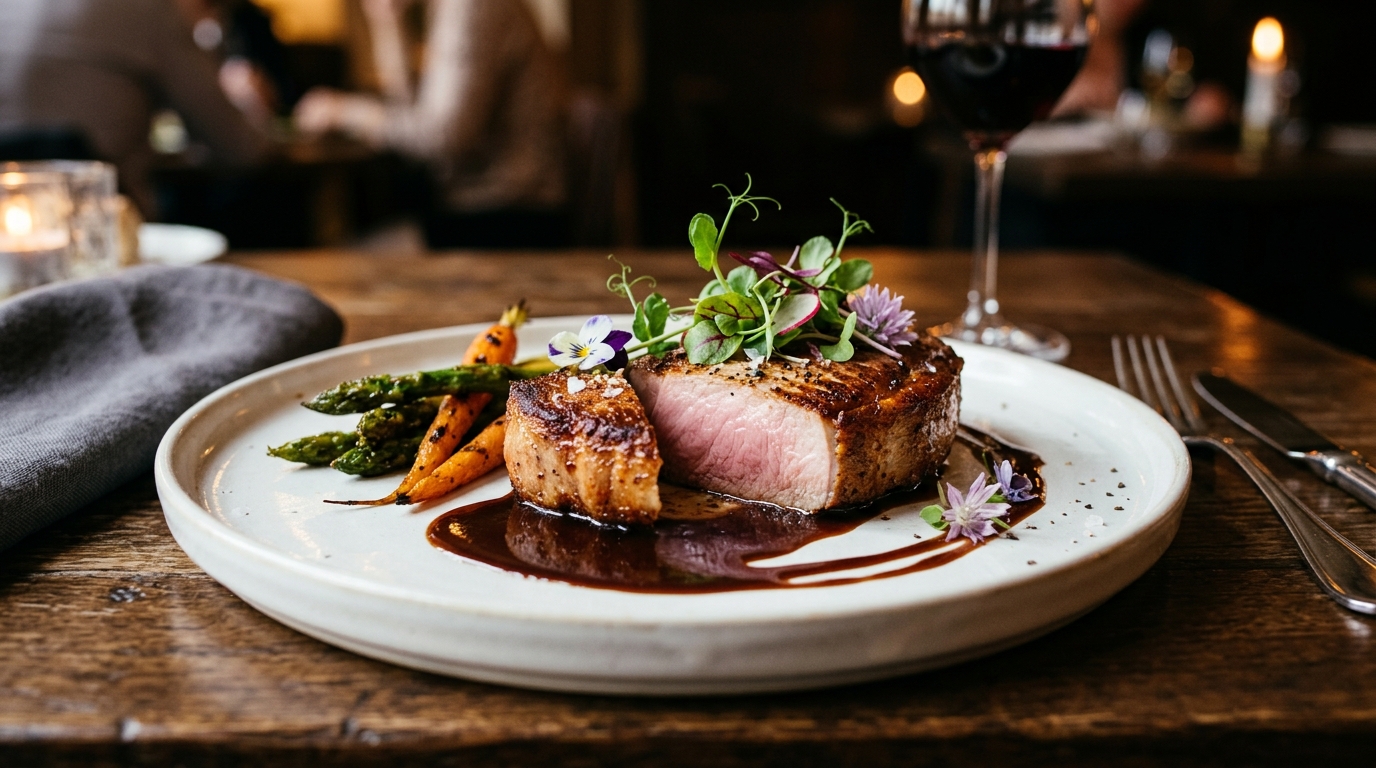
This is the recipe I prepare when I really want to impress my guests!
It relies on a classic restaurant technique: searing over high heat, careful deglazing, and sauce made in the same pan. Nothing complicated, but every step counts.
The exact ingredients for 4 people
- 700 to 800 g of pork spider steak (marinated for 3 hours)
- 2 tablespoons of grapeseed oil or clarified butter
- 30g of unsalted butter (for finishing)
- 3 finely chopped shallots
- 15 cl of full-bodied red wine (Côtes-du-Rhône or Burgundy)
- 10 cl of veal stock
- 1 sprig of fresh thyme
- Salt, freshly ground black pepper
- Fleur de sel for serving
Pan-frying: the step-by-step technique
Pan-frying pork spider steak requires a very hot pan and precise timing. Here's how I do it:
Step 1 — Preparation. Remove the meat from the marinade. Pat it dry thoroughly with paper towels. Meat that is too moist won't sear; it will boil. This is the first mistake to avoid.
Step 2 — Heating the pan. Heat a stainless steel or cast iron pan over high heat for 2 minutes. Add the oil. It should be smoking slightly before adding the meat.
Step 3 — Searing. Place the spider crab in the hot pan. Do not touch it for 2 to 3 minutes. A crust should form naturally. Turn it over only once.
Step 4 — Cook side two. Continue for 2 more minutes over medium heat. Add the butter and baste the meat regularly (brown butter basting technique).
Step 5 — Checking for doneness. The spider crab is cooked when the meat is still slightly pink in the center. Press it with your finger: it should be firm but yield slightly. Remove it from the pan and let it rest (see dedicated section).
Don't turn the meat too often. Each time you turn it, you interrupt the crust formation. One turn is enough for a spider steak 2 cm thick.
Wine and shallot sauce for the spider crab
It is in the same pan, directly after removing the meat, that I make the pork spider sauce with wine. The caramelized cooking juices provide an incomparable aromatic base.
Lightly degrease the pan if necessary, then sauté the chopped shallots for 2 minutes over medium heat. They should become translucent without browning.
Deglaze with red wine : pour in 15 cl of wine all at once and scrape up the browned bits with a spatula. Let it reduce by half over high heat.
Next, add the veal stock and thyme. Continue reducing for 3 to 4 minutes until the sauce thickens enough to coat the back of a spoon. Remove from the heat, whisk in 20g of cold, diced butter, swirling the pan to thicken the sauce. Adjust the seasoning.
For a different version with a creamy mushroom sauce, my mushroom and pea recipe offers a lovely spring alternative.
Oven-baked version for gentler cooking
For the oven-baked pork spider steak recipe, I proceed differently. After a quick sear of 2 minutes on each side in an oven-safe casserole dish, I bake at 160°C for 10 to 12 minutes.
This method ensures more even cooking, ideal for thicker pieces or when cooking for a large number of people. The result is slightly less crispy but even juicier inside.
The principle is similar to the cooking time of a filet mignon in the oven, with the same requirements for precision.
The keys to tender and juicy cooking
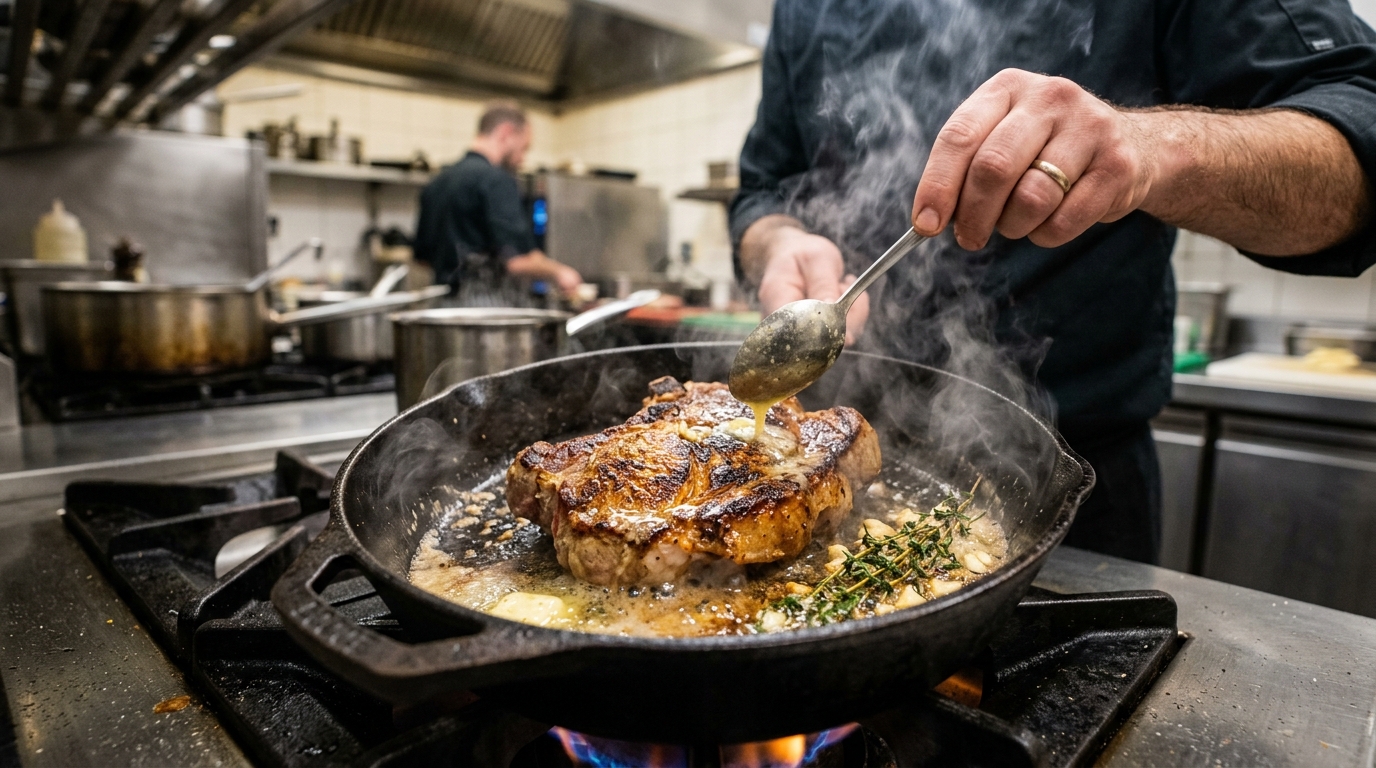
This is often where everything is decided. I've seen beautiful pieces of meat ruined by overcooking or neglecting to rest.
This is what I will never compromise on this point.
Cooking temperature and time to be respected
For a tender and juicy pork spider steak, the golden rule is: high heat for searing, moderate heat for finishing.
| Cooking method | Temperature | Total duration |
|---|---|---|
| Pan (direct heat) | High heat, then medium heat | 4 to 6 minutes in total |
| Oven (after input) | 160 °C | 10 to 12 min |
| Ideal core temperature | 63 to 68 °C | — |
I recommend using a cooking thermometer for cooks who want perfect results. An internal temperature of 65°C results in pink, juicy, and perfectly cooked meat.
This is the equivalent of what I'm looking for, like for a filet mignon with mustard, where precision makes all the difference.
Professionals recommend never exceeding 70°C at the core for a piece of pork of this type, at the risk of obtaining a dry and stringy texture which would lose all the interest of this cut.
Resting the meat: an essential step!
I consider this step non-negotiable, and yet it is the one that is most often skipped, pressed by hunger or guests.
Resting the meat after cooking allows the muscle fibers to relax and the juices to redistribute evenly throughout the meat.
If you cut the meat immediately, these juices escape onto the board and the meat becomes very dry.
For a pork spider steak, I let it rest for 5 to 7 minutes under a sheet of aluminum foil, without wrapping it tightly (to avoid condensation which softens the crust).
Resting time is about half the cooking time, so for every 6 minutes of cooking, allow 3 to 5 minutes of resting time. This is a rule that professional chefs always follow.
- Naturally tender meat without long cooking
- A rare and valuable cut of meat for the table
- It goes well with many sauces and marinades
- Quick cooking time (less than 10 minutes)
- Low in fat, with a fine and delicate taste
- Difficult to find without pre-ordering
- Very sensitive to overcooking
- Small item: limited quantity per animal
- Price higher than classic cuts
🎯 Are you an expert on the pork spider?
5 questions to check if you are ready to elevate this exceptional piece.
1. Where on the pig is the spider located?
2. Why is the pork spider steak considered a particularly tender cut?
3. What is the recommended cooking technique to obtain a juicy and tender pork spider steak?
4. What is the main purpose of marinating pork spider steak before cooking?
5. Why is it essential to let the pork spider steak rest after cooking?
Side dishes and presentation for a refined result
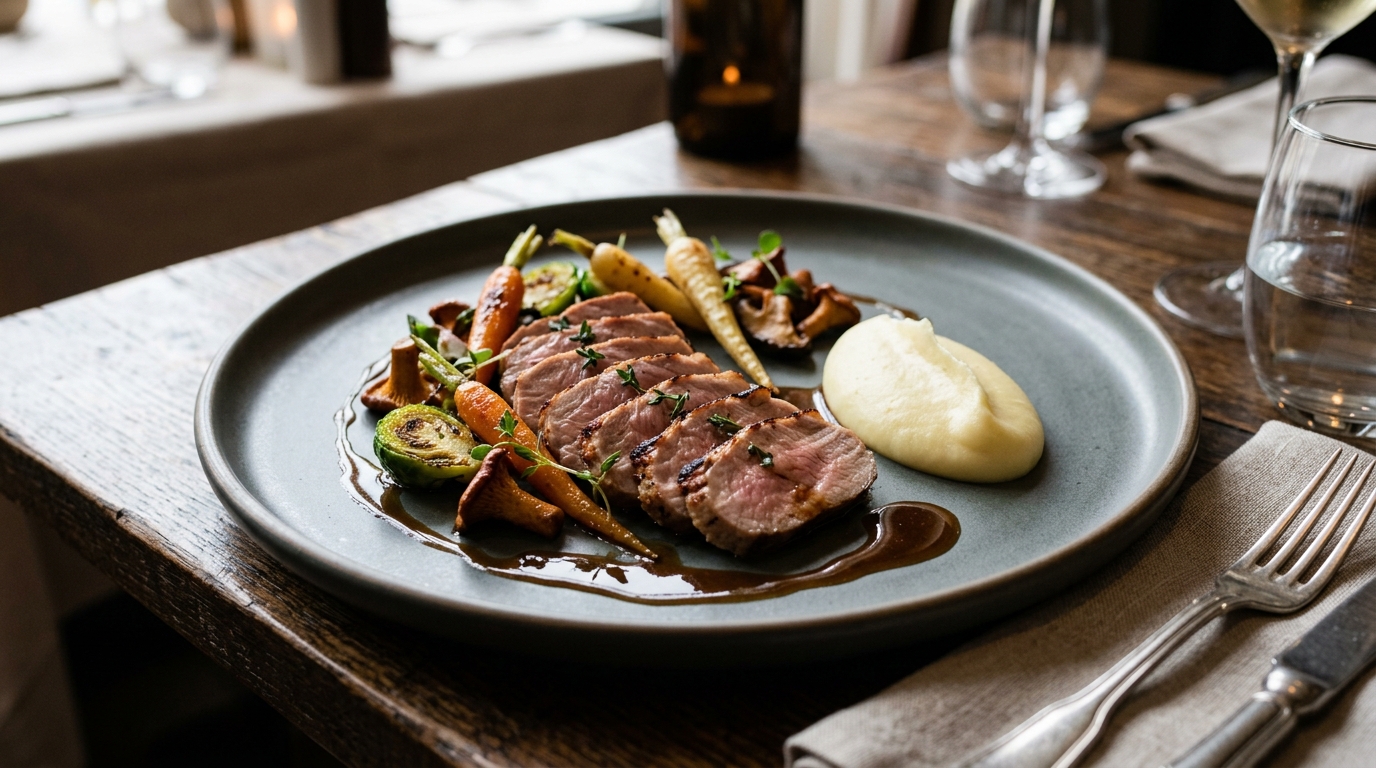
The meat is magnificent, the sauce is glossy—all that remains is to plate it. That's where the dish takes on its gastronomic dimension. I never neglect this step!
The best side dishes for this dish
I always look for a side dish that contrasts in texture with the meat — something soft and creamy, or on the contrary, slightly crunchy.
- Celeriac purée : smooth, slightly sweet, it balances the strength of the wine sauce.
- Crushed potatoes with olive oil : rustic and comforting, ideal for an autumn meal.
- Light gratin dauphinois : the timeless classic that always works.
- Green beans and toasted almonds : for a touch of freshness and crunch.
- Sautéed button mushrooms with garlic : a natural pairing with pork.
For seasonal vegetables, I really like the suggestions found on the vegetable side to accompany a roast pork because several adapt perfectly to the spider steak.
Avoid strongly flavored side dishes (cabbage, raw beetroot, very vinegary sauces) which would overwhelm the natural delicacy of the meat.
Plating tips like a Michelin-starred chef
Presentation is the final touch that takes a dish from "very good" to "remarkable".
Here's how I compose the plate:
1 — The placement of the meat. I slice the spider crab diagonally into slightly thick medallions. I arrange them in a fan shape, slightly off-center on the plate, not in the middle.
2 — The sauce. I pour it in an elegant stream around the meat, never on top — so as not to soften the crust.
3 — The accompaniment. The purée is placed using a spoon in a quenelle shape, or piped with a nozzle for a neat and even result.
4 — The finishing touch. A few crystals of fleur de sel on the meat, a drizzle of good quality olive oil, and a sprig of fresh parsley or chervil. It's understated, precise, elegant.
Warm the plates in the oven at 60°C for 5 minutes before serving. A cold plate cools the meat in seconds — a detail that chefs never overlook.
Practical questions
How do you cook pork spider steak so that it stays tender?
For a tender pork spider steak, the key is a quick sear over high heat—2 to 3 minutes per side in a very hot pan—followed by resting for 5 to 7 minutes under foil. Avoid prolonged cooking, which dries out the fibers. Marinating for 2 to 4 hours beforehand also helps retain moisture.
What is the difference between pork spider steak and pork tenderloin?
The spider steak is a flat muscle located on the iliac bone of the pelvis, with characteristic radiating fibers. The tenderloin is a long, thin muscle located along the spine. Both are tender, but the spider steak is even rarer—only two pieces per animal—and cooks more quickly.
Can you make a pork spider steak in the oven without searing it first?
It's technically possible, but not recommended. Without searing, the meat won't develop the golden crust that provides flavor and texture. A quick 2-minute sear on each side before baking at 160°C guarantees a better result in every way.
Which gourmet sauce goes best with pork spider steak?
Pork spider sauce with red wine and shallots is a classic that perfectly complements the delicate flavor of this cut. A white wine and cream sauce also works beautifully for a lighter version. In either case, build the sauce directly in the cooking pan to take advantage of the caramelized juices.
Where can I buy pork spider steak and what price should I expect?
Pork spider steak is primarily purchased from a traditional butcher, with orders placed 24 to 48 hours in advance. It is rarely available in supermarkets. The price varies between €12 and €20 per kilo depending on the breed and region. Expect to pay around €3 to €4 per person for a standard portion.