
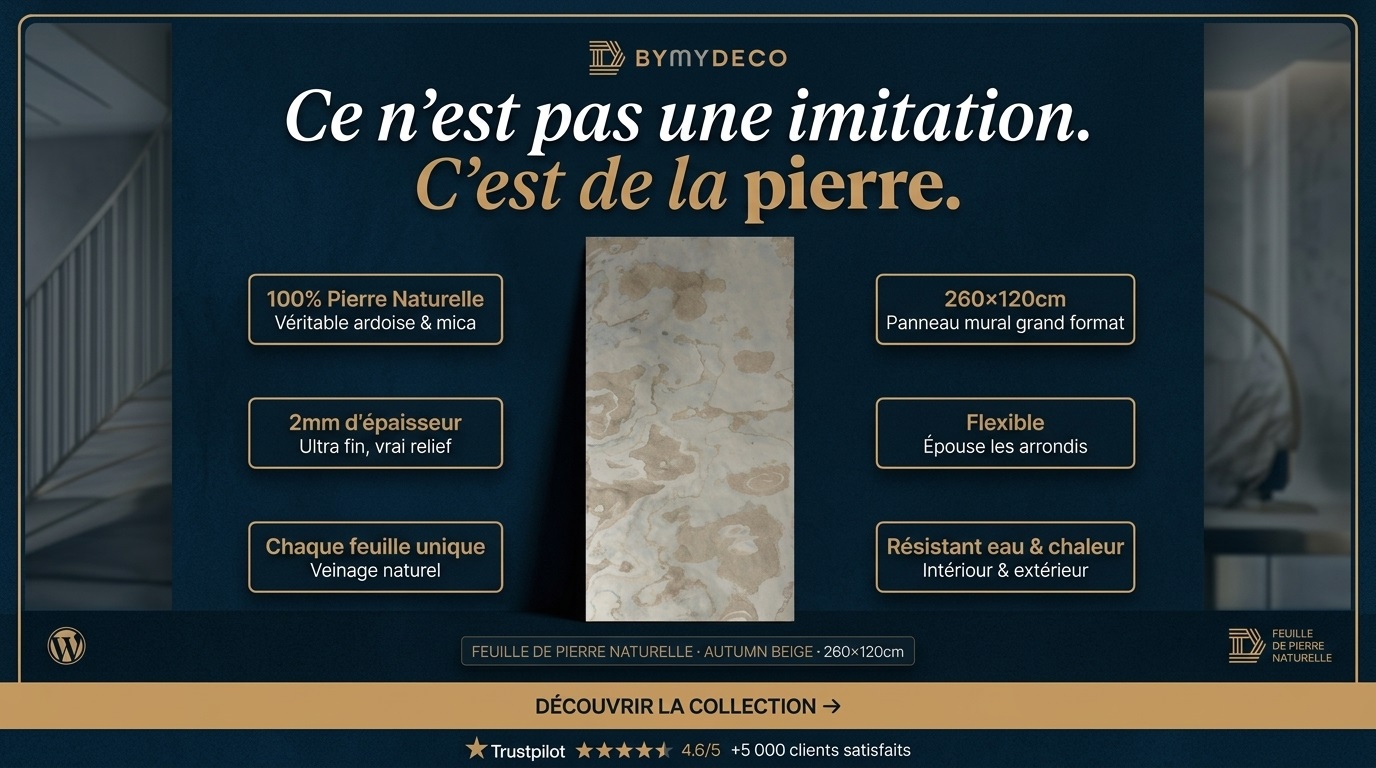
What is stone leaf?
Stone veneer is a wall covering made of natural stone, taken in very thin layers from its original rock and then fixed onto a flexible backing.
It retains the look, feel and character of a real stone: veins, reliefs, nuances, but with a lightness and simplicity of installation that completely changes the game.
This practical article describes all its advantages and how it could greatly improve your decor.
To discover the different finishes, shades and formats available, you can consult the natural stone leaf at ByMyDeco, which offers several variations.
From raw rock to thin sheet
The manufacturing process relies on a precise method: a resin is applied to the polished face of a rock, then a thin layer is detached following its natural veins.
This "sheet" is usually a few millimeters thick. It is then fixed to a flexible backing (fiberglass, polyester or textile) which gives it its flexibility.
A real stone, not an imitation
This is the major difference with the stone-effect imitations on the market. What you see, what you touch, what you look at in the light, is real stone.
Each leaf is unique, just as each slab from a quarry once was.
The different types of stone veneer
Depending on the original rock, the appearance changes completely.
Slate and its dark reflections
Deep greys, anthracite blacks, sometimes crossed with metallic reflections, slate gives a strong atmosphere, ideal for structuring a large living room wall or creating a very contemporary shower area.
Quartzite and its golden tones
Brighter and warmer, quartzite tends towards beiges, browns, and golden hues. It is one of the most prized stones in interior design for its sunny quality.
Sandstone and mineral nuances
Stoneware offers soft hues (sand, terracotta, light grey) and a more regular texture. It is particularly suited to minimalist or contemporary interiors.
Shale and irregular surfaces
For those seeking character, slate provides more pronounced, rustic surfaces with a more pronounced relief.
Ideal for an accent wall in a living room or entryway.
Why choose stone veneer
The authenticity of a natural material
No wallpaper, no printed imitation will ever be able to reproduce the depth and subtlety of real stone.
It is a material that captures light differently throughout the day: warm at sunset, more subdued in full sunlight.
The lightness of a flexible coating
Where solid stone weighs several tens of kilos per square meter and requires reinforced support, stone veneer can be handled by hand and placed on any sound wall.
A pose accessible to all
No complex sealing, no grout to spread, no professional equipment required. For a careful DIY enthusiast, installing a stone veneer remains an accessible project.
Where to use stone veneer in the home
In the bathroom
This is one of the most spectacular uses.
Around the shower
Stone veneer transforms a standard shower area into a true spa space. When properly installed and treated for humid environments, it offers excellent resistance to splashes and steam.
On the perimeter walls
Beyond the shower, treating one or two walls with stone veneer immediately gives the entire bathroom a hotel-like feel.
In the kitchen
In credence
Stone veneer used as a backsplash brings an incomparable mineral character. It is an excellent alternative to traditional tiles while protecting the wall from splashes.
On an accent wall
A single kitchen wall treated with stone is enough to structure the whole room, especially in kitchens open to the living room.
In the living room and the entrance
This is the most emblematic use.
Behind the sofa, around a fireplace, as a welcoming wall in the entrance: stone brings immediate and lasting elegance.
Outdoors, under certain conditions
Some stone sheets are treated to withstand outdoor conditions and are suitable for facades, low walls, covered terraces.
It is essential to check the technical data sheet before using outdoors, as not all products are certified for this use.
Which finish and which format to choose?
Standard sheets
The most common size: approximately 120 × 60 cm. Ideal for medium-sized projects and easy to transport.
Adhesive versions
The self-adhesive stone sheet has an adhesive backing. Easier to apply, it is ideal for projects without complex preparation.
Large custom formats
To cover an entire wall at full height, some suppliers offer large custom-made formats (up to 240 or 260 cm in height) to limit joins.
The shades: beige, grey, black, gold
The choice of shade changes everything. Beiges bring light, greys add structure, blacks create a strong contrast, and golds warm up.
Testing several shades before deciding is always a good idea.
How does a sheet of stone lay down?
Preparing the substrate
The wall must be clean, dry, dust-free and sufficiently flat.
Many surfaces are compatible: placo, painted walls, concrete, old tiles. Light sanding or a primer may be necessary depending on the surface.
Glue application
For non-adhesive sheets, a specific glue recommended by the manufacturer is used.
Comb application, smoothing with a spatula, checking with a level: the method is similar to that of thick wallpaper.
Adhesive versions, without glue
For adhesive sheets, the principle is even simpler: remove the protective film, position, smooth.
The result is immediate!
Cutting and finishing
The stone sheet can be cut with a cutter for thin models, and with a jigsaw for thicker versions.
Corner profiles neatly cover the joints.
The budget: what you need to plan for
Price per square meter
The price of a sheet of stone per square meter varies depending on the rock, thickness, format and treatment.
The first items start around an accessible budget; the premium pieces, in large format or in rare stones, go higher.
To situate his project, you should expect a budget somewhere between high-end tiling and a solid marble slab.
Additional costs
Specific adhesive, possible bonding primer, finishing profiles, water repellent for wet areas: these are all items to consider in addition to the price of the sheet itself.
Comparison with other coatings
For an equivalent surface area, stone veneer is often cheaper than high-end tiles laid properly, provided that labor and the duration of the project are included in the calculation.
It is on this point that its simplicity of installation changes the overall calculation.
Getting your project off to a good start
Order a sample
The stone is judged in the light, and before deciding on a shade, the best approach is to order a sample to see the material in your own room, at different times of the day.
Choose a reliable supplier
Not all sellers are created equal!
Some offer genuine natural stone taken from the rock; others settle for a printed veneer that is not very durable.
A specialist brand like ByMyDeco, which has a Trustpilot rating of 4.6/5 and more than 5,000 verified customers, offers a useful benchmark when entrusting an entire wall of a living room to a covering.
Stone veneer is neither a passing fad nor a low-cost imitation: it is a truly noble material, made accessible by a modern process, and this is precisely what explains its lasting success in decoration.
