
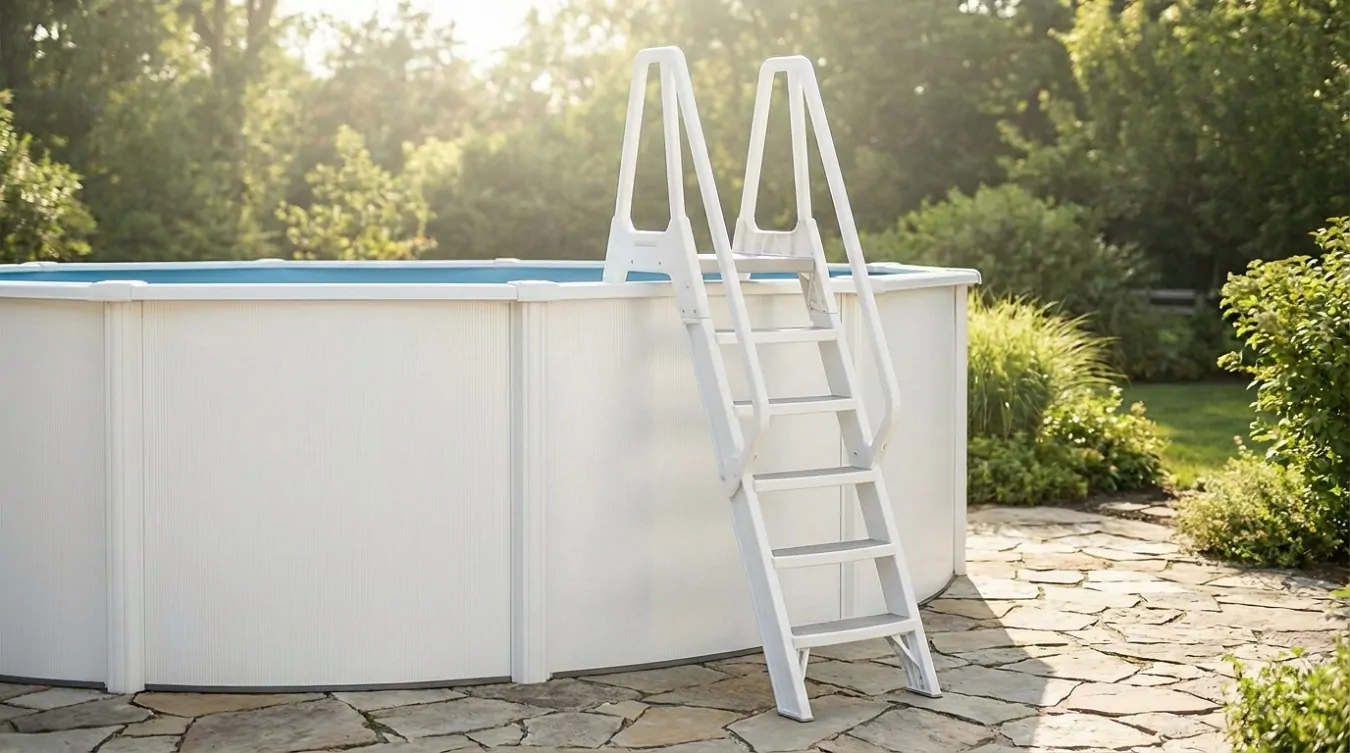


For many above-ground pool owners, the steps may be considered a simple accessory. However, they are what structure access to the pool, reassure parents, facilitate daily swimming, and ultimately set the tone for the outdoor space.
A model that is too light, poorly adapted or poorly designed can transform every entry into the water into a small source of worry, whereas a robust and comfortable staircase becomes, on the contrary, a permanent invitation to enjoy your pool.
Beyond the safety of children, the elderly or people with reduced mobility, the staircase also conditions the way we live around the pool and depending on whether it is removable, semi-permanent or perfectly integrated, it will have a direct impact on storage, wintering, but also on the overall aesthetics of the garden.
Some homeowners are looking for a discreet and effective solution, while others want it to be a true decorative element, coordinated with the decking, the wood of the terrace, or the surrounding vegetation. But in all cases, choosing the type of structure, materials, and accessories requires careful consideration!

Marie and Julien, who installed their first above-ground pool a few years ago, experienced this firsthand. Their first set of steps, a small, entry-level metal ladder, proved to be slippery, noisy, and unsafe for their children.
By replacing this equipment with a semi-permanent PVC staircase with wide steps and a handrail, they profoundly changed the way they enjoyed the pool: swimming became more serene, games more spontaneous, and swimming sessions more regular.
This ordinary story illustrates the issue well: choosing the right staircase means investing in a safer, more enjoyable and more sustainable swimming experience!
In short
Access and safety: the staircase is the essential access point for the above-ground pool; it must minimize the risk of falling and reassure all users.
Three main categories: removable stairs (mobile and economical), semi-permanent (a good compromise), permanent (integrated and customizable).
Strategic choice: size, capacity, stability and type of steps must be adapted to the height of the pool and the profile of the bathers.
Key materials: PVC, aluminum and treated wood offer different levels of durability, maintenance and aesthetic appeal.
Ease of use: wide steps, platforms and integrated benches transform the staircase into a true relaxation space.
Make or buy: the market offers a wide range of prices, but it is possible to build your own safe and durable treated wood staircase.
In the long term: regular maintenance and a few simple checks guarantee the durability of the staircase against frost, UV rays and chlorinated water.
The importance of stairs in the safety and comfort of above-ground pools
In the world of above-ground pools, the steps are often the first point of contact with the pool. It's how you get into the water, help a child get down, or support a loved one who is less comfortable.
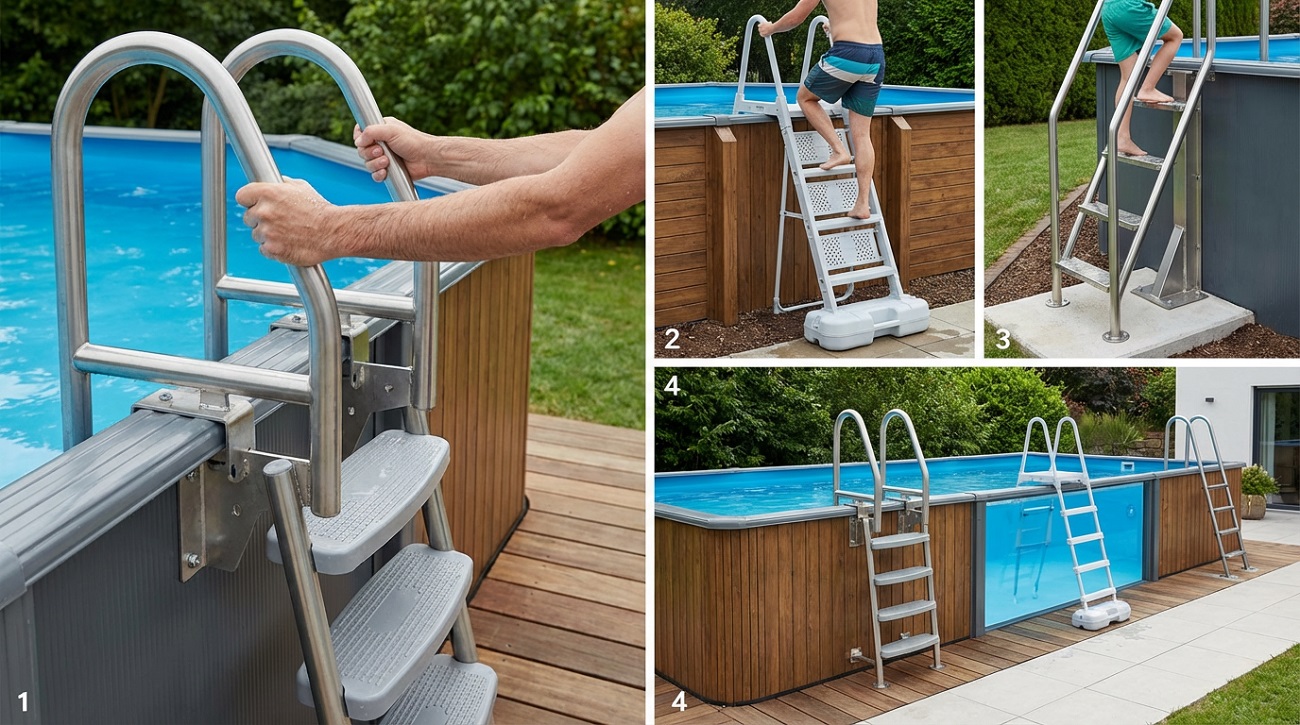
It thus becomes an essential element for your safety, far more crucial than some decorative accessories to which we sometimes devote more budget.
We see it every summer: a poorly designed access leads to hesitation, unsteady footing, and a risk of slipping. Conversely, a well-proportioned, stable, and ergonomic staircase fosters a sense of trust with the pool, especially for the most vulnerable swimmers.
This psychological dimension is just as important as the technical characteristics.
The crucial role of the pool steps for safe and comfortable access
A good staircase acts as a bridge between the ground and the water. Its primary function is to allow smooth access, without excessive effort, with regular and predictable steps.
When the height between two steps is too great or the support width is insufficient, the simple act of going up or down becomes a challenge, which mechanically increases the risks.
For children, the presence of sturdy handrails and non-slip surfaces on the steps is crucial. This allows a parent to accompany the young swimmer without fear of them losing their balance.
Older people, who are often susceptible to joint pain, appreciate the possibility of gradually lifting themselves up, with well-placed support points.
Marie recounted that her mother-in-law had given up swimming with the old equipment, because she didn't feel safe.
The arrival of a more stable staircase, equipped with handrails on each side, completely changed the game. In one summer, the pool became a popular intergenerational family gathering place!
This simple change illustrates the concrete scope of a well-chosen staircase and its impact on comfort and conviviality.
The aesthetic impact of the staircase on the pool environment
The visual impact of the staircase is often underestimated. Yet, it is one of the first elements that one notices when approaching above-ground pools, especially when the pool is surrounded by a terrace or relaxation area.
A bulky, poorly matched or aged model can disrupt the harmony of the garden.
Conversely, a well-designed staircase, coordinated with the colors of the liner, cladding or outdoor furniture, reinforces the identity of the place.
Some manufacturers opt for clean lines inspired by contemporary architecture, while others favor more rounded shapes reminiscent of Mediterranean pools. The choice of design then becomes a way to express a lifestyle.
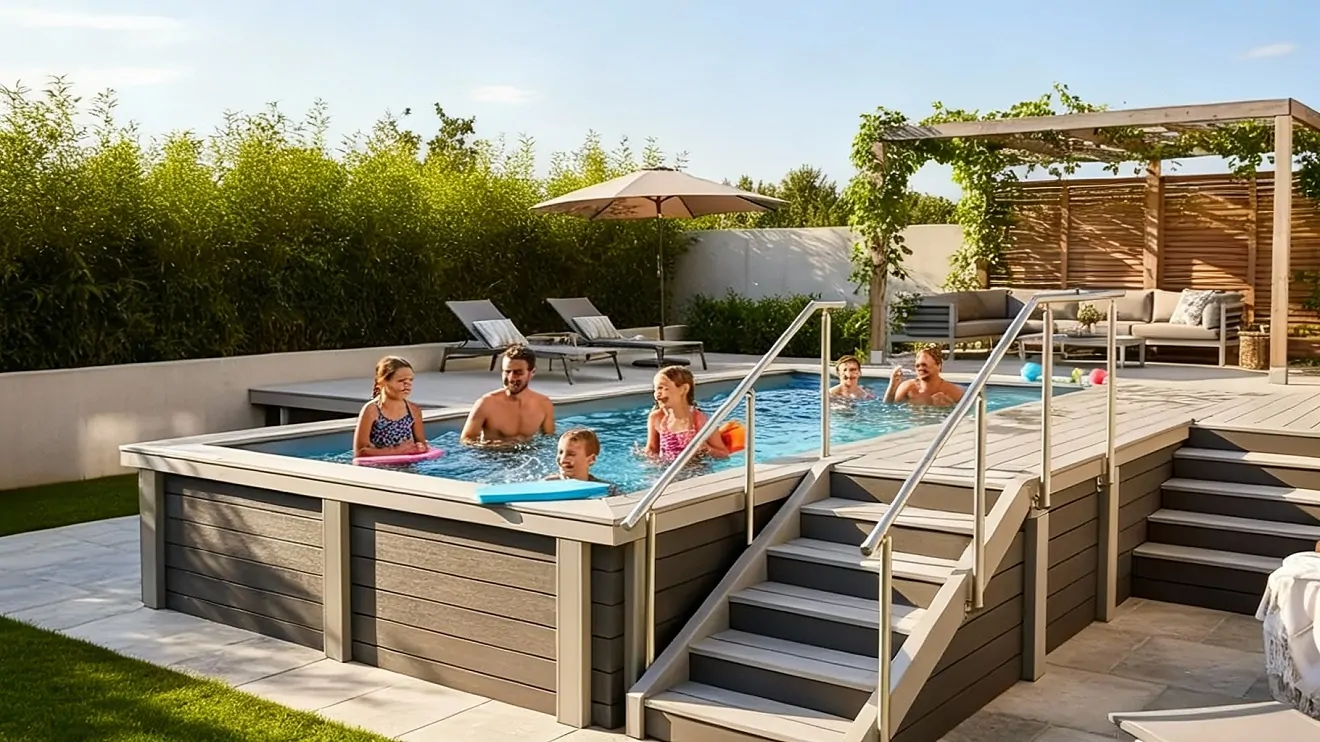
In Marie and Julien's project, the semi-permanent PVC staircase was chosen in a color close to the wood of their composite deck. The result gives an impression of continuity between the garden furniture, the pool, and the landscape.
At a glance, one understands that the staircase is not an added element, but a piece integrated into a coherent whole.
The different types of steps for above-ground pools: characteristics and advantages
Before delving into the selection criteria, it's helpful to understand the main categories of pool stairs available. Each type meets specific needs in terms of budget, mobility, stability, and customization.
The challenge is to align these features with your actual way of using the pool.
Removable stairs: lightweight and easy to install
Removable stairs are often the first option considered, especially for medium-sized above-ground pools or those installed for a short season.
Their main advantage lies in their lightness and ease of installation : most models can be assembled in a few minutes, without heavy work or permanent anchoring.
This mobility allows the staircase to be completely removed for winter storage, or when it is desired to limit children's access outside of swimming periods.
This is also an advantage for rented land or for owners considering moving their pool. However, this flexibility comes at the cost of sometimes reduced robustness and a somewhat basic aesthetic.
Entry-level models can lack stability when several people are using them at the same time. Therefore, it is essential to check the load capacity and step width before purchasing.
These stairs are particularly suitable for those who prioritize modularity and a controlled budget, while accepting a more discreet and less elaborate visual presence.
Semi-permanent staircases: stability and versatility
Semi-permanent stairs can be an interesting compromise between mobility and long-term stability.
They are designed to remain in place for much of the season, while also being able to be dismantled for thorough maintenance or to protect the structure during winter. Their design emphasizes stability, thanks to a wider base or reinforced support systems.
This type of product is particularly popular with families who use the pool daily. The steps are generally wider and better proportioned, the handrails more generous, and the finishes more refined.
The choice of materials is also more varied, with combinations of PVC, aluminum or reinforced resins.
For Marie and Julien, who wanted a reassuring solution for their children without embarking on major renovations, the semi-permanent staircase was the right solution.
Once in place, it gave the feeling of a fixed element while retaining the possibility of being moved, which simplified the cleaning of the liner and the winterizing of the pool.
Permanent staircases: optimal fixing and customization
Permanent stairs, often integrated into the structure of the pool or a wooden, composite or stone terrace, are the top of the line in terms of durable fixing.
They are designed as an architectural extension of the basin and are sometimes anchored in a slab or load-bearing structure.
Their degree of customization is very high, both in terms of shape and finish.
Staircases can be straight, corner, fan-shaped, or with integrated benches. Materials range from treated wood to clad aluminum, and include concrete finished with tiles or synthetic flooring.
This diversity makes it possible to create a set that is perfectly coordinated with the style of the house, whether it is contemporary, rustic or minimalist.
This type of project nevertheless requires prior planning, sometimes with the help of a professional, because the structure must support the weight of the users and withstand exposure to water and UV rays over time.
For those who know that their above-ground pool will remain in place for many years, choosing a permanent staircase translates into significantly higher quality of use and perceived value!
Criteria for choosing a suitable staircase for your above-ground pool
Once the type of staircase has been identified, the time comes to make some concrete decisions. Size, capacity, safety level, aesthetics—everything must be carefully considered to avoid unpleasant surprises. The goal is to find the right balance between actual needs, the garden environment, and the available budget.
Adapt the size and capacity of the stairs to the pool
The height of the pool is the first parameter to consider. A staircase that is too short forces a precarious final step, while a model that is too high becomes unnecessarily cumbersome.
It therefore becomes essential to measure the height of the pool precisely, including the coping, and to choose a staircase whose steps cover this difference in level in a regular manner.
The accommodation capacity must also be realistically assessed. A family with several children or who frequently entertains friends will benefit from choosing a model that can support several people at the same time without compromising stability.
Technical specifications usually mention a maximum load; it is better to overestimate it than to be at the limit.
A simple comparison table could help you see things more clearly:
Type of above-ground pool | Average height of the basin | Recommended type of staircase | Recommended capacity |
|---|---|---|---|
Small family pool (3-4 m) | 90-110 cm | Removable or semi-permanent | 2 people simultaneously |
Medium model with terrace | 110-130 cm | Reinforced semi-permanent | 3 people simultaneously |
Large swimming pool with landscaping | 120-140 cm | Permanent integrated | 4 or more people simultaneously |
This approach avoids buying an undersized staircase, which would quickly become a source of frustration and a limiting factor on a daily basis.
Ensure safety with non-slip steps and handrails
Safety remains the guiding principle in every decision!
To limit falls, non-slip steps must be deep enough to accommodate the entire foot, with an effective non-slip coating, even when wet.
Specific reliefs, grooves or coatings should be preferred, as well as slightly contrasting colors that allow each level to be clearly distinguished.
Handrails also play an important role. Ideally present on both sides, they provide support during ascent and descent, especially when the user has wet feet or is carrying a child.
For younger children, some staircases incorporate removable barriers or locking systems to restrict access outside of supervised periods.
By combining non-slip steps, solid handrails and a stable structure, domestic accidents around the pool are drastically reduced.
A well-designed staircase does not eliminate parental vigilance, but it becomes a valuable asset in the face of the uncertainties of daily life.
Match the aesthetics of the staircase to the design of the swimming pool
The staircase must visually engage with the pool and its surroundings. The aim is to create a continuity of materials, shapes, and colors.
Indeed, a pool clad in treated wood will naturally match a staircase in the same tones, while a pool with white walls and grey coping will harmonize better with a light and contemporary model.
Manufacturers are offering more and more design variations: very graphic straight lines, rounded contours for a softer effect, openwork or solid steps, solid or two-tone colors.
It is also wise to consider the other elements present on the terrace: furniture, pergola, planters….
The whole thing should tell a coherent story, like you would when furnishing a living room.
A staircase chosen solely for its price, without any aesthetic considerations, risks being replaced prematurely. By taking the time to match style and function, you invest in an element that will contribute to the pool's identity for many seasons to come.
Recommended materials for a staircase resistant to humid environments
The choice of materials directly determines the lifespan of the staircase, as well as its ease of use and maintenance requirements. Between PVC, aluminum , and treated wood, each option embodies a different philosophy, with its own strengths and limitations.
Advantages of PVC and simplified maintenance
PVC dominates the market for above-ground pool stairs, particularly for removable and semi-permanent models. This material is valued for its lightness, resistance to moisture, and ease of cleaning.
Regular rinsing with clean water, supplemented if necessary by wiping with a soft sponge, is generally sufficient to maintain a good surface condition.
Another advantage is that PVC allows for the molding of various shapes, with rounded steps, integrated handles, or anti-slip surfaces. Its color palette has expanded in recent years, ranging from classic white to more contemporary grays, and even to shades that mimic wood.
For Marie and Julien, this compromise between aesthetics, price and ease of maintenance was decisive.
Particular attention should be paid to the quality of the manufacturing process. PVC that is too thin or poorly treated can discolor prematurely or become brittle under the effects of UV rays.
Hence the importance of always checking the manufacturer's reputation and the guarantees offered!
Aluminum: strength and corrosion resistance
Aluminium is prized for its robustness and high resistance to corrosion over time. When properly treated, it withstands splashes of chlorinated water and temperature variations without any problem.
It also provides excellent structural rigidity, ideal for ensuring optimal stability, even when several people are using the stairs simultaneously.
This metal is particularly well suited to load-bearing structures combined with other materials, such as PVC for steps or composite decking for platforms.
The aesthetic result can be very modern, especially when combined with clean lines and neutral colors.
In return, the initial cost may be higher than for all-PVC solutions.
However, for intensive use over several years, aluminum often proves to be economical in the long term, thanks to its excellent durability.
Treated wood: natural aesthetics requiring maintenance precautions
Treated wood remains a preferred choice for those seeking a warm and natural aesthetic. Integrated into a wooden deck or a lush garden, it creates a visually appealing continuity.
The wood species used are generally treated in an autoclave or selected for their natural resistance to moisture.

However, wood will require regular attention. To maintain its mechanical qualities and appearance, it will be necessary to periodically apply protective products (stain, saturator) and to monitor for the possible appearance of cracks or splinters, particularly on steps that are frequently used.
A light preventative sanding may be necessary at the beginning of each season.
When well designed and maintained, the treated wood staircase becomes a true piece of outdoor furniture, providing a feeling of comfort to the touch of the bare foot.
However, these maintenance requirements must be accepted , as they are more demanding than those for PVC or aluminum.
Comfort and ergonomics: steps, platforms and accessories for pleasant use
Beyond its sturdiness, the pleasure of use lies in the ergonomic details. The shape of the steps, the presence of platforms and accessories transform a simple staircase into a living space, where one can sit, play or simply enjoy the sun.
Importance of the dimensions and shape of the steps
The width and depth of the steps directly influence the feeling of security: steps that are too narrow force you to place your foot at an angle, which increases the risk of missteps.
Conversely, generous steps, slightly inclined backwards to drain water, guarantee stable and reassuring support.
The height between each level should remain constant and moderate: a gentle progression is particularly appreciated by the elderly or those who suffer from knee problems.
Some designs even include an extra-wide first step, which acts as a mini-beach where you can splash around with a child.
To quickly check the ergonomics of a model, a good tip is to compare it to a comfortable indoor staircase: if the proportions are similar, the sensations will be too!
This alignment between domestic use and access to the pool reduces the adaptation phase and increases overall comfort.
Usefulness of integrated platforms and benches
The intermediate platforms, installed at the top or halfway up the stairs, have several functions.
They allow you to pause, turn around, observe the children, or chat without remaining in the water. Furthermore, for less confident users, they provide a particularly reassuring sense of security.

Built-in benches, sometimes found on high-end permanent or semi-permanent staircases, literally transform the access area into a relaxation corner. You can sit there half-submerged, read, chat, or simply refresh yourself at the end of the day.
Marie also recounts that, at their home, the first wide step became their son's "favorite spot" to play with his boats.
These additional features represent an extra cost, but they significantly increase the actual use of the pool.
Instead of being a simple passageway, the staircase becomes a living area, extending the comfort of the pool.
How to build your own staircase using treated wood
The market is full of ready-made solutions, but some DIY enthusiasts prefer to design their own staircase, especially in treated wood, to control the design and integration with the terrace.
The two approaches can coexist, depending on your time and skills.
Price ranges for materials and available options
Prices vary considerably depending on the type of structure, materials, and integrated features.
To gain a clearer understanding, we can distinguish three main categories:
Category | Indicative price range | Main materials | Typical characteristics |
|---|---|---|---|
Entry-level | 100 – 250 € | Lightweight PVC, painted steel | Removable staircase, simple steps, few options |
Mid-range | 250 – 700 € | Reinforced PVC, aluminum | Semi-permanent, wide steps, handrails, improved stability |
High-end / custom-made | €700 and up | Treated wood, aluminum, composite | Integrated permanent staircases, platforms, benches, custom design |
This diversity allows each pool owner to find a compromise between budget and level of equipment.
It is often wise to invest a little more to obtain better structural quality, rather than replacing a very basic model after a few seasons.
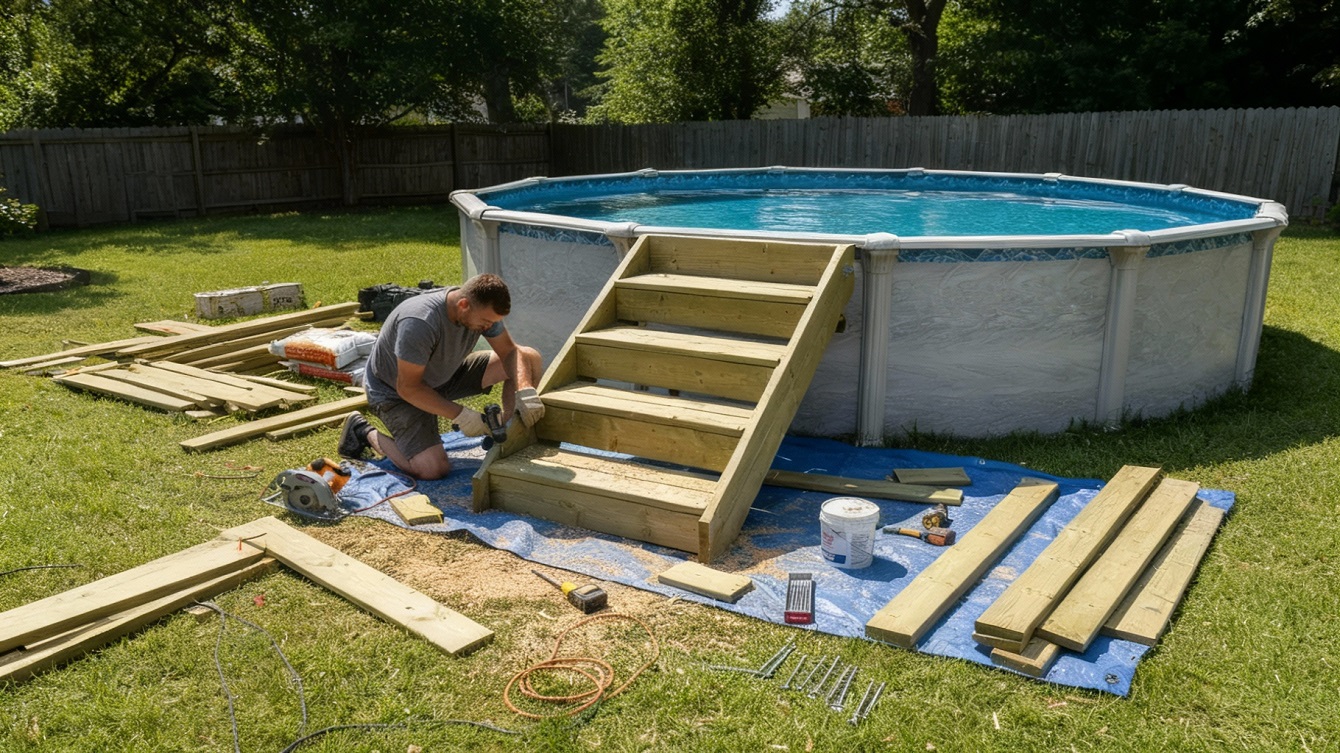
Key steps to building a safe wooden staircase
For DIY enthusiasts, building a treated wood staircase suitable for an above-ground pool can be a rewarding project. The process requires precision, as user safety depends directly on the quality of the workmanship.
The main steps are as follows:
Create a precise plan based on the height of the pool, determining the number of steps and their dimensions.
Construct two stringers (side sections) out of treated solid wood, which will support the whole assembly.
Securely fix the steps, ensuring a regular distribution of height and a good depth of support.
Add handrails and, if possible, a small platform at the top to facilitate entry into the water.
Treat and protect the wood with products suitable for a humid environment.
Each step must be carried out with fixings sized for outdoor use (stainless steel or galvanized screws) and respecting basic stability rules.
Once in place, it is wise to test the staircase gradually, under load, before making it accessible to everyone.
Materials and precautions to take for durable manufacturing
To guarantee maximum resistance, the choice of materials is crucial.

The wood must be treated to a class suitable for occasional contact with water, ideally accompanied by spacers that prevent permanent contact with a damp ground.
The screws must be corrosion-resistant and able to withstand repeated mechanical stresses.
It is also advisable to provide a slight slope for the steps to allow for the drainage of rainwater or splashes.
Sharp angles can be softened by a slight chamfer to prevent impacts and splinters.
Finally, regular visual inspection of the assemblies allows for the rapid detection of any play or creaking.
By respecting these precautions, a homemade treated wood staircase can rival many commercial models, while offering perfect integration into the overall landscaping project.
Regular maintenance of your above-ground pool steps
The longevity of a staircase depends not only on the initial quality of the materials. Regular maintenance, tailored to each type of structure, helps preserve user safety and the overall aesthetic appeal season after season.
Cleaning adapted to the material chosen
For a PVC staircase, cleaning with clear water, occasionally supplemented with mild soap, is usually sufficient.
Avoid using wire brushes and abrasive products, which can scratch the surface and retain more dirt.
On aluminum, a simple non-abrasive cloth and a specific product, if necessary, will remove traces without damaging the protective coating.
Treated wood requires a little more care. Gentle brushing in the direction of the grain, followed by rinsing, helps to remove organic deposits (algae, pollen).
Once dry, the regular application of a saturator or stain suitable for humid environments restores the wood's protection and color. This annual ritual will directly contribute to the structure's longevity.
By incorporating this cleaning into the beginning and end-of-season task schedule, we will ensure that the staircase remains welcoming and safe for the whole family.
The verification and maintenance of fixings and structures
Beyond cleaning, checking the fixings is an essential safety measure!
At the end of winter and mid-season, it's a good idea to check that the screws, nuts, and anchors haven't loosened. Preventative tightening avoids unwanted movement that could compromise the stability of the staircase.
For wooden models, an inspection of the assembly areas helps to identify any cracks or deformations.
On metal stairs, we monitor for the appearance of corrosion, even slight, in order to act before the problem worsens.
Some users record these checks in a small notebook, which makes tracking easier year after year.
This inspection time, often less than an hour, is a minimal but very important investment to guarantee a reliable structure, especially when children and vulnerable people regularly use the pool!
Protection against external aggressions: frost, UV rays and chlorinated water
Above-ground pools are exposed to significant climatic variations. Winter frost, summer UV rays, and chlorinated water exert constant pressure on the steps.
To address this, a few simple measures are necessary:

Removable or semi-permanent models can be taken down and stored away during the winter, which greatly reduces constraints.
For permanent staircases, protection involves regular surface treatments, the use of cover tarpaulins limiting direct exposure, and particular attention to the regulation of water treatment.
Indeed, water that is too chlorinated or unbalanced can accelerate the aging of certain components.
By combining these actions, the staircase retains its structural and aesthetic qualities for longer.
The initial investment is thus amortized over a greater number of seasons, while preserving the safety of all users.
Answers to your questions
How can I tell if my staircase is safe enough for my children?
Check that the steps are non-slip, sufficiently wide and even, that the staircase doesn't move when two adults are using it simultaneously, and that at least one handrail is easy for a child to grasp. If possible, choose a model with barriers or a locking system to restrict access outside of supervised swimming areas. A weekly visual inspection of the fixings further enhances safety.
Which material should I choose: PVC, aluminum, or treated wood?
PVC is suitable if you're looking for a lightweight, easy-to-maintain, and economical solution. Aluminum is recommended for its excellent stability and high corrosion resistance, especially under heavy use. Treated wood is ideal for blending naturally into a garden, provided you're willing to accept regular maintenance (protection, crack control). The choice depends on your surroundings, your budget, and the desired style.
Can I install my above-ground pool steps myself?
Yes, most removable and semi-permanent staircases are designed for installation , with detailed instructions. It's important to follow the instructions carefully, properly level the base, and check for stability under load. For a permanent staircase integrated into a terrace, professional intervention or at least advice is strongly recommended, as the structural stresses are greater.
How often should I maintain my staircase?
A thorough cleaning at the beginning and end of the season is essential. During periods of intensive use, a quick weekly rinse and a visual inspection of the fasteners are recommended. For treated wood, a more in-depth inspection and possible reapplication of the protective product should be considered every one or two years, depending on exposure and the condition of the material.
Is a more expensive staircase necessarily more durable?
A high price often reflects better quality materials and a more sophisticated design, but it's not a guarantee. Durability also depends on how well the chosen model suits its intended use, as well as how well it's maintained over time. Therefore, it's important to consider budget, technical specifications (load capacity, type of materials, stability), and user reviews before making a decision.

