
In short
Choosing a bedside table seems simple at first glance. Yet, many people end up with a piece of furniture that's too tall, too bulky, or clashes completely with their bed. A poor choice, and the entire atmosphere of the bedroom suffers!
This handy little article helps you make the right choice, step by step, taking into account height, dimensions, material, storage and style.
Whether you're furnishing a small bedroom or renovating a large room, you'll find concrete criteria here to avoid making mistakes!
The ideal height for a bedside table

This is often the most overlooked criterion, yet it is the one that most impacts daily comfort.
A bedside table that is too low or too high forces uncomfortable movements, especially when looking for your phone in the middle of the night.
What height should it be in relation to the mattress?
The basic rule is simple: the ideal height of a bedside table should be between 5 and 10 cm above the top of the mattress.
In practical terms, when you are lying down, your hand should reach the surface of the table without you needing to sit up or bend over.
For a mattress placed on a standard height bed base (approximately 20 to 25 cm frame height) with a 20 cm thick mattress, the sleeping surface is generally between 40 and 55 cm from the floor.
A bedside table between 45 and 65 cm in height therefore corresponds to the majority of configurations.
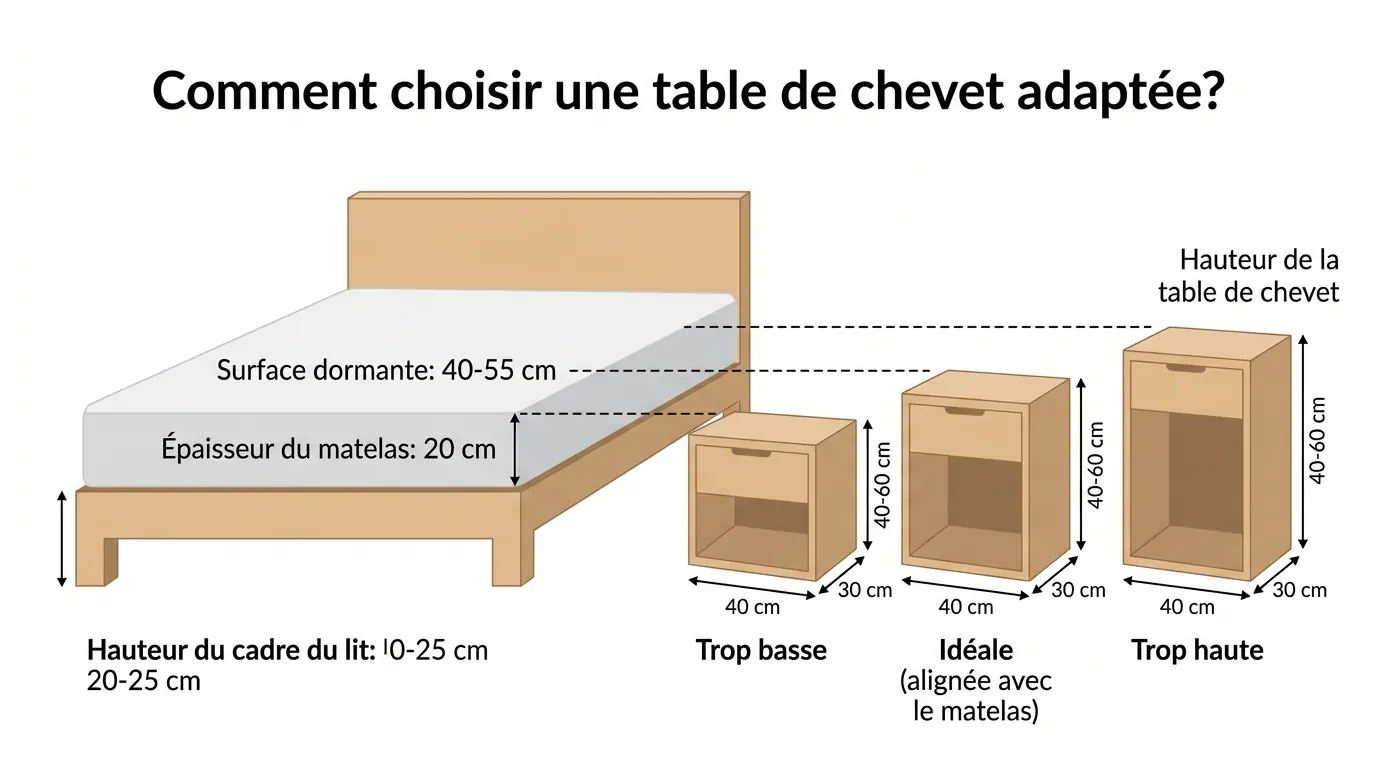
Professionals recommend always measuring the exact height of your bed first, and a difference of 10 cm really changes the ergonomics of the movement.
If you read in bed or frequently use your phone at night, a surface at shoulder height while seated is more practical than a flat surface.
The ideal height for a bedside table in relation to the bed is easily calculated: measure from the floor to the top of your mattress, then add between 5 and 10 cm. This is your target height.
Adjust the height according to the chosen bedding
Bedding directly influences the appropriate table height.
A solid wood bed with a high frame and a thick mattress can reach a total height of 65 to 70 cm. Conversely, a mattress placed directly on low slats can be as low as 35 cm.
If you are planning to choose the best mattress at the same time as your bedside table, check the thickness of the model chosen, as memory foam and latex mattresses often exceed 25 to 30 cm in thickness, which considerably increases the sleeping surface.
For suspended bedside tables, the height is adjustable during installation, making them particularly flexible.
The standard size for a suspended bedside table ranges between 50 and 60 cm from the floor, but nothing prevents you from fixing it higher depending on your bedding.
This is a solution to seriously consider if you change your mattress regularly!
The dimensions are suitable for your room
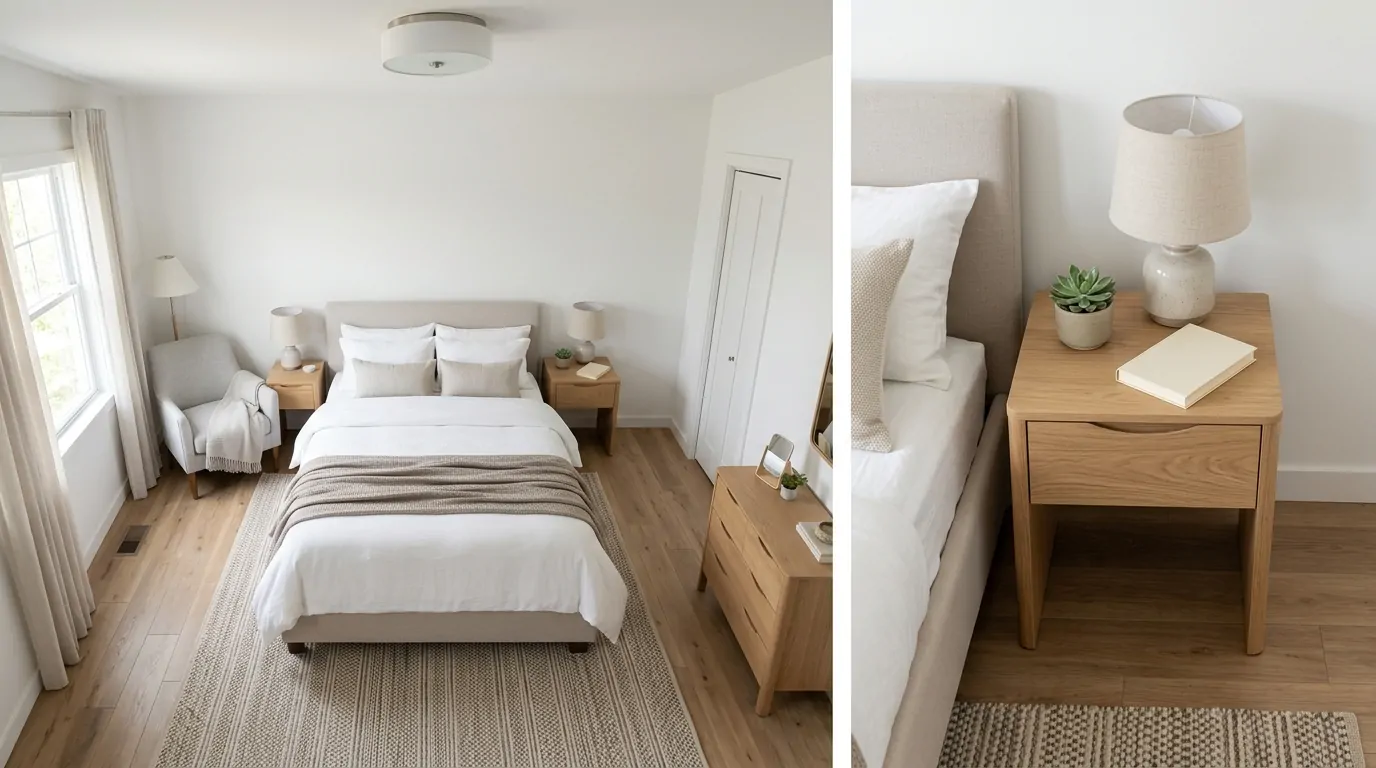
Before even thinking about style or material, you have to measure, since the available space on each side of the bed conditions all other decisions.
A beautiful bedside table that is unusable because it blocks the passage is a common and costly mistake.
The standard dimensions of a bedside table
The standard dimensions of a bedside table are generally between 40 and 60 cm wide, 35 to 45 cm deep, and 50 to 65 cm high.
These measurements correspond to what most retailers offer, including the dimensions of IKEA bedside tables, for example, which are around 45 x 40 cm for standard models.
The minimum size for a bedside table to be respected is about 30 cm wide to properly place a lamp and a glass of water, because below that, the surface becomes negligible.
Here is a brief summary in table format to help you understand.
| Dimension | Current value | Recommended use |
|---|---|---|
| Width | 40 to 60 cm | Standard, most rooms |
| Depth | 35 to 45 cm | Enough for a lamp + a few other items |
| Height | 50 to 65 cm | Compatible with most beds |
| Minimum size | 30 cm wide | Small room, very limited space |
Choosing a bedside table for a small bedroom
In a small bedroom, choosing a bedside table that fits the space takes precedence over everything else.
The distance between the bedside table and the bed must allow free movement, i.e. a minimum of 60 cm between the edge of the table and the wall or any other piece of furniture.
Hanging models or very compact tables (30 to 35 cm wide) are preferable here.
Some even prefer a shelf fixed to the wall, because the advantage is that the floor remains clear, which visually gives more space to the room.
User feedback shows that this solution truly changes the perception of the room.
🛏️ What type of bedside table suits you?
Answer the questions below to get a personalized recommendation.
The dimensions for a large bedroom or for a couple
In a large bedroom, you can afford wider bedside tables, between 55 and 70 cm, with more depth and storage.
The result is more luxurious and the usable surface area is frankly appreciable.
For a couple, the question of bedside tables in sets of 2 naturally arises, and buying two identical models guarantees immediate visual consistency.
The distance between the bedside table and the bed should remain the same on both sides for a successful symmetrical effect, generally between 5 and 15 cm between the edge of the bed and the table.
What material should you choose for your bedside table?
The material determines the visual appearance, longevity and maintenance; however, there is no absolute good or bad choice, as everything will depend on the style of your room and your intended use.
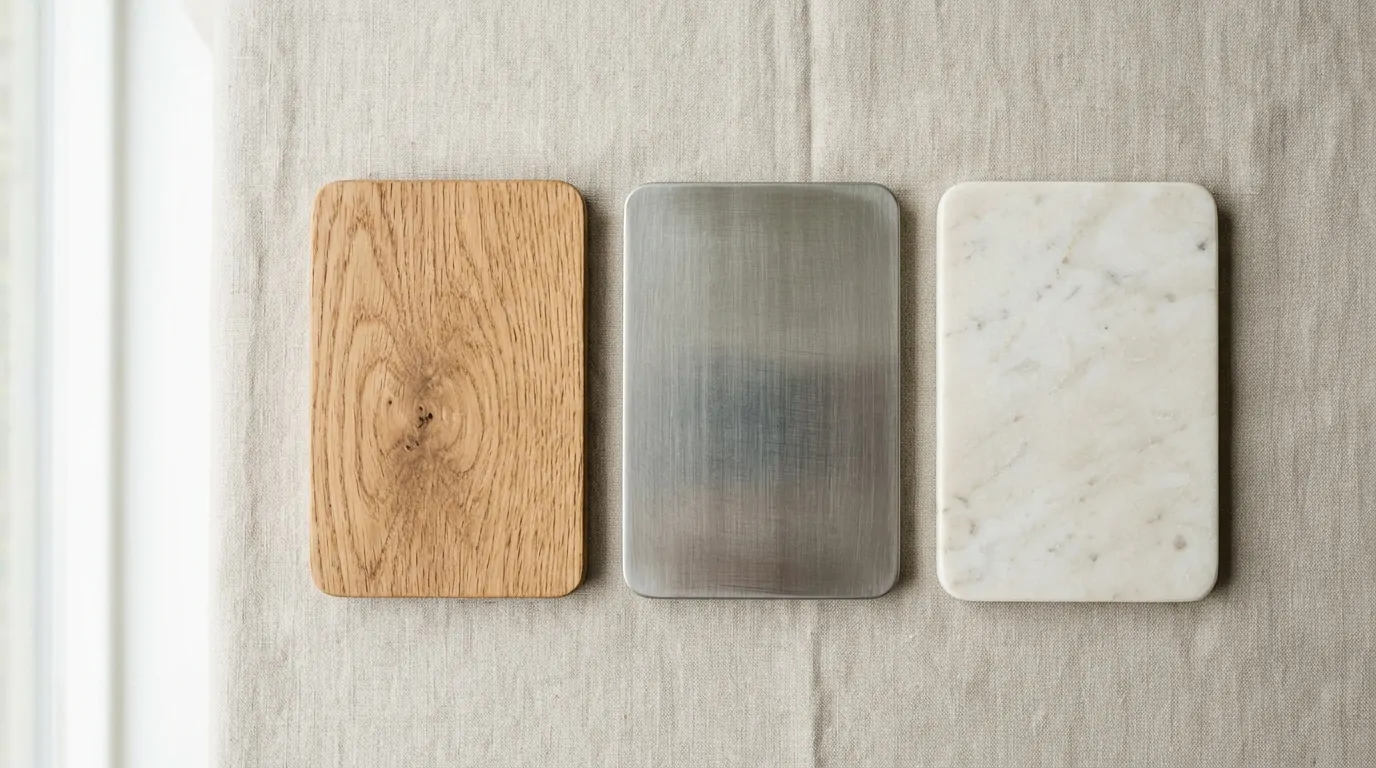
Here's how to compare the main options in practice.
The wooden bedside table: durability and warmth
The wooden bedside table remains a safe bet, because solid wood, oak, beech or pine, withstands everyday shocks well and improves with age.
It is the material of choice for rooms with a warm, Scandinavian or natural feel.
Solid wood costs more than engineered wood (MDF, particleboard), but its lifespan is significantly longer, so a solid oak model can survive several moves without a hitch.
If you want to adopt an organic and natural style in your bedroom, raw or oiled wood will be the first choice.
Lacquered wood is an interesting alternative: it provides the robustness of wood while offering a smooth and colorful finish, and in white, grey or black, it integrates into contemporary interiors.
Maintenance is simple, a soft cloth is sufficient, although scratches are more visible than on raw wood.
- Remarkable durability and longevity
- Warm, natural appearance
- Compatible with many decorating styles
- It can be repaired, sanded, and stained
- Higher price for solid wood
- Sensitive to prolonged humidity
- Heavy to move, made of thick solid wood
The metal bedside table: design and sturdiness
The metal bedside table has become a staple in industrial and contemporary interiors.
Steel, wrought iron or aluminium provide visual lightness and solidity, and the thin metal legs give an impression of space, making them particularly suitable for small rooms.
The metal supports the loads without bending, so this is a significant point if you are placing books, an alarm clock, a lamp and a charger at the same time.
According to specialists in the field, epoxy-coated metal is highly resistant to shocks and corrosion, provided that the topcoat is of good quality.
The main drawback remains the coldness of the touch, because a room entirely furnished in metal can seem clinical.
The solution: mix metal and wood, or metal and fabric, to soften the look. This is why bedside tables with a wooden top and metal legs are so popular.
- Very sturdy and durable
- Light visually, ideal for a small bedroom
- Easy to clean
- Modern or industrial design
- A cold look in an interior devoid of textures
- May rust if the finish is damaged
- Less warm than wood
Other materials: glass, rattan and lacquered wood
Tempered glass provides transparency and visually enlarges the room; since it's easy to clean, it suits contemporary spaces. However, be aware that fingerprints and drink marks are immediately visible!
Rattan and wicker are experiencing a resurgence in popularity because these natural materials fit well into bohemian interiors and pair nicely with linen or cotton. They are lightweight and easy to move.
According to product design standards, the longevity and resistance of natural fiber furniture depend heavily on the quality of the weaving and the treatment applied.
Lacquered wood, mentioned above, deserves to be mentioned here as well because it has a clean and modern finish, available in white in particular, as I found on sweeek.fr last time.
Storage options to consider
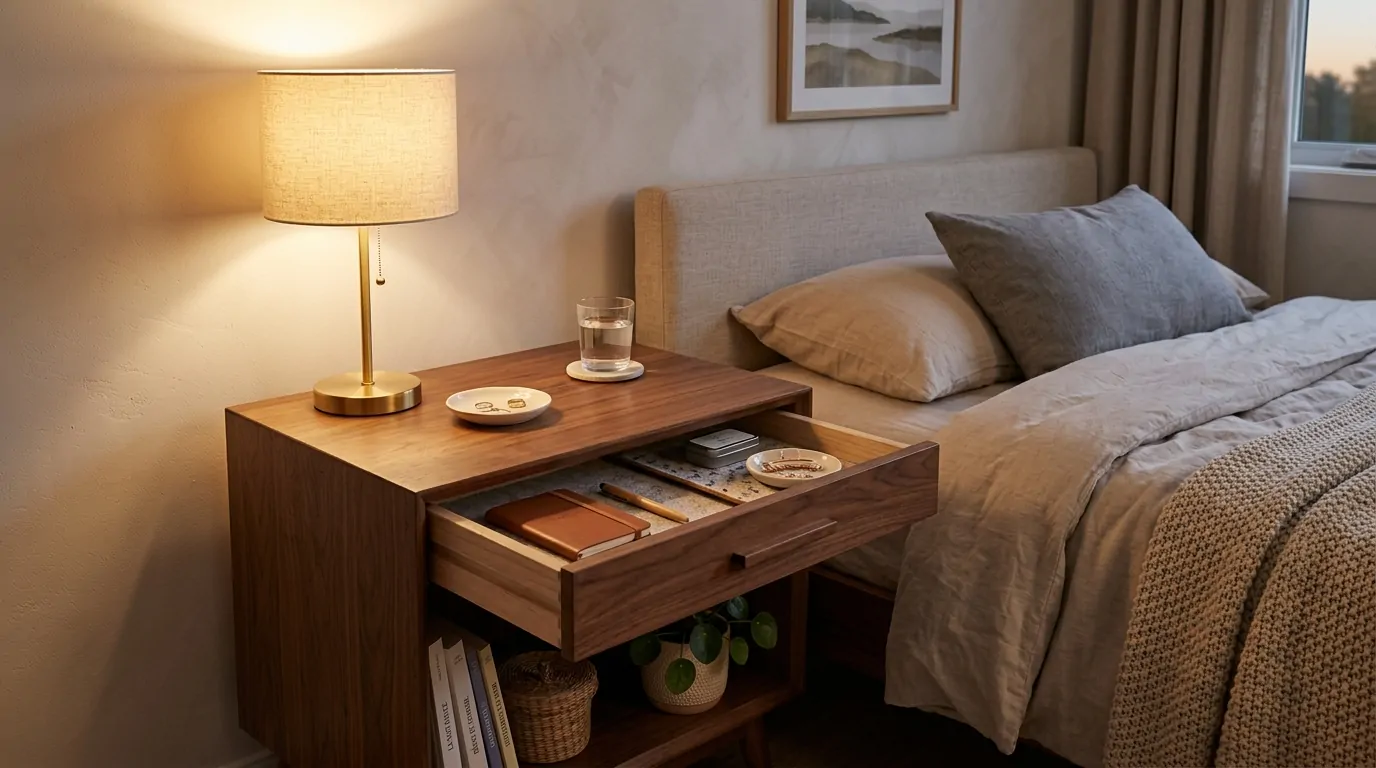
A bedside table without storage is a piece of furniture that will be overflowing in two days with cables, books, medications, notebooks – everything ends up piling up! So it's better to anticipate your real needs before buying.
The bedside table with a drawer or niche
The bedside table with a drawer is the most practical solution for discreet storage, since the drawer hides what you don't want to see, protects objects from dust and keeps the surface clear.
A single, well-sized drawer is sufficient in most cases.
The niche, on the other hand, is an open compartment integrated into the body of the furniture, and it allows for the placement of larger objects, such as books or a small tablet, while remaining visible.
It's a compromise between an open shelf and a closed drawer, and models combining a drawer and a niche are particularly versatile.
Before you buy, list the items you usually keep on your nightstand. Lamp, phone, glass, book, medication? This list will determine the usable surface area and the type of storage you truly need.
Models with open shelves
Open shelves give an airy and decorative feel, since books, a plant, or a decorative object can be placed on them.
It's visually interesting, but it requires discipline: because everything is visible, all the time.
This type of bedside table with open storage is best suited to tidy people or those who want to intentionally display a few items.
For those who tend to accumulate things easily, open shelves quickly turn into an apparent mess, which detracts from the atmosphere of the room.
Storage and clutter: finding the right balance
A piece of furniture overloaded with storage can become visually heavy, but conversely, a simple shelf without any storage forces you to put everything on the floor or on the bed.
The right balance will therefore depend on your actual lifestyle.
If you live in a small bedroom, opt for a compact model with a single drawer or niche, while in a large bedroom, you can afford a taller model with two storage levels.
The goal remains the same: a bedside table adapted to the bedroom and to real use, not to what you see in a catalogue.
Avoid models with too many open shelves if your bedroom is a passageway or if you share the room. Visible storage requires daily maintenance to keep it looking presentable.
How to match your bedside table to your bed?
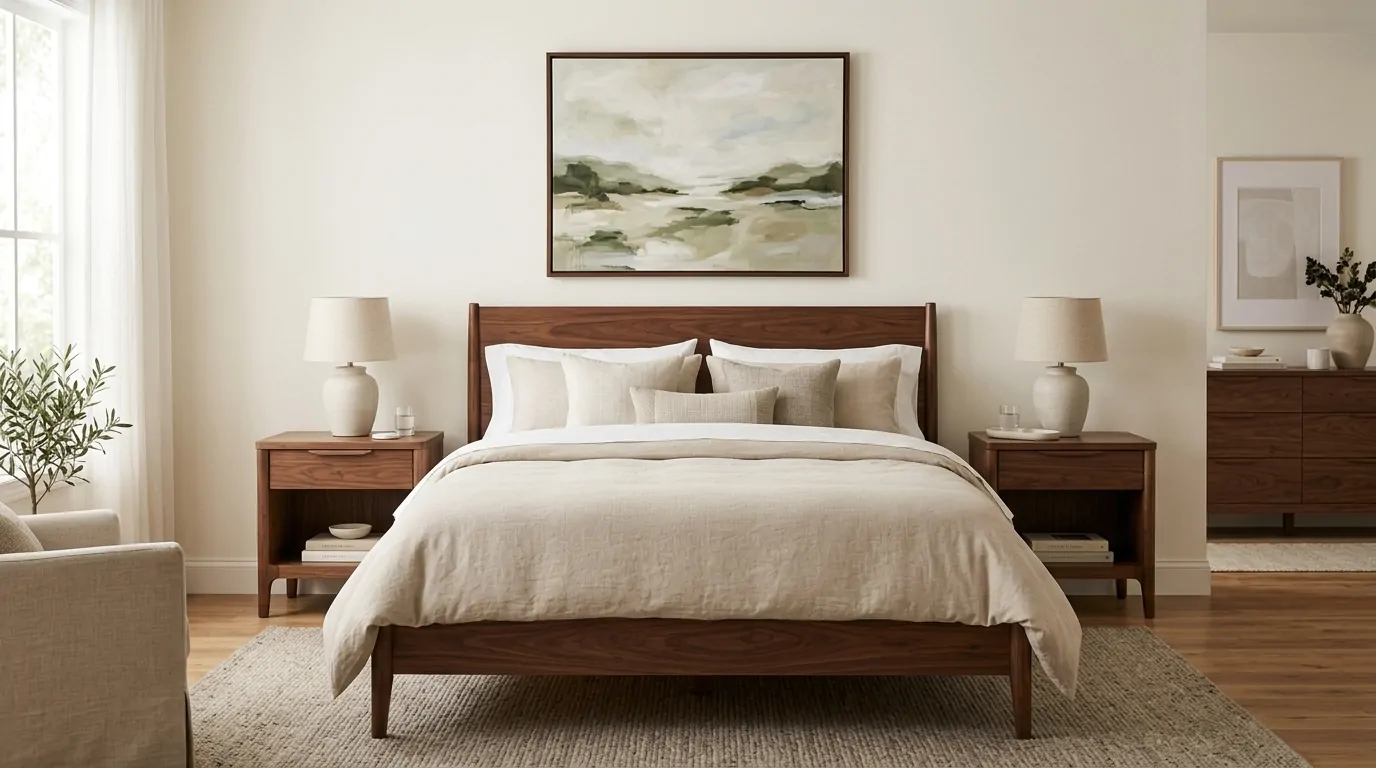
A standalone bedside table can look nice in the store but be disappointing in your bedroom if it doesn't match your bed.
The harmony between the two pieces of furniture is built on design, materials, and colors.
Harmonizing modern, Scandinavian or classic styles
The style of your bedside table should match that of your bed, and more broadly the ambiance of the room, so a light wood bed in a Scandinavian style will naturally call for a table with clean lines, without ornamentation.
Furthermore, a wrought iron bed with an ornate headboard will go better with a table with a more classic or industrial design.
To match the design of the bedside table, here are 3 simple guidelines: straight lines and neutral colors suit modern and Scandinavian styles; rounded shapes and warm hues suit classic or bohemian styles; raw metal structures and aged wood suit industrial styles.
Match the materials and colors to the bedding
The bedside table does not need to be made of the same material as the bed, but the colors should complement each other.
In this setting, a light oak bed with a white lacquered table works very well. An anthracite grey bed with a natural wood table also works well.
The rule of thumb for professionals is this: share at least one common element between the bed and the bedside table—a color, a texture, or a line. This is enough to create a sense of coherence without uniformity.
To further enhance the atmosphere of the room, you can also boost your bedroom decor with suitable lighting.
Do you need two identical bedside tables?
No, not necessarily, however, two identical tables guarantee perfect symmetry and a neat effect, but it is not mandatory.
Mixing two models of the same color but different shapes can also give a very successful result!
What matters more is that the two tables share a visual link: same shade, same material, same general style, because editorial interiors often play on deliberate asymmetry.
But if you're unsure, an identical pair remains the safest bet, especially in a room with harmonious dimensions.
Choose according to your profile and needs
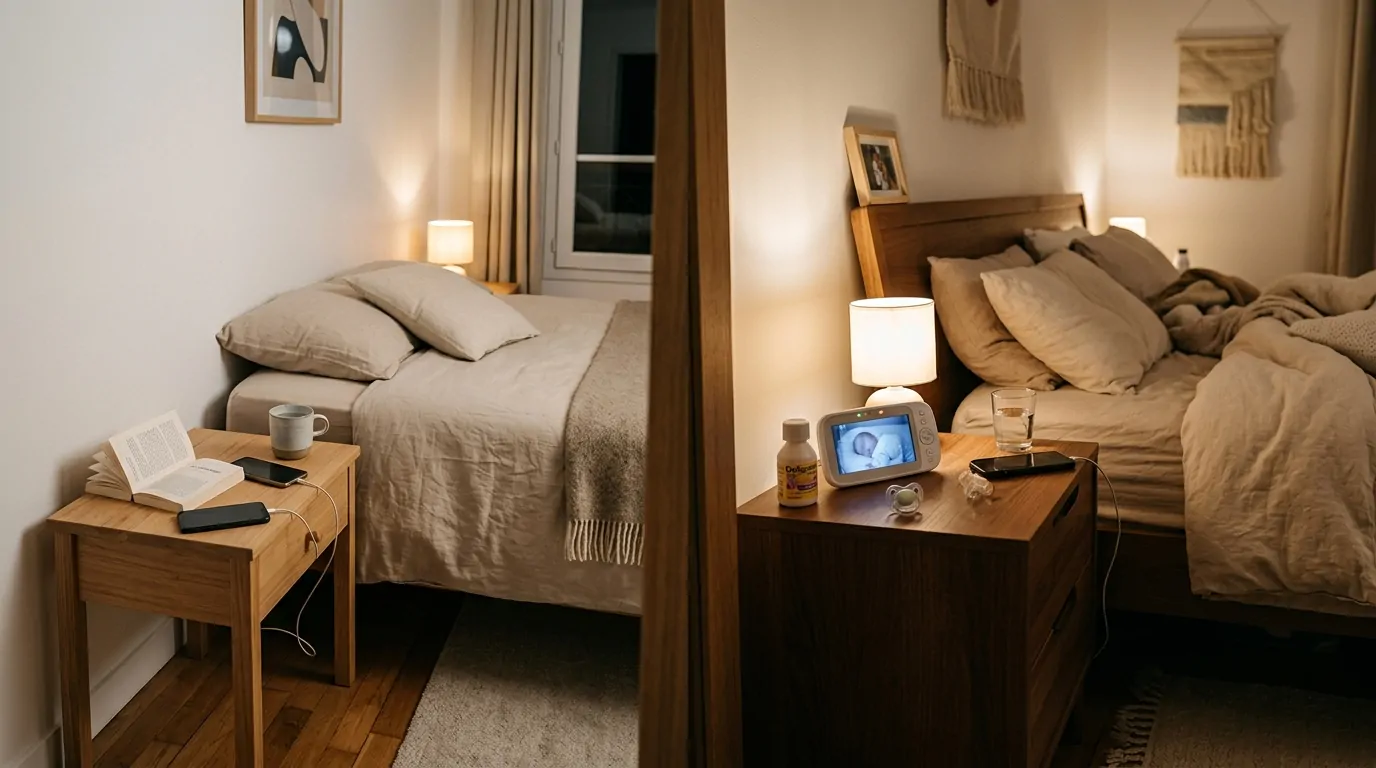
There is no such thing as a universal bedside table, and what fits perfectly in a spacious master bedroom may not necessarily be suitable for a child's bedroom or a studio apartment.
Here's how to adapt the choice to each specific situation.
The ideal bedside table for a small bedroom
In a small room, space is the main constraint, so the ideal solution is to opt for a suspended model or a shelf fixed to the wall: the floor remains free, which really changes the perception of the room.
If you prefer a piece of furniture on legs, choose a compact model, 30 to 40 cm wide maximum, with thin legs.
Transparent models made of glass or acrylic are also a good option: they occupy physical space without visually weighing it down.
Choosing a bedside table based on the available space takes precedence over any aesthetic criteria!
The best options for a child's bedroom
For a child, the priority is safety and practicality, so there should be no sharp corners, no glass.
Wooden or lacquered MDF models with rounded corners are the most suitable, but the height must correspond to that of the child's bed, which is often lower than an adult bed.
A closed drawer allows the child to store their nighttime belongings without creating visible clutter, so avoid overly complex models with many open compartments: in use, they quickly turn into a toy depot.
For a child's bedroom, choose a bedside table that is sturdy enough to withstand impacts, easy to clean, and without fragile decorative elements such as glass handles or very thin legs.
The priority criteria for a couple
For two people, the visual consistency on both sides of the bed is what structures the space.
The priority criteria are as follows: the same height on both sides, sufficient storage space for two separate uses, and a style that suits both occupants.
Buying bedside tables in sets of 2 simplifies the choice and guarantees harmony, and if the two people have different needs (one reads a lot, the other mainly uses their phone), it is possible to choose models that look identical but have different storage options depending on the versions available in the same range.
The checklist for buying the perfect bedside table
You now have all the criteria in mind, but before confirming your purchase, review these two sets of points, as they will help you avoid common mistakes and make a choice suited to your actual situation.
Questions to ask yourself before buying
- What is the exact height of my sleeping surface? Measure from the floor to the top of the mattress, then add 5 to 10 cm to find the target height of the table.
- How much space do I have between the edge of the bed and the wall? Minimum 60 cm of free passage, not counting the depth of the table.
- What items will I put on it each night? Lamp, phone, glass, book, medication? The answer determines the usable surface area and the type of storage.
- What is the dominant style of my room? Scandinavian, industrial, classic, bohemian? The table should fit in, not clash.
- Do I need one or two models? If the room is shared, consider consistency on both sides.
- What budget am I prepared to invest? Between an entry-level chipboard model and solid wood, the difference in lifespan is significant.
Comparative tests indicate that a well-maintained solid wood model lasts on average two to three times longer than an equivalent model made of particleboard. In the long run, the initial investment often pays for itself.
Some common mistakes to avoid
- Buying without measuring is the number one mistake. A table that's too wide blocks the passage, one that's too narrow becomes unusable.
- Ignoring the height of the mattress. A thick latex or memory foam mattress raises the sleeping surface by several centimeters compared to what you had before.
- Choose based on the photo only. The color on screen does not always match reality. If possible, see the furniture in store before buying online.
- Don't disregard the weight if you have a wall-mounted model. The wall fixing must be suitable for the type of wall (plasterboard, concrete, brick). A poorly anchored piece of furniture is dangerous.
- Forget about maintenance. A glass top or a white lacquered surface requires more attention than matte oiled wood. Think about your actual lifestyle.
- Buying something too big for fear of something too small. A large bedside table in a cramped bedroom visually overwhelms the entire space. A well-chosen, compact model is much better.
Answers to your questions
How can I tell if my bedside table is the right height?
Lie down in your usual sleeping position and extend your arm towards the table. You should be able to reach the surface without having to straighten up or bend over excessively. If your shoulder lifts, the table is too low. If you have to raise your arm, it's too high. The ideal height for a bedside table relative to the bed is generally the height of the mattress plus 5 to 10 cm.
Can a floating bedside table be placed in any bedroom?
Not without prior checks. A wall-mounted table must be fixed to a wall capable of supporting the load, such as concrete, brick, or reinforced timber framing. On placo without studs, special anchors are required, or this option is not recommended. The height of a wall-mounted bedside table is freely adjustable during installation, which is a real advantage, but installation requires more care than for a freestanding piece of furniture.
What is the difference between a bedside table with a drawer and one with a niche?
The drawer closes and protects items from dust, ideal for small accessories you don't want on display. The niche is an open space integrated into the furniture: practical for books or larger items, while still allowing everything to be seen. Models that combine both offer greater flexibility. The choice depends on what you actually store at night and your personal approach to tidiness.
Do you absolutely need two identical bedside tables in a bedroom shared by two people?
No, it's not mandatory. Two different tables can work very well together if they share a common element, such as the same color, material, or overall style. Deliberate asymmetry is even a popular design choice in contemporary interiors. That said, to guarantee effortless harmony, an identical pair remains the simplest and most visually appealing solution.
How much space should be left between the bedside table and the bed?
The distance between the bedside table and the bed is usually 5 to 15 cm. This allows easy access to items placed on it without the table being too far away. In a small bedroom where space is limited, some people place the table directly against the bed. The key is to ensure that there is at least 60 cm of clearance around the bed for comfortable movement.
