

In short
Building your own remote-controlled car track is a project that makes eyes light up!
Whether you are 8 or 40 years old, all it takes is a good afternoon of DIY, a few salvaged materials, and you can easily transform a corner of the living room or a bit of garden into a real playground.
This practical article explains how to build a homemade RC circuit, step by step, without breaking your budget and without advanced technical skills.
From the choice of materials to track maintenance, each section will provide you with concrete and immediately applicable answers.
The materials needed to build an RC circuit
Before laying the first border, you need to know what you'll need. The list varies depending on whether you're building a DIY indoor RC car track or an outdoor one. The requirements and materials are different.
In principle, the models you can find in off-road RC car should fit well both indoors and outdoors.
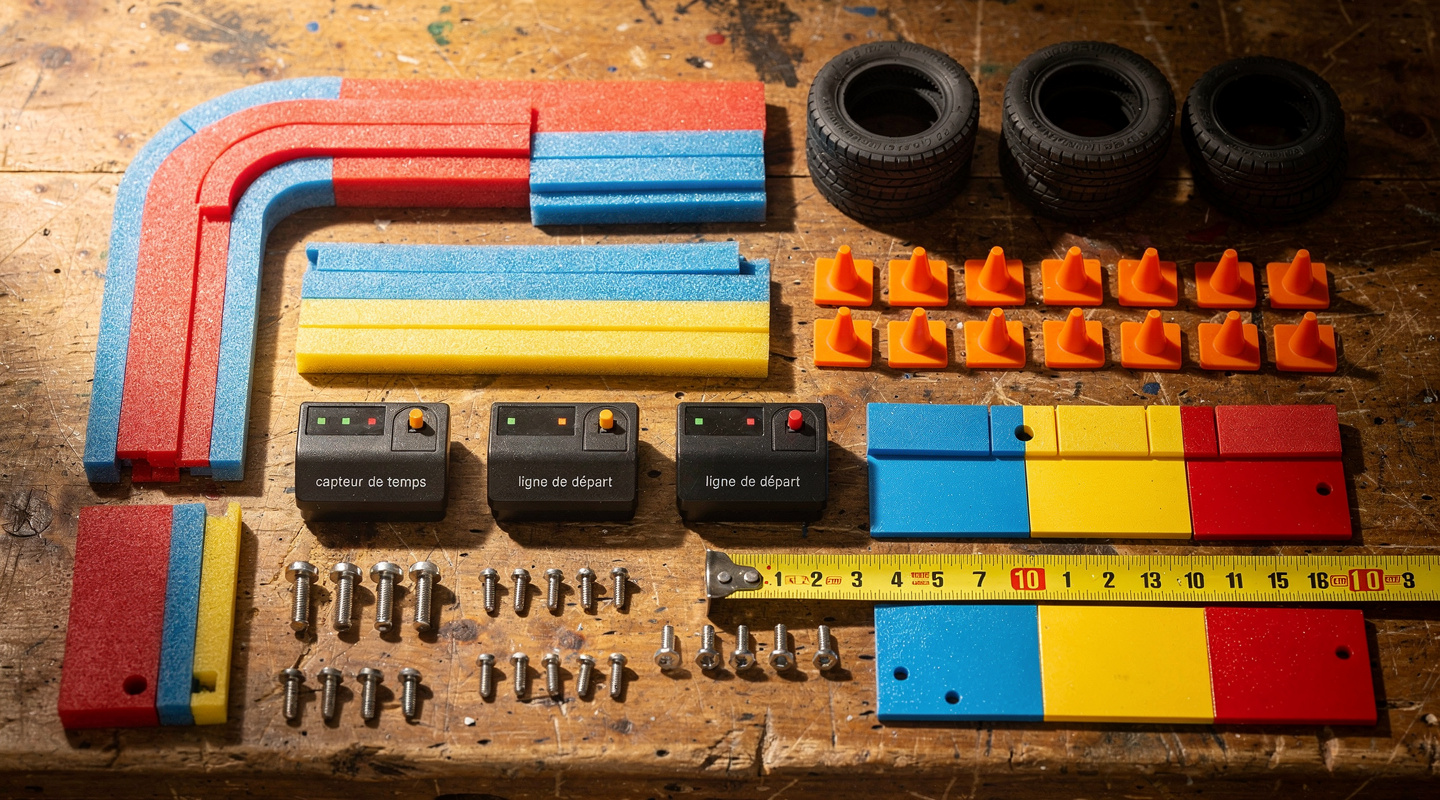
Materials for a DIY indoor RC track
For an indoor remote-controlled car track, lightness and ease of handling are paramount. You're working on a flat surface—parquet flooring, tiles, low-pile carpet—and the materials must be lightweight, clean, and easy to store.
Here's what you need:
- EVA foam puzzle mats : perfect as a rolling surface, they cushion shocks and protect the floor.
- Colored adhesive tape (gaffer tape or washi tape): for marking track lines directly on the ground.
- Foam blocks or cardboard bricks : to form borders and boundaries.
- Cereal boxes, toilet paper rolls : very effective improvised obstacles.
- A flat surface of at least 2m × 3m : the minimum surface area recommended for small RC cars of the electric toy car circuit type.
The advantage here: everything can be disassembled and stored away in minutes. Ideal for an activity with children.
Materials needed for an outdoor RC track
To build an outdoor remote-controlled car track, you need materials that are weather-resistant and stable on uneven ground.
- Treated wood planks or exterior plywood : to delimit track edges and form ramps.
- Stakes and rope : to mark out and temporarily delimit the route.
- Sand, compacted earth or fine gravel : to create a natural and stable riding surface.
- Stones or cinder blocks : to anchor the borders to the ground.
- Exterior acrylic paint : for marking starting lines, zones and obstacles.
If you wish to take your design further, be aware that the techniques used to make a fake rock out of cement or foam concrete are very well suited to creating decorative and realistic obstacles for an outdoor RC track.
🏎️ RC Track Budget Estimator
Enter your criteria to get a personalized cost estimate for your remote control car track.
Choosing the location and planning your RC circuit

A good track starts with a good choice of terrain. The location determines everything: the layout, the dimensions, the materials, and even the driving pleasure.
Always take the time to properly assess the space before you begin.
The ideal dimensions depending on the type of RC car
The ideal dimensions for a radio-controlled car track depend directly on the scale of the car.
Here are the most common ones
| RC car scale | Recommended track width | Minimum recommended length |
|---|---|---|
| 1/28 to 1/24 (minimum) | 30 to 50 cm | 3 to 5 m |
| 1/18 to 1/16 | 50 to 80 cm | 6 to 10 m |
| 1/10 (standard) | 80 cm to 1.2 m | 15 to 25 m |
| 1/8 and up (off-road) | 1.2 to 2 m | 25 m and more |
For 1/10 or 1/8 scale RC off-road cars, it is strongly recommended to plan a track at least 20 meters long for a truly enjoyable driving experience.
How to easily draw up a map of your route?
You don't need to be an architect to draw up a plan for a remote-controlled car track !
Start with a sheet of graph paper and a pencil. Represent the available space to scale, then draw a closed loop track with at least 2 to 3 turns, a main straight line and one or two obstacles.
Professionals recommend alternating right and left turns to balance tire wear and make driving more technical.
Once the plan on paper has been approved, transfer it to the ground with chalk or stakes before fixing anything permanently.
Adapt the circuit to the constraints of the available space
A 20m² garden doesn't offer the same possibilities as a 100m² plot. But even in a small space, setting up a RC car track is still possible with a few clever ideas.
For example, in a small space, favour figure-eight or spiral layouts, which maximize track length in a limited area.
Note: if you are planning a permanent outdoor circuit, consider the advantages of a bioclimatic pergola to partially cover the playing area and thus use it even in overcast weather!
If you live in a condominium or housing development, check the building regulations before installing a permanent outdoor RC track. The noise generated by electric RC cars can disturb the neighbors, especially during extended sessions.
Building your RC circuit step by step
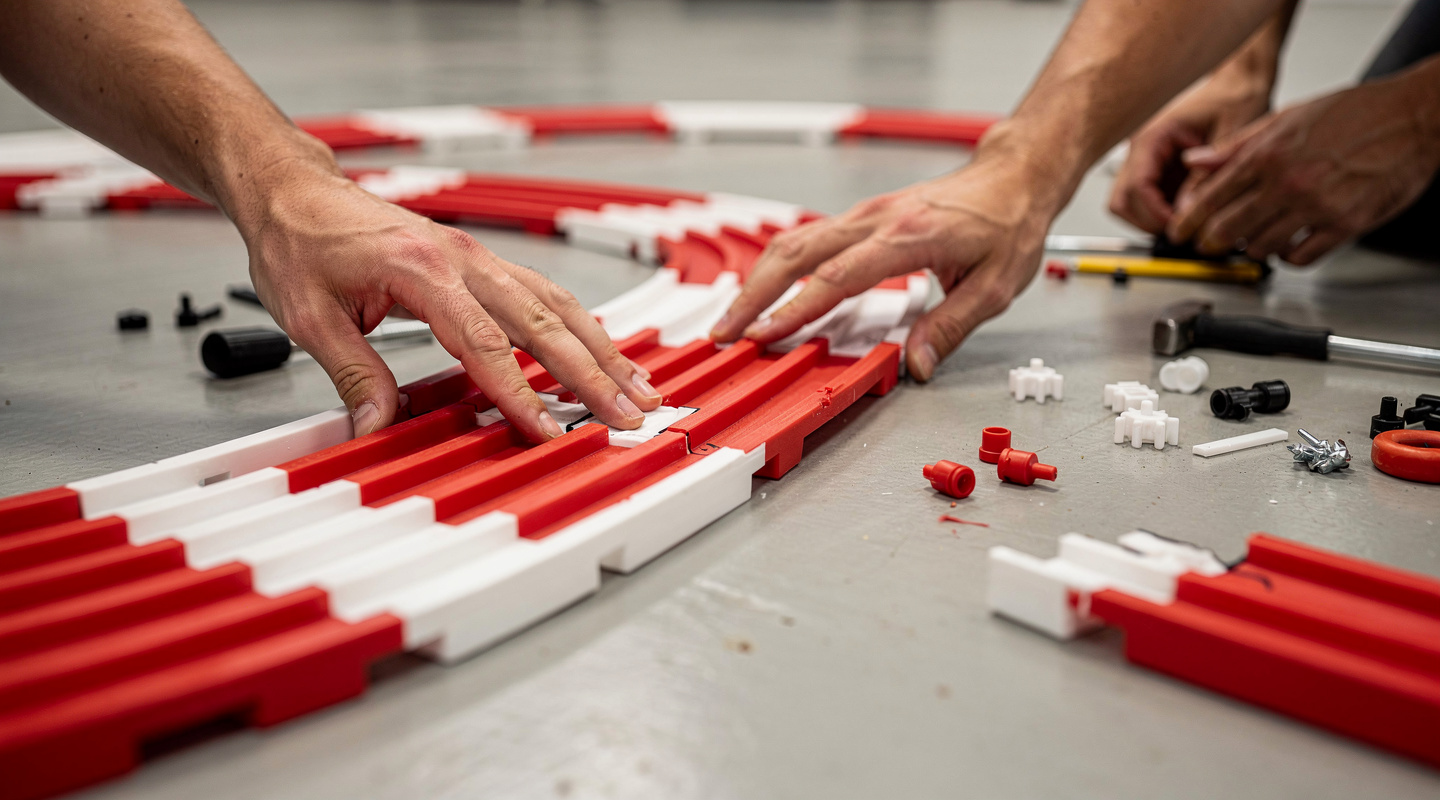
Once the plan is drawn up and the location confirmed, it's time to build!
This phase requires some organization, but no professional tools, and most of the steps are accessible to a beginner or even a novice.
Lay the borders and mark out the RC track
The borders serve two purposes: to visually define the track and to contain cars in case of going off the road.
To delimit a homemade RC track, several options work well.
Indoors, foam bricks, balsa wood planks or compressed newspaper rolls will do the trick.
Outdoors, 10cm high wooden planks, nailed to stakes driven into the ground, give a solid and clean result.
Recommended spacing between stakes: 60 to 80 cm for good rigidity.
Painting the outer edges red or white improves visibility, especially during sessions in low light conditions or with FPV goggles.
Create realistic turns, bumps, and obstacles
This is the most creative part!
of ideas for obstacles for a remote-controlled car track , and most cost almost nothing.
- The mounds : create mounds with compacted soil or sand, covered with geotextile fabric to prevent erosion. Ideal height: 5 to 10 cm for a 1/10 scale car.
- The ramps : a plywood board inclined at 15-20°, fixed to a wooden support. Simple and effective.
- The chicanes : miniature traffic cones or plastic bottles weighted with sand.
- The tunnels : a PVC tube 15 to 20 cm in diameter, buried slightly or laid flat.
A circuit with at least 3 different types of obstacles (bump, chicane, tight turn) multiplies the driving sensations and makes the sessions much more engaging, according to feedback from users passionate about model making.
Secure and stabilize the RC circuit components
A track that moves every time a car passes is frustrating.
To fix the elements of an RC circuit , a few simple techniques are sufficient.
Outdoors, anchor the edging with stakes every 60 cm and fill the gaps with soil. For movable obstacles such as railings, use deck screws or cable tensioners to secure them to the ground.
Indoors, strong double-sided adhesive tape is sufficient to fix lightweight items to parquet or tiled floors without damaging the surface.
Estimate the budget and reduce the costs of the RC circuit

The good news is that a homemade RC track can cost very little. It all depends on the ambition of the project and the resources you already have available at home.
The average budget for a homemade RC circuit
Here is a realistic estimate regarding the budget for building an RC circuit based on the level of equipment:
| Circuit type | Main materials | Estimated budget |
|---|---|---|
| Temporary indoor circuit | Ribbon, cardboard, foam | 0 to 15 € |
| Semi-permanent internal circuit | EVA mat, foam blocks, paint | €20 to €50 |
| Removable outdoor circuit | Wooden planks, stakes, paint | 40 to 100 € |
| Permanent outdoor circuit | Treated wood, gravel, concrete edging | €150 to €400 |
These figures are based on purchases from large DIY stores. They drop significantly if you reuse materials.
Economic alternatives using recycled materials
Recycling is often the best option for materials for a low-cost homemade RC track.
User feedback shows that some of the most ingenious circuits are built entirely from recycled materials.
Wooden pallets salvaged from a local shop make excellent edging and outdoor railings. Cut in half lengthwise, they form perfectly sized 10cm high barriers.
In general, the most commonly used are:
- Thick cardboard : for interior demarcations and temporary barriers.
- Old parquet floorboards : for building sturdy railings.
- Hollow bricks or reclaimed concrete blocks: for anchoring exterior borders.
- The soil and pruned plants : to shape the landscape naturally.
In this logic of reuse, knowing how to transform your green waste into compost or mulch can also be used to stabilize areas of loose soil around the track.
- Very low cost with recycled materials
- Complete customization of the track and obstacles
- Adaptable to all spaces, indoors or outdoors
- Family and creative activity from the construction stage
- Demountable and modifiable at will
- Limited durability for lightweight materials
- Regular maintenance is required outdoors
- Uneven surface possible if the ground is not prepared
- Noise that could disturb the neighborhood
Securing and maintaining your RC circuit over the long term
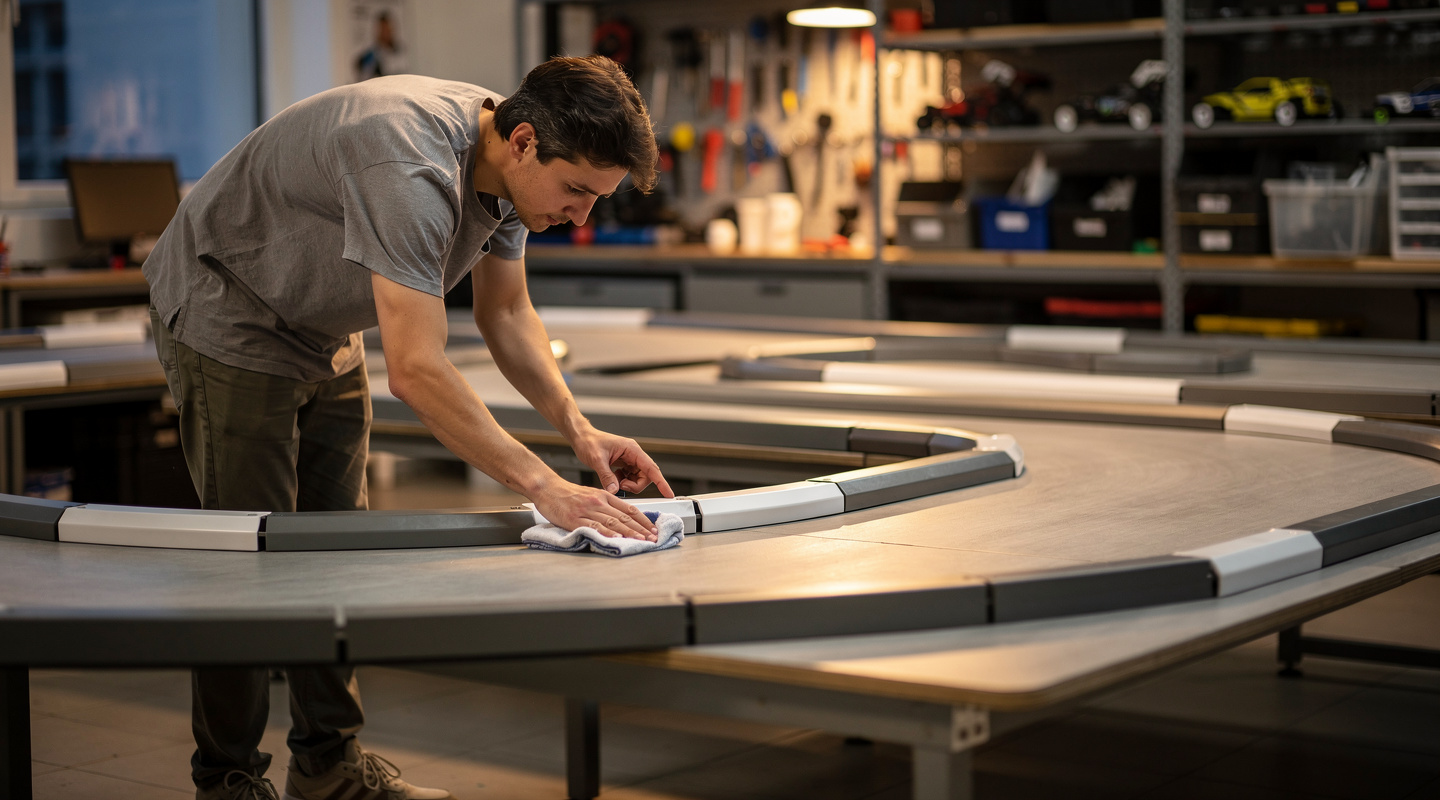
A good circuit is also a safe circuit that lasts over time!
A few simple precautions are enough to avoid accidents and extend the life of the track.
Safety rules for a home RC track
According to general safety recommendations for games and leisure activities, remote-controlled toys should be used in a suitable space, away from passageways and slippery surfaces.
To ensure the safety of a remote-controlled car track, here are the basic rules:
- Keep the circuit away from stairs, fragile furniture or areas where there is a risk of falling indoors.
- Provide sufficiently high curbs to stop cars (minimum 8 to 10 cm for fast models).
- Never let young children operate powerful RC cars unsupervised. Experts point out that some high-speed adult models can reach speeds of 40 km/h in real life.
- Outdoors, clearly delimit the play area to prevent the car from going out onto the street or a public space.
- Regularly check the condition of the batteries and power cables for electric models.
A remote-controlled car track intended for a 6-year-old child must absolutely use cars with limited speed (less than 10 km/h) and padded edges. Safety depends as much on the equipment as on the track layout.
Regular maintenance to preserve your RC track
A track that is not maintained deteriorates quickly, especially outdoors.
Here's how to preserve the lifespan of an RC track with minimal effort.
- After each session : collect the debris (dirt, pebbles, leaves) that can block the wheels or damage the bodywork.
- Each month in summer : check the condition of the wooden borders, tighten the fixings, treat the wood with oil or stain to prevent swelling due to humidity.
- After winter : check for any ground subsidence, fill in ruts and re-trace track lines if necessary.
- For indoor circuits : clean the foam mats with soapy water and check that the glued edges have not come loose.
Specialists in the field recommend applying a coat of exterior paint to the wooden edges at least once a year to prevent frost damage and extend the life of the circuit by several seasons.
With minimal but regular maintenance, a well-built outdoor RC track can last 3 to 5 years without major rebuilding , and investing a little time upfront in the quality of materials and fasteners will make all the difference in the long run.
Practical questions
How to build a homemade RC circuit without spending too much?
All you need are simple materials: cardboard boxes, wooden planks, hollow bricks, or rolls of fabric. For a temporary indoor track, the budget can be reduced to zero with cardboard and tape. The key is to plan a closed-loop track with a few obstacles to make it enjoyable.
What is the ideal width for a remote-controlled car track?
The track width depends on the scale of the car. For a standard 1/10 RC car, allow between 80 cm and 1.20 m of track width. For mini cars (1/24 or 1/28), 30 to 50 cm is more than enough. A track that is too narrow makes driving frustrating and increases the risk of going off the track.
Is it easy to build an outdoor remote-controlled car track?
Yes, with treated wood planks for the edging, sand or compacted soil as the surface, and a few stakes to anchor everything. A weekend's work is enough for a basic 10- to 15-meter outdoor circuit. The most time-consuming part is preparing and leveling the ground.
What obstacles can you create yourself for an RC circuit?
Bumps made of compacted earth, plywood ramps, chicanes made of weighted cones or bottles, and tunnels made of PVC pipe are the simplest to create. These elements require neither specialized tools nor expensive materials and transform a simple track into a real technical course.
How can I make an RC circuit safe for a 6-year-old child to use?
For a remote-controlled car track intended for a 6-year-old, choose a car with a limited speed (less than 10 km/h), install padded foam borders, and keep the track away from any walkways or stairs. Also, remove any sharp obstacles that could cause injury in case of an accidental collision.
