
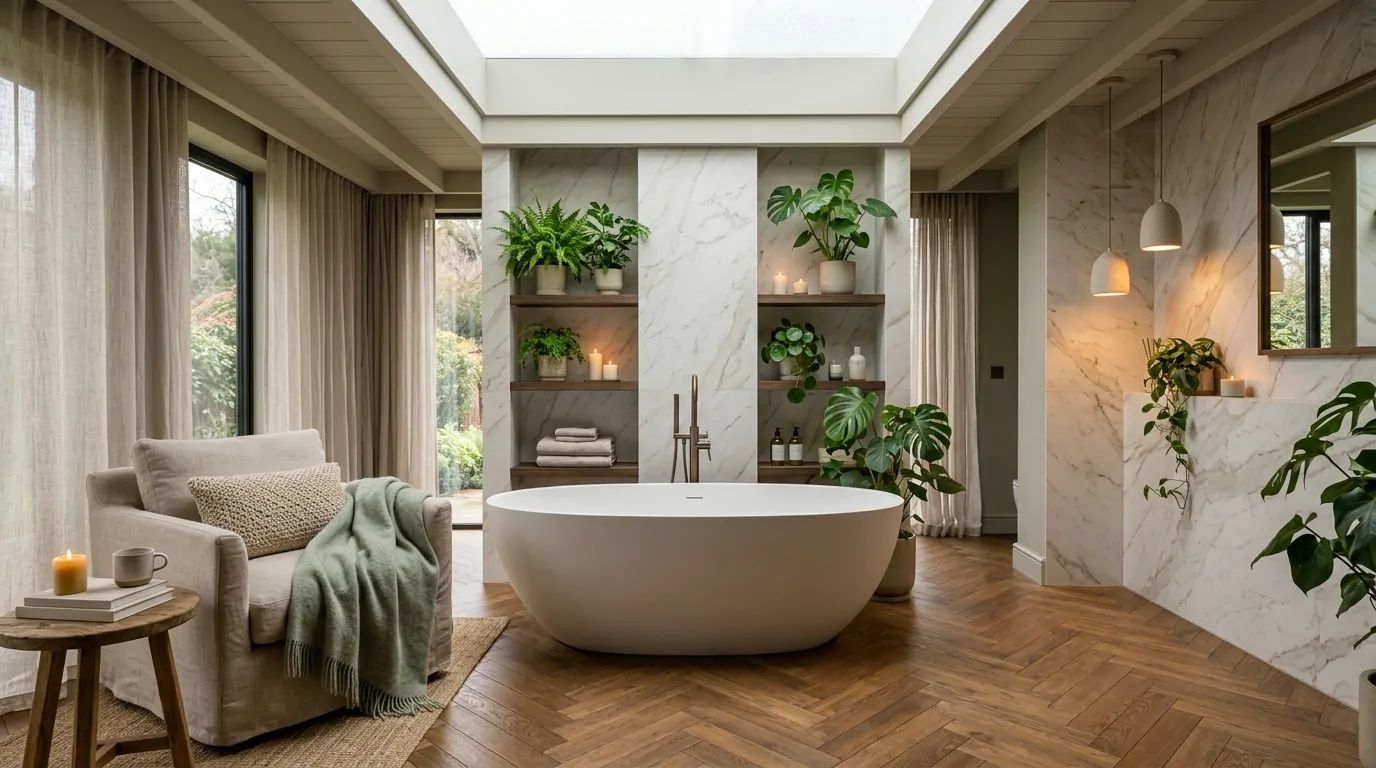
In short
The bathroom is no longer just a room where we wash. For several years now, it has established itself as a true living space, just like the living room or the bedroom.
It is a place where you take care of yourself, where you breathe, where you start and end the day in an atmosphere designed for comfort.
Transforming your bathroom into a living space means completely rethinking its layout. Circulation, light, materials, storage…
This article gives you concrete keys to successfully complete this transformation, regardless of the space you have available!
Transforming your bathroom into a living space: a new concept
What is a bathroom converted into a living room?
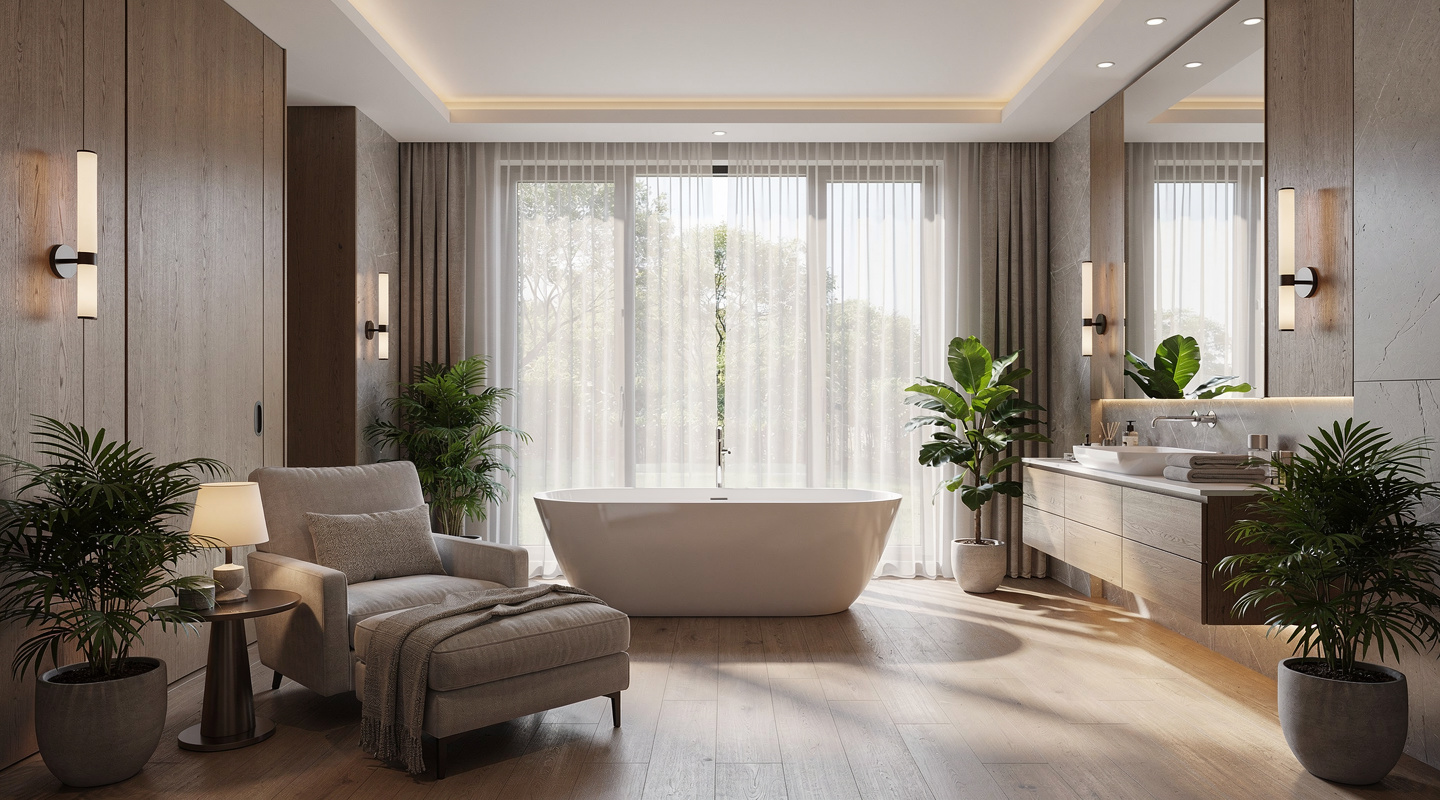
For a long time, the bathroom was designed to meet a single need: hygiene. A sink, a shower or a freestanding bathtub like this one, functional storage. That's all!
But this model has had enough of an era…
Transforming the bathroom into a living space means assigning it several functions at once: washing of course, but also relaxing, getting dressed, sometimes reading or listening to music in a peaceful setting.
The idea is to think of this room as one would think of a private living room.
In concrete terms, this translates into specific design choices: furniture that resembles that of a living room, clearly defined areas, and particular attention paid to light and materials.
Interior design professionals observe that this trend has accelerated with the rise of home wellness, particularly since individuals have been spending more time at home.
The idea is not to decorate a bathroom like a living room. It's to give it a real identity, a coherent atmosphere, and comfort thought out down to the smallest detail!
What are the advantages of rethinking this space?
- A relaxation space accessible every day, without leaving home
- Increased property value upon resale
- Real comfort gain for the whole family
- Aesthetic consistency with the rest of the accommodation
- Better organization thanks to separate zones
- Renovation budget often higher than for a standard bathroom
- Requires a minimum surface area to be fully utilized
- Technical constraints related to ventilation and humidity should not be underestimated
- Maintenance is more demanding if high-quality materials are chosen
Creating a bathroom that truly functions as a living space provides a comfort that can be felt from the very first morning.
of ideas for a convivial bathroom : a well-positioned freestanding bathtub, a discreet armchair, soft lighting… These details change everything about the daily experience.
Beyond immediate pleasure, a bathroom designed as a living space significantly increases the value of a property.
Agencies regularly find that a quality bathroom is among the decisive factors when viewing a property.
Rethinking traffic flow and space zoning
How to effectively open up your bathroom?
Knowing how to open up the bathroom is often the first question that individuals ask themselves during renovations.
The answer depends primarily on the existing configuration and structural constraints.
The most common technique involves removing a non-load-bearing wall between the bathroom and the master bedroom. This immediately creates a feeling of spaciousness and flow.
But that's not the only option!
You can also visually without major work: replace a solid door with a glass partition, choose a walk-in shower without a shower tray or high wall, or remove overly bulky furniture that blocks the view.
Before making any such changes, we encourage you to:
- Before any demolition, check whether the walls are load-bearing or not
- Plan for a suitable ventilation system if the room is enlarged or opened up
- Use the same flooring materials to visually merge two spaces
- Opt for tempered glass partitions to preserve brightness
Before demolishing any partition wall, have the wall's composition checked by a building professional. A load-bearing wall cannot be removed without prior structural reinforcement, otherwise the stability of the entire dwelling will be compromised.
Create separate zones: hygiene, relaxation, dressing
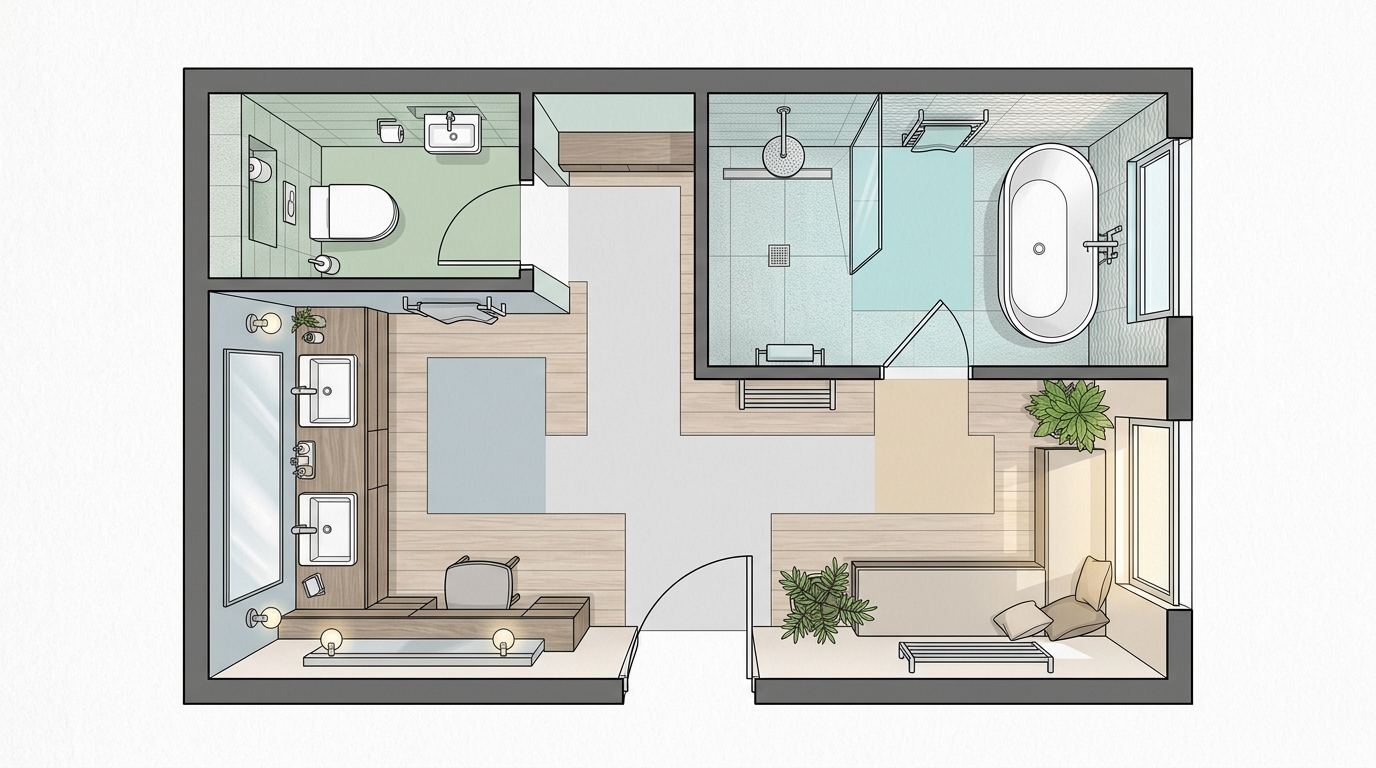
A contemporary bathroom layout is based on a simple principle: each activity has its own zone. The shower area is not mixed with the dressing area, and a relaxation chair is not placed next to the water spray.
Here's how to organize the three main areas:
| Area | Typical equipment | Recommended location |
|---|---|---|
| Hygiene | Shower, bathtub, sink, toilet (if integrated) | Near water inlets and outlets |
| Relaxation | Freestanding bathtub, seat, decorative niche, candle | A naturally bright or quiet spot |
| Clothing | Built-in wardrobe, full-length mirror, dedicated lighting | Keep away from direct sources of humidity |
This organization is not reserved for large retailers only.
In an average bathroom, light partitions such as a wooden screen or an open shelf are sufficient to delimit spaces without visually weighing down the room.
The bathroom is open to the master bedroom
The bathroom open to the master bedroom is one of the most popular layouts today. It blurs the line between an intimate space for relaxation and a space for personal care, creating a seamless and luxurious suite.
In practice, this can take the form of a large sliding glass door, a double entrance, or a simple arched passage without a door.
The care taken to ensure harmony of materials and colors between the two spaces is therefore crucial: the same parquet flooring, a common color palette, and lighting fixtures in the same style.
For a bathroom open to the bedroom without sacrificing privacy, a workshop-style glass partition with frosted glass or a thick linen curtain allows the separation to be modulated at will, while maintaining visual coherence.
🛁 Bathroom/Living Room Configurator
Answer the questions below to get personalized recommendations based on your profile and space.
Design solutions for a welcoming space
Choosing the right furniture for a modern bathroom
Designing a modern bathroom requires a complete rethink of the furniture. Out with the glossy white plastic furniture that screams mass-produced bathroom furniture.
Make way for pieces that look like they came straight out of a bedroom or dressing room.
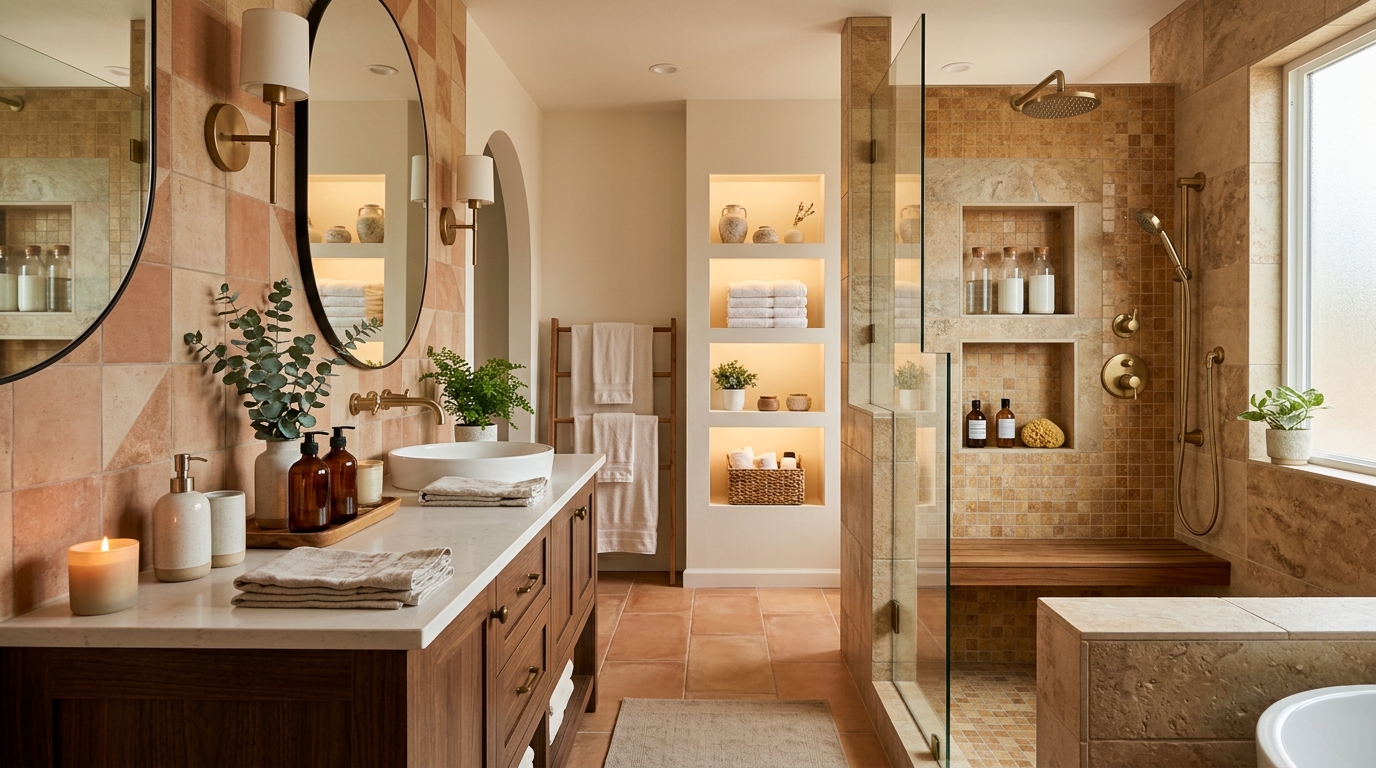
Today, professionals recommend washbasin units made of treated solid wood or smoked oak, countertops in natural stone or waxed concrete, and handles in brushed brass or handcrafted ceramic.
These materials provide immediate warmth and are highly resistant to moisture when properly treated.
To make the bathroom a place of relaxation, the furniture must also respond to a logic of height and proportion.
A low, wall-mounted cabinet visually enlarges the space. A cantilevered washbasin creates a strong architectural line.
Just as when choosing dining room furniture, the relationship between the height of the rooms, the floor area and the scale of the furniture plays a decisive role in the feeling of harmony.
Incorporate discreet seating and storage
A seat in the bathroom: this is an element that radically changes the perception of space.
A teak stool, a marble bath bench, a small armchair dressed in waterproof fabric are all these small elements that immediately signal that the room is not just functional.
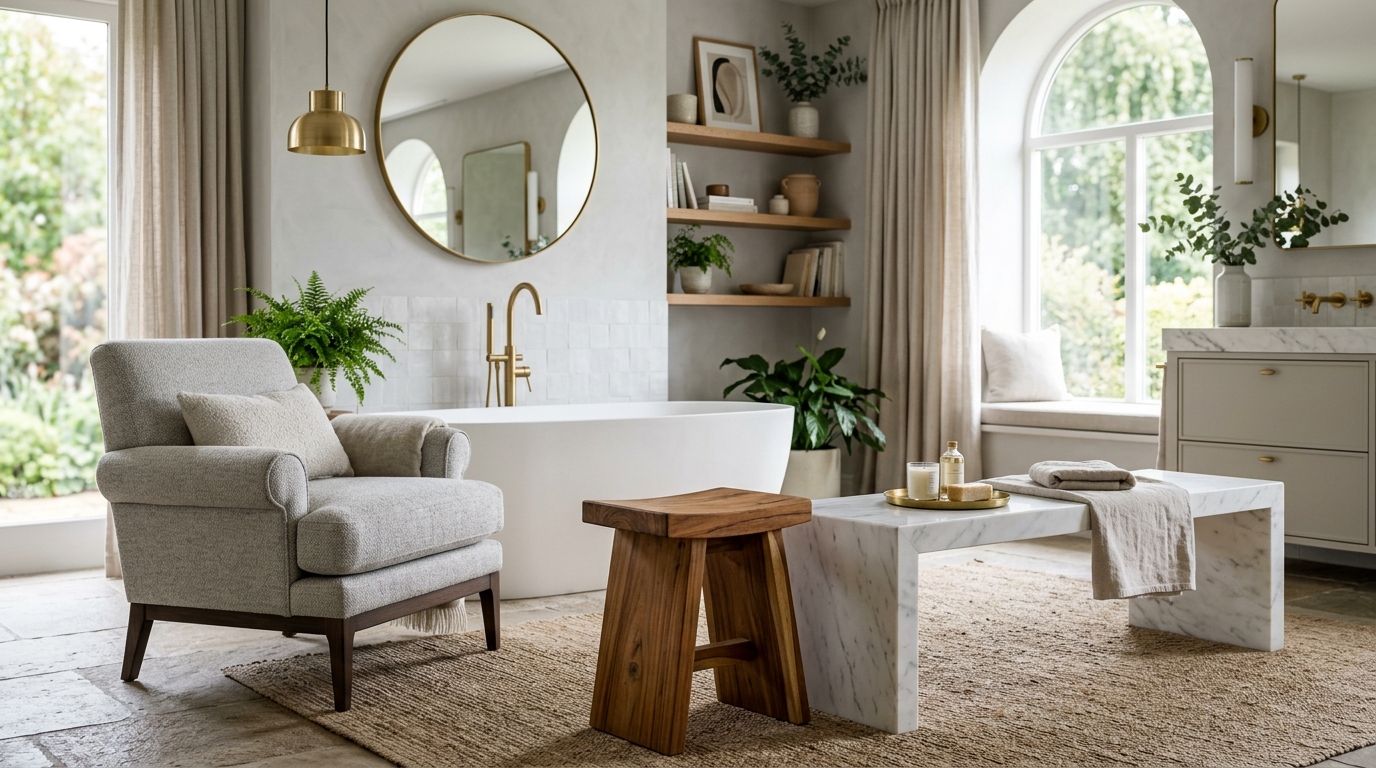
Storage solutions, on the other hand, must be designed to easily disappear.
Niches carved into the walls, built-in cupboards behind mirrored fronts, rattan baskets placed on floating shelves: discreet storage in a bathroom allows you to maintain a clean aesthetic without sacrificing practicality.
We can think of easy-to-implement ideas such as:
- A wall niche in the shower for toiletries
- Drawers hidden under the vanity unit
- A storage column built into the wall between two walls
- A mirror with a built-in compartment for small accessories
The goal is to keep everything clear and within easy reach. Always remember that a clean and uncluttered space is a calming space!
How to make the most of space in a large bathroom
Optimizing space in a large bathroom may seem paradoxical, but a large area that is poorly utilized gives an uncomfortable feeling of emptiness.
It is therefore a matter of structuring the space intentionally.
One could consider a freestanding bathtub positioned in the center of the room. For example, the major brands offered by the X2O store clearly illustrate how this centerpiece can become the focal point of the entire design.
Around it, the other zones are organized radiating outwards: shower on one side, dressing room on the other, relaxation area near the window.
In a large space, one can also afford strong architectural elements: a built-in shower column, a double sink on a long worktop, or even a small waterproof bookcase with a few chosen books.
In a large bathroom, draw up a scale plan before ordering anything. Define the zones (hygiene, relaxation, dressing) and follow a simple rule: leave at least 90 cm of free passage between each fixture for optimal comfort and ease of movement.
Lighting to create a warm atmosphere
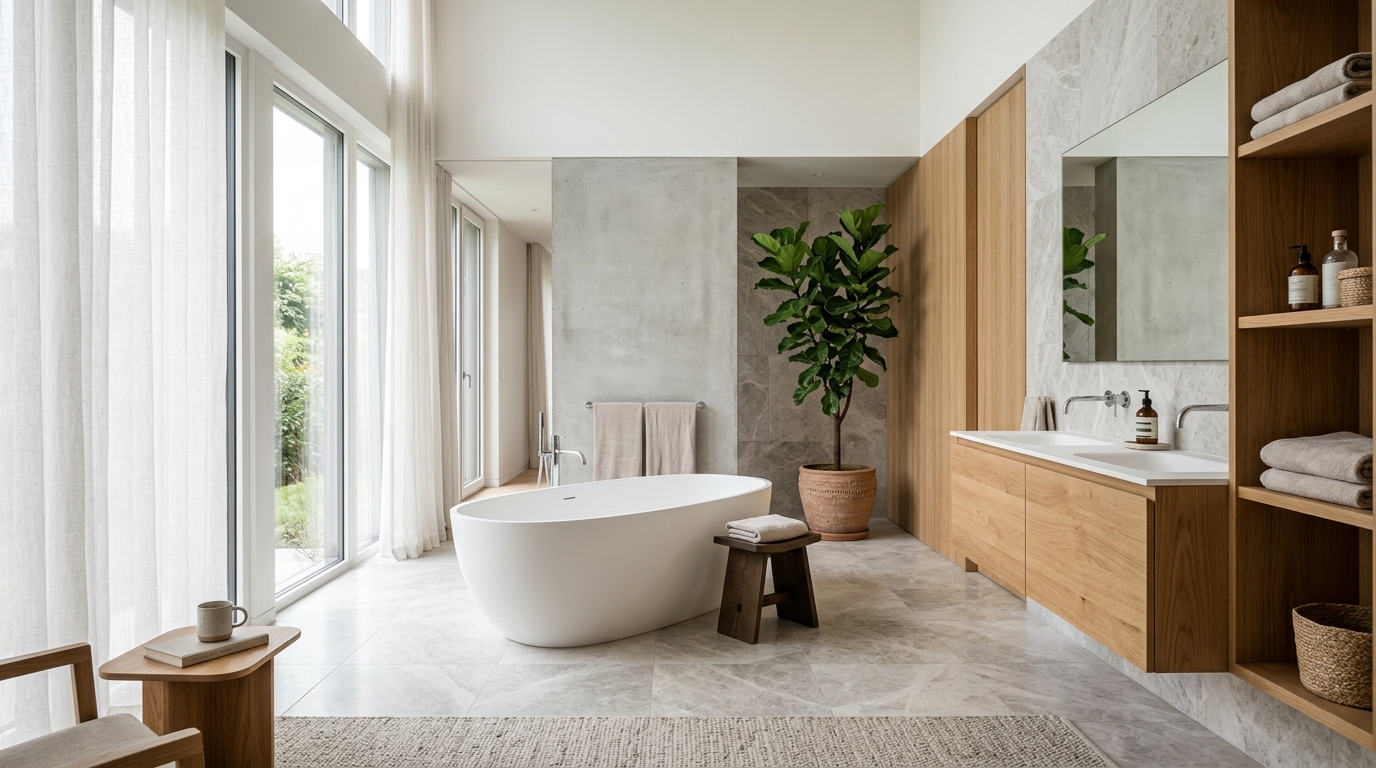
Maximize natural light in the bathroom
Natural light is the primary factor determining whether a bathroom makes you want to linger or leave quickly. Yet, it is often sacrificed in favor of privacy!
Several solutions exist to maximize the intake of daylight without sacrificing discretion.
Translucent glass windows let in light while preserving privacy, while skylights, for bathrooms on the top floor, radically transform the atmosphere.
In addition, the interior glass partitions allow light to circulate from an adjacent room.
Creating a cozy atmosphere in the bathroom therefore begins with this step: honestly assessing the natural exposure and working with it, not against it.
A north-facing bathroom deserves light-colored walls and well-positioned mirrors to amplify any available light.
According to ADEME, good management of natural light in the home significantly reduces the consumption of artificial lighting throughout the day… An argument that is both ecological and economic for rethinking openings during a renovation.
Install cozy and adjustable artificial lighting
A single, fixed light is the enemy of atmosphere!
Artificial lighting in a modern bathroom is conceived in several layers, just like in a living room or bedroom.
The first layer is functional lighting: bright light around the mirror for makeup or shaving.
The second is ambient lighting: recessed spotlights with dimmer, warm LED strip under suspended furniture, filament wall lights.
The third, more decorative, punctuates the space: a table lamp on a shelf, candles for relaxing evenings.
In all cases, even if a layer is incomplete or missing, you should generally consider:
- Opt for warm color temperature light bulbs (2700K to 3000K) for ambiance
- Install dimmer switches on at least two lighting circuits
- Provide dedicated lighting on the mirror side, at face level
- Use adjustable spotlights to highlight decorative areas
The light intensity must be able to go from very bright in the morning to very dim in the evening.
It is this modularity that makes the difference between a functional bathroom and a bathroom that truly resembles a living space.
Comfort at the heart of contemporary design
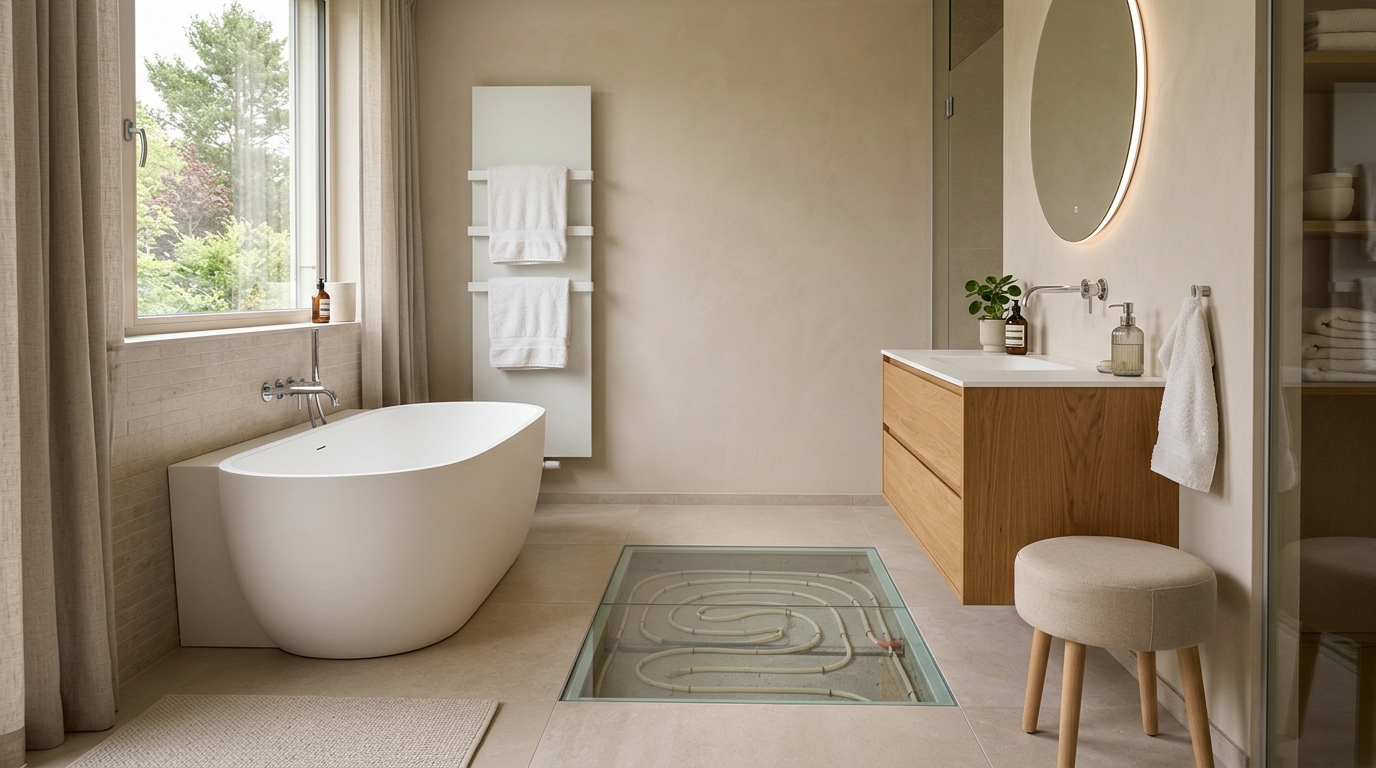
Warm materials and textiles for a soft atmosphere
The materials chosen for a bathroom determine 80% of its atmosphere.
Glossy white tiles and PVC flooring will never create the same emotion as travertine, solid wood, and polished concrete.
For a cozy chic bathroom, industry specialists advise focusing on contrasting materials: a natural stone wall opposite a piece of furniture in matte lacquered wood, a marble-effect tiled floor with a thick organic cotton bath mat.
These contrasts create visual richness without clutter!
Textiles play an often underestimated role, such as soft towels stored rolled up in an open niche, a bathrobe hanging from a brass hook, a linen bath mat for a natural and neat decoration
These small details instantly transform the atmosphere and are inexpensive.
The golden rule: limit the palette to a maximum of three materials to maintain visual consistency. Too many different textures tire the eye and give an impression of clutter.
Heating: underfloor heating and designer towel warmer
Stepping onto a cold floor when getting out of the bath or shower is the detail that ruins all the fun.
Underfloor heating in the bathroom is one of the most cost-effective investments in terms of perceived comfort, and it can be electric (easier to install in renovation) or hydraulic (connected to the central heating circuit, more economical in the long term).
The towel warmer is no longer just a technical piece of equipment. Current models are designed as design objects in their own right: graphic shapes, matte black or copper finishes, generous dimensions.
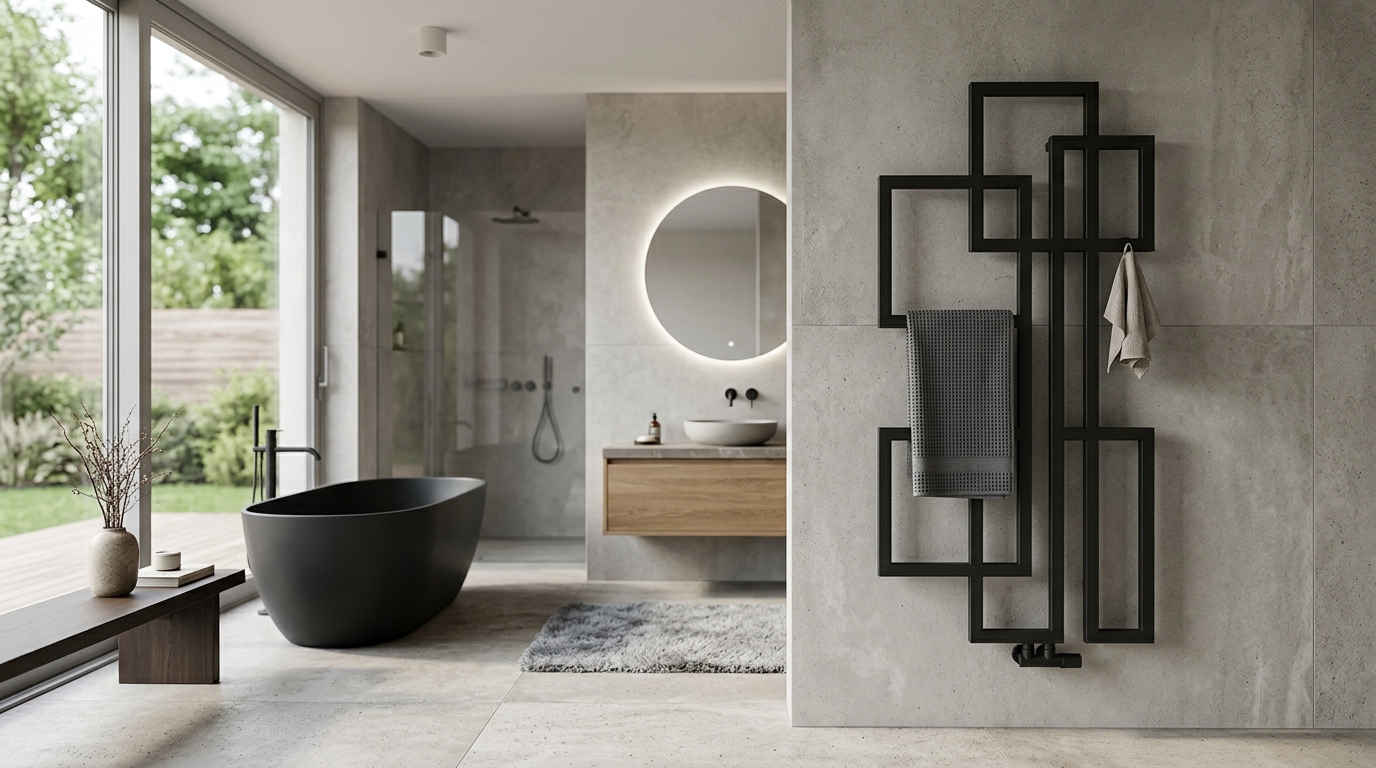
Some models combine heating function and sculptural aesthetics, becoming true decorative elements.
According to INRS recommendations on thermal comfort, maintaining a stable temperature in humid spaces directly contributes to well-being and reduces the risks associated with sudden temperature changes.
This is an additional argument for integrating underfloor heating from the design phase.
Managing humidity and ventilation without sacrificing design
It's often the neglected aspect of renovation projects. Yet a bathroom that doesn't breathe properly deteriorates quickly, regardless of the materials chosen!
Bathroom ventilation should be considered from the outset, and not added as a last resort, if possible.
A humidity-controlled mechanical ventilation system automatically adapts to the room's humidity level. It is quiet, efficient, and can be perfectly concealed within moldings or behind custom-made paneling.
The materials themselves play a role: large format tiles limit joints (areas conducive to mold growth), water-repellent treated wood resists well if properly maintained, and anti-humidity paints help to keep walls healthy over time.
An open-plan bathroom requires special attention to ventilation. Humidity can migrate into the bedroom and cause condensation and mold on the walls or textiles. Install a sufficiently powerful extractor fan and increase the airflow during showers or baths.
Concrete ideas based on the available space
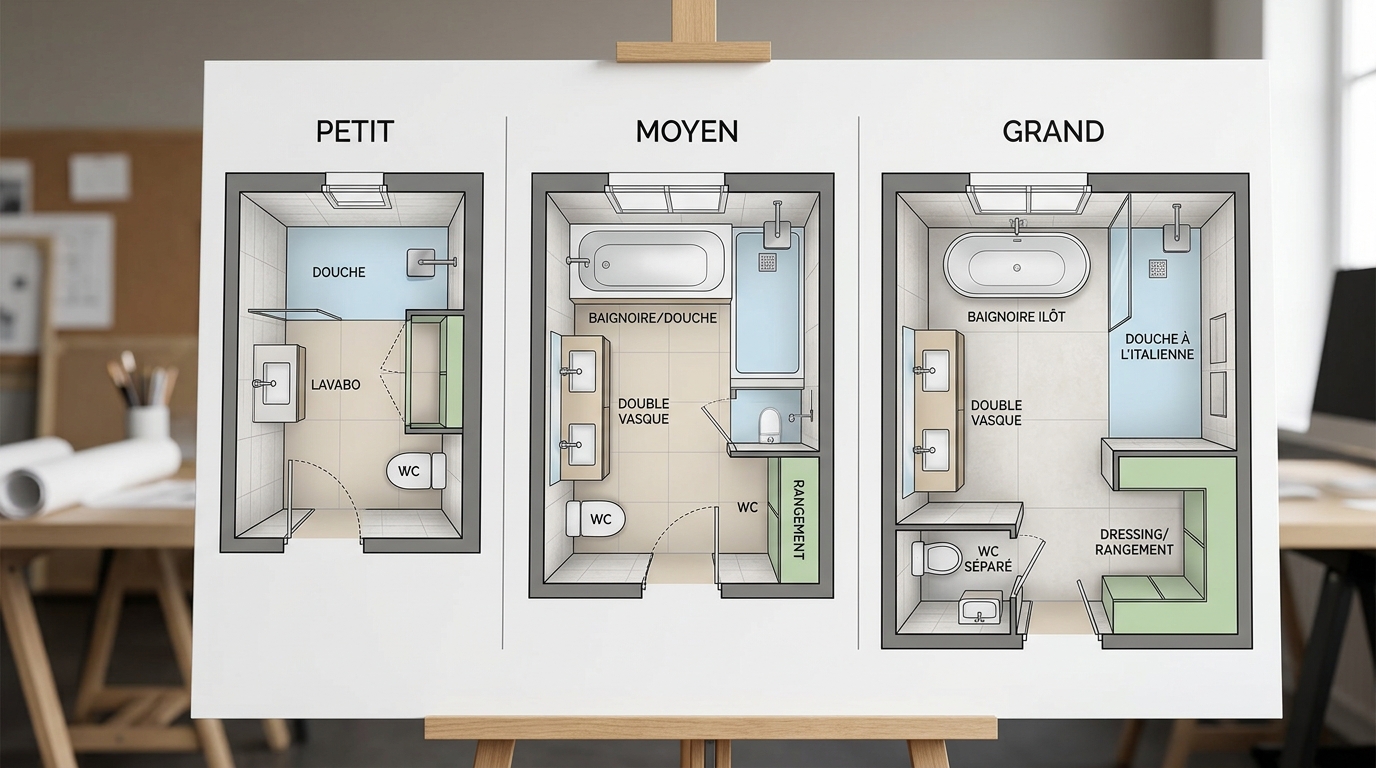
Small bathroom: tips for increased comfort
A small, fully equipped bathroom can definitely create a warm atmosphere if you play with space intelligently.
Examples of successful small bathrooms show that an area of 4 to 5 m² can be sufficient for a small bathroom renovation worthy of the name.
The tricks that make the difference: a large format mirror to amplify the depth, a walk-in shower without a tray to eliminate visual boundaries, and a wall-mounted vanity unit to free up floor space.
Height is your ally! High wall shelves free up floor space and guide the eye towards the ceiling, expanding the perception of space.
Average bathroom: creating a relaxation area
Between 6 and 10 m², the average bathroom has enough space to integrate a real relaxation area without compromising functionality.
This is the ideal configuration for a small bathroom with a bath: a bathtub built into an alcove, complemented by a separate shower, a double sink and a discreet dressing area.
A wooden stool, a decorative shelf and well-thought-out lighting are all it takes to transform a standard bathroom into a space that really makes you want to linger.
Furthermore, it is also necessary to take into account that the renovation budget for this area is generally between 8,000 and 20,000 euros depending on the services chosen.
Large bathroom: creating a true master suite feel
Beyond 12 m², the master suite-style bathroom becomes fully achievable!
Freestanding bathtub in the center of the room, rain shower, integrated dressing room, reading corner with an armchair and a wall light: the most beautiful bathrooms seen in architecture magazines often correspond to this configuration.
The challenge is to structure the space to avoid emptiness.
Lightweight glass partitions, changes in flooring to delineate areas, or a slightly raised platform under the bathtub are all ways to add depth and rhythm to a large space.
In a large bathroom, a successful renovation almost always incorporates careful attention to transitions: the same tiles between the bathroom and the adjacent bedroom, continuity of wall colors, and identical light fixtures on both sides of the passageway. This visual consistency immediately creates the feeling of a private hotel suite.
Practical questions
How to transform an ordinary bathroom into a comfortable living space?
Transforming the bathroom into a living space relies on three key elements: defining distinct zones (hygiene, relaxation, dressing), choosing warm and inviting furniture that complements the rest of the home, and carefully planning the lighting with at least two adjustable circuits. A large bathroom isn't necessary: a well-designed small bathroom can offer just as much comfort as a large, poorly utilized one.
What is the minimum surface area required to create a bathroom that can also be used as a living space?
There is no absolute minimum size, but from 6 m² you can already incorporate a relaxation area with a bathtub or shower, a dressing area, and ambient lighting. Below 5 m², the concept remains achievable but focuses primarily on materials, light, and discreet storage rather than on creating multiple zones.
Does an open-plan bathroom/bedroom cause humidity problems?
Yes, that's the main risk of an open-plan bathroom/bedroom. The humidity generated during showers or baths can migrate into the bedroom and cause condensation on the walls or textiles. To prevent this, you need a powerful humidity-controlled mechanical ventilation system (VMC), a high-flow extractor fan, and moisture-resistant materials in the transition zone.
What materials should you choose for a warm and easy-to-maintain bathroom?
For a bathroom that's both inviting and easy to maintain, professionals recommend large-format tiles (fewer grout lines), water-resistant treated solid wood, polished concrete protected by a suitable varnish, and resin or Corian surfaces for vanity tops. The idea of a maintenance-free bathroom remains an ideal, but these materials come much closer to it than classic white tiles with thin grout lines.
Is it possible to create a cozy atmosphere in a bathroom on a small budget?
Absolutely. Creating a cozy atmosphere in the bathroom doesn't necessarily require a complete renovation. A few low-cost actions are enough to radically change the ambiance: replace the light bulbs with warm-light models with a dimmer switch, add a thick bath mat, change the faucets to brushed brass models, and place a few moisture-resistant plants such as ferns or pothos.
