
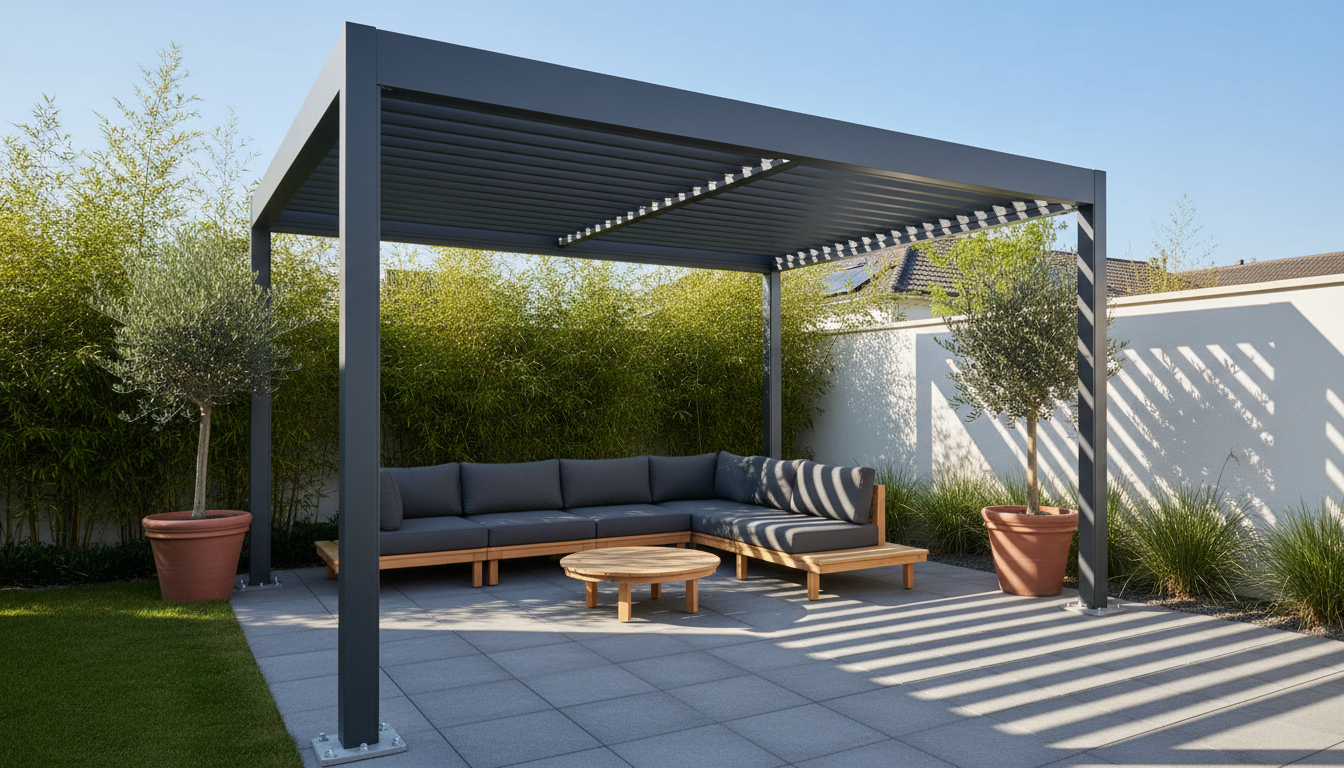
Summers are getting longer, the transitional seasons are becoming unpredictable, and the terrace often remains unused. Too hot in August, too humid when the clouds arrive, not adaptable enough to the light.
It is in this context that a bioclimatic pergola makes all the difference, especially the freestanding version sold as a kit. We're talking about a shelter that adapts to everyday life: opening, orienting, closing, ventilating, protecting. All without turning the garden into an endless construction site, or exceeding the budget of a conservatory.
But the promise is not everything: the cost, maintenance, certain installation constraints and the actual resistance depending on the configuration remain points to be considered.
Between comfort and requirements, the subject deserves better than a sales brochure: it requires concrete examples, clear benchmarks, and an honest reading of the advantages as well as the limitations.
Freestanding bioclimatic pergola kit: its simple definition and the uses that change everything
A freestanding bioclimatic pergola kit is an outdoor structure equipped with a roof of adjustable slats, most often made of aluminum.
The idea is simple: instead of a fixed roof (canvas, polycarbonate, reed), you adjust the opening of the slats to control the light, shade and air circulation.
In a freestanding version, the pergola stands on its own posts, without being attached to a wall. And when sold as a kit, it arrives in ready-to-assemble components, with instructions, numbered profiles, and an assembly process designed to minimize major construction work.
To get a concrete idea, let's take the case of Léa and Karim, who live in a house on the outskirts of Montpellier. Their garden table was unusable between 2 p.m. and 6 p.m. in the summer: too much heat, too much glare.
With a bioclimatic pergola, they adjust the louvers to create sun protection without plunging the entire space into darkness. When the air is heavy, they open them wider: the hot air escapes, providing natural ventilation that makes the space more breathable.
The result: they stay outside, even when the day is hot, without depending on a parasol that moves at the slightest breeze.
This type of product is also chosen for purely aesthetic reasons. Because it is freestanding, the pergola can be placed at the back of the garden to cover an outdoor lounge, near a swimming pool, or away from the house to create a quieter dining area.
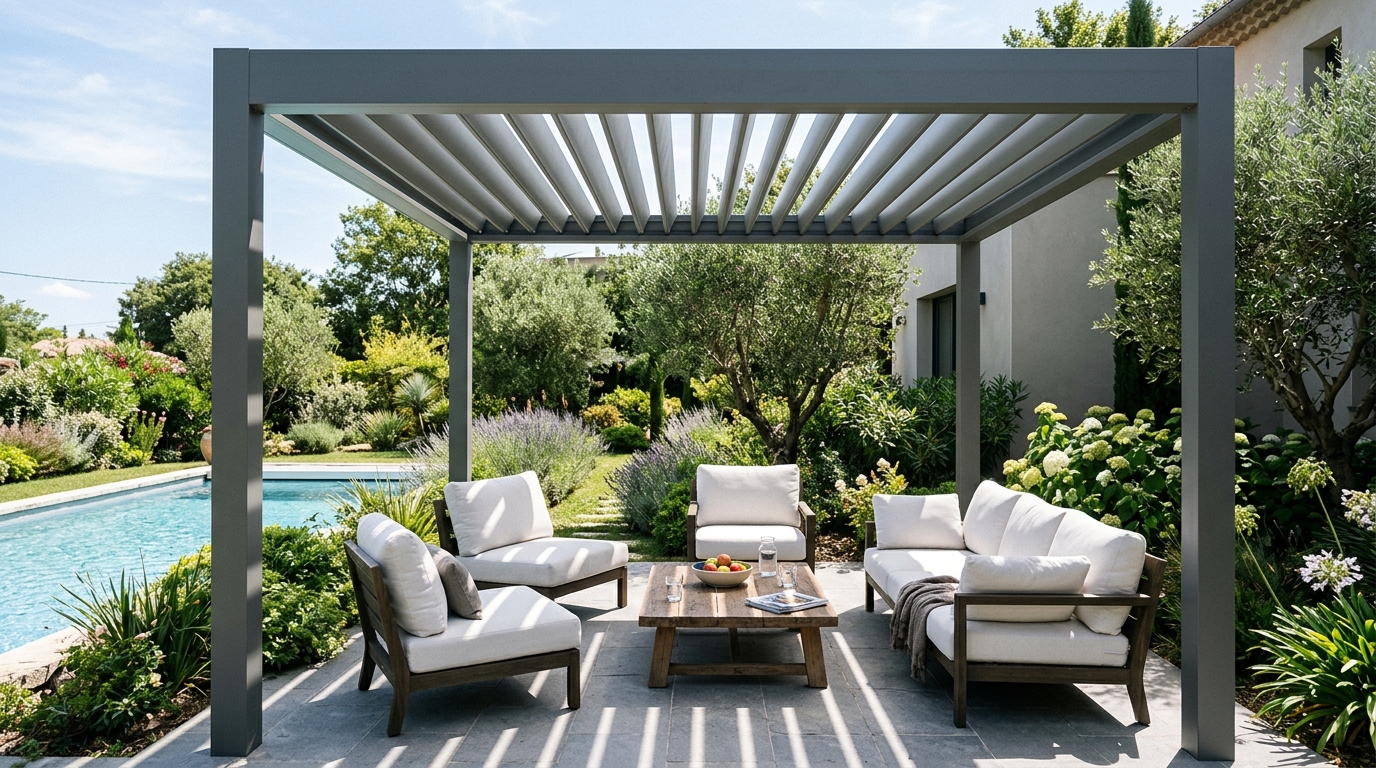
In a courtyard, it sometimes replaces a light pergola, but with a more architectural feel.
The contemporary look of aluminium, especially in sober shades (anthracite, off-white), quickly gives an impression of organised space, almost like an open-air room.
And it is often this detail that changes the way it is used: because we no longer "put out a table", we actually live outside!
When choosing, many hesitate between a traditional pergola and a bioclimatic pergola. The simplest guideline is adaptability: a fixed structure provides protection but doesn't adjust. A bioclimatic pergola, on the other hand, adapts to the day's changing conditions.
This explains why it is increasingly seen as a compromise between simple shelter and extension, without tipping into a totally enclosed space.
Before discussing budget and constraints, it is therefore necessary to keep this point in mind: we are not just buying a roof, we are buying a more flexible way of inhabiting our outdoor space in a more relevant way.
The value of a freestanding bioclimatic pergola kit is measured less by its shape than by its ability to make a space usable when the weather remains unpredictable.
The advantages of a freestanding bioclimatic pergola kit: modularity, comfort and aesthetics
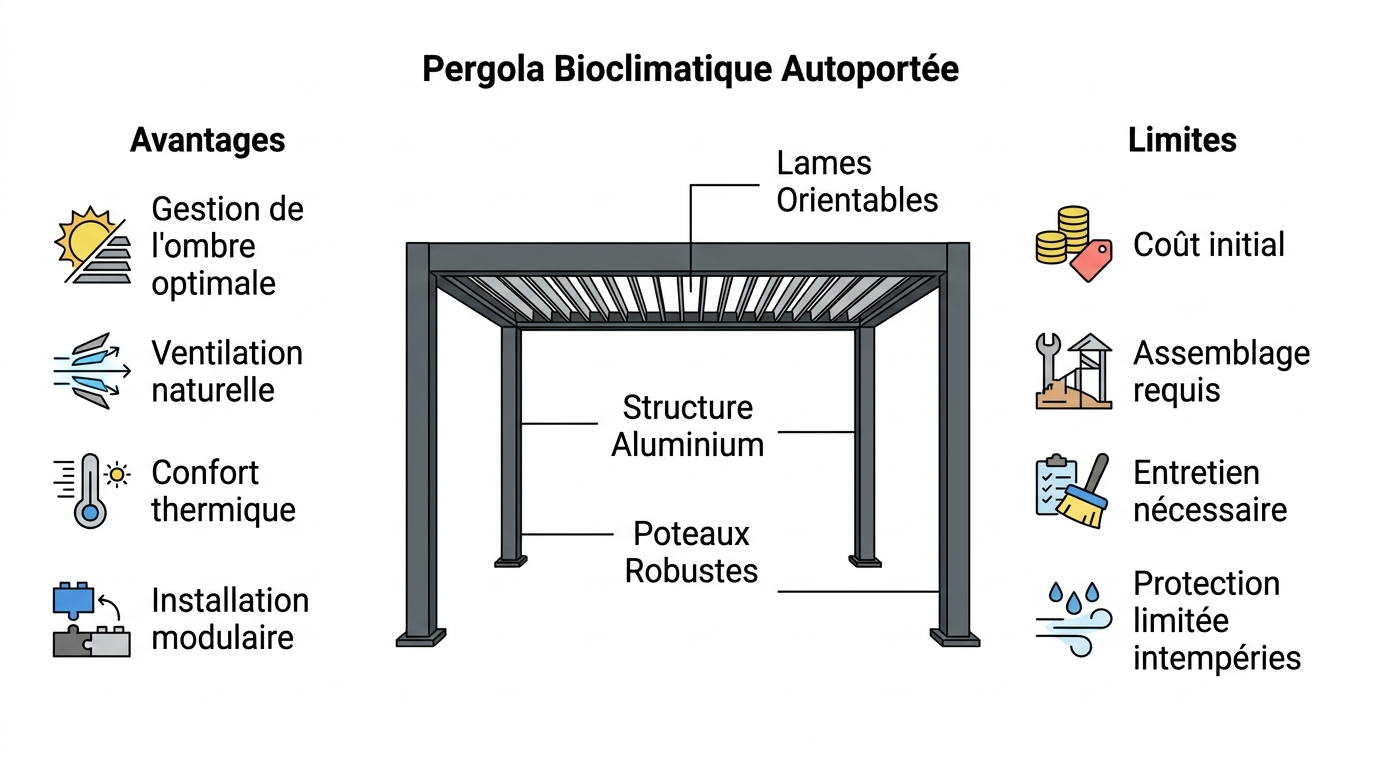
The first benefit, the one you feel from the first week, is comfort. The adjustable slats allow you to create intelligent sun protection: you block direct sunlight while letting in light.
In practice, this avoids the cave effect that we see with some opaque fabrics.
On a south-facing terrace, this shade management often makes it feel several degrees warmer.
Indeed, natural ventilation is the other major advantage. By slightly opening the slats, the hot air escapes above, and a light breeze is created.
It's not air conditioning, but it's a very real comfort for summer meals, naps on a deckchair, or an aperitif that doesn't turn into a sauna.
And when the rain arrives, the complete closure of the roof, on some models, channels the water towards drains provided in the structure.
It is easy to understand why many say "we use it almost all year round": the terrace ceases to be a place reserved for two months of good weather.
Homeowners readily describe a difference of about 5°C compared to an uncovered area during the hottest hours, especially when the air is circulating well.
The modularity of the kit is a major factor in the decision. On paper, it promises easy installation, and in practice, that's often true… if the support is ready.
Once the slab is stable and level, assembly is mainly a matter of method, time, and tools. For a couple of DIY enthusiasts, a weekend can be enough for a reasonably sized project.
And if you prefer to delegate, the kit does not prevent professional installation: it sometimes reduces the construction time, therefore the labor bill.
Another interesting advantage: the autonomy of the self-propelled version.
It doesn't need a load-bearing wall, which opens up very practical scenarios such as:
- Create a dining area in the middle of the garden, away from the bay windows to avoid interior noise.
- Covering a spa or jacuzzi on an adjoining terrace, without altering the facade.
- Create a shaded area near a swimming pool that remains bright, even at the end of the day.
- Install in a courtyard where backing is impossible (fragile walls, property boundaries).
Regarding longevity, powder-coated aluminum plays a reassuring role: no rust, good resistance to UV rays, and real resistance to weathering (rain, sea spray, temperature variations).
Where wood regularly requires staining and treatment, aluminum only needs careful cleaning.
And in terms of personalization, you can go far: motorized blades, integrated LED lighting, weather sensors (rain, wind) that automate closing when you are away.
For everyday use, it's more than a gadget: it's the comfort of not having to run outside at the first sign of cloud.
Its advantages are mostly "invisible" on the product sheet, but obvious in use: you gain freedom of placement, thermal comfort, and quality of outdoor living.
To visualize the result and possible configurations, a video demonstration often helps to imagine a real-life situation, between open blades and closing them in case of rain, etc
The limitations of a freestanding bioclimatic pergola kit: budget, maintenance, installation constraints and performance
The most obvious limitation is the cost. Even as a kit, a bioclimatic pergola remains more expensive than a traditional pergola. For a comparable surface area, the price ratio is often 2 to 2.5.
In other words: where a fixed structure can be found for around €3,000 to €5,000 for a standard size, a motorized bioclimatic structure easily goes up to between €7,500 and €15,000 depending on the range and options.
And for a surface area of 20 m² including installation, many projects are priced between €10,000 and €18,000.
It's a worthwhile investment, but one that deserves careful consideration: will you really be using it for 9 to 10 months a year, or only a few weeks in the summer?
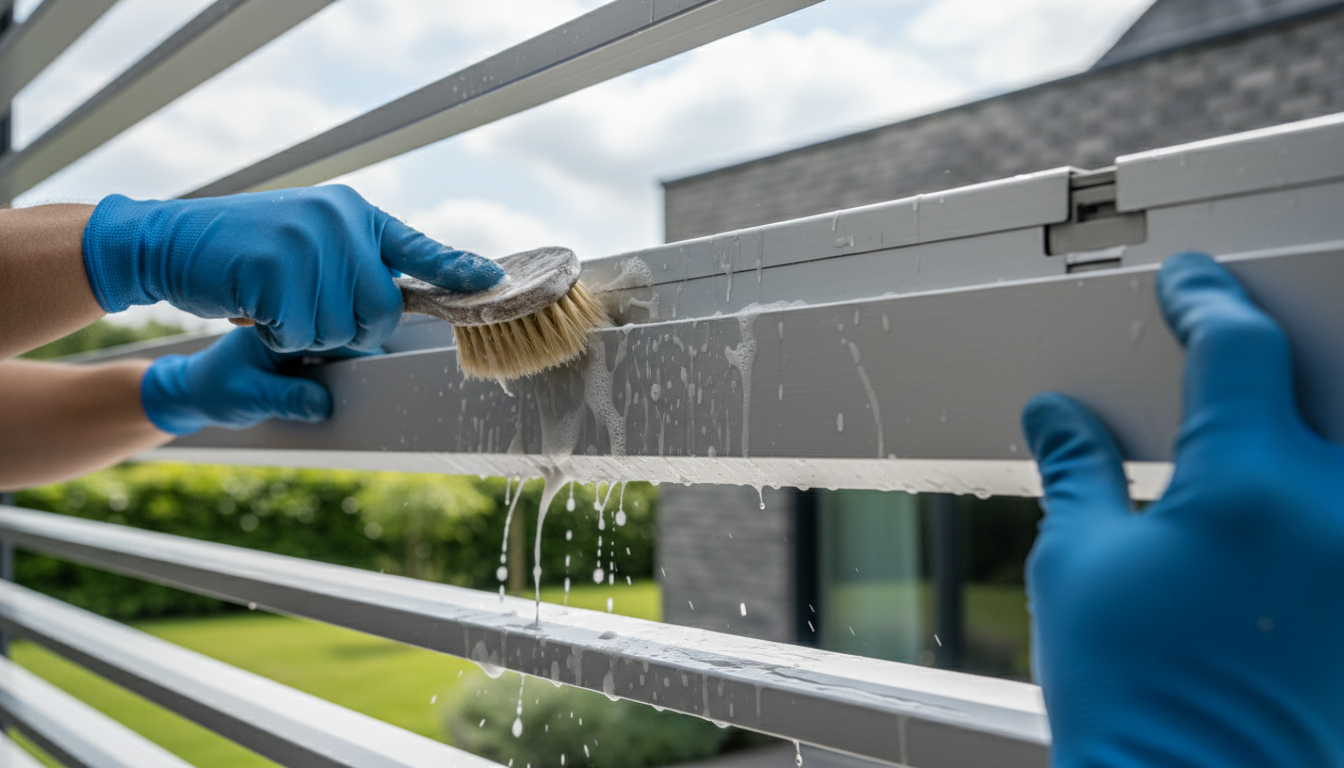
Maintenance, moreover, is often underestimated because aluminum "doesn't move." The material holds up well, yes, but the mechanism itself is subject to dust, pollen, pollution, and sandy rain.
To maintain good blade mobility, simple but regular cleaning is best. Ideally: a quick wash with soapy water from time to time, and two more thorough cleanings in spring and autumn.
Without it, you see squeaking, blades that strain, or dirt that gets ingrained.
Assembly can also be a real limitation. The term "kit" is reassuring, but it doesn't transform uneven ground into a perfect support. Indeed, a freestanding pergola requires a stable base: a concrete slab, concrete blocks, and secure anchors.
On soft ground, a slope, or an old, cracked terrace, preparation is necessary. This is often where the easy installation becomes relative: assembly is accessible, but preparing the surface may require calling in a professional.
And when the pergola is motorized, you also have to think about the electrical supply (clean, protected, with a suitable circuit breaker).
Another very practical point: wind resistance and waterproofing. Good models handle rain well, but in strong crosswinds, drops can still get through depending on the design and orientation.
As for very strong winds, manufacturers generally recommend a specific blade position (often more open) to reduce wind resistance. In extreme gusts, an incorrect position can expose the structure.
This is not a fatal flaw, but a constraint of use: just like a blind, you will have to respect the weather rules.
The footprint also matters. Four posts take up space, and in a small garden, this can hinder movement or landscaping.
Some people realize afterwards that the table, chairs and passageways do not coexist as well as expected.
Taking precise measurements, or even marking the ground before purchase, avoids this regret.
Price benchmarks and simple comparison with alternatives
To keep things clear, here is a typical estimate of budgets, which vary depending on options (motorization, lighting, sensors) and quality of finish.
These orders of magnitude remain consistent with the prices observed in recent years for residential projects.
| Solution | Indicative price per m² | What you earn | What you agree to |
|---|---|---|---|
| Classic Pergola | €200 to €500 | Simple shade, low budget | Limited adaptation to climate, limited protection from rain depending on the roof |
| Bioclimatic pergola (often sold as a kit) | €450 to €1,000 | Adjustable light/shade, natural ventilation, adjustable comfort | Higher cost, mechanical maintenance, demanding installation on the substrate |
| Veranda | €1,200 to €2,500 | Enclosed room, used 12 months/year (if insulated and heated) | High budget, more frequent procedures, maintenance of windows and seals |
To be pragmatic, the bioclimatic pergola falls between two worlds: more habitable than a simple shelter, less demanding than an extension.
Its appeal is greatest when seeking lasting outdoor comfort, without turning the house into a lengthy construction site.
And it is precisely at this stage that a decision must be made: what level of comfort is worth the investment, at your home, with your weather and your habits?
Its limitations are not traps, but constraints to anticipate: budget, support, wind, maintenance… those who integrate them from the start avoid 80% of disappointments.
To delve deeper into the most frequently asked questions (maintenance, motorization, wind behavior), an installer's video is useful: it often shows common mistakes and good practices.
Practical questions
Is a freestanding bioclimatic pergola kit really easy to install?
The kit is generally designed to be easy to assemble, with clearly marked parts and step-by-step instructions. However, the real challenge often lies in the foundation: a stable, level surface and secure anchors are essential. If the slab needs to be created or repaired, installation becomes less straightforward, and professional help may be advisable.
What difference in comfort does natural ventilation bring to everyday life?
By slightly adjusting the louvers, hot air escapes from the top, keeping the space more breathable. On a sunny terrace, this natural ventilation significantly improves meals and relaxation during the hottest hours, where a fixed roof can trap heat. It's not air conditioning, but it's a very real improvement in comfort.
Is weather resistance guaranteed, even in windy areas?
Powder-coated aluminum offers excellent weather resistance (rain, UV rays, corrosion). In windy areas, stability depends primarily on the foundations and installation. It is also essential to follow the operating instructions: depending on the model, certain blade positions are recommended when the wind picks up to minimize wind resistance.
What maintenance is required to prevent the blades from jamming?
Regular cleaning with warm water and mild soap limits soiling (pollen, dust, pollution). Two more thorough checks per year, in spring and autumn, help maintain good mobility. On motorized models, periodic inspection of the mechanisms and fasteners extends their lifespan and prevents minor breakdowns.
How can I judge if the cost is consistent with my usage?
Ask yourself a simple question: how many months a year do you actually use your outdoor space, and at what times? If you're looking for a flexible space that can be used from April to October (or even longer depending on the region), the cost can be recouped through increased comfort and usage. If the patio is only used for a few weeks, a high-quality, traditional pergola might be a more practical choice.
