
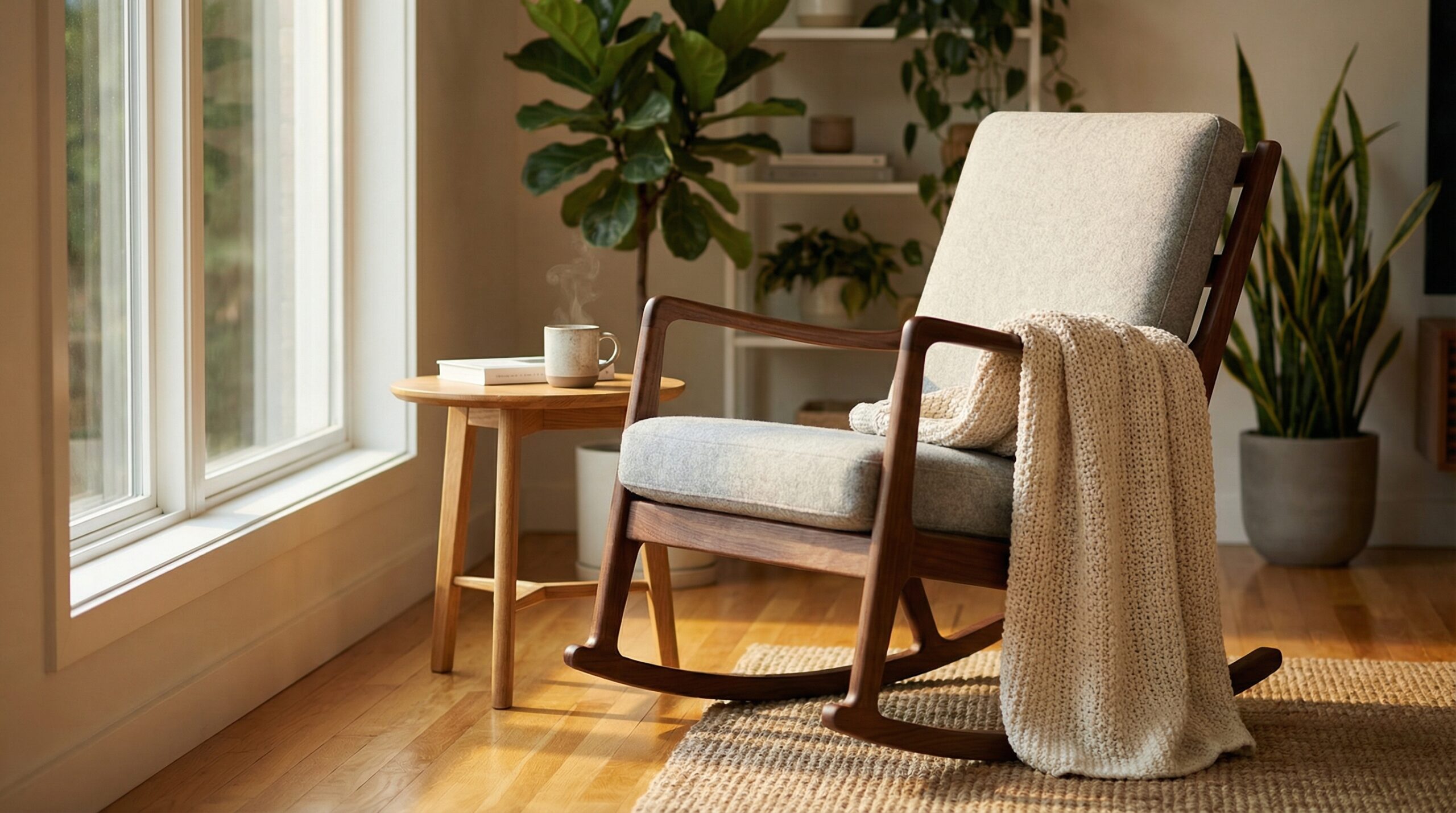
In short
Types of rocking chairs for indoor use
We tend to lump all rocking chairs together. That's a mistake!
There are several families of them, with very different characteristics depending on whether you are looking for a warm, functional piece of furniture or one that is frankly comfortable to sit in for hours.
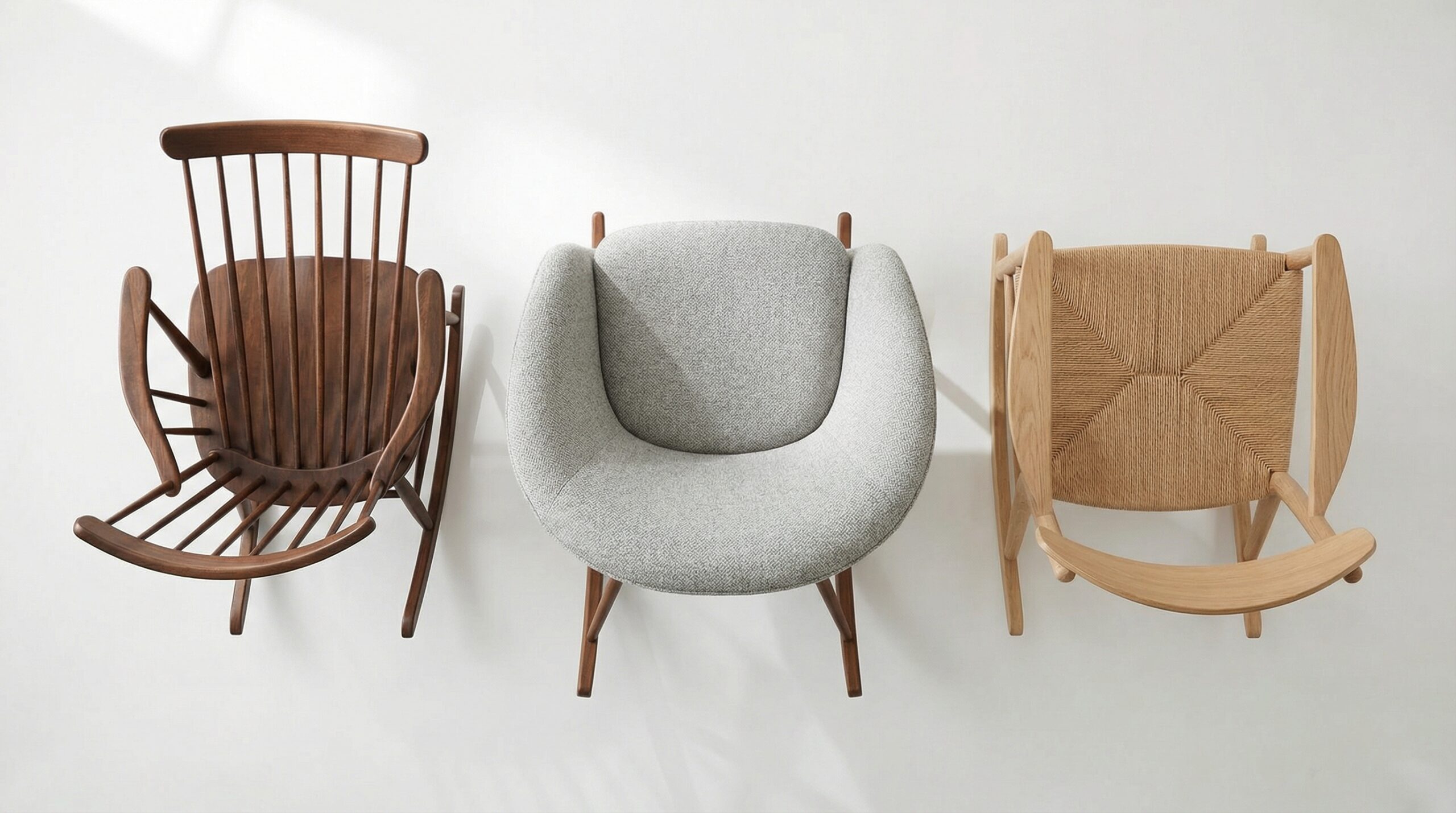
Before considering its use, it is necessary to understand what each type actually offers.
Indoor rocking chair models generally fall into two main categories: traditional wooden models and modern or reclining versions. Let's explore them together!
The traditional wooden rocking chair
The classic model is easily imagined by everyone. A curved wooden frame, arched gliders that allow for rocking, a slatted or solid backrest.
This is the type that is often found in country houses, libraries or bedrooms with a decidedly vintage feel.
What many people don't know is that the traditional wooden rocking chair can be very uncomfortable for prolonged use if it is not equipped with a thick cushion.
Wood is unforgiving. Without padding, an hour of reading can quickly become unpleasant!
Some models incorporate a padded seat and backrest from the design stage, which really changes the game.
In terms of durability, they're often very sturdy. A good armchair made of solid oak or beech can last for decades with minimal maintenance. The design blends well with natural, Scandinavian, or rustic decor.
Beware of low-end models made of chipboard or lightweight pine: wear and tear occurs quickly with a rocking chair in daily use.
Modern and relaxing designs for the living room
In recent years, modern models of rocking chairs for the living room have evolved considerably.
Now you can find fully padded versions, sometimes swiveling, some with a gliding mechanism rather than actual skates.
The result: a much more generous seat, suitable for long relaxation sessions.
The materials vary: fabric, velvet, synthetic leather, even rattan with an integrated cushion. These models blend more easily into a contemporary living room. They are often heavier than wooden versions, but also more stable.
Some combine a rocking motion with a reclining function, featuring a retractable footrest. This is a good option for those looking for a rocking chair for everyday comfort and who truly want to relax after a long day.
The movement remains gentle, often less pronounced than on a traditional model, but sufficient to enjoy the benefits of rocking.
Comfort and ergonomics for extended use
Buying a rocking chair to sit in for ten minutes now and then is one thing. Using it every day for reading, teleworking or relaxing is another story.
Ergonomics then becomes a central criterion.

A bad chair can create tension in the lower back, shoulders or neck within a few weeks.
Here's what really matters for the ergonomics of a rocking chair for long-term use.
The ideal lumbar support and tilt angle
The back needs support in its lower part. It is the lumbar region, between the kidneys and the middle of the back, that suffers first on an unsuitable seat.
The lumbar support of a rocking chair must maintain the natural curve of the spine. Some models incorporate a bulge in this area, while others require an additional lumbar cushion.
The tilt angle also deserves attention. A chair that tilts too far back forces you to contract your abdominal muscles to maintain your balance. If it's too upright, it loses all the benefit of the movement.
The ideal tilt angle for a rocking chair is generally around 10 to 15 degrees backwards at most. Beyond that, relaxation becomes discomfort.
Also consider the seat height. If your feet don't comfortably touch the ground, the rocking motion will be difficult to initiate and control.
A good rule of thumb: when you are sitting, your knees should form a 90-degree angle and your feet should be flat.
The armrests and padding for everyday use
For everyday use of a rocking chair, armrests are not a luxury. They relieve pressure on the shoulders and neck, make it easier to get up, and provide support during the rocking motion.
Their height should allow the arms to rest naturally, without shrugging the shoulders or letting them hang in the air.
The padding, however, makes all the difference between an armchair that is pleasant for twenty minutes and a seat where you really settle in for the long haul.
High-density foam is the best: it doesn't sag too quickly and retains its shape under body weight.
The synthetic fiber or down filling, often used as an addition, provides softness but flattens more quickly.
For the seat and backrest, aim for a padding thickness of at least 8 to 10 cm. Below that, you'll quickly feel the underlying structure, especially on wooden versions.
Low-density foam padding will sag within a few months of daily use. Always check the foam density before buying, or at the very least, test the chair by sitting on it in the store.
Is a rocking chair good for your back?
The question comes up often. And the honest answer is: it depends.
Rocking chairs can be beneficial for the back in certain situations, but they are not a universal remedy.
The rocking motion gently stimulates the back and abdominal muscles, preventing prolonged static postures that often cause pain. It also improves blood circulation in the legs.
For people suffering from mild muscle tension or looking to relax after an active day, this is a good option.
On the other hand, if you have herniated disc problems, chronic lower back pain or significant postural problems, the rocking chair will not always be suitable.
Repetitive movement can aggravate certain medical conditions. In this case, medical advice or a prolonged trial period before purchase is essential.
A rocking chair is not an orthopedic seat. It can support good posture, but it does not replace a seat specifically designed for diagnosed back problems.
The day-to-day advantages of a rocking chair
Beyond its style, the benefits of a rocking chair for the home are tangible. It's not merely a decorative object. Used regularly, it can truly enhance everyday moments.

This is why many people who buy one end up not being able to live without it.
Relaxation, reading and breastfeeding made easy
The rocking chair for everyday relaxation excels in all those moments when you want to unwind without falling asleep. Reading is the best example.
The gentle rocking motion helps to focus, creates a kind of soothing rhythm that promotes immersion in a book or listening to music.
Many regular readers testify to their inability to do without it once they have adopted this seat.
For breastfeeding, this is a choice many parents make deliberately. The gentle movement soothes the infant, helps the mother stay relaxed during feedings, and the repetitive rhythm of the rocker can even help lull a fussy baby to sleep.
Provided that the chair is wide enough and well padded to comfortably support the user for the duration of a breastfeeding session.
Working from home is another situation where a rocking chair comes in handy, for breaks or listening sessions. While less suitable for typing, it becomes ideal for phone calls, listening to podcasts, or simply unwinding between meetings.
Finally, it's a great alternative to the sofa for those who struggle to find a comfortable position in a fixed seat. The movement creates a dynamic that naturally relieves pressure on certain areas of the body.
The benefits of the rocking motion on the body
The benefits of rocking chairs on the body are documented, even if modest. The first is mechanical: the rocking motion alternately engages the postural muscles of the back and abdomen. Not intensely, but enough to prevent the stiffness that sets in on a fixed seat after long hours.
The second benefit relates to circulation. The regular leg movements associated with the swinging motion slightly activate the calf muscles, which helps venous return.
For people who have heavy legs or who sit for long periods, this is a real advantage.
The third, often underestimated, is neurological. Rhythmic movement acts on the nervous system in the same way that a lullaby does for a child: it reduces anxiety, promotes the secretion of serotonin, and helps to move more easily from a state of tension to a state of calm.
Studies in geriatrics have also shown that regular rocking improves general well-being in older people.
Finally, simply changing posture by rocking reduces pressure on the intervertebral discs compared to a static position. It's not dramatic, but in the long run, it matters.
- Relieves muscle tension through regular movement
- Promotes relaxation and reduces daily stress
- Ideal for reading, breastfeeding, and active breaks
- Slightly improves blood circulation
- Durable if the material is well chosen
- Blends in with different interior styles
- Bulky in small spaces
- May become noisy as the pads wear down
- The low-quality padding sags quickly
- Not well suited for chronic back pain
- Not recommended for certain types of flooring (fragile parquet)
- Not always comfortable without a cushion for wooden models
Disadvantages to be aware of before buying
No piece of furniture is perfect. The drawbacks of a rocking chair in everyday use deserve to be addressed frankly, because they can really influence the purchasing decision.
It's better to know them in advance than to regret it once the chair is delivered.
Clutter and noise: real problems?
Yes, space is a real issue. A rocking chair takes up more space than a regular chair because the rockers extend forward and backward.
In a medium-sized living room, this can be a problem if the space is already well furnished.
Generally, allow 20 to 30 cm more depth compared to a fixed chair.
The noise level depends on the model and its condition. A wooden armchair on a parquet floor can create an unpleasant creaking sound. It's not always the case, but it's common with wear and tear.
Accelerated wear with frequent use
It makes sense: the more you use a piece of furniture, the more it wears out.
Wear and tear on a rocking chair in frequent use primarily affects the glides (scratches, creaks), the padding (sagging) and the wood-fabric joints on upholstered models.
An entry-level model used daily will show signs of wear in less than two years. A well-built model can last ten years or more.
Concrete solutions for each drawback
Regarding space requirements: measure the available space before buying and allow at least 50 cm of free space around the chair for rocking.
Regarding noise: self-adhesive felt pads placed under the ends of the skates significantly reduce friction on the floor.
For wear and tear: choose a model with a warranty of at least two years and opt for certified high-density foams.
Finally, a rug under the armchair protects both the floor and dampens the noise.
Before buying, measure your space with the full dimensions of the chair in the maximum reclining position, not just the static dimensions indicated on the product sheet.
How to choose your rocking chair for the home
Choosing a rocking chair for indoor use requires considering several criteria. Style alone is not enough. You must think about its actual use, how often you'll use it, your body type, and of course, your budget.

Here are the points to check methodically:
Materials according to your use and your interior
Solid wood (oak, beech, walnut) is the safest bet for durability. It withstands heavy daily use, is easy to repair, and ages well. Pine or poplar wood, lighter and less expensive, is suitable for moderate use but wears out more quickly.
For upholstered models, the quality of the fabric is just as important as that of the structure.
- Corduroy is pleasant but fragile when subjected to repeated rubbing.
- Microfiber or tightly woven fabrics offer better resistance. Genuine leather is very durable but hot in summer and requires specific care.
- Synthetic leather is practical but can crack after a few years of heavy use.
If you have pets at home, avoid open-textured fabrics that trap fur. Opt for a smooth-surface material, which is easier to clean daily.
The choice of materials for an indoor rocking chair should always be guided by your domestic reality, not by catalogue photos.
Stability and dimensions to be checked
The stability of a rocking chair depends on several factors: the spacing of the runners, their curvature, the center of gravity of the seat and the weight of the user.
A wheelchair that is too light or has runners that are too narrow can tip backward too easily. Check that the runners are wide enough and that the wheelchair does not tip backward more than 15 to 20 degrees.
For dimensions, here is a reference table:
| Dimension | Recommended value | Why this is important |
|---|---|---|
| Seat height | 42 to 48 cm | Feet flat on the ground, knees at 90° |
| Seat depth | 48 to 55 cm | Thigh support without knee compression |
| Seat width | 55 to 65 cm | Ease of movement and lateral comfort |
| Backrest height | 70 cm minimum | Back support up to the shoulders |
| Total length including skates | 90 to 110 cm | Floor space required in the room |
What budget should be allocated for a sustainable model?
That's a direct question that deserves a direct answer.
The budget for a quality rocking chair intended for everyday use should not fall below 250 to 300 euros. Below this price, you'll find models whose frame or padding deteriorates quickly.
| Price range | What we find | Estimated lifespan (daily use) |
|---|---|---|
| Less than €150 | Lightweight wood, thin foam, basic finish | 1 to 2 years |
| 150 to 300 € | Decent wood, average padding, neat design | 3 to 5 years |
| €300 to €600 | Solid wood or solid structure, high-density foam | 7 to 10 years old |
| Over €600 | Handcrafted, high-quality materials, long guarantees | 10 to 20 years |
If you're on a budget, opt for a simple wooden chair without built-in padding, then invest in a separate, high-quality cushion. You'll get better value for your money than with a low-end, upholstered model.
Maintaining your rocking chair to ensure it lasts a long time
A rocking chair used every day needs attention. Not much, but regularly.
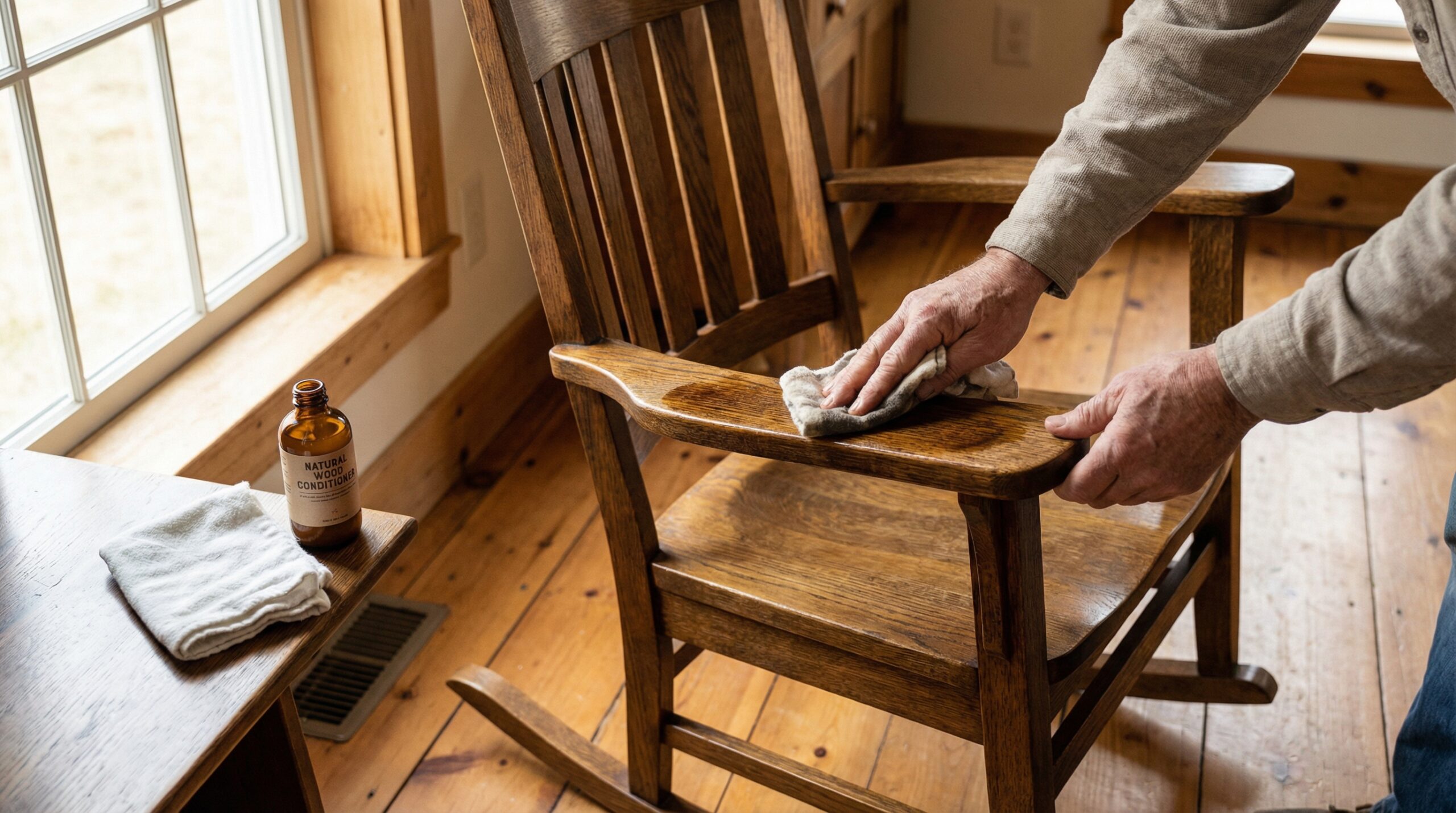
Regular maintenance of a rocking chair is what makes the difference between a piece of furniture that lasts ten years and one that falls apart in three. The steps are simple, you just need to keep them in mind.
Clean and protect the different materials
Wood requires little daily care. A quick wipe with a dry cloth is enough to remove dust.
Once or twice a year, apply a special wood wax or oil to nourish the surface and protect it from moisture.
Avoid conventional household cleaners that can strip varnish or natural wood.
For fabrics, vacuum the seat and backrest weekly. In case of stains, treat them immediately with a damp cloth and a little Marseille soap.
Avoid rubbing hard: instead, pat to absorb without spreading. Some covers are removable and machine washable, which greatly simplifies the daily maintenance of the rocking chair.
Natural leather requires a specific conditioner two to three times a year to prevent cracking. Synthetic leather, on the other hand, can be easily cleaned with a slightly damp cloth. Never use solvents on either type of leather.
Regular checks to prevent wear and tear
Every two to three months, take the time to quickly inspect your chair. A few minutes can prevent costly repairs.
- The pads: check that they are free of cracks or chips. A cracked pad can suddenly fail. If you have installed felt pads, check that they are still securely attached.
- For wood joints: test each joint by applying slight lateral pressure. If it moves, tighten the screws or re-glue the edges. A chair that starts to become unstable should be repaired quickly.
- The padding: check if the seat has sagged. A replacement cushion or an extra layer of foam can revive the chair without having to buy a new one.
- Textile components: check the seams, especially at corners and areas of friction. A coming undone seam is easily repaired if addressed early.
A well-maintained and regularly checked rocking chair can last twice as long as an identical model left unattended. Maintenance is the best investment after the purchase itself.
Also, place your armchair out of direct sunlight. UV rays degrade fabrics, discolor wood, and dry out leather. If your living room is very sunny, use curtains or move the armchair to a less exposed area.
Practical questions
Is a rocking chair suitable for all body types?
Not necessarily. Taller people will need a high back and a deep seat. Shorter people should make sure their feet touch the floor comfortably without having to bend over. Some models offer more generous dimensions, while others are designed for standard sizes. Always check the measurements before buying, and if possible, try out the chair in the store.
Can a rocking chair be used on parquet flooring without damaging it?
Yes, provided you take precautions. Bare wood glides will scratch the parquet floor over time. The simplest solution is to place a thick rug under the chair, or to glue felt pads to the ends of the glides. Avoid very thin felt pads, which wear out quickly, and check their condition regularly. Some models come with protective rubber tips, which is even better.
What is the difference between a rocking chair and a gliding chair?
The classic rocking chair rests on curved gliders and rocks back and forth by rotating the entire seat. The gliding chair (or rocking chair with a mechanism) uses a fixed articulated system: the seat glides on a stable base without the chair's legs moving. The latter is often more stable and less bulky, but the movement is slightly different, less pronounced and more controlled. Both can be suitable for everyday use.
How can you tell if the padding of a rocking chair is of good quality?
The simplest test in-store: press firmly on the seat with your fist, then release. Quality foam will spring back to its original shape in less than a second. If it remains compressed for several seconds or doesn't return to its original shape, the density is too low. Online, look for "high-density foam" or a density rating of 30 kg/m³ or higher. Below this, the foam will quickly flatten with daily use.
How long per day can you sit in a rocking chair?
There's no set maximum time limit, but as with any chair, remaining motionless for hours isn't ideal. The advantage of a rocking chair is that the movement reduces postural strain. That said, even with the rocking motion, it's advisable to get up and walk around for a few minutes every hour or so. For reading or relaxation sessions lasting 30 to 90 minutes, a good rocking chair is perfectly suitable without causing any particular discomfort.
