
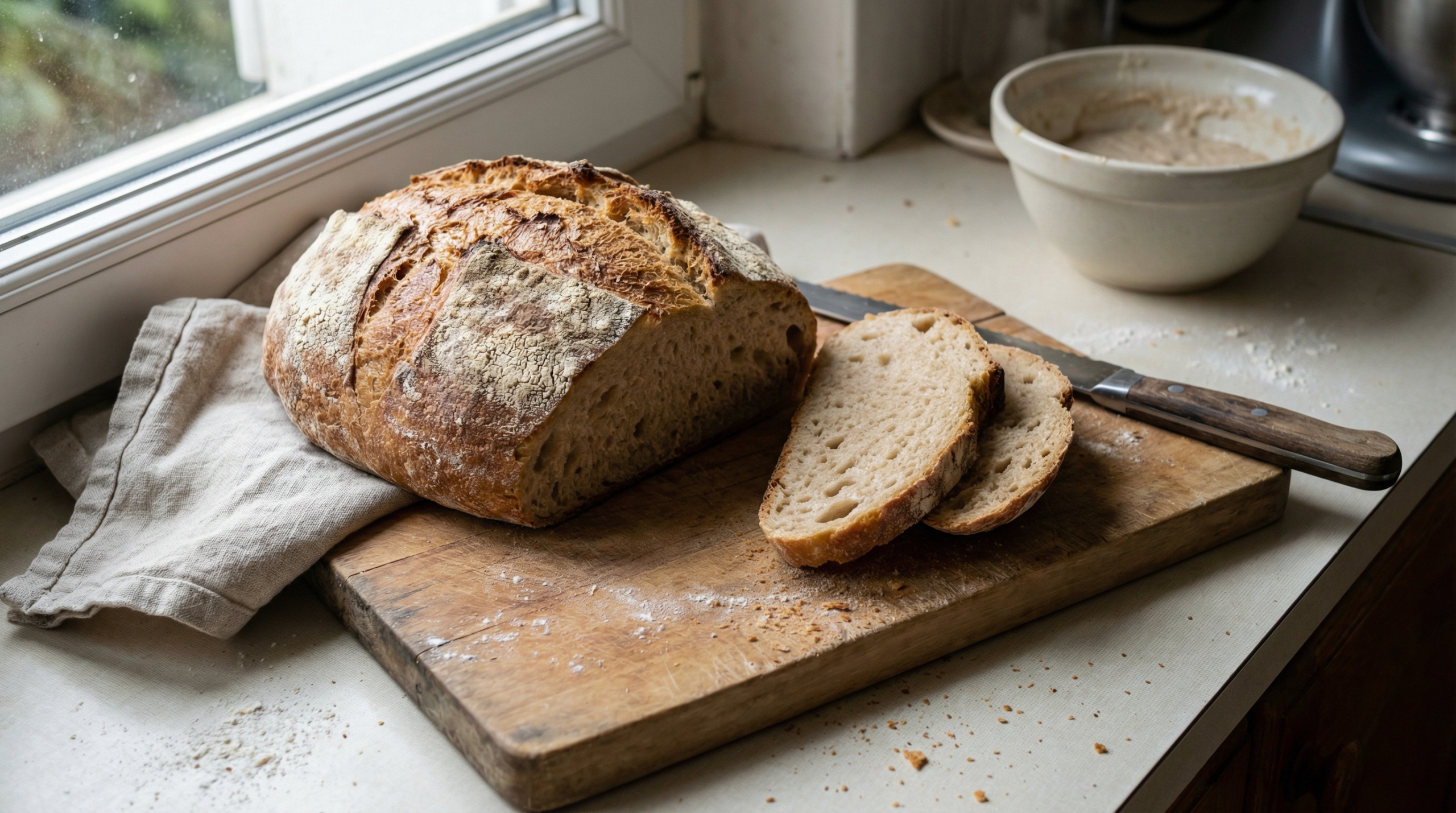
I have a soft spot for spelt bread: its slightly nutty aroma, its more delicate crumb compared to modern wheat, and its rustic character that pairs equally well with salted butter or aged cheese. I really got hooked after a few batches, because spelt has its own personality: it absorbs less water, doesn't hold its shape as well, and requires a gentle touch rather than vigorous kneading.
In this natural sourdough version, I stick to the basics: spelt flour, water, salt, and sourdough starter. No additives, no hidden flavors. The "personal touch" is mainly the method: a short autolyse to hydrate gently, a few folds to give structure, then baking in a Dutch oven for a beautiful rise and an even crust.
The major advantage is that you get a bread that's very easy for many people to digest, with a tender crumb and a thin crust. Nutritionally, einkorn wheat provides a good amount of minerals (magnesium, phosphorus) and B vitamins, and the sourdough starter helps make it all more palatable.
If you're new to sourdough, this recipe is a great starting point: it's simple, but it teaches you how to read the dough. The number one guideline: you're looking for a lively dough, slightly supple, that smooths out with each fold. And if the shape is a little "free-form" when it comes out of the banneton, that's normal with spelt flour: as long as the crumb is good, you've succeeded.

Plain spelt bread
10
slices45
minutes45
minutes421
kcal3
hours30
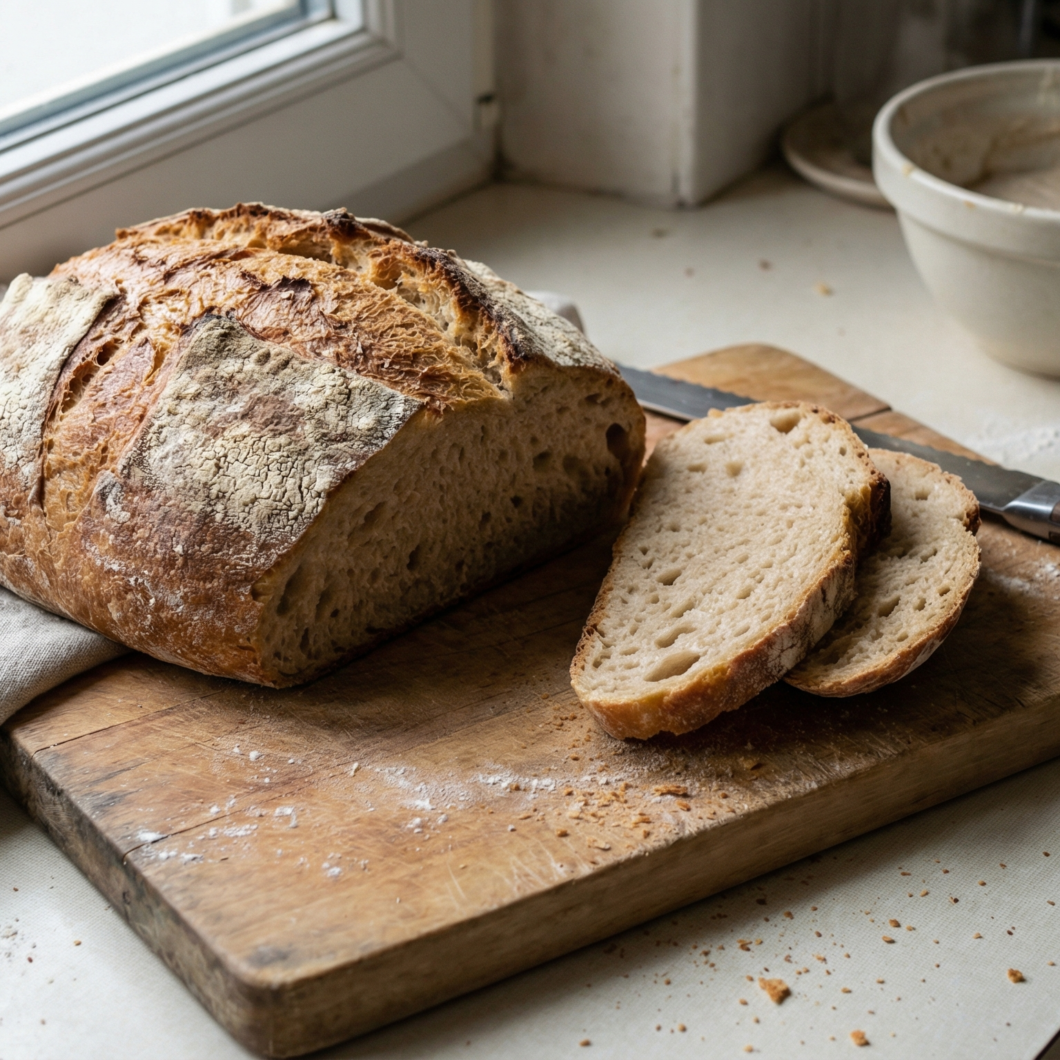
minutesA sourdough spelt bread with a thin crust and a soft, slightly nutty crumb. Minimal kneading, gentle folding, and a piping hot bake: simple and very satisfying.
Keep your device's screen on
Ingredients
400g of spelt flour (ideally T80)
260 g of water at 20-22°C
100g of active natural sourdough starter (100% hydration )
8 g of fine salt
30g of pumpkin seeds
25g of roasted hazelnuts, roughly crushed
20g of finely chopped spring onion (or scallion)
Preparation steps
- Prepare the sourdough starter: make sure it is fully active (it has doubled in size, has a domed surface, and visible bubbles).
- Toast and prepare the seasonal ingredients: roast the hazelnuts for 8-10 minutes at 160°C (or 4-5 minutes in a pan, stirring). Roughly chop them. Finely slice the spring onion. Set aside with the pumpkin seeds.
- Autolyse (20 minutes): In a bowl, mix the spelt flour and water just until no dry flour is visible. Cover and let rest for 20 minutes. The dough will begin to relax and hydrate.
- Mixing: Add the sourdough starter and mix for 2-3 minutes (by hand, pinching and folding) until you obtain a smooth dough. Add the salt and mix for another minute, until it dissolves.
- Incorporate the pumpkin seeds, crushed hazelnuts and spring onion. Mix gently: you want to spread it out without tearing the dough.
- Bulk fermentation (1 hour 15 minutes to 1 hour 30 minutes): cover and let rise at room temperature. During this time, perform 3 sets of folds every 20 minutes: take one edge of the dough, stretch it slightly, and fold it back to the center; turn the bowl and repeat 4 times. The dough should become firmer without becoming dense.
- Pre-shaping (10 minutes): Pour the dough onto a lightly floured surface. Quickly shape it into a round by bringing the edges towards the center, then turn it over and rotate it gently to create some tension. Let it rest for 10 minutes, uncovered (or with a tea towel).
- Shaping: Lightly flour the work surface. Form a ball (or a small loaf) by pressing it firmly: spelt doesn't like to be handled roughly. Place the dough, seam side up, in a well-floured banneton (or a bowl lined with a floured cloth).
- Proofing (20 to 35 minutes): Let rise at room temperature until the dough has doubled in size and springs back when lightly pressed. Meanwhile, preheat the oven to 250°C (480°F) with a cast-iron casserole dish inside (lid included).
- Scoring and baking: Remove the hot casserole dish. Turn the pastry over onto a sheet of baking paper and score it (make a deep 1 cm cut). Place it back in the casserole dish, cover, and bake for 20 minutes at 250°C (480°F).
- To finish cooking: reduce the oven temperature to 220°C (425°F), remove the lid, and continue baking for 20-25 minutes, until a golden brown crust forms. If you prefer a darker color, bake for an additional 5 minutes.
- Cooling: Let it cool for at least 1 hour on a wire rack before slicing. The crumb will finish settling as it cools.
📊 Nutritional Information
1 serving (approx. 210g)
| Nutrient | Value |
|---|---|
| Calories | 421 kcal |
| Proteins | 15.1g |
| Carbohydrates | 76.7g |
| including sugars | 2.3g |
| Lipids | 7.5g |
| including saturated fatty acids | 0.8g |
| Fibers | 8.4g |
| Sodium | 786mg |
| Vitamins | |
| Vitamin B1 | 26% AJR |
| Vitamin B3 | 18% AJR |
| Vitamin E | 10% AJR |
| Minerals | |
| Magnesium | 33% AJR |
| Phosphorus | 37% AJR |
| Iron | 22% AJR |
* RDA = Recommended Daily Allowance
📝 Notes
Total time indicated = “active” time + short fermentation at room temperature. If your kitchen is cool, proofing may take longer than 35 minutes: rely on the dough (the impression that slowly returns to its original shape) rather than the timer.
💡 Chef's Tips
If your bread dough seems too soft, don't necessarily add more flour: instead, fold it over once more and work with slightly damp hands. And for a thin but crispy crust, leave the bread in the oven for 5 minutes after it's turned off, with the door ajar, at the end of baking.
🔄 Variations
- You can remove the spring onion if you want a 100% neutral taste, but keep the seeds/nuts for crunch.
- If your spelt flour is very whole and absorbs a little more, increase the water to 270g (do it in small increments).

The crust is described as thin. After a day or two in the open air, does it tend to soften faster than a classic wheat loaf, given that einkorn wheat is more fragile?
Hello Magritte, yes, it does take a little longer. The thin crust holds up well on the same day and then softens the next day. The easiest thing to do is to put it back in a hot oven for a few minutes if you want it crispy again, or slice it and freeze what you don't eat that day.