
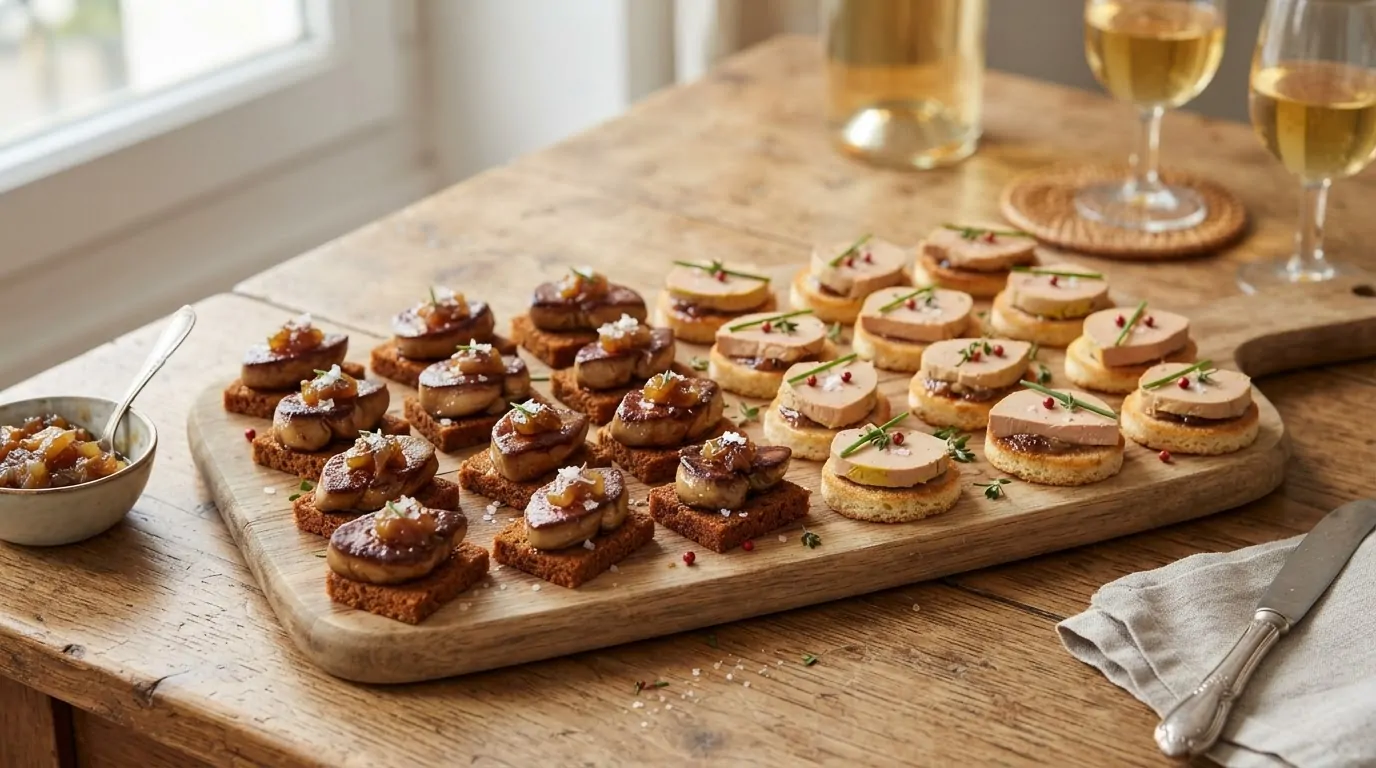
Serving foie gras bites as an appetizer instantly gives a festive air to the table, without requiring long hours of cooking.
The real challenge isn't the recipe. It lies in three practical questions: what format to choose, what quantity to buy, and what to prepare before the guests arrive.
This guide remains focused on the practical side: four formats compared, a calculation of quantities, a process from the day before to serving and the rules for preserving opened foie gras.
Which foie gras appetizers should I choose?
The right format depends mainly on what you can do in advance and when the guests arrive.
Here are four approaches taken from recipes published by culinary brands and websites.

| Format | Cooking | What is being prepared in advance | When to choose it |
|---|---|---|---|
| Gingerbread and chutney | None | Gingerbread squares and chutney | For quick assembly, in 10 or 15 minutes |
| Gingerbread-shaped balls | None for foie gras (toasted gingerbread) | Everything, right down to the coating | To prepare many pieces in advance |
| Mousse molded onto small toasts | Hot cream in a saucepan | The mousses, frozen and then unmolded | For a very even and neat table setting |
| Warm potato and chanterelle verrine | 20 minutes | Almost nothing, she serves it lukewarm | For a seated aperitif, for 4 people |
The first three courses should be served cold or at refrigerator temperature. The lukewarm verrine is the only one that is served hot, and it comes from the recipe for Alsace Wine (accessed October 2026), intended for 4 people.
This recipe alternates crushed potatoes, chanterelles pan-fried in foie gras fat and seared foie gras cubes, with an Alsatian Pinot Gris suggested as a pairing.
Pan-fried or seared foie gras is served warm, while semi-cooked, block or mousse is served cold: do not mix the two approaches on the same platter, or you risk serving bites that warm up at different rates.
How much foie gras should I plan to serve per guest?
For an aperitif of toasts or verrines, Croq-Kilos (article of December 14, 2025) recommends 20 to 30 g per person, or 2 to 3 bites per guest.
For a seated starter, the same source suggests 40 to 50 g: an aperitif therefore requires about half as much.

Calculate the amount of foie gras to buy for your guests
Indicate the number of guests and the place of the foie gras in the aperitif: the tool applies the range of 20 to 30 g mentioned above, with a bite of about 10 g.
Typical example: for 10 guests, with foie gras as the star of the aperitif, allow 200 to 300 g in total.
Based on the price recorded by Que Choisir in December 2025, from €66.60/kg for the cheapest to €246/kg for the most expensive of the semi-cooked ones tested, 250g costs around €17 in the first case and €61.50 in the second.
Price doesn't tell the whole story: in this test, the most expensive semi-cooked (€246/kg) only comes in sixth, while the first in the ranking costs €110/kg.
Gingerbread, crumbs or mousse: three no-oven recipes
These three preparations are made in the refrigerator and are suitable for a block or semi-cooked foie gras, which should be very cold when cutting.
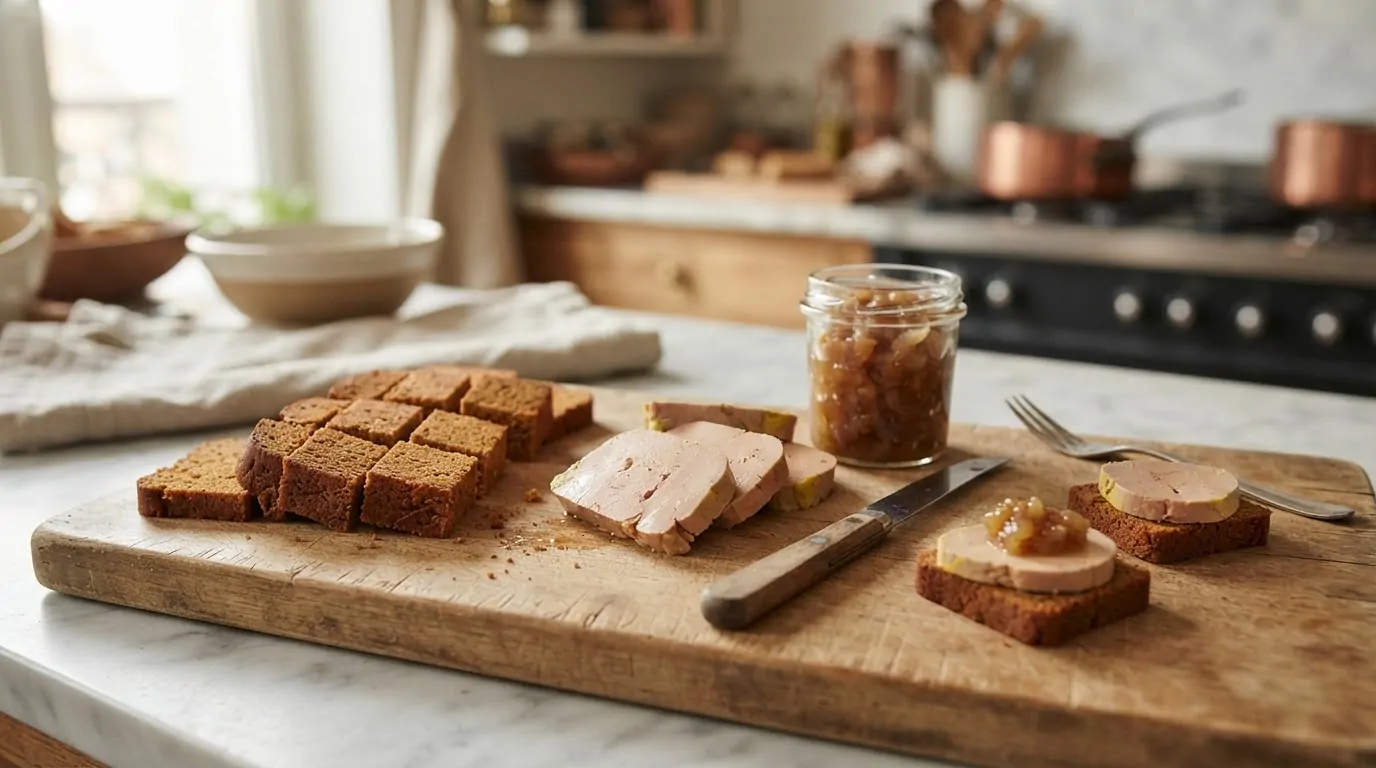
The first: a square of gingerbread, a spoonful of onion chutney and a slice of foie gras.
Delpeyrat 's recipe (accessed in October 2026) says it takes 10 to 15 minutes and enhances the chutney with a little ginger zest and a drop of soy sauce, with Espelette pepper and fleur de sel to finish.
The second: balls of foie gras coated in crumbs, detailed version by the Academy of Taste (consulted in October 2026): 20 pieces with 100 g of foie gras in block and 4 slices of gingerbread, grilled then blended into fine crumbs.
The third: a molded mousse. At Guy Demarle (accessed in October 2026), 150 g of cooked foie gras melts in 90 g of hot liquid cream with 2 sheets of gelatin.
The preparation then spends 1 hour in the freezer to unmold cleanly, then 1 hour in the refrigerator before being assembled on small toasts or gingerbread.
To do: cut the foie gras taken out of the fridge at the last moment, in small batches, and put the rest back in the fridge between two trays.
What should be prepared the day before and what should be assembled at the last minute?
A foie gras appetizer is prepared in two stages: everything dry or neutral the day before, everything that touches the foie gras just before serving.
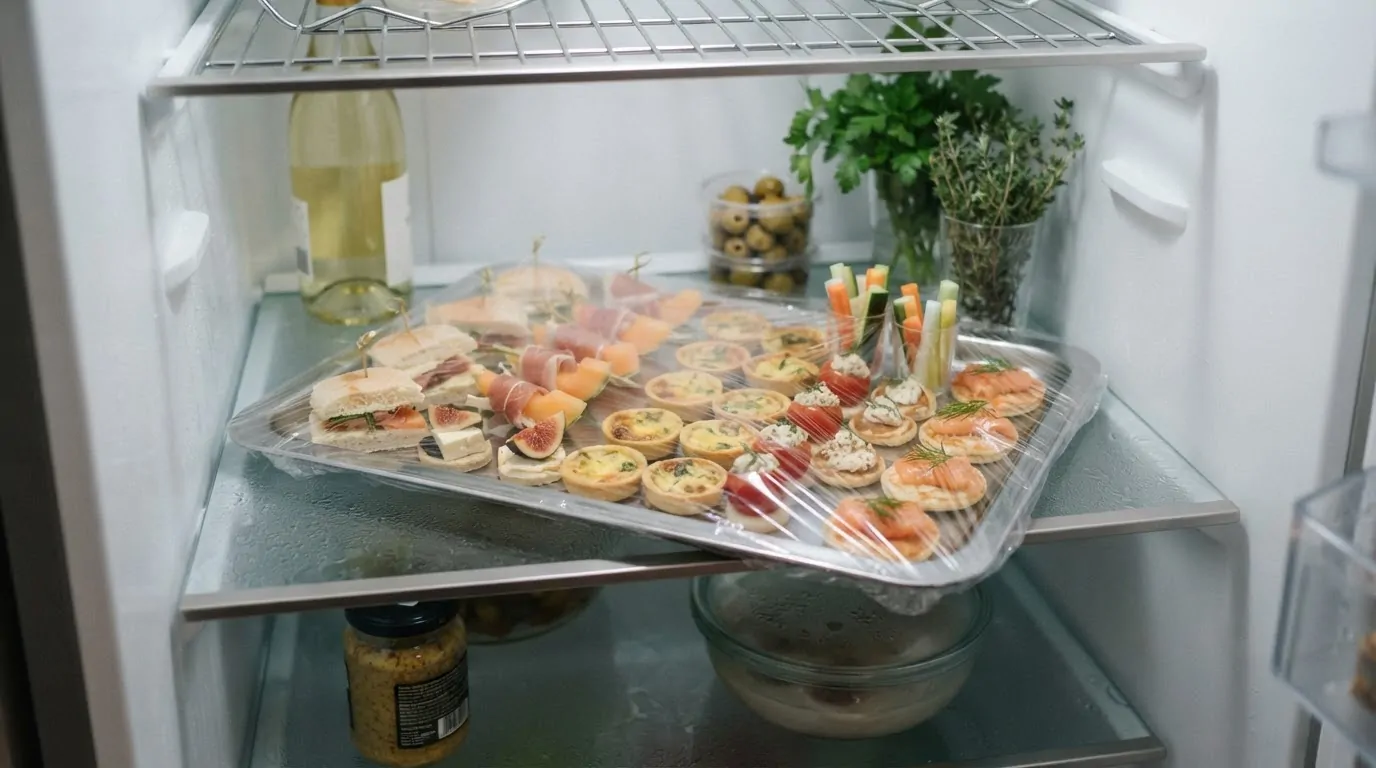
- The day before: cut the gingerbread into squares, prepare the chutney or crumbs, mold and freeze the mousses.
- In the morning: take the mousses out of the freezer to unmold them, then keep them in the refrigerator.
- Just before serving: slice the foie gras and assemble the bites on the supports.
Our guide to cold appetizers that can be prepared in advance offers other cold bites that can be prepared ahead of time, with a table for the day before and at the last minute.
Assembling the bites several hours in advance can soften the gingerbread under the chutney: if you absolutely must prepare ahead of time, keep the chutney separate and add it at the end.
How to store opened foie gras and leftover canapés?
Recipe pages rarely mention it, even though foie gras doesn't keep for very long once opened.
According to Que Choisir (December 2025), a semi-cooked product can be kept for 2 to 3 weeks in the refrigerator before opening and should be consumed within 24 hours.
For cooked foie gras in a jar or can, the time limit is 24 to 48 hours after opening.
Other sources are broader: Croq-Kilos (accessed in October 2026) cites 4 to 5 days for foie gras in a jar or vacuum-packed, and 2 to 3 days for fresh or artisanal foie gras.
These differences vary depending on the type of product: always follow the manufacturer's instructions and, if in doubt, choose the shortest timeframe.
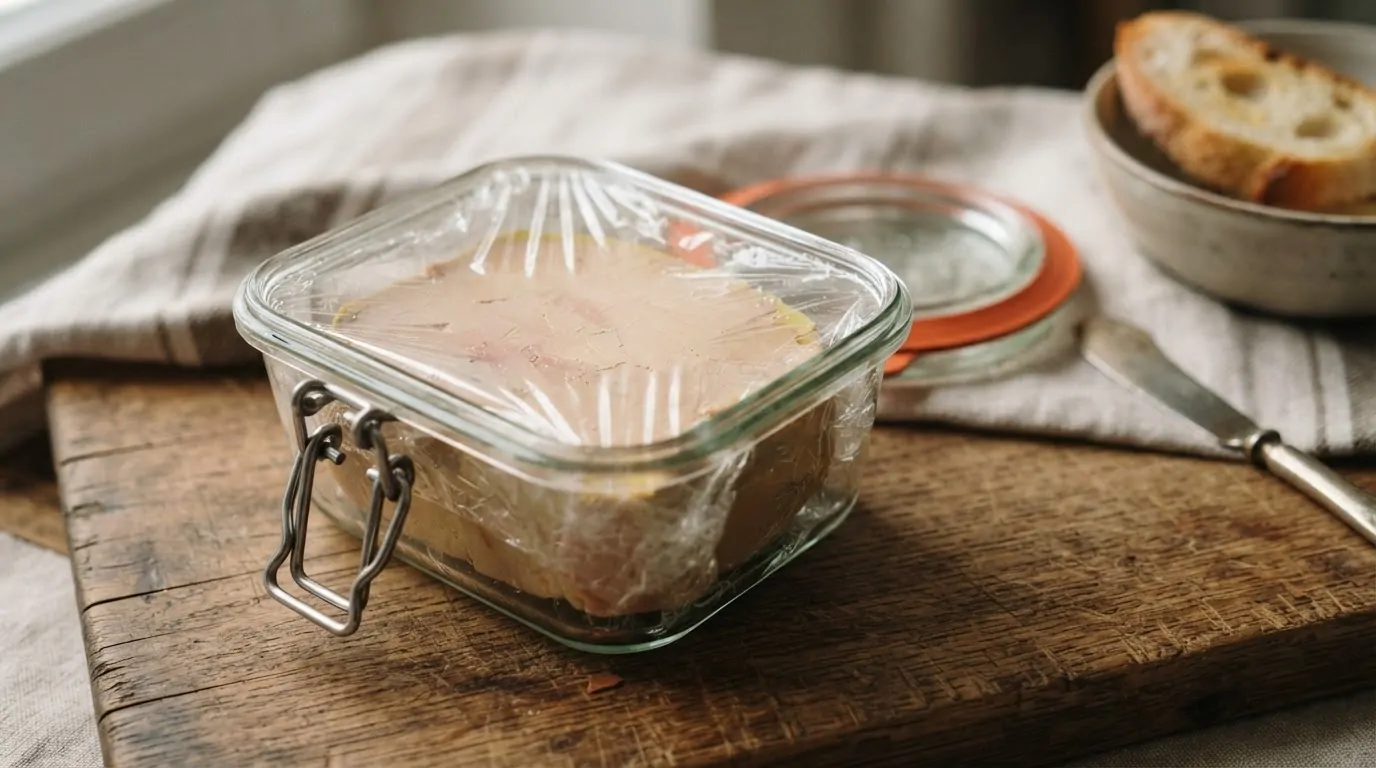
As for the handling, smooth the cut surface, press a piece of cling film against the surface or a thin layer of fat, then store everything in a small airtight container between 0 and 4 °C.
Typical example: there's a third of the block left after the party. Cut it into portions, wrap them individually and freeze them quickly: the same source mentions approximately 3 months of freezing, with slow thawing in the refrigerator for 24 hours.
Discard any foie gras that is turning grey, smelling strong, or has a dry crust on the surface, even if the deadline has not been met.
In summary
Allow 20 to 30 g of foie gras per guest, or 2 to 3 bites, and choose a cold format if you want to prepare everything before the guests arrive.
Prepare the bases, chutneys and mousses the day before, slice the foie gras at the last minute, and finish any opened foie gras within the time indicated by the manufacturer or freeze it in portions.
Practical questions
- What wine should I serve with foie gras canapés?
Vins d'Alsace suggests an Alsatian Pinot Gris with its verrine of foie gras and chanterelles. - How can you prevent foie gras from softening during appetizers?
Bring out the platters in small batches and don't leave the foie gras at room temperature for more than 30 minutes, as Croq-Kilos advises. Keep the rest in the refrigerator. - Should you choose semi-cooked or cooked foie gras in a jar?
In its December 2025 test, Que Choisir ranked the six semi-cooked foie gras options at the top, with a more pronounced fresh foie gras flavor and a firmer texture, making it easier to slice. Cooked foie gras, on the other hand, keeps longer before opening.
