

The whole fish
At the market, whole fish often costs less per kilo than filleted fish, and it's fresher: you can see the eye, the gills, the firmness of the flesh. The only drawback is the work involved at home.
And it's scary, because many people I meet in the fish department leave with vacuum-packed fillets because they don't dare.
Yet, filleting a clean fish takes two minutes once you understand three things: where the blade goes, how to hold the fish, and what to cut with. Nothing more!
What you need on the worktop, and what's missing in most kitchens
A stable board. A damp cloth underneath to prevent it from slipping, a second one to hold the fish, and a suitable blade.

This is where the problem lies in most kitchens: you attack a sea bream with a chef's knife, rigid and thick, and you leave half the flesh on the bone.
The right tool is a fish fillet knife, with a long, thin and flexible blade, which follows the spine instead of going around it.
I prefer a blade of 18 to 20 cm for common round fish like sea bass, sea bream, and mackerel. Below 16 cm, you lack length when dealing with a good-sized fish, and above 22 cm, you lose control.
Flexible or semi-flexible? For beginners, the semi-flexible blade is more forgiving: it bends enough to follow edges but remains firm enough not to go sideways.
The very flexible blade is a fishmonger's tool, great once mastered, frustrating before, and I advise against starting with it: you get disgusted with filleting because of a blade issue.
The gesture
First, scale it, if you are keeping the skin, working from tail to head under a trickle of water to limit splashing.
Empty, rinse, dry thoroughly: a wet fish slips, and a slippery fish is difficult to cut.
Place the fish on its side, head to the left if you are right-handed. Make an incision behind the pectoral fin, at an angle, until you feel the central bone.
Next, turn the blade flat, cutting edge towards the tail, and run it along the spine in long strokes, without sawing. The free hand holds the net raised, allowing you to see where the blade is passing.
Reaching the tail, the net detaches with one last tug. There!
All you have to do now is turn the fish over and start again on the other side.
The lateral bones remain, those that cross the top of the fillet, and kitchen tweezers remove them one by one, pulling in the direction they are embedded.
Tedious! But that's what separates a restaurant fillet from a canteen fillet.
The mistakes I see most often
Sawing instead of slicing: the blade must glide in one long movement, otherwise the flesh will shred.
Here are the most common examples:
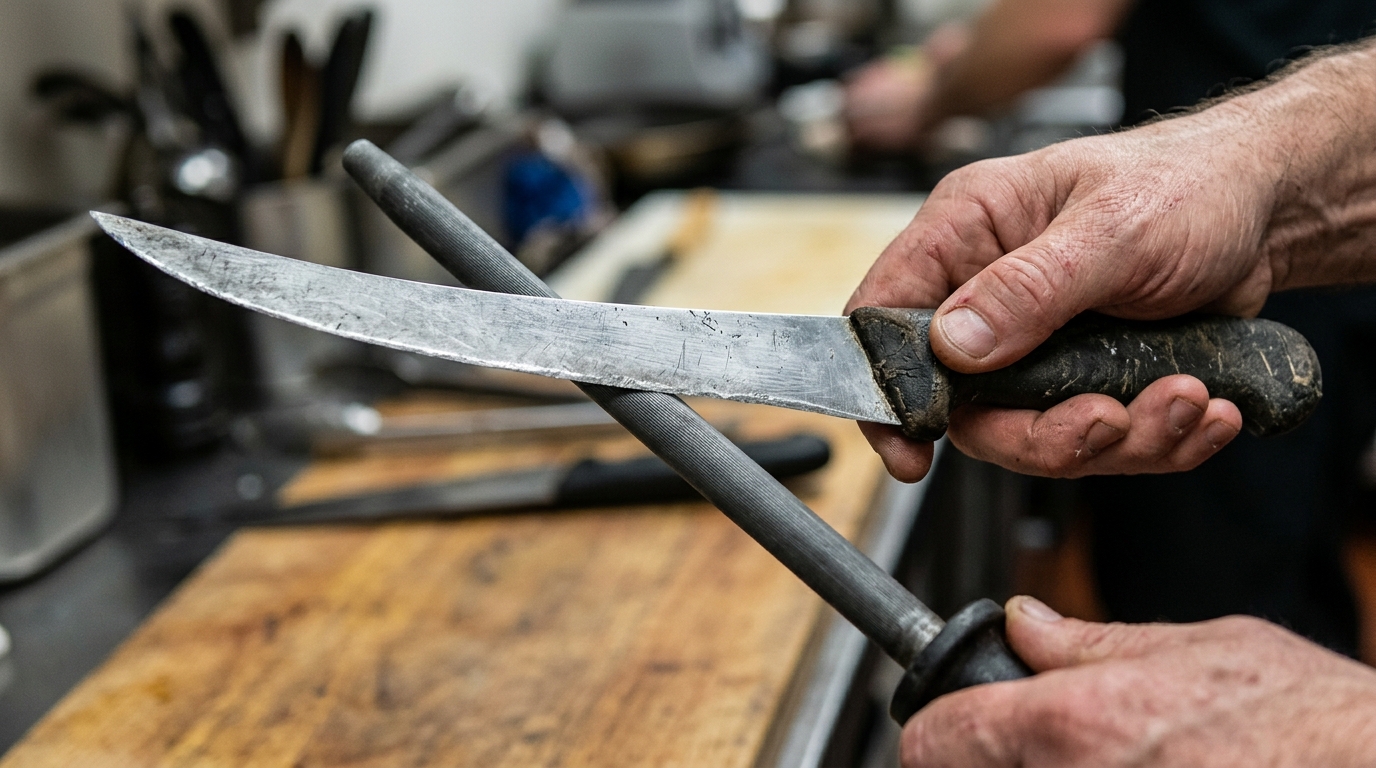
- Attacking with a dull knife: a filleting knife scratches easily on the bones, it must be sharpened with a steel before each fish, not after.
- Pressing too hard: the flexible blade does the work, the hand only guides it.
- Trying to remove everything at once: it's better to go over the edge a second time than to tear the fillet.
Sole, turbot, and the Japanese way of doing exactly the opposite
The sole, turbot or flounder are lifted into four fillets, two per side, starting from the median line.
The very flexible blade is essential here, as the fillets are thin and the bones numerous. Conversely, Japanese tradition uses a deba knife, thick, heavy, with a single bevel, which slices the head and separates the fillets using its own weight.
Two opposing philosophies: a flexible blade that follows, a massive blade that imposes. Both work. Not one to replace the other.
On the plate
A homemade fillet, cooked skin-side down in a very hot pan with a little butter at the end, is nothing like an industrial fillet that has released its water during vacuum sealing. The bones and head will infuse the fish with flavor in twenty minutes.
Nothing is lost, neither skin, nor head, nor what one would have paid the fishmonger for a job that one now knows how to do oneself.
And once acquired, the technique is never forgotten: in my opinion, it is the most profitable cooking skill that can be learned in an afternoon.
