
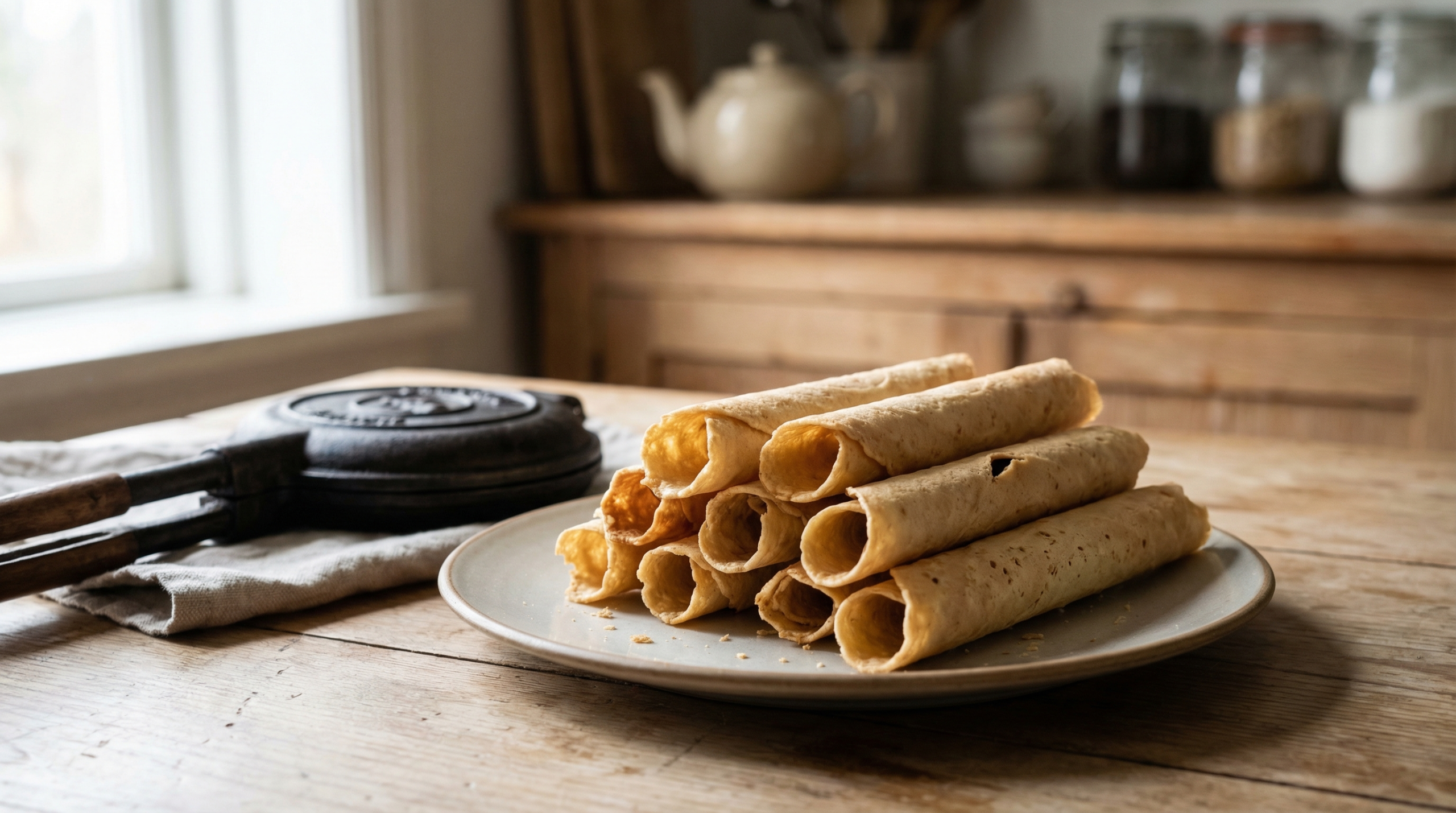
The first time I heard about Curbelets, they were pronounced to me with the accent: "Curbélets". And then, I knew that I was immersed in the traditional cuisine of the Tarn, the kind you nibble on at teatime, with a coffee or tea.
This specialty from the Tarn region is one of those unassuming yet incredibly appealing desserts: thin waffles, almost wafer-like, cooked until golden brown and then immediately rolled into small tubes. They're crispy, perfectly dry, and keep quite well… if no one eats them first.
On the cultural side, we often come across the idea that the name comes from the Occitan "Curbel" (or a similar root), which evokes the act of bending/rolling: it fits the shape perfectly.
In Occitan cuisine, these simple little things tell a lot: eggs, butter, a little flour, sugar… and above all, a technique.
I've refined my technique quite a bit by watching and reading well-explained cooking basics, especially from Chef Simon, because everything comes down to thickness and timing.
Here, I give you my version of the traditional recipe which I have enhanced: flavored with orange zest and a hint of vanilla, with a little seasonal touch thanks to the honey (instead of some of the sugar) and the orange.
The key is the cooking: you need to aim for a very thin, completely dry waffle, and roll it while it's still hot and pliable. After cooling, it becomes crispy and holds its shape.
You can keep them plain, dip them in chocolate, or serve them with compote. But honestly, at tea time, just like that, they do the job perfectly: simple, clean, and terribly addictive!
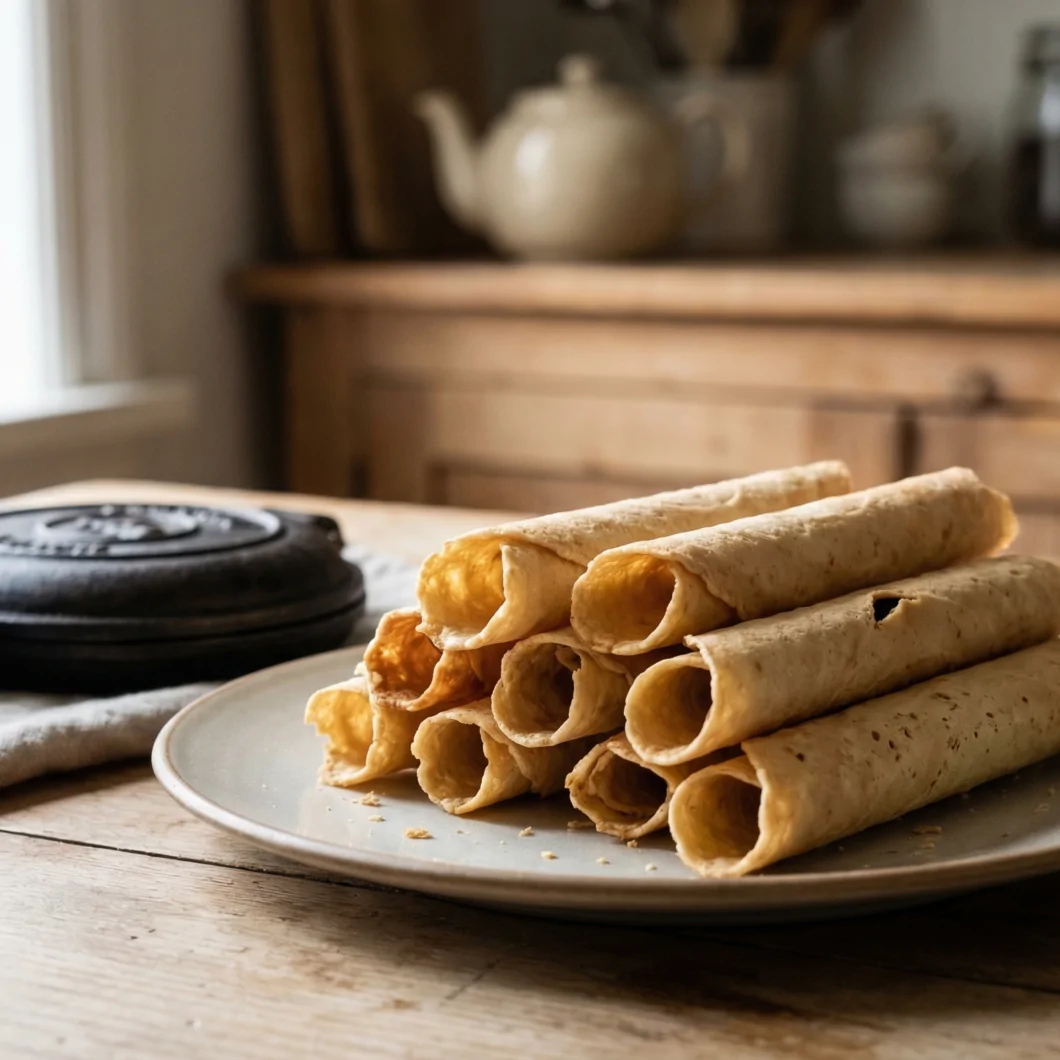

Honey Curbelets
4
people22
minutes16
minutes392
kcal38
minutesA recipe for Curbelets (or Curbélets) from the Tarn region: very thin, dry wafers rolled into tubes, perfect for an afternoon snack or tea time. A Tarn specialty that seems simple on paper, but requires a good touch with the waffle iron.
Keep your device's screen on
Ingredients
2 eggs (approx. 55g per unit without shell)
80 g of sugar
25g of honey (spring or acacia)
90g of unsalted butter, melted + a little extra for greasing
110 g of wheat flour (T45 or T55)
1 pinch of fine salt
1/2 teaspoon of vanilla extract
The finely grated zest of 1 orange (adjust as needed)
1 tablespoon of orange juice
1 tablespoon of orange blossom water (optional)
Preparation steps
- Melt the butter gently and let it cool down (it should be liquid, not hot).
- In a bowl, whisk the eggs with the sugar, honey and a pinch of salt, just to homogenize (no need to make it completely white).
- Add the vanilla, orange zest, orange juice and, if you like, orange blossom water.
- Incorporate the flour all at once and mix until you obtain a smooth dough.
- Pour the warm melted butter in a thin stream while mixing: the batter should be soft and slightly spreadable. Let it rest for 10 minutes at room temperature (while the flour hydrates and the waffle iron heats up).
- Heat your thin-plate waffle iron (ideally a wafer iron). Grease very lightly with a buttered paper towel: too much grease will cause frying and thickening.
- Place a small spoonful of batter (test first: the batter should spread into a thin disc). Close and cook until golden brown, almost nutty: this is what will give you dry and crispy Curbelets.
- Remove the thin waffle from the oven as soon as it's cooked. Work quickly: immediately roll it into a tube around the handle of a wooden spoon (or a small rolling pin), squeezing it tightly without breaking it. Hold for 5 to 10 seconds, until it sets.
- Place on a wire rack to cool completely. Repeat with the remaining dough, re-greasing very lightly if necessary.
- Let them air dry for 15 minutes on the rack before storing them: they will become even crispier.
📊 Nutritional Information
1 serving (approx. 4 curblets, ~80g)
| Nutrient | Value |
|---|---|
| Calories | 392 kcal |
| Proteins | 6g |
| Carbohydrates | 42g |
| including sugars | 23g |
| Lipids | 22g |
| including saturated fatty acids | 13g |
| Fibers | 1g |
| Sodium | 105mg |
| Vitamins | |
| Vitamin A | 14% AJR |
| Vitamin B2 | 18% AJR |
| Vitamin E | 7% AJR |
| Minerals | |
| Phosphorus | 14% AJR |
| Selenium | 20% AJR |
| Iron | 7% AJR |
* RDA = Recommended Daily Allowance
📝 Notes
Store the Curbelets in a metal tin at room temperature for 5 to 7 days. If they soften, place them in a 150°C oven for 4 minutes, then let them cool on a wire rack.
💡 Chef's Tips
The secret is thinness and a deep golden brown: the paler they are, the more they soften. If your tubes break, it's often because they've cooled for 10 seconds too long: roll them as soon as they come out of the waffle iron.
For regular Curbelets, like in the Tarn and surrounding areas, weigh the first batch of dough that works (often 12 to 18g depending on the waffle iron) and keep the same.
🔄 Variations
- Chocolate version recipe: dip one end of the Curbelets in 120g of melted dark chocolate, then let it set on baking paper.
- Anise version recipe: replace the orange zest with 1/2 teaspoon of ground green anise in your Curbelets (or a few crushed seeds) for a very Southwest flavor.

The green anise version really intrigues me: would half a spoonful of liquid anise extract work instead of crushed seeds, or is the flavor really too different for this type of wafer?
Hello Moïse, liquid anise extract will release a much more diffuse aroma and, above all, will largely evaporate during cooking. With crushed seeds or green anise powder, the aroma remains present and slightly caramelized after baking, a bit like the seeds themselves, which are lightly toasted during cooking.