
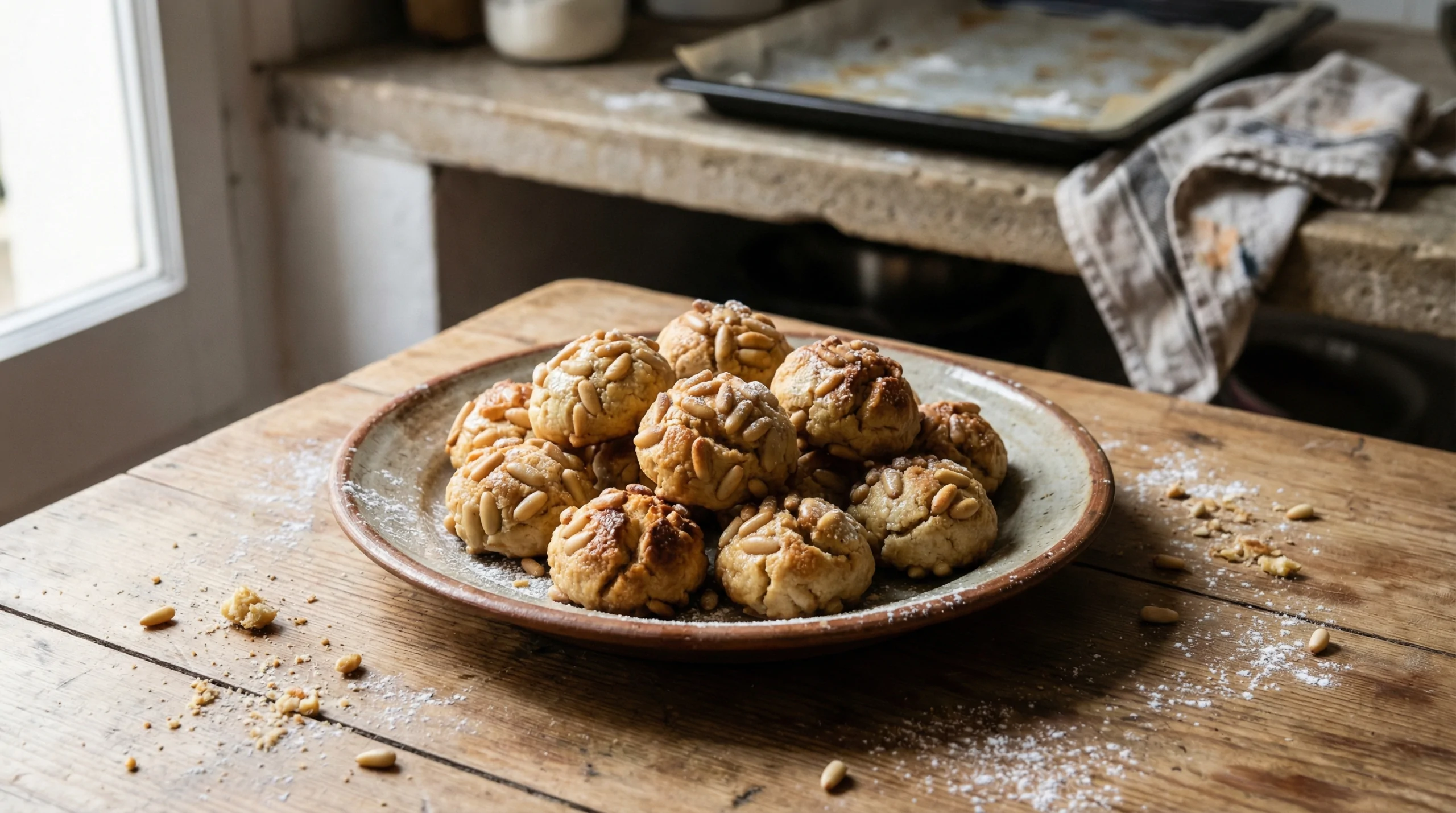
The first time I made Catalan panellets, I understood why these little treats reappear every year around All Saints' Day: they're simple, they smell of almonds, and they have that "little pastry" feel without taking up the whole afternoon. The principle is ultra-traditional: an almond paste (almonds + sugar) bound with a little cooked potato (or sweet potato), then shaped and rolled in pine nuts.
I love this recipe because it plays on two textures: on the outside, the pine nuts become nicely toasted and crispy; on the inside, they remain tender, almost melting. The lemon zest (a classic and very Catalan touch) brightens everything up and prevents the slightly heavy "sugar-almond" effect.
On the practical side, you'll be working with a slightly sticky dough (that's normal), so the trick is to keep your hands slightly damp. And to make sure the pine nuts stick well, give it a generous egg wash: beaten egg, then press the pine nuts in firmly.
Nutritionally speaking, Catalan panellets are definitely a rich dessert (almonds and sugar), but the almonds provide healthy fats, some protein, and a good amount of vitamin E and magnesium. In short: make them in small pieces and enjoy them slowly with a coffee.
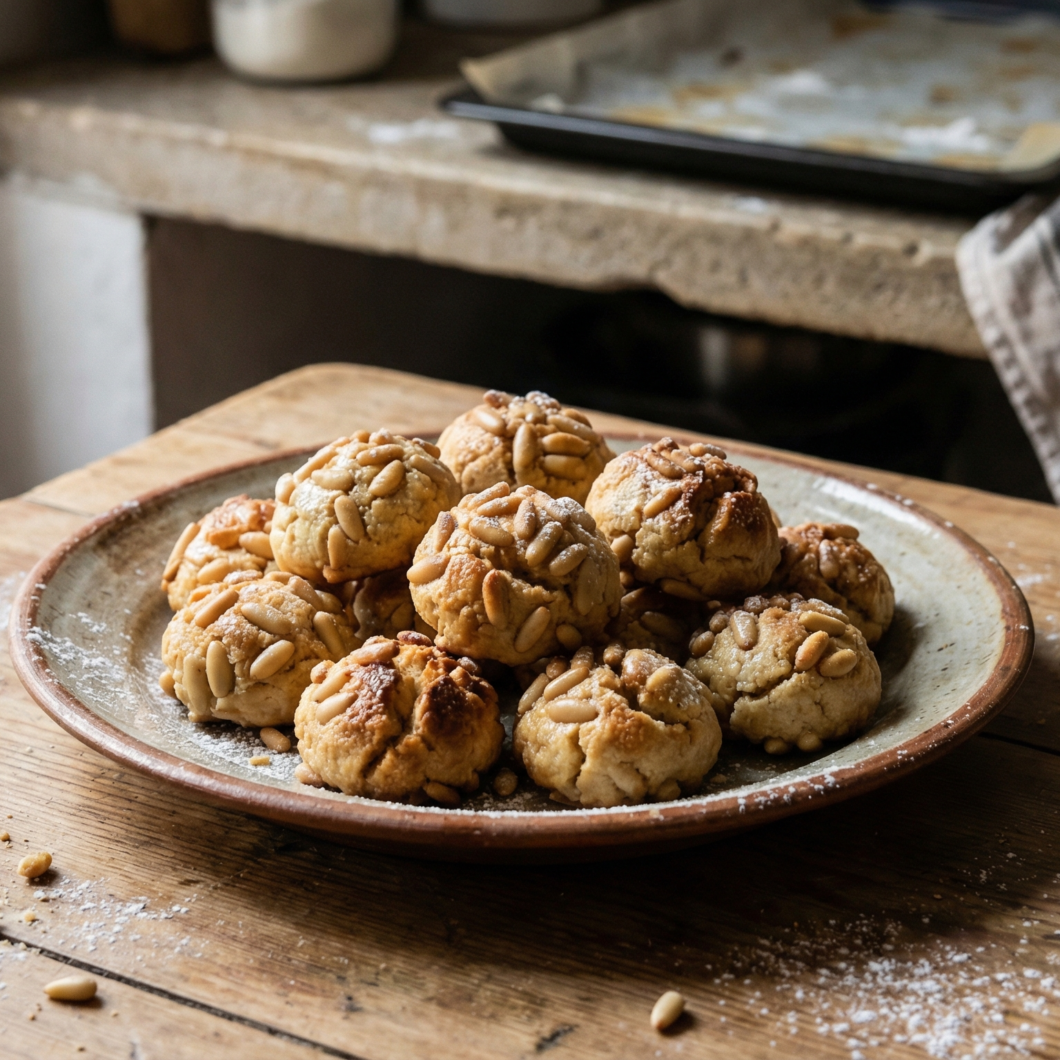

Catalan panellets
12
pieces30
minutes12
minutes667
kcal42
minutesSmall Catalan almond paste bites, soft in the center and beautifully golden. Here, the most classic version: pine nuts and a hint of lemon.
Keep your device's screen on
Ingredients
200g of almond flour
150 g of sugar
80g of cooked potato (or sweet potato) mashed into a fine purée
Finely grated zest of 1 lemon
1 egg
120g of pine nuts
1 pinch of salt
Preparation steps
- Preheat the oven to 200°C (conventional heat). Line a baking tray with baking paper.
- Prepare the base: in a bowl, mix the almond flour, sugar and a pinch of salt. Add the lemon zest.
- Add the very cold, smooth mashed potato (or sweet potato). Mix with a spoon, then finish by hand: you should obtain a soft, slightly sticky but homogeneous almond paste.
- Cover and chill for 10 minutes: the dough will firm up and be easier to shape.
- Beat the egg in a bowl (it will be used both to bind and to glaze).
- Shape: divide the dough into 12 small, even balls (approximately 35g each). Lightly dampen your hands if it's sticky.
- Roll each ball in the beaten egg, then in the pine nuts. Press gently but firmly so that the pine nuts are well embedded over the entire surface.
- Place on the baking sheet. Brush another light coating of egg on top for a beautiful golden finish.
- Bake for 8 to 12 minutes, watching carefully: the pine nuts should be golden brown (not brown).
- Let them cool for 10 minutes on the baking sheet: they will firm up as they cool. Serve warm or at room temperature.
📊 Nutritional Information
1 portion (approx. 140g, or 3 panellets)
| Nutrient | Value |
|---|---|
| Calories | 667 kcal |
| Proteins | 15g |
| Carbohydrates | 61g |
| including sugars | 47g |
| Lipids | 42g |
| including saturated fatty acids | 4g |
| Fibers | 7g |
| Sodium | 75mg |
| Vitamins | |
| Vitamin E | 62% AJR |
| Vitamin B2 | 18% AJR |
| Vitamin B9 | 13% AJR |
| Minerals | |
| Magnesium | 46% AJR |
| Phosphorus | 44% AJR |
| Zinc | 23% AJR |
* RDA = Recommended Daily Allowance
📝 Notes
If you're making the panellets ahead of time, store them in an airtight container: they'll be even softer the next day. And if your pine nuts won't stick, it's often because the dough is too dry: knead it for 30 seconds with a tiny bit of beaten egg.
💡 Chef's Tips
The key is the cooking time: they brown quickly. Stay in the kitchen after 8 minutes, and take them out as soon as the pine nuts have turned a nice honey color. For an easier dough to work with, use a very smooth, well-chilled purée.
🔄 Variations
- None: this recipe follows the traditional Catalan version with pine nuts.
