
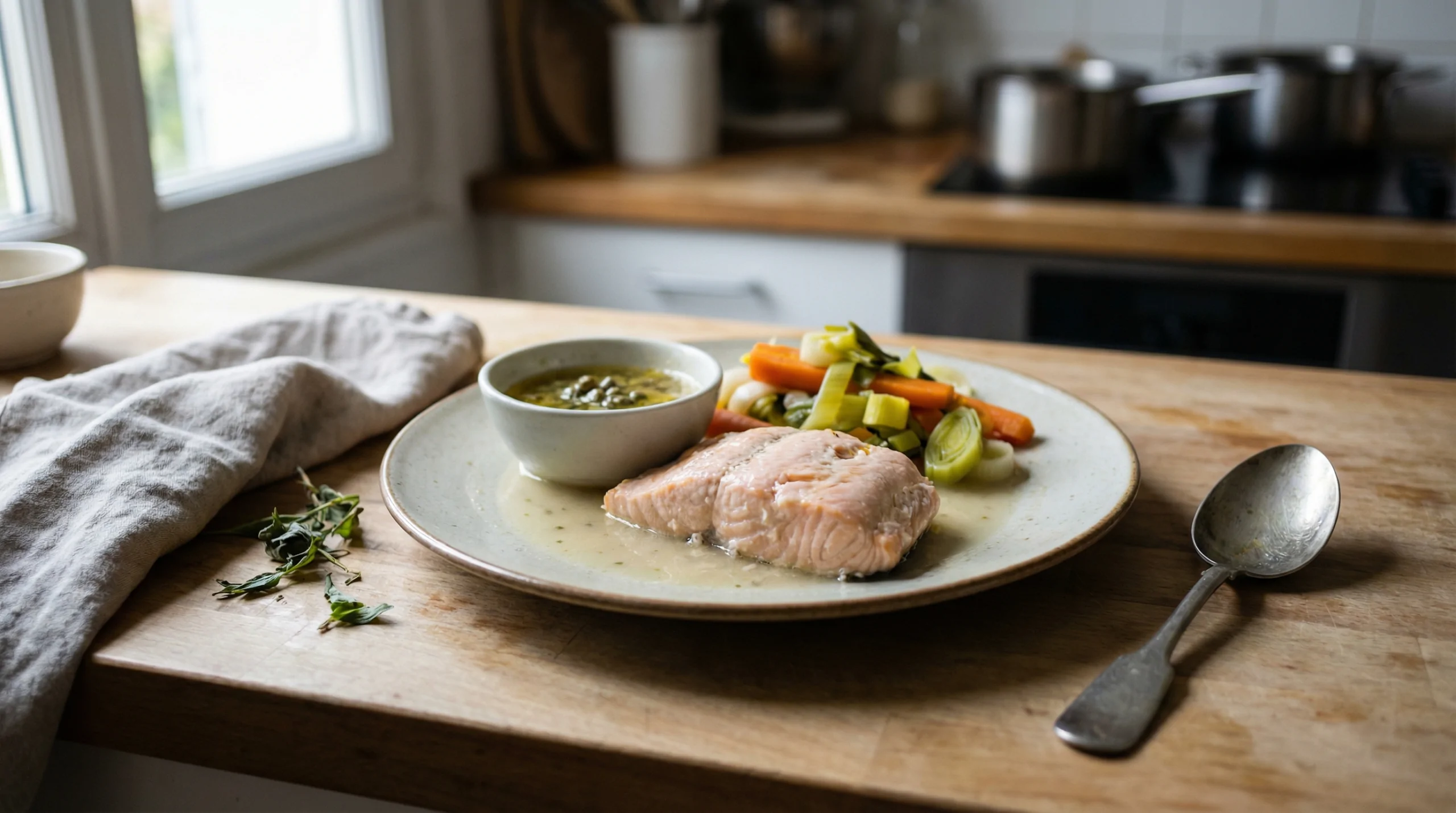
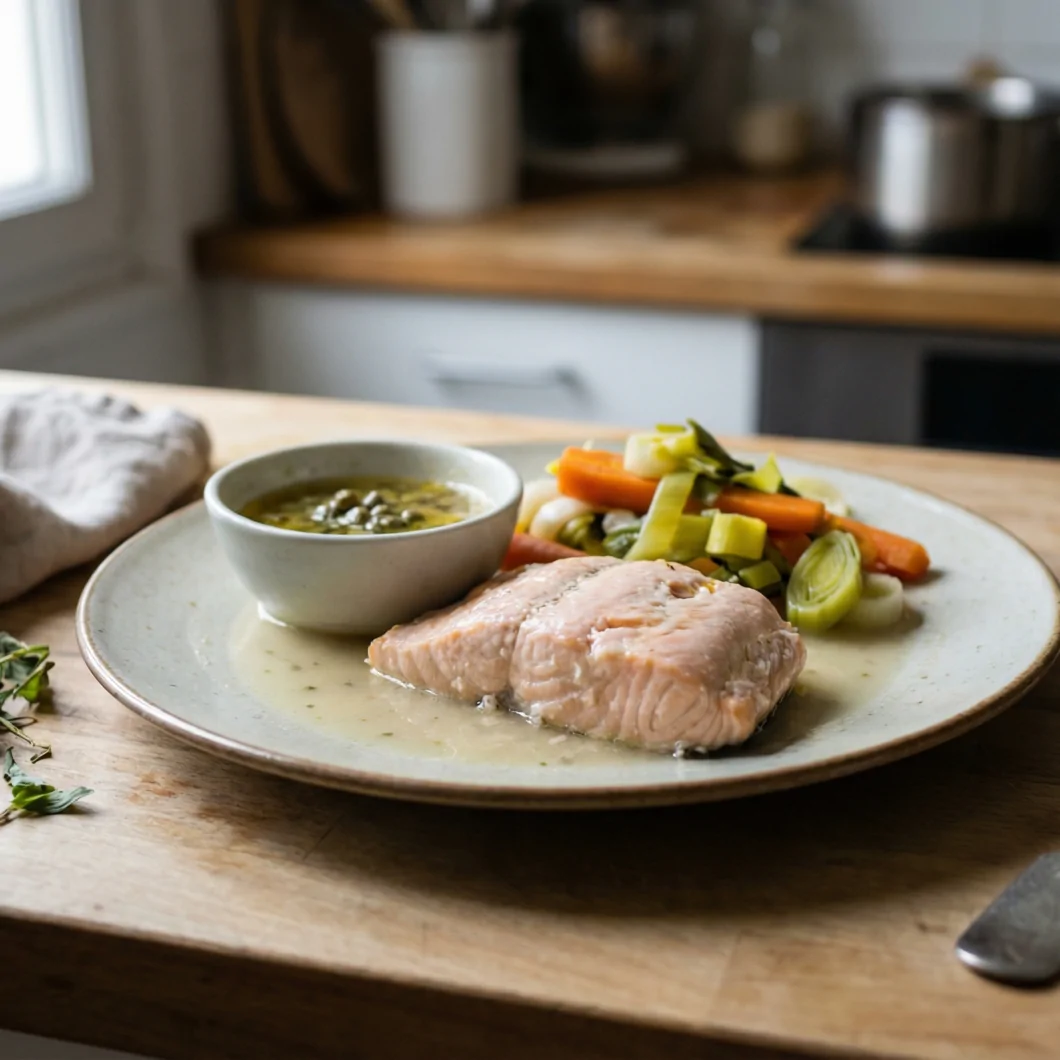
Salmon in court-bouillon is the kind of dish I like to make when I want a tender fish like dogfish (its other name), without any fuss, but with that little "French cuisine" flavor that everyone agrees on.
I discovered it at my aunt's table; she cooked by feel: a pot, some herbs, a glass of white wine, and a fish that cooks gently without ever catching fire. Since then, I make it often, as the result is so consistent.
The secret is gentle poaching. Don't boil it like laundry detergent; keep it at a gentle simmer. This way, the flesh stays tender and doesn't fall apart.
And while the salmon is cooking, you have time to prepare a simple lemon-caper sauce that enhances the dish without masking it!
For a seasonal touch (and because it goes well with this fish), I add leeks and carrots to the court-bouillon: they add flavor, make a natural accompaniment, and save you from having to cook multiple pots. A little parsley when serving, and you have a complete, light, protein-rich, and frankly delicious dish.
You can easily adapt this fish recipe: make it more lemony if you like it really spicy, milder with a little more butter, or even with steamed potatoes on the side, if you want a very "Sunday dinner" feel.

Salmon in court-bouillon
4
people17
minutes38
minutes380
kcal55
minutesA recipe for salmon gently poached in a fragrant court-bouillon, served with a lemon-caper sauce and lightly cooked vegetables. It's simple, clean, and evokes the feeling of bistro-style cooking at home.
Keep your device's screen on
Ingredients
1.2 kg of small-spotted catshark or dogfish in chunks (with skin)
2 leeks
2 carrots
1 onion
2 garlic cloves
1 lemon (zest + juice)
15g of flat-leaf parsley
2 bay leaves
1 small sprig of thyme
8 black peppercorns
12 cl of dry white wine
1.2 L of water
18 g of salt (for the court-bouillon)
30g of butter
1 tablespoon of capers (approx. 15 g per tablespoon, drained)
1 tablespoon of flour (approx. 10 g per tablespoon)
1 tablespoon of Dijon mustard (approx. 15 g per tablespoon)
Preparation steps
- Rinse the salmon fillets and dry them. Keep them chilled while preparing the court-bouillon.
- Prepare the vegetables: slice the onion, crush the garlic, cut the carrots into thin half-moons, and the leeks into rounds (rinsing well to remove the sand).
- In a large pot, pour the water and white wine. Add the onion, garlic, carrots, leeks, bay leaf, thyme, peppercorns, lemon zest, and salt. Bring to a simmer and cook for 12 minutes at a gentle simmer to allow the flavors to infuse.
- Lower the heat: the liquid should simmer, not boil vigorously. Gently slide the salmon fillets into the court-bouillon. Poach for 11 to 13 minutes, depending on their thickness, at a gentle simmer. The flesh should flake easily without falling apart.
- While the poaching is taking place, prepare the sauce: in a small saucepan, melt the butter over medium heat. Add the flour and stir for 1 minute (you are making a mini-roux).
- Take 35 cl of court-bouillon (without peppercorns if possible) and gradually whisk it into the roux. Let it thicken for 3 to 4 minutes over low heat.
- Remove from heat and add the mustard, lemon juice, capers, and 10g of chopped parsley. Taste and adjust: if it's too strong, add a little more butter; if it's too mild, add a squeeze of lemon juice.
- Gently drain the salmon and vegetables. Serve the fillets with the leeks and carrots, coat with the sauce and finish with the remaining parsley.
📊 Nutritional Information
1 portion (approx. 430g, with fish + vegetables + sauce)
| Nutrient | Value |
|---|---|
| Calories | 380 kcal |
| Proteins | 37g |
| Carbohydrates | 11g |
| including sugars | 4g |
| Lipids | 16g |
| including saturated fatty acids | 7g |
| Fibers | 3 g |
| Sodium | 980mg |
| Vitamins | |
| Vitamin B12 | 120% of the recommended daily allowance (RDA) |
| Vitamin A | 70% of the recommended daily allowance (RDA) |
| Vitamin C | 35% AJR |
| Minerals | |
| Selenium | 85% of the recommended daily allowance (RDA) |
| Phosphorus | 45% AJR |
| Potassium | 22% AJR |
* RDA = Recommended Daily Allowance
📝 Notes
If the ammonia smell sometimes bothers you when cooking salmon, gentle poaching and a good lemon in the sauce usually solve the problem. And above all, avoid overcooking it: that's when it becomes less enjoyable!
The small-spotted catshark, or lesser spotted dogfish, belongs to the shark family, so its flesh is naturally richer in ammonia than other fish. Some people may find this smell a little difficult to tolerate.
💡 Chef's Tips
For a perfectly tender salmon fillet : maintain a gentle simmer (small bubbles), and remove the fish as soon as it flakes easily with the tip of a knife. If you prefer a recipe with a lighter sauce, use two-thirds of the sauce and thin it out with a little court-bouillon at the last minute.
🔄 Variations
- Dogfish with steamed potatoes : serve with 600g of steamed potatoes, and also top with a little sauce.
- For a more herbaceous Saumonette : add tarragon (in place of some of the parsley) to the sauce recipe.

I noticed in the variations the version with steamed potatoes: can they be cooked directly in the court-bouillon at the same time as the salmon, or is it really better to cook them separately for better texture?
Hello Eponine, technically the potatoes can cook in the court-bouillon, but I really don't recommend it: they absorb a lot of salt and white wine, and end up with an overpowering flavor that dominates the dish. Steaming or boiling them separately keeps them neutral and allows the lemon-caper sauce to fully express itself; that's where the real difference lies. Enjoy!
I thinned the lemon-caper sauce with a little court-bouillon as advised in the article, resulting in a lighter sauce but still very flavorful, perfect with fish.
Hello Janvier, I'm glad you liked the longer version; that's exactly the idea: to keep the flavor without weighing down the dish. I often make this choice when serving it with steamed potatoes; it balances things out nicely. The sauce remains very flavorful even diluted thanks to the capers and lemon.