
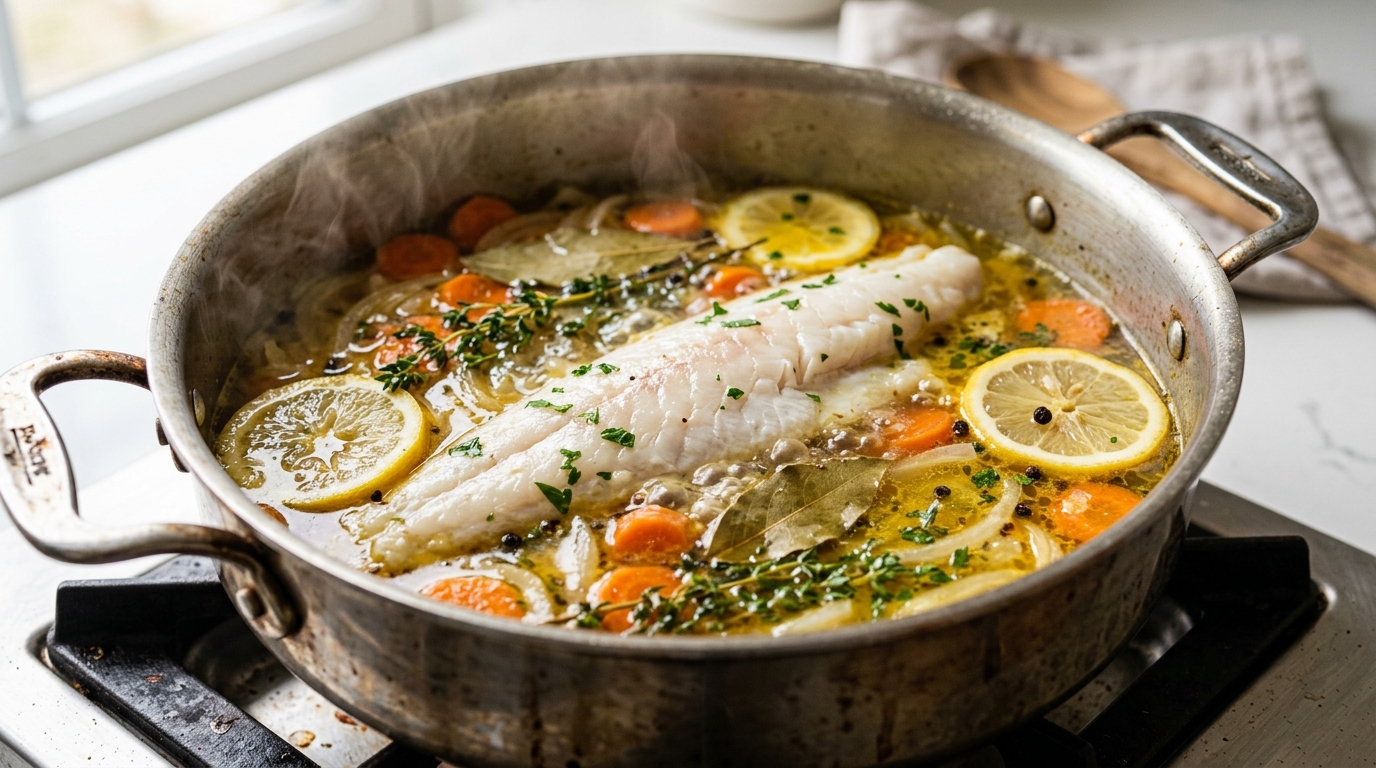
You have your dogfish on the worktop and a saucepan to prepare it. But the question that's holding everything up is: how long should I cook the dogfish in court-bouillon without ruining it?
And the simple answer is: between 8 and 25 minutes depending on the format. However, a few details make all the difference — notably the temperature of the liquid and the uniformity of the pieces.
Our detailed article will help you learn more about the precise times and control points that will allow you to successfully poach dogfish in court-bouillon, without it falling apart in your pan.
Cooking time for dogfish in court-bouillon
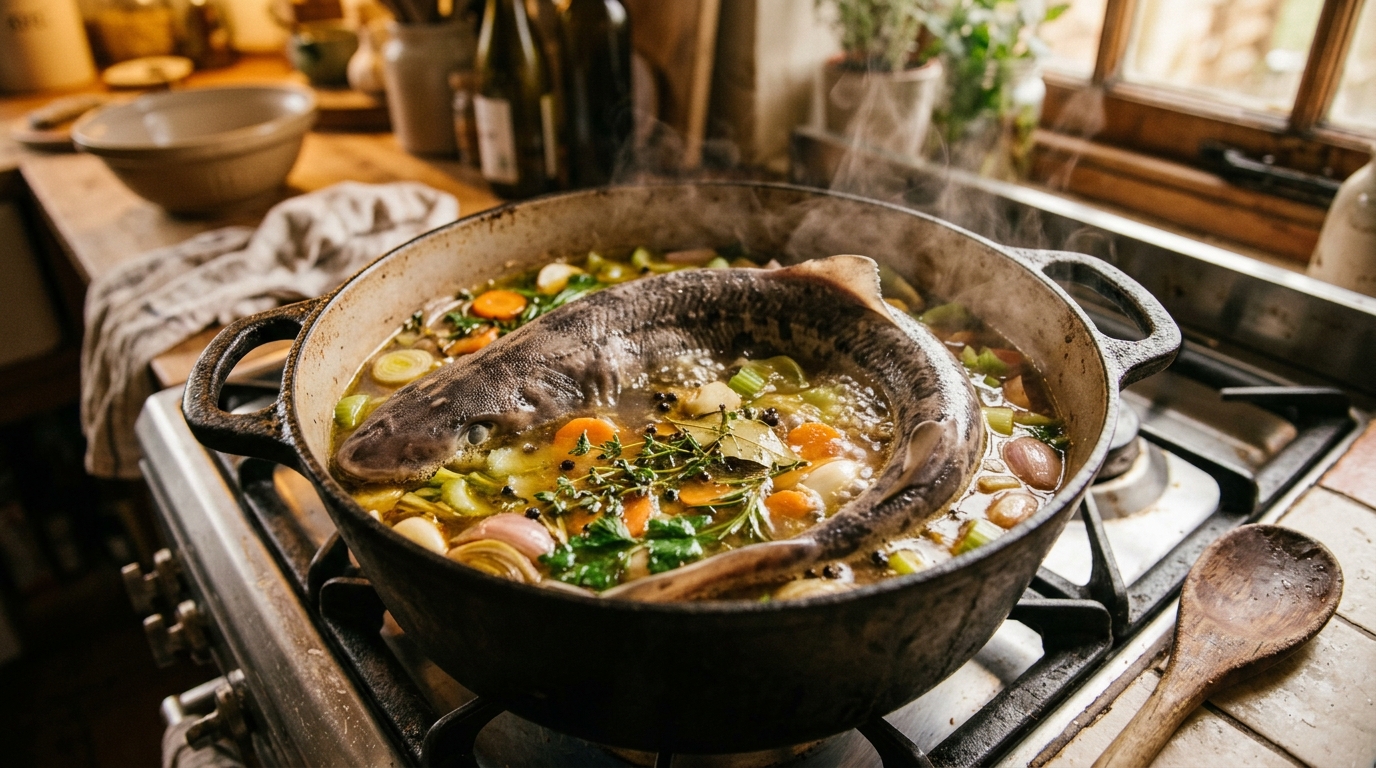
The cooking time for dogfish in court-bouillon depends primarily on the format: thin slices, thick slices or whole fish.
But regardless of the thickness, the number one rule remains the same: the liquid should never boil vigorously. A slight simmer—a few bubbles gently rising to the surface—is more than enough.
This is what differentiates a successfully poached fish from a mushy mess.
A court-bouillon that boils vigorously will break down the flesh of the dogfish. So, maintain a gentle simmer—a few bubbles rising slowly—throughout the cooking process.
Segments or whole: the table of exact durations
Here are the cooking times to follow depending on the size of your dogfish. The countdown always starts when the court-bouillon returns to a simmer after the fish is added, not when the fire is lit.
| Format | Thickness / Approximate Weight | Cooking time |
|---|---|---|
| Thin sections | 2 to 3 cm thick | 8 to 10 minutes |
| Thick sections | 4 to 5 cm thick | 12 to 15 minutes |
| whole flying fox | 600 g to 1 kg | 20 to 25 minutes |
Why avoid large boils with this fish?
The dogfish has firm flesh, but it breaks apart easily when agitated. Rapidly boiling liquid creates turbulence that disintegrates the flesh before it is fully cooked.
The result: pieces that go in all directions, a cottony texture, and fish that doesn't stay on the plate well.
For a well-cooked dogfish that holds its shape, gentle simmering is the only viable option.
In practice, a slightly open lid helps to regulate the temperature effortlessly: it lets excess steam escape while keeping the liquid hot.
Never cover the pan tightly over high heat. The accumulated steam causes the temperature to rise sharply and ruins the texture of the fish in seconds.
Prepare a homemade court-bouillon for the dogfish
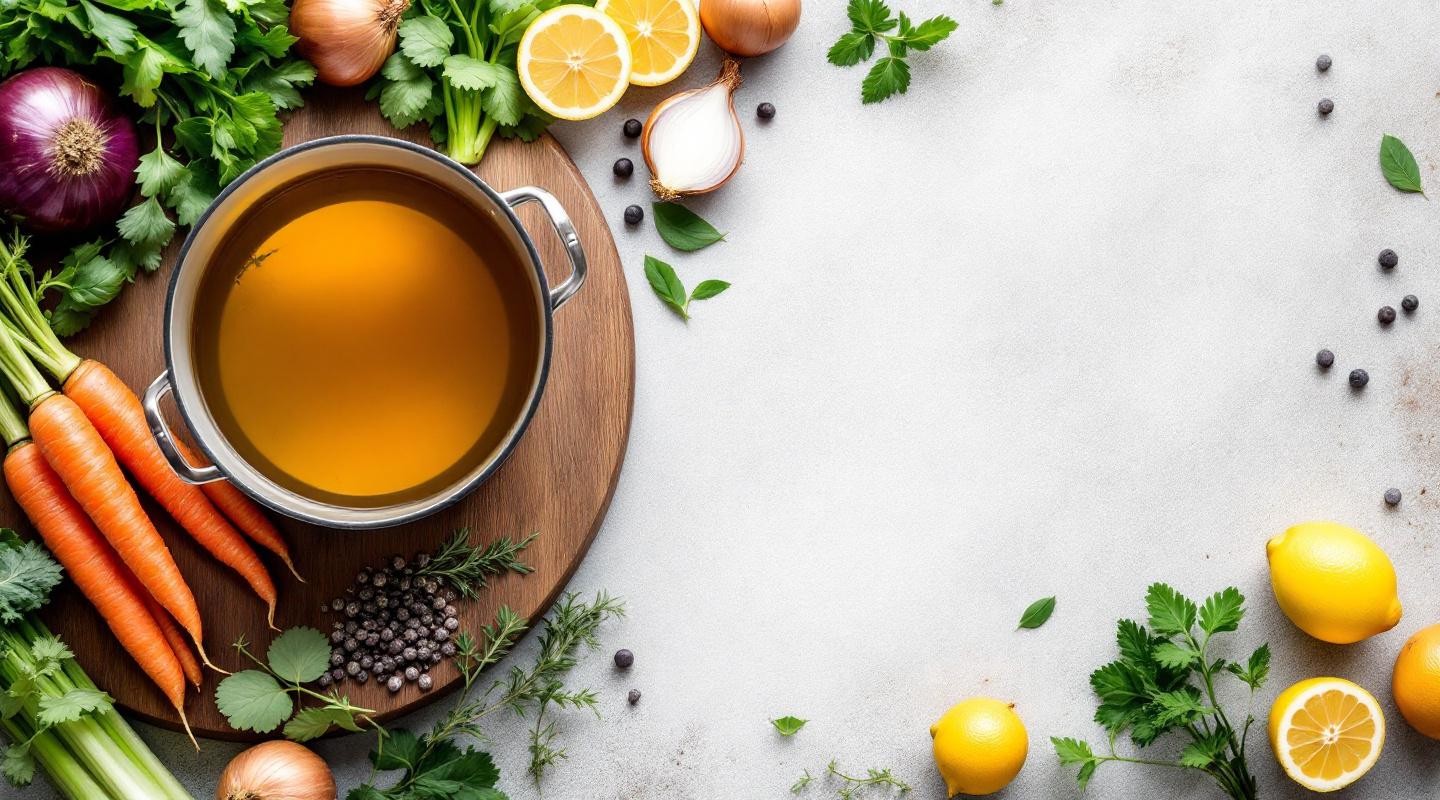
A homemade court-bouillon for dogfish doesn't need to be complicated. A few common ingredients are enough to flavor the flesh and give it that delicate taste we're looking for.
The acidity provided by white wine or vinegar plays an important role: it slightly tightens the surface proteins and helps the flesh to retain its shape during cooking.
To learn more about the method, see our page on preparing homemade court-bouillon, which details most of the basics you need to know.
Simple ingredients for an aromatic court-bouillon
For approximately 1.5 liters of court-bouillon:
- 1 liter of water + 20 cl of dry white wine (or 3 tablespoons of white vinegar)
- 1 carrot, sliced into rounds
- 1 onion studded with 2 cloves
- 1 bouquet garni (thyme, bay leaf, parsley)
- 1 teaspoon of coarse salt
- A few grains of black pepper
There's no need to pile on the spices. This simple court-bouillon will flavor the dogfish without masking its natural, slightly briny taste.
If you don't have white wine on hand, diluted white vinegar works very well: use 2 to 3 tablespoons for 1.5 liters of water, no more, otherwise the acidity becomes noticeable in the flesh.
How long should I let it simmer before putting the fish in?
This is a step that many people wrongly skip! The court-bouillon must simmer for at least 15 to 20 minutes before adding the dogfish.
This time allows the aromas of the vegetables and herbs to properly infuse the liquid. A barely warm broth imparts almost nothing to the meat.
If you put the fish in cold or lukewarm broth, it will cook unevenly: the surface heats up too quickly while the center remains raw.
Gently place the pieces into a very hot broth, sliding them in with a skimmer rather than throwing them from above to avoid creating unnecessary commotion.
Strain the court-bouillon before adding the fish. This will prevent small pieces of vegetables from sticking to the fish and making presentation difficult.
⏱️ Cooking calculator — Dogfish in court-bouillon
Specify the type and weight of your dogfish to obtain the precise cooking time.
Prepare the dogfish (small salmon) well before poaching it
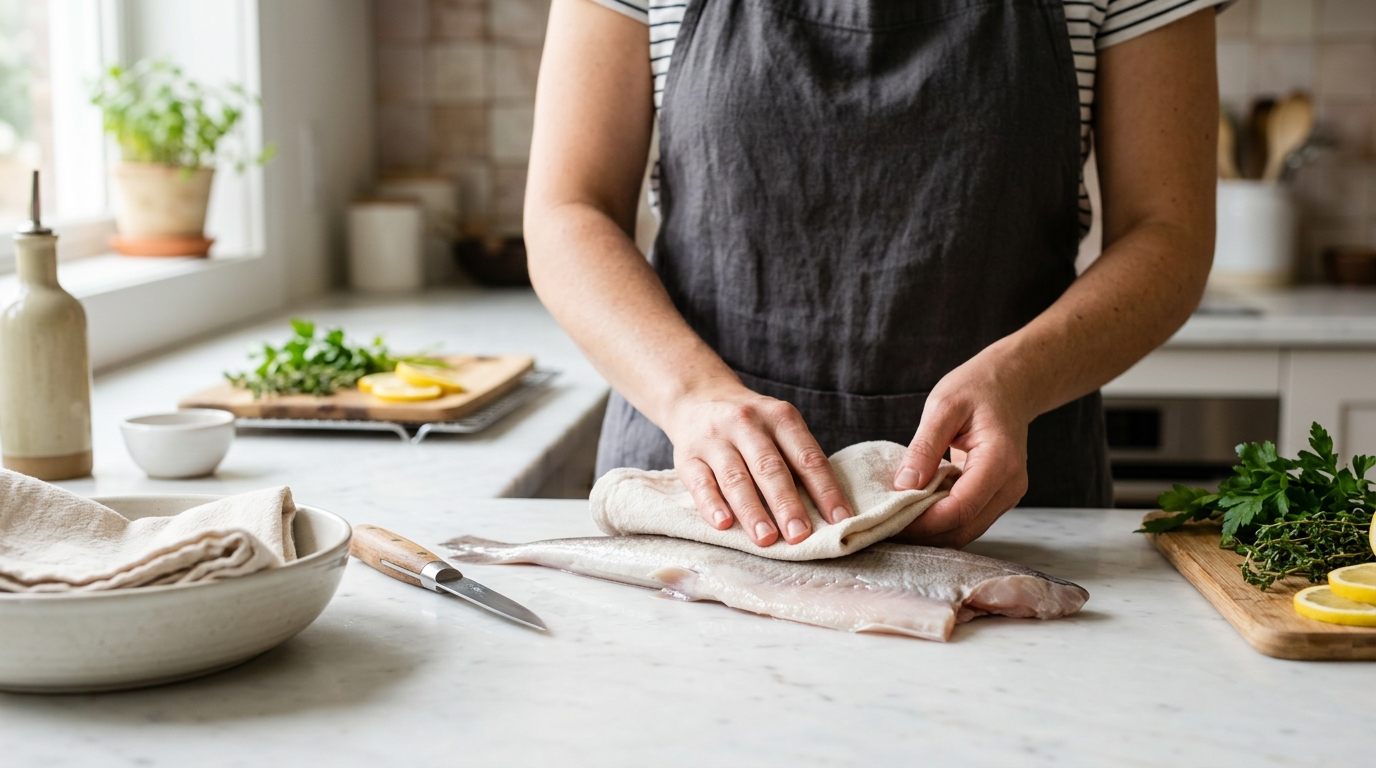
The preparation of the fish directly affects the success of the cooking process. A few minutes of care beforehand will prevent unpleasant surprises in the pan.
Rinse, cut into even slices for uniform cooking
Start by rinsing the dogfish under cold water, then dry it with absorbent paper.
If your fishmonger hasn't already done so, this is called salmonette, remove the skin: tough and unpleasant to eat once cooked, it adds nothing to the dish.
An incision along the back is usually sufficient to detach it cleanly.
For cutting into pieces, use a filleting knife or any knife with a thin, rigid blade that allows for clean cuts.
The goal is to obtain pieces of uniform size: this is what guarantees even cooking of the dogfish in a pan .
Uneven pieces inevitably give a two-speed result — the thinnest overcooked, the thickest still raw in the center.
Reduce the odor before cooking
The small-spotted catshark, like all elasmobranchs (sharks and rays), can give off a slight smell of ammonia, especially if it is not very fresh.
To remedy this before cooking, soak it for 20 to 30 minutes in cold water with the juice of one lemon or 2 tablespoons of white vinegar.
This acid bath dissolves the compounds responsible for the odor without altering the flesh.
Then scrub thoroughly under cold water before poaching.
Dogfish and small-spotted catshark: the same fish, two common names
If you are looking for a recipe for salmon in court-bouillon, you are exactly in the right place.
Roussette and saumonette refer to the same fish — a small bottom-dwelling shark sold under these two names depending on the region and the fishmonger.
The term " saumonette " is mainly used in commerce because it sounds more appealing.
In the kitchen, the techniques are strictly identical: the cooking time for the small salmon in court-bouillon is exactly the same as for the dogfish.
How can you tell if the dogfish is cooked properly?
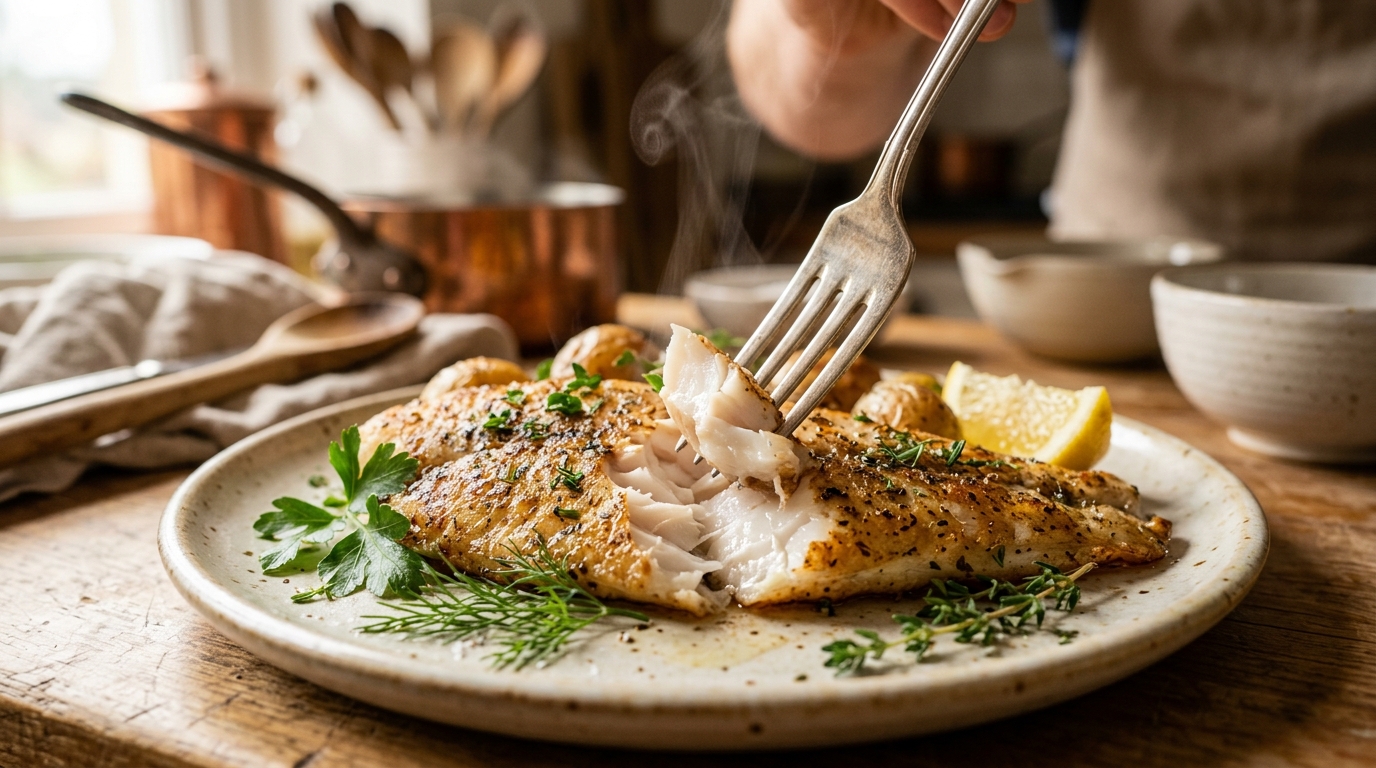
No need for a thermometer! A few simple checks are enough to ensure that the poached dogfish is ready without being overcooked.
The difference between "perfectly cooked" and "overcooked" is often a matter of two to three minutes: it's better to test early and check than to wait too long.
Visual and textural signs to watch out for
Three reliable indicators:
- The flesh changes color : it goes from a translucent pearly white to a matte and uniform white throughout its thickness.
- The flesh easily detaches from the central bone when you test with a fork — without forcing it.
- The texture is firm yet supple : it resists slightly under the finger, without being hard or cottony.
If the flesh crumbles or disintegrates to the touch, the fish has been cooked for too long or at too high a temperature.
Unlike other fish, dogfish does not easily "come back" from overcooking: the cottony texture remains, even with a sauce.
Test for doneness with a fork after 8 minutes for thinner slices. Slide a tine into the center of the thickest slice: if it goes in without resistance, it's cooked.
The best ways to serve poached dogfish
Poached dogfish can be eaten warm or cold, depending on your preference and the season. Its neutral, slightly briny flesh pairs well with acidic sauces and fresh herbs. Here are some of the most successful combinations:
- Gribiche sauce (capers, gherkins, hard-boiled egg, mustard) — a classic bistro dish, very effective with this fish
- Warm shallot vinaigrette — simple to prepare, poured over at the last minute so as not to cook the meat further
- Brown butter and capers — quick and tasty, the golden butter enhances the delicate flavor of the fish
- Served as a cold salad with steamed potatoes, flat-leaf parsley, and a mustard vinaigrette.
Avoid heavy sauces made with thick cream: they completely mask the delicate flavor of the fish.
Poached dogfish also lends itself very well to cold preparations the next day — shredded on toast, incorporated into a tabbouleh or served in a terrine.
If you enjoy working with fish fillets in different ways, keep this option in mind to avoid waste.
- Simple cooking, no special equipment required
- A lean, light, and easily digestible fish
- Firm flesh that holds its shape well if the simmering is respected
- Versatile hot or cold, with many sauces
- The flesh crumbles if the temperature is too high
- Requires constant monitoring of the simmering
- A neutral flavor that requires a carefully chosen sauce
- Cooking time is difficult to correct if it's too long
🎯 Are you an expert on cooking dogfish in court-bouillon?
5 questions to check that you have understood everything before you start cooking.
1. What is the recommended cooking time for dogfish pieces in court-bouillon?
2. At what temperature should the dogfish be poached in the court-bouillon?
3. What ingredient is essential in a homemade court-bouillon to flavor dogfish?
4. How can you tell if the dogfish is cooked properly when poaching?
5. What preparation step is recommended before poaching the dogfish to reduce its odor?
Let's summarize in the form of practical questions
What is the exact and recommended cooking time for dogfish in court-bouillon?
It depends on the size: allow 8 to 10 minutes for thin slices (2-3 cm), 12 to 15 minutes for thick slices (4-5 cm), and 20 to 25 minutes for a whole dogfish. The timer starts as soon as the court-bouillon returns to a simmer after the fish is added.
Why does the dogfish fall apart in the court-bouillon?
The main cause is boiling too vigorously. Dogfish should be cooked at a gentle simmer, not a rolling boil. The agitation of the boiling liquid breaks down the flesh before the fish is cooked through. Maintain a gentle temperature throughout the cooking process.
What is the difference between the dogfish and the salmon?
There's no difference in cooking: "roussette" and "saumonette" refer to the same fish, a small bottom-dwelling shark. The name "saumonette" is mainly used commercially to make the product sound more appealing. Cooking times and techniques are identical.
How can you tell if the dogfish is cooked properly without a thermometer?
Three telltale signs: the flesh has turned a matte, uniform white (more translucent), it flakes easily from the central bone with a fork, and it remains firm without crumbling. If the texture is cottony or the flesh falls apart, it has been cooked for too long.
Can you use water alone to cook dogfish in a saucepan?
Technically yes, but the result will be tasteless. A court-bouillon with white wine or vinegar, vegetables, and herbs flavors the flesh during cooking. Water alone would impart no aroma to the fish, which would remain bland.

I soaked the fish pieces for thirty minutes in lemon water as advised, but the ammonia smell was still slightly noticeable during cooking. I'm not sure the fish from my fishmonger is fresh enough for this type of recipe.
Hello Geneviève, this kind of residue, even after the lemon bath, is most common when the dogfish is a few days old; the ammonia smell intensifies quickly with this fish. A reliable fishmonger who sells it the same day or the day after it arrives usually minimizes this problem, but a second 10-minute bath can also help if you're still unsure. It's more of a detail to keep an eye on than a real warning sign, as long as the flesh smelled fresh before cooking.