
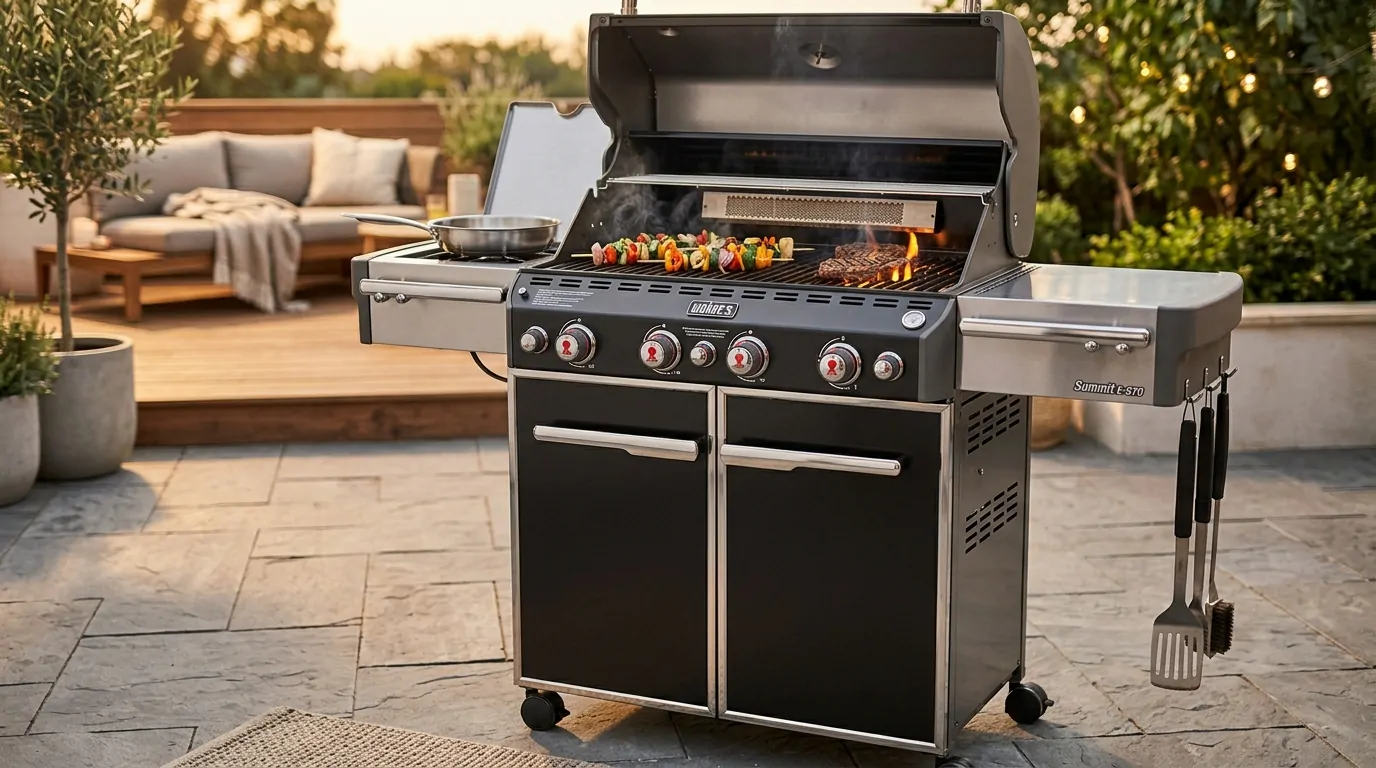
When setting up a barbecue area on your terrace, three decisions matter more than the choice of appliance: the location in relation to the wind and the house, the covering placed under the cooking area, and the cleaning routine after the meal.
When placed incorrectly, a griddle makes the terrace dirty and fills the house with smoke; when well-designed, it allows you to cook and entertain without running between the kitchen and the garden.
In short
- The location is chosen based on the prevailing wind, the openings in the house, and the route to the kitchen.
- Under the cooking area, the coating must withstand grease splashes and be cleaned without harsh products.
- A charcoal barbecue should not be placed directly on decking boards: a mineral area or a protective plate is required.
- According to the Consumer Safety Commission, of the 229 barbecue accidents recorded between 1995 and 2000, 35.8% occurred when lighting or rekindling the fire with gasoline, white spirit or a lighter.
- The maintenance is done the same evening: a fresh grease stain comes off much more easily than a stain baked in the sun.
Where should I install the griddle or barbecue on the terrace?
The question concerns many households. According to INSEE, 55.8% of main residences in France were individual dwellings in 2024, in other words houses, often with a terrace or a garden.
The question of the cooking area therefore begins with the plan, not with the catalogue.
The prevailing wind. Before deciding on the location, observe the wind direction for a few evenings. The smoke should drift towards the garden, not towards the guests' table or a bedroom window. A cooking area placed against the wall, under a bay window, will bring odors and smoke back inside with every meal.
The journey to the kitchen. Raw dishes, utensils, served dishes: an outdoor meal involves many trips back and forth. Placing the griddle near the kitchen door, but not in the way, avoids having to cross the patio with your hands full between the table and the appliance.
Distances. The distances to be respected in relation to walls, vegetation, and combustible materials vary depending on the type of fireplace (gas, electric, or coal): the manufacturer's instructions are the definitive source. A hedge, parasol, or canvas pergola above the cooking area is prohibited.
What type of covering should I choose under the cooking area?
The floor of the barbecue area suffers what the rest of the terrace does not: oil splashes, marinade drips, radiant heat and, with the charcoal, the risk of falling embers.
| Coating | Grease splatters | Heat and embers | Post-meal interview |
|---|---|---|---|
| Solid wood | Because it's a porous material, grease will penetrate if it's not wiped off quickly | Fuel, to be protected under a coal-burning appliance | Quick cleaning, regular treatment of the terrace |
| Composite wood | Wipe clean promptly; some warranties cover stain resistance under normal residential use | Protect from hot blades under a charcoal appliance in direct summer sun | No stain or saturator, high-pressure jet held at a safe distance |
| Outdoor porcelain stoneware | The joints, being relatively non-porous, remain the weak point | Withstands heat well | Simple wash, but keep an eye on the joints |
| Natural stone | Variable: limestone absorbs more than hard stone | Good fit | Depends on the stone and its treatment |
| concrete slab | Porous without protective treatment | Good fit | Old stains leave lasting marks |
Many terraces combine two materials: decking on the dining and relaxation area, and a mineral area under the cooking appliance.
This solution solves the problem of embers and keeps the heat of the wood where you sit.
For an electric or gas griddle placed on a piece of furniture, the blades can run under the whole thing, provided that the projection area is protected.
The choice between wood and composite decking depends primarily on the level of maintenance you're willing to undertake. A solid wood deck requires regular treatment, while a composite deck needs neither stain nor saturator.
A trader that distributes both materials, such as E-Wood, a trader of wood and composite, allows you to compare the profiles of the blade and their warranty conditions before making a decision: some composite blade warranties cover, for example, resistance to stains, within the framework of normal residential use.
One last point to anticipate: like any exposed decking material, a composite board can get hot in full summer sun, which is important for an area where people walk barefoot.
Safety rules that prevent most accidents
The most detailed French figures are old, but the causes they describe have not changed.
In its opinion on the safe use of barbecues, the Consumer Safety Commission analyzed 229 accidents recorded between 1995 and 2000.
Of this total, 82, or 35.8%, occurred by lighting or reigniting the fire with gasoline, white spirit or an ignition product, and 75, or 32.75%, by direct contact with a hot element of the device.
The Commission specifies that 35% of these accidents required hospitalization. Details are available in the opinion published by the DGCCRF.
These two factors dictate both the layout and the actions:
- Lighting. Never use methylated spirits or gasoline, and never pour any kindling onto already hot embers to revive the fire. Firelighters are only for the initial ignition.
- Contact. A stable device, placed on a flat surface, out of the way of children and people coming and going to the table.
- Equipment. An electrical appliance should be checked before the season: the DGCCRF deemed a third of the 131 electrical products analyzed in 2022 to be dangerous, a campaign which included outdoor cooking appliances such as barbecues or planchas.
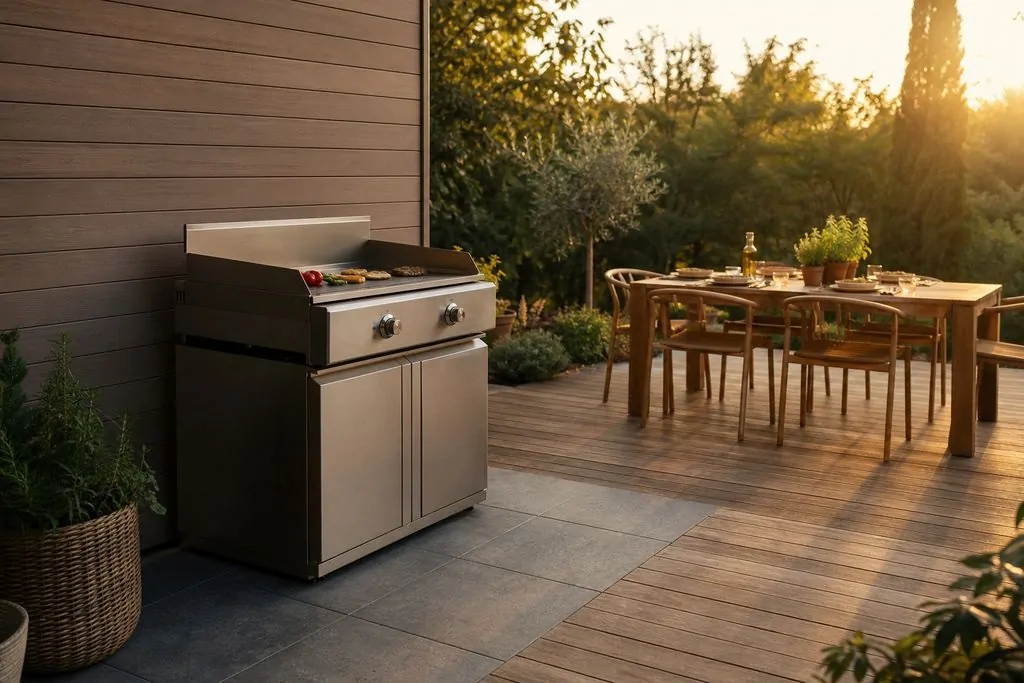
A concrete example: on a 4-meter by 5-meter decking terrace, a corner of approximately 2 meters by 1.5 meters is reserved at the foot of the kitchen wall, on the side opposite the prevailing wind. Porcelain stoneware tiles are laid there, upon which the griddle is placed, with a small work surface alongside. The table remains at the other end, on the decking, and the path from the kitchen to the griddle never intersects with that of guests.
Clean the terrace after meals
Maintaining a barbecue area involves two steps. In the evening, wipe up any still-warm grease splatters with absorbent paper, then with a sponge and slightly soapy hot water.
A fresh stain remains on the surface; after a day in the sun, it has penetrated the pores of the wood, stone or joints.
At the end of the season, a thorough cleaning is necessary. On a composite deck, cleaning with a high-pressure jet is sufficient, keeping the jet at a safe distance to avoid damaging the surface.
On solid wood, it precedes the treatment of the terrace. On tiles, special attention is paid to the grout, which retains grease residue.
Practical information: barbecue area and terrace
Can you place a barbecue directly on your wooden terrace?
A charcoal barbecue should not be placed directly on decking, wood, or composite materials due to the risk of falling embers. It should be installed on a mineral surface or on a protective plate designed for this purpose.
How to remove a grease stain from a patio?
It's essential to act the same day: use absorbent paper, then warm soapy water and a soft brush. On composite decking, a final cleaning with a high-pressure jet held at a safe distance completes the process. On solid wood or stone, an old stain requires a cleaner specifically designed for the material.
What type of flooring should I choose for a barbecue area on my terrace?
Beneath the unit, a mineral area of porcelain stoneware or hard stone is easy to clean. Around it, in the dining area, solid wood or composite decking provides the comfort and appearance of wood. Composite decking eliminates the need for the regular maintenance required for a solid wood deck.

Sources
- Insee, "The housing stock as of January 1, 2024", Insee Focus No. 332: https://www.insee.fr/fr/statistiques/8251576
- Consumer Safety Commission, opinion concerning the safe use of barbecues, BOCCRF of September 30, 2003: https://www.economie.gouv.fr/files/files/directions_services/dgccrf/boccrf/03_11/a0110021.htm
- DGCCRF, “Hair dryers, light fixtures, barbecues, mosquito repellent devices: serious risks identified,” May 14, 2024: https://www.economie.gouv.fr/dgccrf/laction-de-la-dgccrf/les-enquetes/seches-cheveux-luminaires-barbecues-appareils-anti