
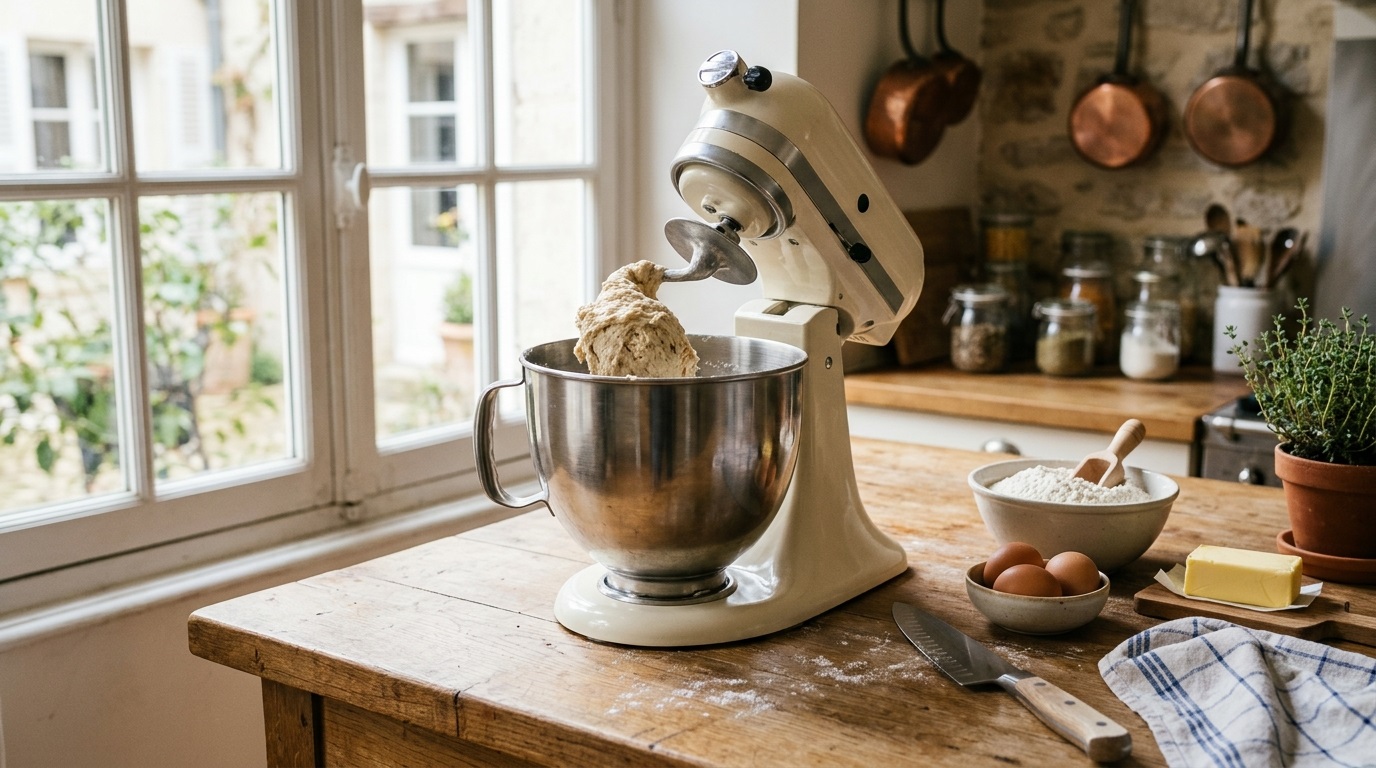
"It does everything." That's the salesperson's argument, and that's precisely where the misunderstanding begins. A food processor doesn't do everything; it does some things much better than a human hand, and it fails at others with remarkable consistency.
Where the machine wins, and by a long shot
Long, controlled-temperature cooking. A custard that needs to be kept at 83 degrees without ever exceeding it, a hollandaise sauce, a risotto that requires twenty minutes of stirring: in these areas, a food processor does better than most amateur cooks, simply because it doesn't get bored.
Leavened doughs, too. Kneading brioche dough by hand for twelve minutes is hard work, and many give up before achieving the gluten network that creates the texture. With a dough hook, there's no question.
And anything involving repetitive chopping: slicing three kilos of onions for soup, grating carrots for a whole family. The time saved is real and no one regrets it.
The three things it won't replace
Searing. Meat that needs to brown requires direct contact with a very hot, dry surface. In a pot, even a heated one, the steam doesn't escape quickly enough, resulting in gray meat that is cooked but lacks a Maillard reaction. Searing in a pan before transferring to the food processor remains essential for a proper beef bourguignon.
Seasoning is added along the way. A robot follows a program; it doesn't taste. A tomato sauce made with late-season tomatoes doesn't need the same amount of sugar as a sauce made in August. It's the cook who adjusts, and that's where the difference lies between a decent dish and a great one.
Fine textures. A food processor blends very well, but it blends everything. A soup where you want to keep some chunks, a tartare cut by hand, a regular brunoise: the high-speed spinning blade doesn't allow for nuance.
The real calculation before buying
The question isn't "does it save time?" but "does it save you time being present?" A food processor doesn't reduce the cooking time; it frees you from having to supervise.
For someone who cooks after work with two children underfoot, it's crucial. For someone who cooks on Sundays for pleasure, there's no benefit, and the item ends up under the counter.
The other factor that's often underestimated is washing. The bowl, blade, basket, seal, and whisk all need to be washed for five to seven minutes after each use, every day. Over a year, that adds up and impacts the machine's actual lifespan.
A category older than we think
These devices are often presented as a recent invention, but they actually come from a lineage that goes back to the stand mixers of the early twentieth century, then to the multi-function robots of the 1970s that were already equipping many French kitchens.
This detour through the history of kitchen robots also sheds light on why some functions have become established and others have not.
In my opinion, since a decision must be made: if you cook four times a week or more, the appliance is well worth it. Otherwise, a good cast-iron casserole dish and a sharp knife will be more useful, for a tenth of the price.
