
In short
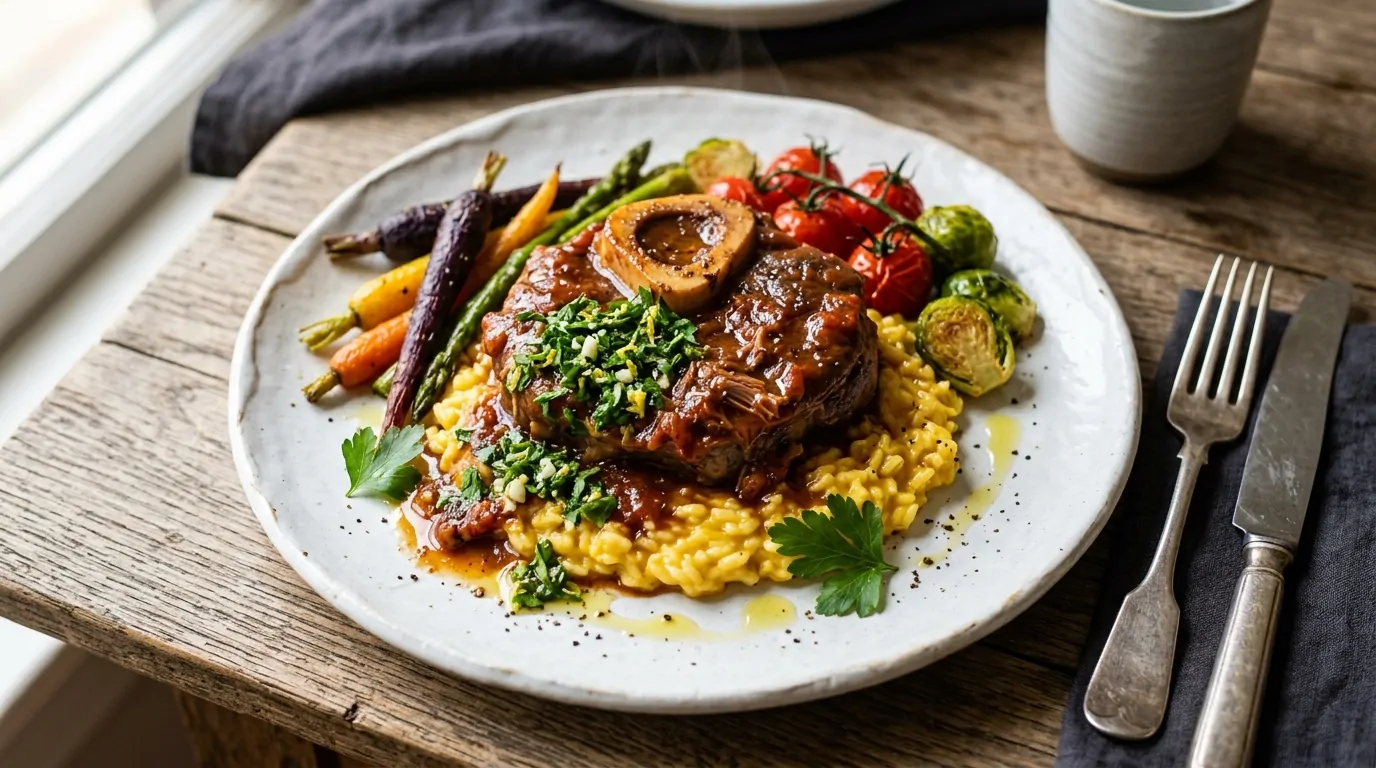
You have your osso buco recipe in hand, the meat is simmering gently, and the kitchen already smells delicious. One question remains: what should you serve with osso buco to create a truly successful meal?
This article reviews most of the possible side dishes — from the most traditional Italian ones to quick alternatives for a weeknight.
You will now know exactly what to choose, why it works, and how to prepare everything without running around in all directions!
Traditional Italian side dishes for osso buco
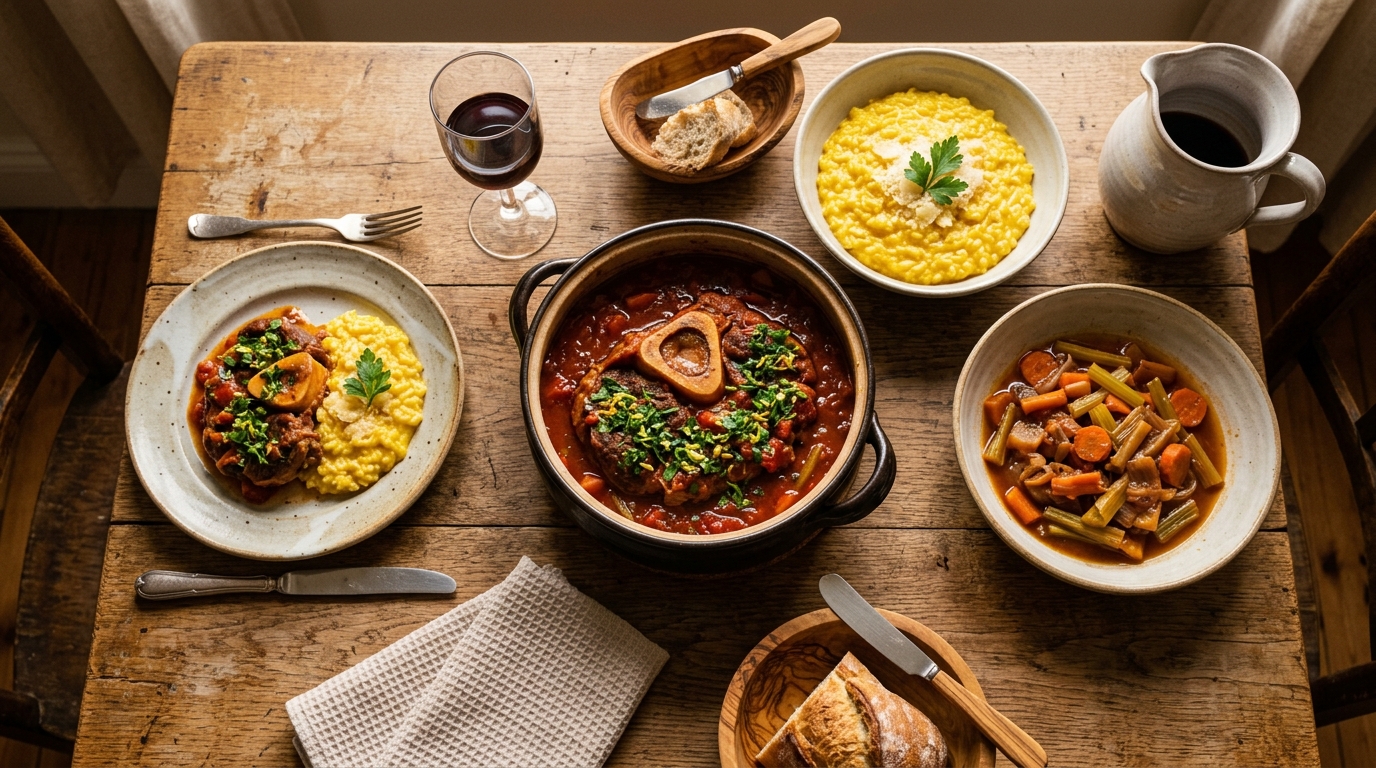
In Italy, you don't serve osso buco with just anything! Lombard cuisine has its own codes, habits, and reasons.
However, two elements consistently appear on Milanese tables: saffron risotto and gremolata. Together, they form a perfect trio with braised meat.
These pairings are not accidental. They are designed to balance the richness of the sauce, bring freshness, and highlight the melting collagen of the bone marrow.
Risotto alla milanese: the classic Lombard pairing
If you're looking for the traditional accompaniment to Italian osso buco, risotto alla milanese is the answer. It's a golden-yellow risotto, colored and fragrant thanks to the saffron. This combination originated in Milan, where the two dishes have been served together for centuries.
The rice absorbs the tomato sauce and cooking juices remarkably well! Each bite combines the creaminess of the risotto with the tenderness of the meat. The saffron adds a subtle floral bitterness that contrasts beautifully with the richness of the braised meat.
To make it stress-free, use Arborio or Carnaroli rice. Sauté an onion in butter, add the rice, toast it until translucent, then stir in the stock ladle by ladle.
Saffron — a pinch infused in a little hot broth — is added at the end of cooking.
Risotto alla milanese takes 25 to 30 minutes to prepare, which corresponds well to the last hour of braising the osso buco.
Gremolata: the essential condiment for osso buco
Many amateur cooks are unaware of this, and that's a shame: gremolata as an accompaniment to osso buco is technically an integral part of the original recipe, not just an added decoration.
Gremolata is a fairly simple mixture—finely grated lemon zest, chopped garlic, and chopped flat-leaf parsley. It's sprinkled over the meat just before serving, never during cooking.
Its role is precise: it brings acidity and freshness to counterbalance the heaviness of the braised sauce.
Without it, the dish can seem overwhelming over time. With it, each bite ends on a bright and fragrant note.
Prepare your gremolata 10 minutes before serving, not before — the lemon zest and parsley lose their aromatic brightness if left too long.
🍽️ What side dish should you choose for your osso buco?
Answer 3 questions and get the perfect recommendation for your meal.
Which starchy foods absorb sauce best?
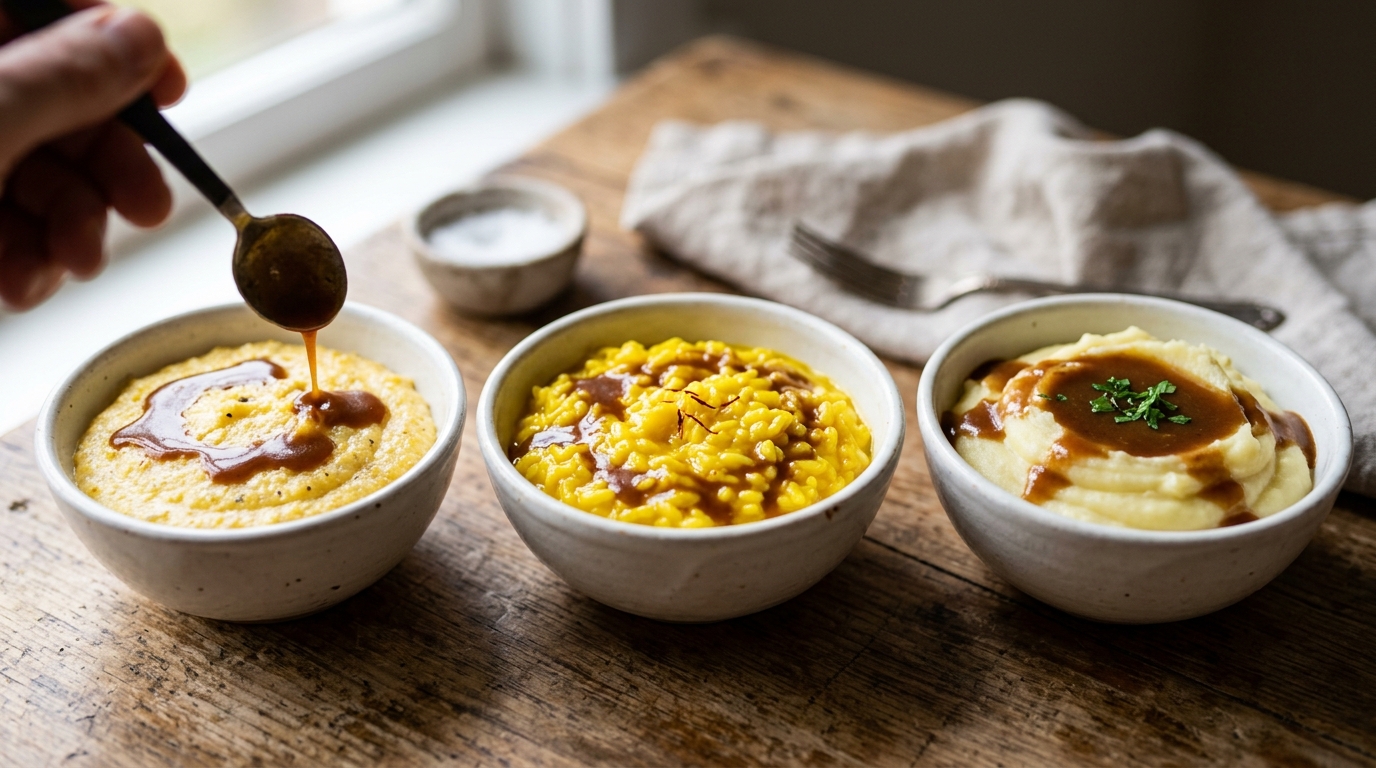
Properly prepared osso buco produces a thick braised sauce, fragrant with tomato, vegetables and herbs.
Choosing the right starchy food with osso bucomeans choosing what will "absorb" this sauce with the most pleasure possible.
Here is a comparison table to help you decide quickly:
| Starchy | Sauce absorption | Preparation time | Difficulty |
|---|---|---|---|
| Risotto alla milanese | Very good | 25-30 min | Intermediate |
| Creamy polenta | Excellent | 10-15 min | Easy |
| Pappardelle / Tagliatelle | Good | 8-10 min | Easy |
| Homemade mashed potatoes | Very good | 20-25 min | Easy |
Creamy polenta: smooth and quick to make
Creamy polenta with osso buco is a northern Italian combination, very common in Veneto and rural Lombardy. It absorbs the sauce like a sponge and forms a smooth base that enhances the braised shank.
For a successful polenta in 15 minutes, boil salted water (1 liter for 250 g of corn flour), pour in the polenta in a steady stream and stir constantly over medium heat.
Add a knob of butter and a spoonful of grated Parmesan at the end of cooking. It should have the consistency of thick cream — not too firm.
Wide pasta shapes: tagliatelle and pappardelle
The question of rice or pasta with osso buco comes up often. Wide pasta has an advantage that rice doesn't: its large surface area absorbs the sauce and keeps it clinging well to every bite.
Tagliatelle and pappardelle work particularly well with osso buco because their porous texture and width retain the small pieces of vegetables and herbs from the braised sauce.
It's a less orthodox option than risotto, but very popular in northern Italian families.
Cook them al dente—never too soft—and don't rinse them after draining. Just a drizzle of olive oil and they're ready to be served with the ham hock and its sauce. It should only take 8 to 10 minutes.
Avoid thin pasta (spaghetti, capellini): it doesn't hold the sauce well and gets tangled under the weight of the ham hock. Always choose a wide, thick pasta.
Homemade mashed potatoes
Homemade mashed potatoes with osso buco are perhaps the most accessible and reassuring option for a family meal. While not originally Italian, they are a natural choice, given how obvious the pairing is.
The richness of the mashed potatoes, with their buttery and milky texture, contrasts beautifully with the acidity of the tomato sauce. The result is a perfectly balanced dish—the sauce colors the mashed potatoes, and the two blend together in a truly delicious way.
For truly silky mashed potatoes, choose floury potatoes (such as Bintje or Agria). Mash them with a potato masher — never with an immersion blender, which will make them sticky.
Remove from heat and add pieces of cold butter, then gradually add hot milk. Season well with salt. The result will be smooth, airy, and melt-in-your-mouth!
- Accessible to all skill levels in the kitchen
- Absorbs braising sauce perfectly
- Appeals to both children and adults
- Prepare in advance and warm up well
- Less authentic than a risotto or polenta
- It can make the meal heavy if it is too rich in butter
- Requires a potato masher for best results
Vegetables to lighten and add colour to the plate
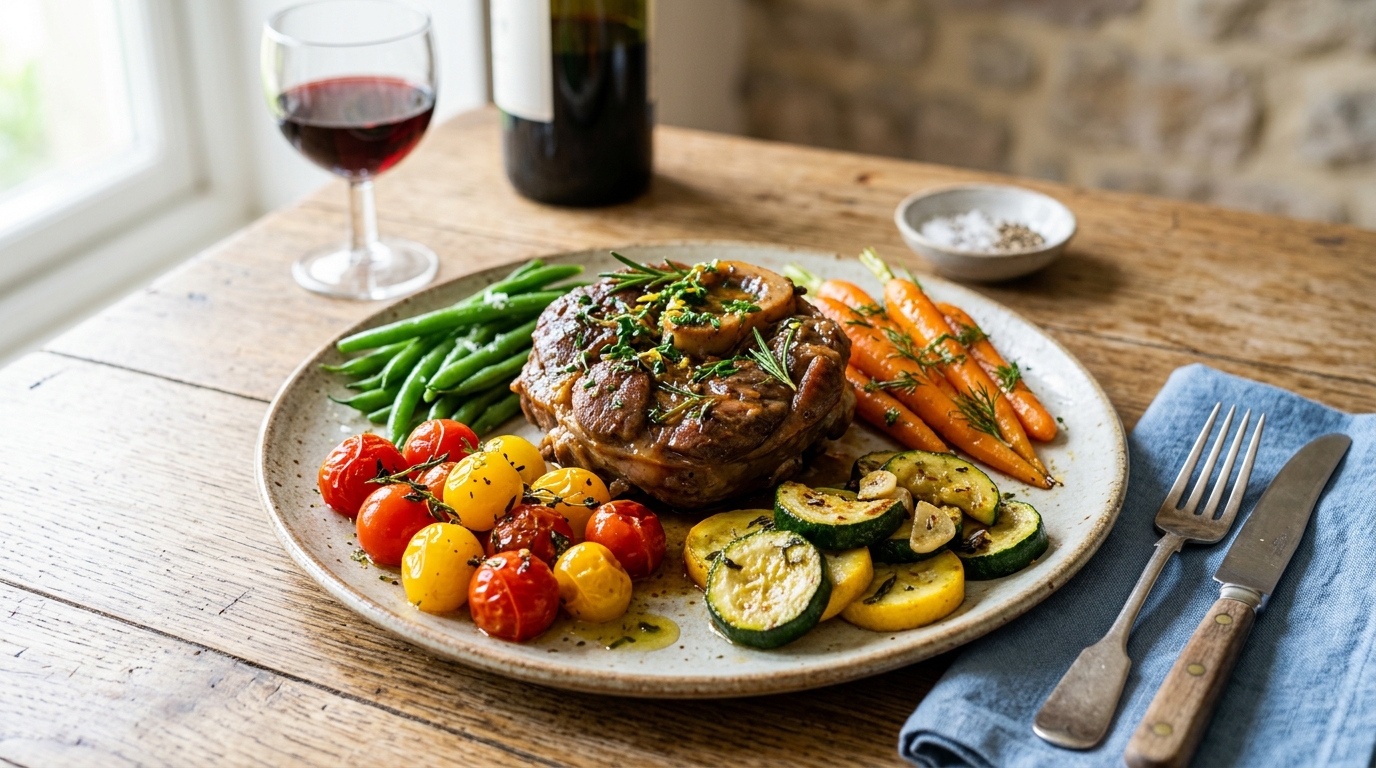
Osso buco is a rich dish, simmered for a long time in a generous sauce. Adding some vegetables alongside the osso bucois a good way to balance the plate both visually and in terms of taste.
Vegetables play a dual role: they bring color (the plate tends to be monochrome brown-orange without them) and they lighten the perception of the meal by providing chewiness and vegetal freshness.
They also provide different minerals.
Oven-roasted vegetables: carrots and celeriac
The roasted vegetables accompanying the osso buco —carrots, celeriac, parsnips, red onions—integrate perfectly into the meal because they share the same underlying flavors as the braised sauce. The result is harmonious, not disjointed.
Cut the vegetables into large, even cubes. Place them on a baking sheet with a drizzle of olive oil, thyme, salt, and pepper. Bake at 200°C (390°F) for 35 to 40 minutes, stirring halfway through. They should be golden brown on the surface and tender inside.
The practical advantage is real: you can put them in the oven while the osso buco finishes simmering. No constant monitoring is required. The oven does all the work.
Garlic spinach and green beans
What vegetables should you choose to serve with osso buco when you want something quick and fresh? Garlic spinach or green beans are the two best answers.
Fresh spinach wilted in a pan with garlic and a drizzle of olive oil takes 5 minutes. Its lightness and slight bitterness contrast nicely with the richness of the sliced ham hock.
Be careful not to drown them in water — drain them thoroughly before sautéing.
The green beans, cooked in salted boiling water and then sautéed in butter with slivered almonds, also add vibrant color and crunch. They refresh the dish and prevent it from being too heavy.
Combine a green vegetable (spinach or green beans) AND a starchy food (polenta or mashed potatoes) for a complete and visually balanced meal. The plate gains in color and structure.
Which starchy food should I choose depending on the time available?
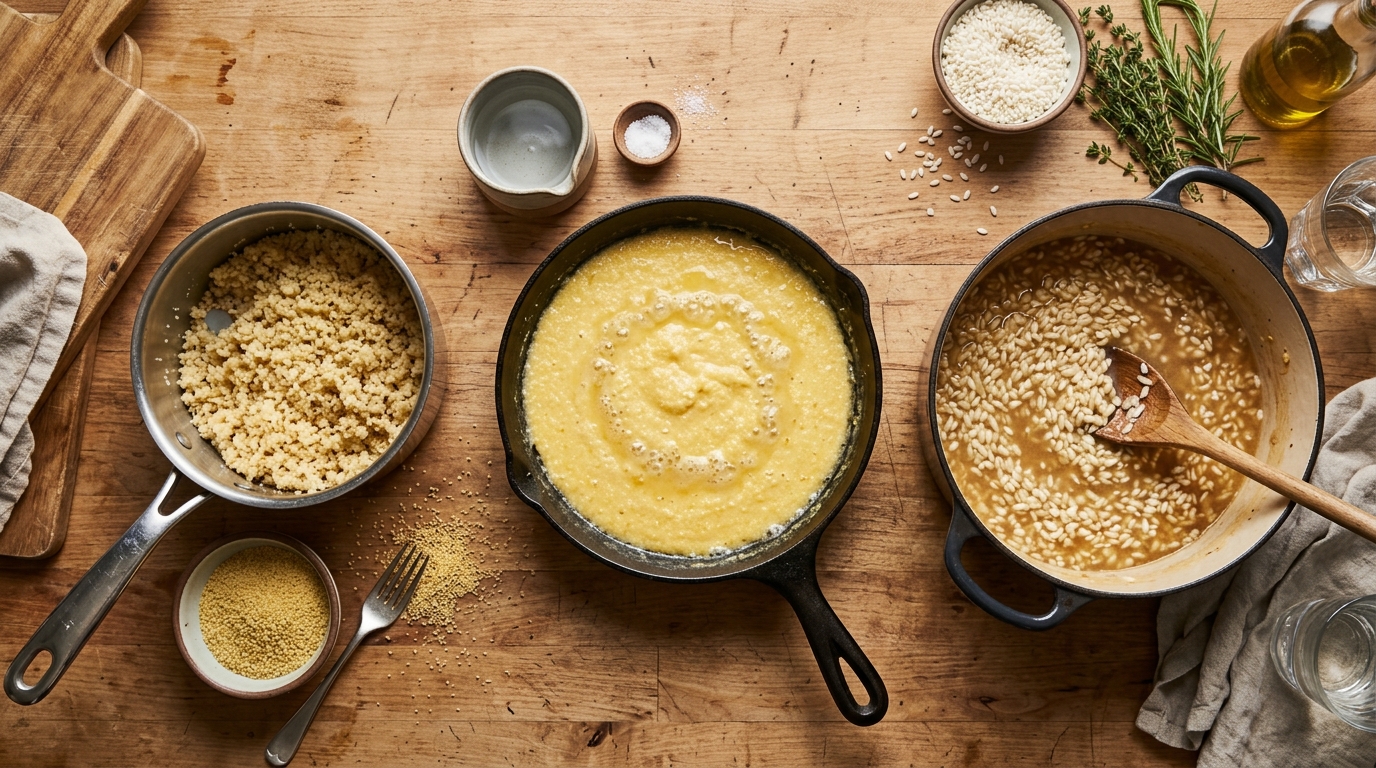
The reality of a successful meal often comes down to timing.
Choosing the right starchy food according to the time available can make all the difference between a meal served hot and in a good mood… and a chaotic meal where everything is ready at different times.
Here are two distinct profiles, each with its own tailored solutions.
Quick options for a weeknight
On a weeknight, we don't always have the time or energy to embark on a risotto , which is a time-consuming process.
Fortunately, several quick side dish recipes for osso buco allow you to get it done in less than 15 minutes.
- Quick polenta : choose pre-cooked polenta (cooking time indicated on the package: often 5 to 8 minutes). Add butter and Parmesan cheese, and it's ready.
- Wide pasta : dry tagliatelle in 8 minutes, seasoned with a drizzle of oil. Nothing to watch over.
- Garlic spinach : 5 minutes in a pan, zero technique required.
- White rice : a neutral option that absorbs sauce well, ready in 12 minutes in a saucepan or 10 in a rice cooker.
Osso buco often simmers for 1.5 to 2 hours. This long cooking time is a real advantage: it gives you plenty of time to prepare a quick side dish just before serving!
Side dishes prepared for a family meal
For a Sunday lunch or a formal dinner, one can afford to go a little further…
The elaborate side dishes for osso buco are really worth the effort when you have the time. Examples include:
- Risotto alla milanese : 30 minutes of active preparation, but the result is impressive. It's the perfect pairing with veal osso buco.
- Homemade mashed potatoes with butter : 25 minutes, twice the pleasure of instant mashed potatoes. Prepare them in advance and keep them warm in a bain-marie.
- Roasted vegetables : 40 minutes in the oven unattended, ideal for freeing up your hands while you manage the meat.
- Gratin polenta : Pour the polenta into a dish, let it cool, cut it into squares, and bake them in the oven with Parmesan cheese until golden brown. Guaranteed success! Corsican chestnut polenta would also be a perfect choice.
What wine should I serve with osso buco?
The question of which wine to serve with osso buco often comes up when preparing this dish for guests. And it's a good question—a successful pairing can transform a good meal into a truly great one.
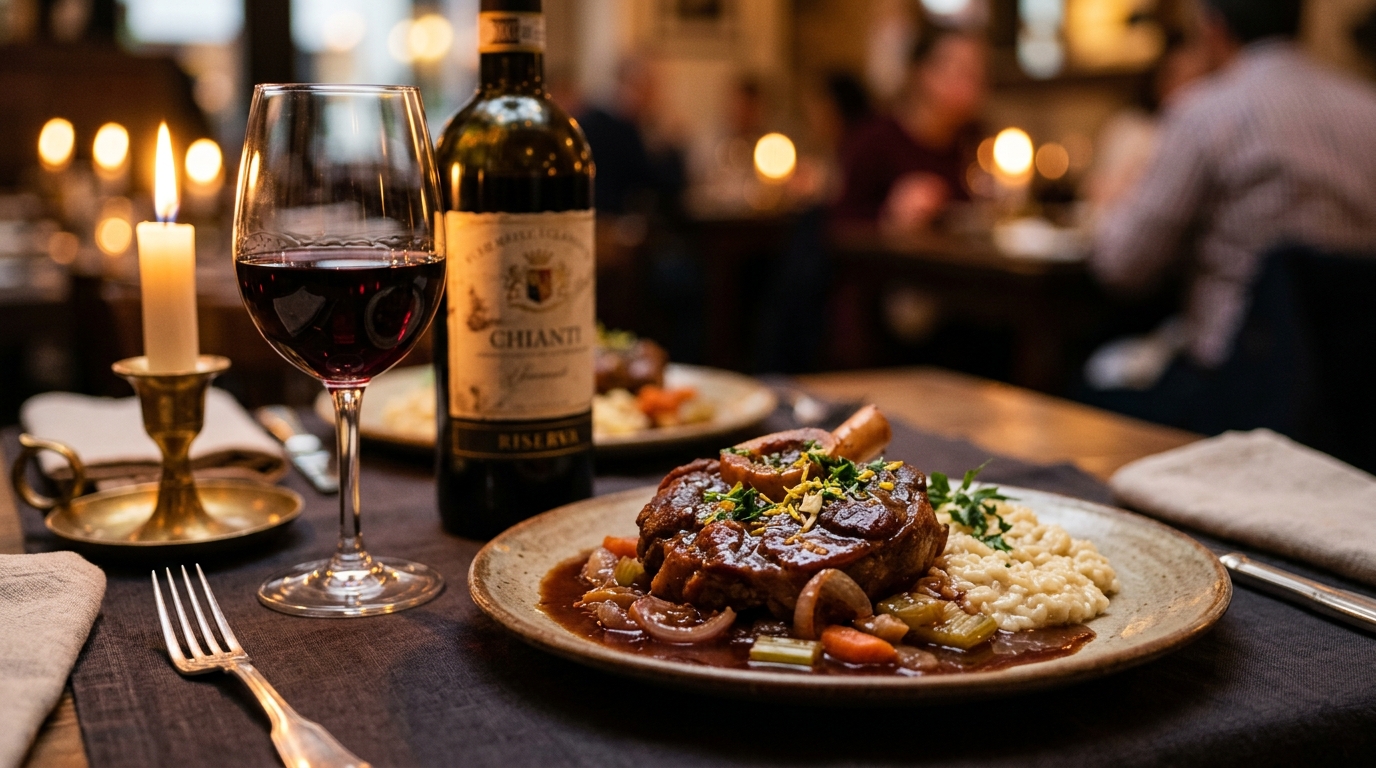
Veal osso buco is a slow-cooked dish with a tomato and herb sauce, tender meat, and a fairly intense flavor. It requires an Italian wine that can stand up to all of that without overpowering it.
Italian red wines: Barolo and Barbera d'Asti
Sticking with the Italian tradition for the choice of wine is the most consistent decision.
Barolo with osso buco is a prestigious pairing: this Piedmontese wine, made from the Nebbiolo grape, is powerful, tannic, and very aromatic (dried red fruits, tobacco, truffle). It harmonizes perfectly with the richness of the braised sauce.
If Barolo seems too ambitious for a Sunday lunch—or for your budget— Barbera d'Asti is a very solid alternative. Less tannic, fruitier, it's more approachable and easier to drink mid-meal.
A Chianti Classico or a Montepulciano d'Abruzzo could also be suitable if you don't have a Piedmontese wine on hand.
A structured white to change things up from the usual reds
Yes, a white wine can go well with osso buco. Not just any white wine, of course!
A structured white wine with osso buco needs to have body and substance so as not to disappear under the sauce.
A Soave Classico (Veneto), a Greco di Tufo (Campania), or a Vermentino from Sardinia make for very pleasant surprises. Their natural acidity contrasts with the richness of the sauce, and the gremolata prolongs their freshness on the palate.
It's a less expected pairing, which can really pleasantly surprise your guests.
Use the same red wine in the osso buco sauce (if your recipe calls for it) and at the table — it's an automatically consistent pairing and avoids opening two different types of bottles.
How to best organize yourself in the kitchen on the big day?
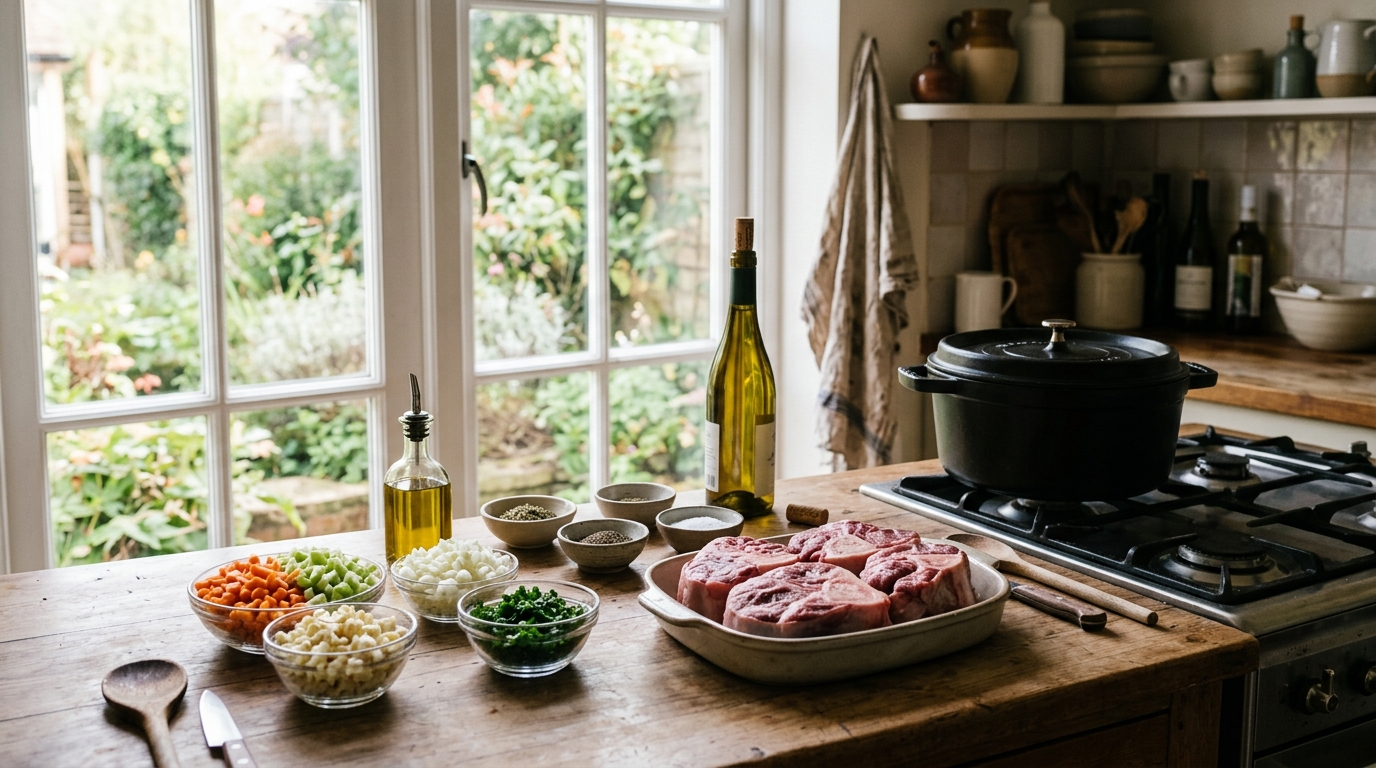
Osso buco is a dish that requires time, but not constant attention. It's precisely this freedom during cooking that you need to use wisely to prepare the side dishes without running around.
What side dishes should I prepare while it's cooking?
Once the osso buco is started in the casserole dish and the lid is put on, you generally have between 1.5 and 2 hours ahead of you.
Here's what you can prepare during this time without pressure:
- Roasted vegetables : put them in the oven during the first hour of braising. They will be ready at the right time.
- Mashed potatoes : Peel and cook the potatoes 20 minutes before the end of cooking time. The mashed potatoes will keep nice and warm in the covered saucepan with a little extra milk.
- The gremolata : grate the lemon, chop the garlic and parsley 10 minutes before serving. Keep chilled until ready to serve.
- Creamy polenta : to be prepared in the last 15 minutes — it does not keep for long before setting.
The right order of preparation to avoid stress
Here is a simple and effective order of operations for a meal that arrives at the table without disorganization:
- H-2h : Brown and start the osso buco in a casserole dish
- H-1h45 : Put the roasted vegetables in the oven if you are making them
- H-30 min : Peel the potatoes or measure the risotto ingredients
- H-20 min : Start cooking the mashed potatoes or begin the risotto
- 10 minutes before : prepare the gremolata, wilt the spinach if necessary
- 5 minutes before : plate the dishes or the serving platter, take out the wines
The golden rule: osso buco can rest for 15 to 20 minutes off the heat, covered. Never sacrifice a side dish that will be ruined just to serve the main course on time!
Prepare everything the day before: chop the herbs, measure the cornmeal or rice, and get the saffron ready. By the morning of the meal, you'll have already done half the work.
Answers to your questions
Can plain white rice be served instead of risotto with osso buco?
Yes, absolutely. White rice absorbs the braised sauce well and remains a neutral option that suits all palates. It's less authentic than a risotto alla milanese, but much quicker to prepare. For a weeknight meal, it's a perfectly acceptable alternative.
What is the difference between gremolata and a simple persillade?
The classic persillade mixes only parsley and garlic. Gremolata adds grated lemon zest, giving it a tangy, floral dimension absent from the persillade. It's this touch of citrus that makes all the difference in the balance of the osso buco.
How can I prevent creamy polenta from solidifying before serving?
Prepare it in the last 10 to 15 minutes before serving. If it starts to thicken too quickly, add a little warm milk or stock and stir over low heat—it will quickly become creamy again. Never leave it uncovered, as the surface dries out quickly.
Can the side dishes for osso buco be prepared the day before?
Mashed potatoes and roasted vegetables reheat very well the next day. Risotto, on the other hand, loses much of its creamy texture when reheated—it's best made the same day. Gremolata should never be prepared the day before: the lemon and parsley lose all their flavor.
What side dish should I choose for osso buco served to children?
Homemade mashed potatoes are a sure thing: they're universally popular and go perfectly with the sauce. Wide pasta like tagliatelle is also a good option—children love it. Avoid gremolata or serve it separately for adults.
