
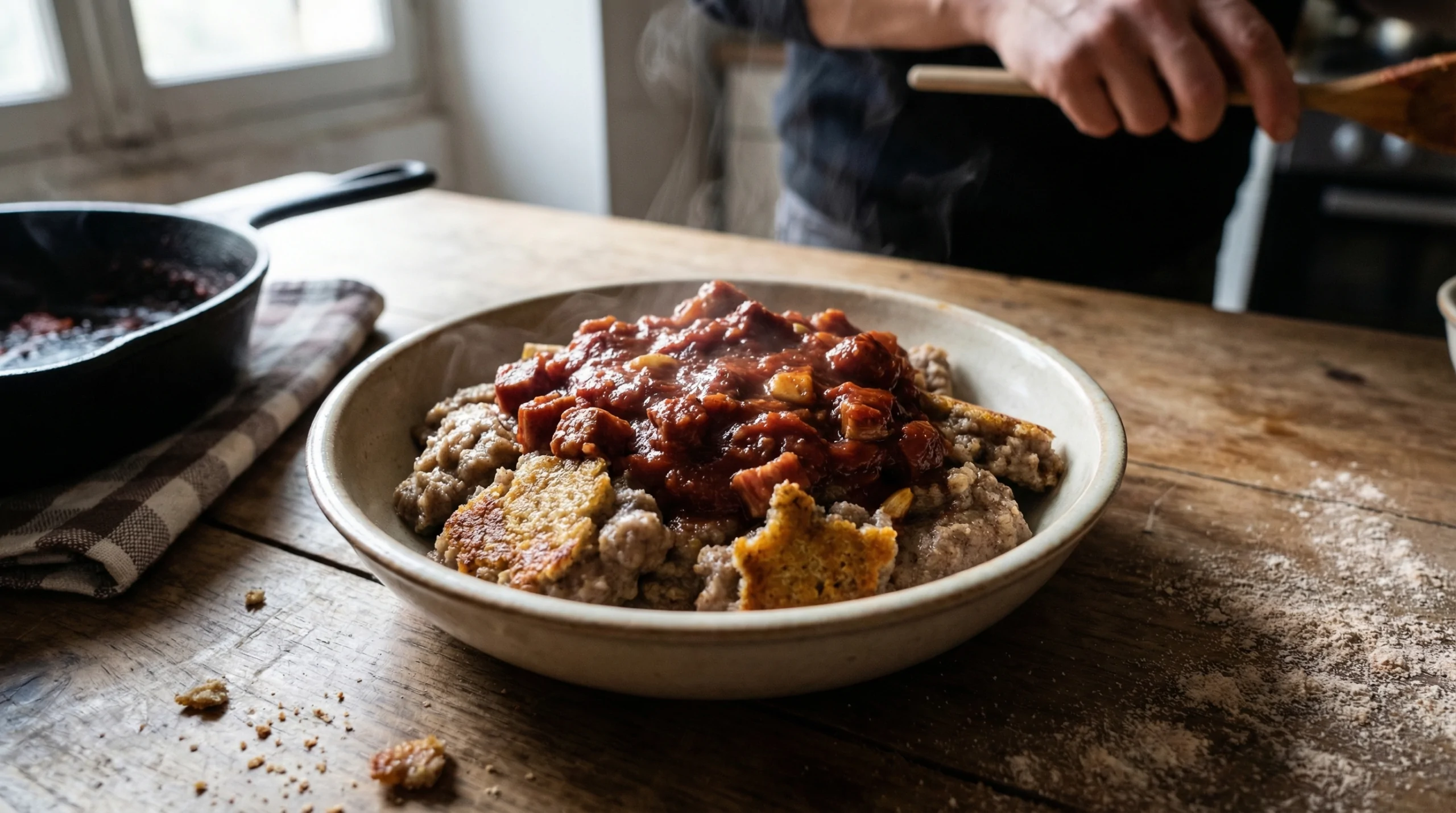
Corsican polenta is the kind of dish that looks incredibly simple… and then completely captivates you from the first bite. I've truly adopted it for those evenings when I crave something nourishing and comforting, without spending two hours in the kitchen. The chestnut flour gives it a slightly nutty, distinctive sweetness that's a complete departure from classic corn-based polenta.
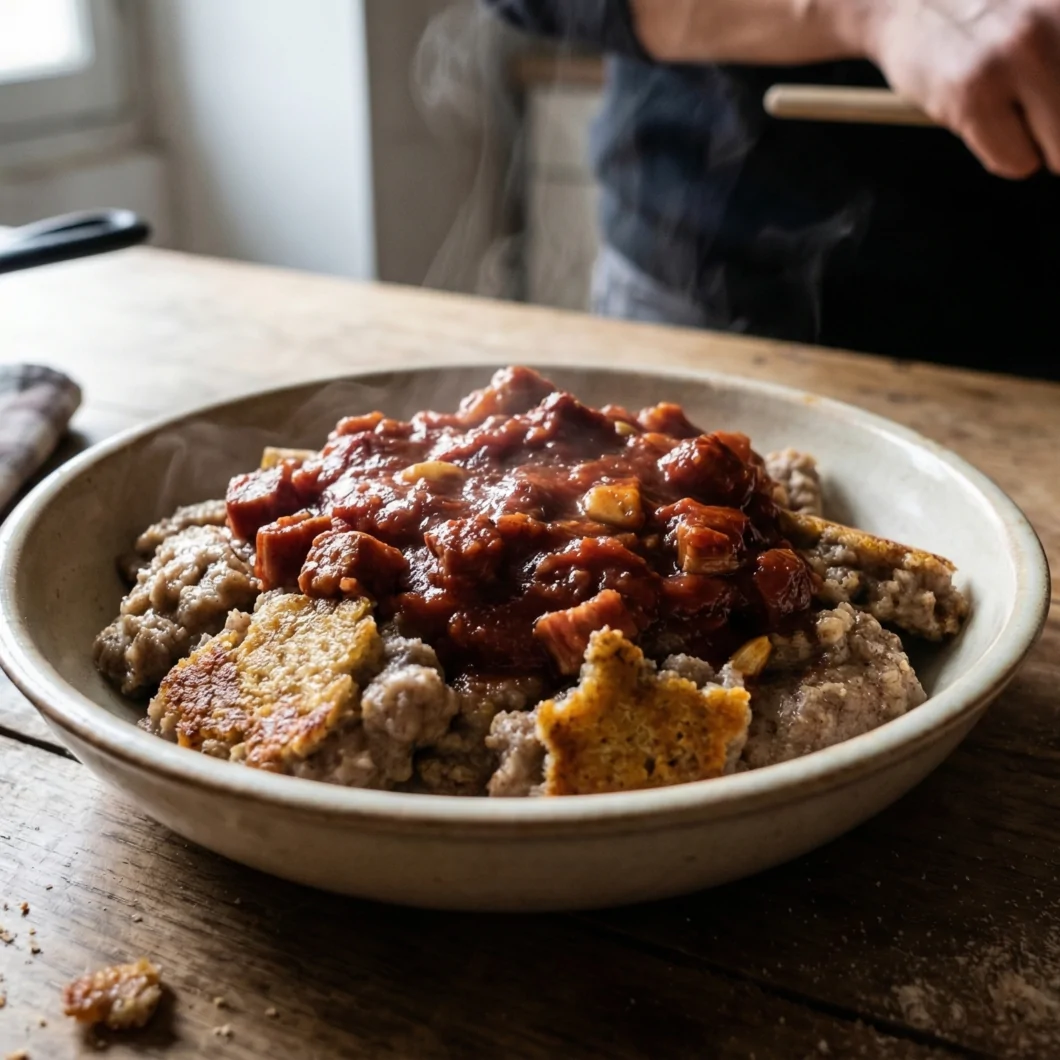
In my version “like there”, I serve it with a very bold tomato sauce, garlic, onion, a little maquis herbs (failing that, thyme/rosemary do the job very well) and Corsican charcuterie when I have some: lonzu, coppa, prisuttu… The fragrant fat of the charcuterie “rounds out” the chestnut, and the tomato brings the acidity that balances everything.
Technically, the only thing to remember is how to cook the pulenda: pour it in gradually, stir often, and let it thicken gently. If you prefer the ultra-traditional texture, pour it onto a board, let it set, then pan-fry it in slices for a crispy-on-the-outside, melty-on-the-inside effect.
In terms of seasonality, chestnuts are already a strong indicator, but I like to add a few touches that go well with them: onion, garlic, and a pinch of rosemary. It stays true to the flavors, it smells wonderful, and you get a complete, simple, and frankly comforting dish.

Pulenda corse
4
parts10
minutes25
minutes518
kcal35
minutesA rustic and fragrant chestnut flour polenta, served with a tomato sauce flavored with garlic and Corsican charcuterie. Creamy in a saucepan, then lightly pan-fried to achieve golden edges.
Keep your device's screen on
Ingredients
300 g of chestnut flour
1.2 L of water
10 g of fine salt
1 onion (approx. 120g), sliced
2 garlic cloves, chopped
400g crushed tomatoes (canned or homemade)
2 tablespoons of olive oil (approx. 20g)
150 g of Corsican cold meats such as lonzu/coppa (or dry-cured ham), in strips
1 teaspoon of thyme (or a thyme/rosemary mixture)
Black pepper
Preparation steps
- Prepare the sauce: In a sauté pan, heat the olive oil. Add the chopped onion with a pinch of salt and sweat it for 5 minutes over medium heat, without browning it.
- Add the chopped garlic and thyme (or thyme/rosemary). Stir for 30 seconds, just to infuse the flavor.
- Add the chopped tomatoes, season with pepper, reduce the heat to low and simmer for 15 minutes. Add the sliced cured meat during the last 5 minutes: it will flavor the sauce without drying it out.
- While the sauce simmers, start the pulenda: bring 1.2L of water to a simmer in a large saucepan. Add salt (10g).
- Gradually add the chestnut flour, whisking vigorously to avoid lumps. Once all the flour has been added, switch to a wooden spoon.
- Cook for 15 to 20 minutes over low heat, stirring very regularly (every 30 to 60 seconds). The pulpada should thicken and pull away from the sides of the pan. If it becomes too thick too quickly, add a splash of hot water.
- Traditional (creamy) service: serve the pulenda piping hot in deep plates, top with tomato and charcuterie sauce.
- Crispy-on-the-outside option (very Corsican): Spread the polenta to a thickness of 2 cm on an oiled board or dish. Let it sit for 5 to 10 minutes, slice, then pan-fry for 2 minutes per side in a lightly oiled pan. Serve with the sauce on top or alongside.
📊 Nutritional Information
1 serving (approx. 430g)
| Nutrient | Value |
|---|---|
| Calories | 518 kcal |
| Proteins | 16g |
| Carbohydrates | 79g |
| including sugars | 9g |
| Lipids | 16g |
| including saturated fatty acids | 4g |
| Fibers | 11g |
| Sodium | 1280mg |
| Vitamins | |
| Vitamin C | 22% AJR |
| Vitamin B6 | 20% AJR |
| Vitamin E | 12% AJR |
| Minerals | |
| Magnesium | 24% AJR |
| Potassium | 18% AJR |
| Iron | 17% AJR |
* RDA = Recommended Daily Allowance
📝 Notes
If you're serving it pan-fried, brown the slices without touching them: they'll stick a little at first, then release as a crust forms. And yes, it's delicious with a bit of sheep's cheese if you have some, but the traditional base of polenta + tomato sauce/cured meats is perfectly sufficient.
💡 Chef's Tips
The real secret is the mixing rhythm: low heat + frequent stirring = smooth texture. To avoid lumps, gradually whisk in the flour at first, then switch to a spoon. The sauce keeps very well for 24 hours in the refrigerator: gently reheat it, and make the polenta in no time.
🔄 Variations
- For a more rustic version: replace some of the chopped tomatoes with 1 tablespoon of tomato paste and a small glass of water, for a thicker sauce.
- For a more herbaceous flavor: add a pinch of rosemary to the sauce (go easy, it quickly becomes overpowering).

Thank you for this traditional recipe! I would like to know the exact preparation time and if the portions can be easily adapted for a family.
Good question! The time varies depending on experience, but allow 45-60 minutes. The portions can easily be doubled without any problem.
Thank you for this interesting recipe! I would like to know the exact cooking time and if the pulenda can be prepared in advance.
Excellent question! The cooking time is approximately 20-25 minutes. Yes, polenta can easily be prepared in advance.
Thank you for this recipe! I would like to know if chestnuts can be replaced with other nuts without altering the traditional taste?
Almonds or hazelnuts work well, but chestnuts remain ideal for preserving authenticity. Give it a try!
Thank you for this recipe! I would like to know if Corsican polenta freezes well, and how long it keeps in the refrigerator?
Excellent question! Polenta freezes very well for up to 3 months and keeps for 4-5 days in the fridge. Happy cooking!
Thank you for this traditional recipe! Do you have any suggestions for adapting the portions for a larger family without losing the authenticity of the dish?
Excellent question! Simply double the ingredients, but keep the cooking times the same to preserve the authentic flavors.
Thank you for this traditional recipe! I would like to know if chestnuts can be replaced with other dried fruits without altering the authentic taste?
I wouldn't recommend it, as I can't think of any equally neutral dried fruit that could replace them in this context, but to add a touch of flavor, no problem! But if anyone has any ideas, we're all ears!