
In short
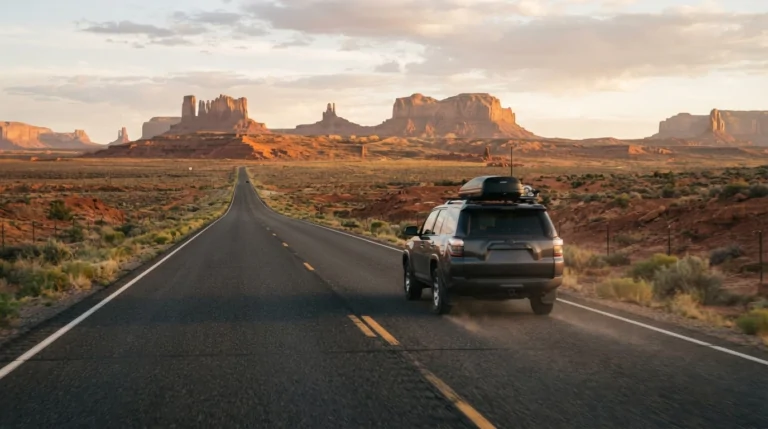
A road trip in the USA looks dreamy on a map, but it's often the map that deceives. Distances seem short, parks appear close together, and the itinerary fills up without you even realizing it.
The perfect road trip isn't necessarily the one with the most famous names ticked off. It's the one where the driving pace, budget, and formalities have been carefully planned before booking a single ticket.
Here is the method, step by step, with the rule changes that many guides have not yet incorporated.
Choosing a region and a duration before anything else
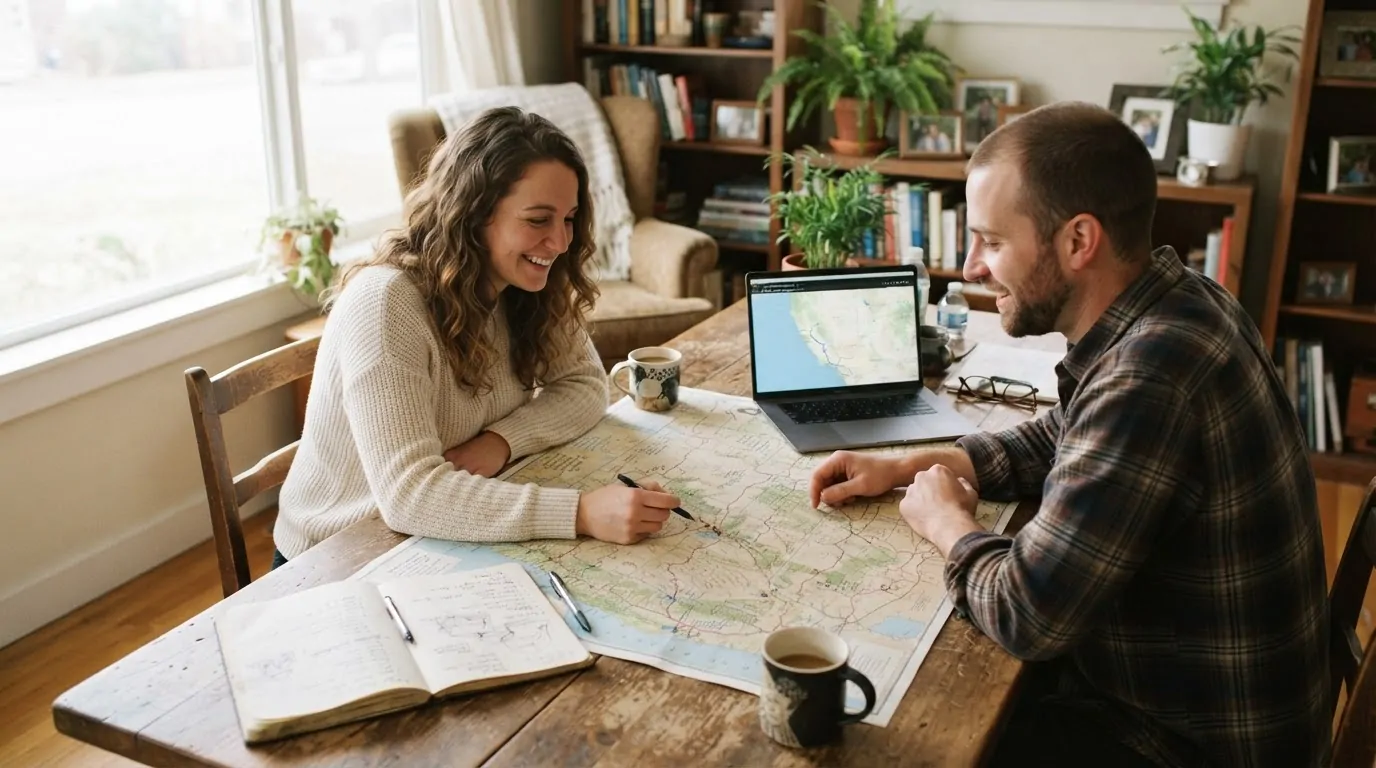
Before planning anything, reading travelogues based on real experiences helps to calibrate one's desires: on JH's Travels, a traveler shares his itineraries tested on site, from the long road trip between Argentina and Chile to the best addresses in Chicago, with those travel times that we always underestimate from our sofa.
This approach avoids the most common mistake: wanting to see everything. The United States is about 17 times larger than metropolitan France, and a single trip will never cover the West Coast, Florida, and New England.
The best approach is to choose 3 to 5 priority destinations within the same region, then build the route around them. Secondary towns and landscapes will naturally fit in between.
The duration matters as much as the region. On a 15-day trip, the outbound flight, jet lag, and return journey easily eat up three days, leaving about twelve truly useful days on site.
| Region | Recommended duration | Best time | For whom? |
|---|---|---|---|
| American West (California, Nevada, Arizona, Utah) | minimum 15 days | May-June, September-October | Lovers of large parks and scenic drives |
| California coast | 7 to 10 days | Spring and early autumn | First trip, leisurely pace |
| Florida | 10 to 14 days | November to April | Families, beaches and nature |
| East Coast and New England | 7 to 10 days | Late September-October | Lovers of cities and autumn colours |
| Route 66 | 2 to 3 weeks | May-June, September | Nostalgic for motel-era America |
Finalize your itinerary before purchasing your plane tickets. Once your flight is booked, your arrival and departure cities are fixed, making it difficult to change your route without incurring vehicle abandonment fees.
Realistic driving stages: the real secret to a successful USA road trip
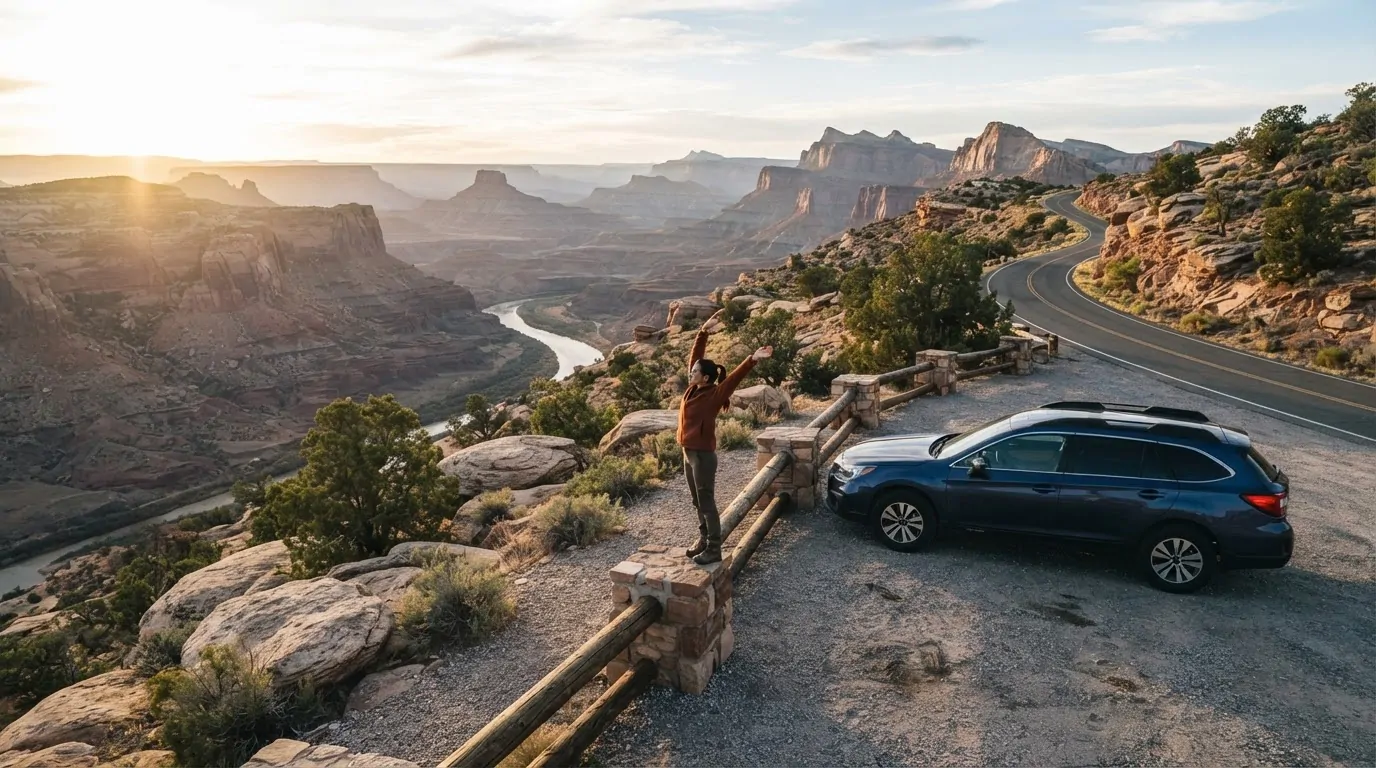
Once there, every trip takes longer than expected. We stop for a viewpoint, a gas station, a roadside dinner, or a herd of bison blocking the road.
A simple rule works well: add 20 to 30% to the travel times displayed by the GPS to account for detours and visits.
Beyond 3 to 4 hours of driving per day, the journey becomes a simple connection and fatigue accumulates.
Let's take a couple who travel for 12 days from San Francisco to the Grand Canyon, passing through Yosemite, Death Valley and Las Vegas. The Las Vegas-Grand Canyon (south rim) leg alone is about 450 km, or more than 4 hours of driving without any breaks.
If this couple repeats this type of day three times in a row, they'll mostly be seeing asphalt. By inserting a two-night stopover every three days, the trip leaves time for walking, resting, and enjoying themselves.
The first day is rarely usable. With a 9-hour time difference on the West Coast in summer, the body demands sleep from mid-afternoon onwards: book a hotel near the airport and save the real journey for the next day.
Simulator: Is your route feasible?
Enter the total distance shown by your GPS and the duration of your road trip: the simulator adds 25% for detours and checks if the pace remains pleasant.
Assumptions: average speed of 85 km/h including breaks, gasoline at $1.18 per litre (national AAA average, September 2026). Indicative estimate.
2026 Formalities: What has changed for French travelers

For a tourist stay of less than 90 days, a biometric passport and an ESTA authorization are sufficient.
The ESTA fee, however, has increased from $21 to $40 per person for any application submitted since September 30, 2025 (source: US Customs and Border Protection, 2025).
The authorization remains valid for two years, or until the passport expires if it arrives sooner. It's best to apply at least 72 hours before departure, and only on the official website, as many intermediaries charge significantly more for the same form.
A proposal by US authorities aims to make it mandatory to declare social media accounts from the past five years on the ESTA application. As of spring 2026, this measure was not yet in effect: check the form in effect at the time of your application.
Regarding driving, a French license is sufficient in most countries for tourist stays. Rental companies generally require at least one year of driving experience.
However, the international driving permit is still recommended by the French Embassy in the United States, particularly in the event of a traffic stop in a state less accustomed to foreign documents.
National parks: the additional cost for non-residents to be budgeted for
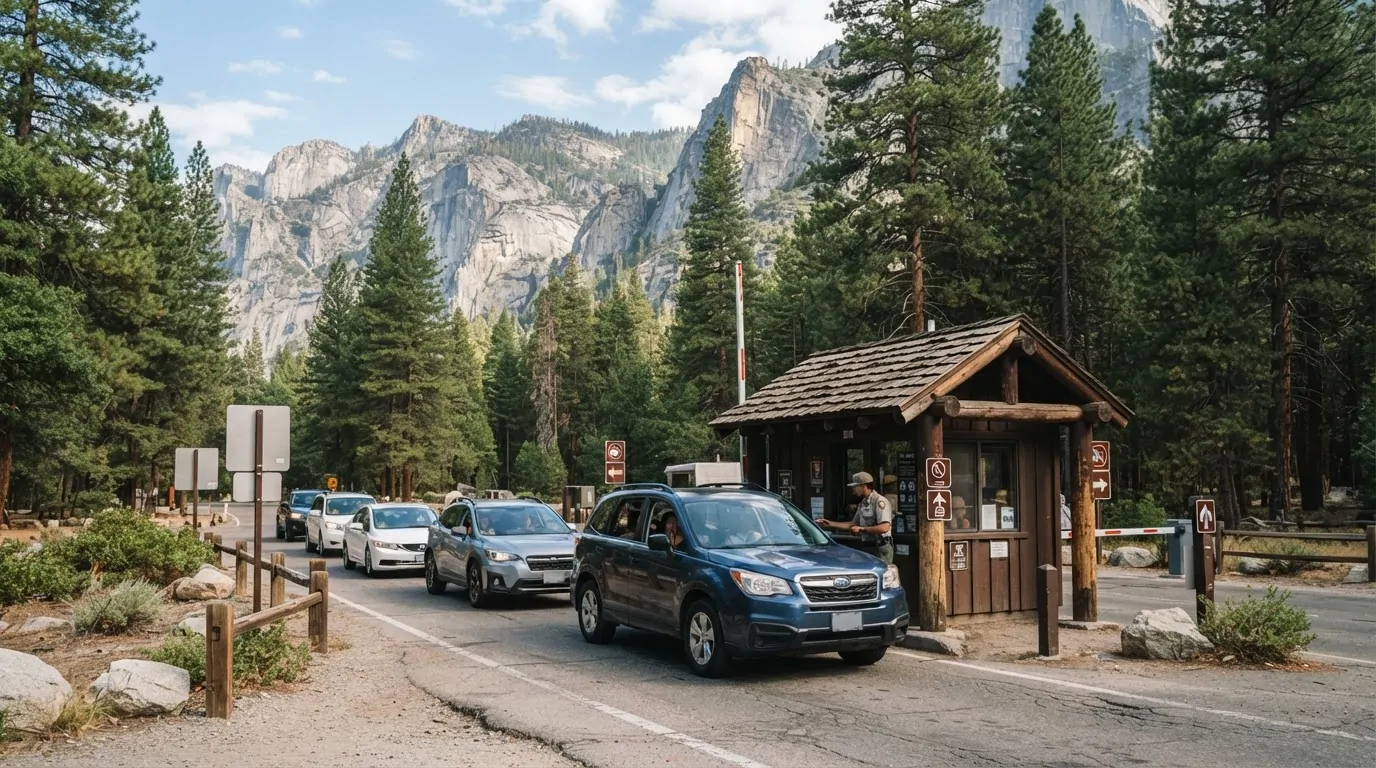
This is the change that most disrupts budgets. Since January 1, 2026, non-resident visitors aged 16 and over pay an additional $100 per person to enter 11 of the most popular parks, in addition to the regular entrance fee (source: U.S. Department of the Interior, 2025).
Among others, Yosemite, Grand Canyon, Zion, Bryce Canyon, Yellowstone, and the Everglades are affected. The America the Beautiful annual pass, meanwhile, is increasing to $250 for non-residents, compared to $80 for residents (same source).
The calculation is simple for two adults. A single entry to one of the affected parks already costs an additional $200, plus the vehicle entry fee.
On Reddit, a foreign visitor recounts having paid $235 at the entrance to the Everglades for himself and his partner, $100 each plus $35 for the car (r/NationalPark, July 2026).
As soon as the route passes through two of the parks concerned, the $250 non-resident pass becomes cost-effective for a couple. It covers the entire vehicle and waives the $100 surcharge per person in those 11 parks.
Some very popular parks also require reservations for entry time slots during peak season. The National Park Service specifies the rules for each park: consult it just before finalizing your dates.
Car, accommodation, meals: the items that make up the budget
Car rentals should ideally be booked 4 to 5 months before departure.
Two items often increase the final bill: the drop-off fee when returning the vehicle in another city, and the young driver surcharge applied before age 25.
Fuel remains cheaper than in France, but it is increasing.
The national average reached $4.47 per gallon on September 23, 2026, or about $1.18 per liter (source: AAA, September 2026), with large differences between California and neighboring states.
For overnight stays, roadside motels offer flexibility, while lodges located in the parks should be booked 6 to 12 months in advance.
A mix of both works well: reserved near the parks, free on the connecting stages.
- Best prices near parks
- No search for a room in the evening, tired
- Budget known before departure
- No margin for error if a road closes or if the weather changes
- Cancellation conditions are sometimes strict
- Less room for unexpected whims
Meals quickly become expensive, as the prices shown do not include local taxes or the tip, which is generally expected to be between 15 and 20% in restaurants, often more today.
For a family of four, eating two restaurants a day for fifteen days can cost more than renting a car.
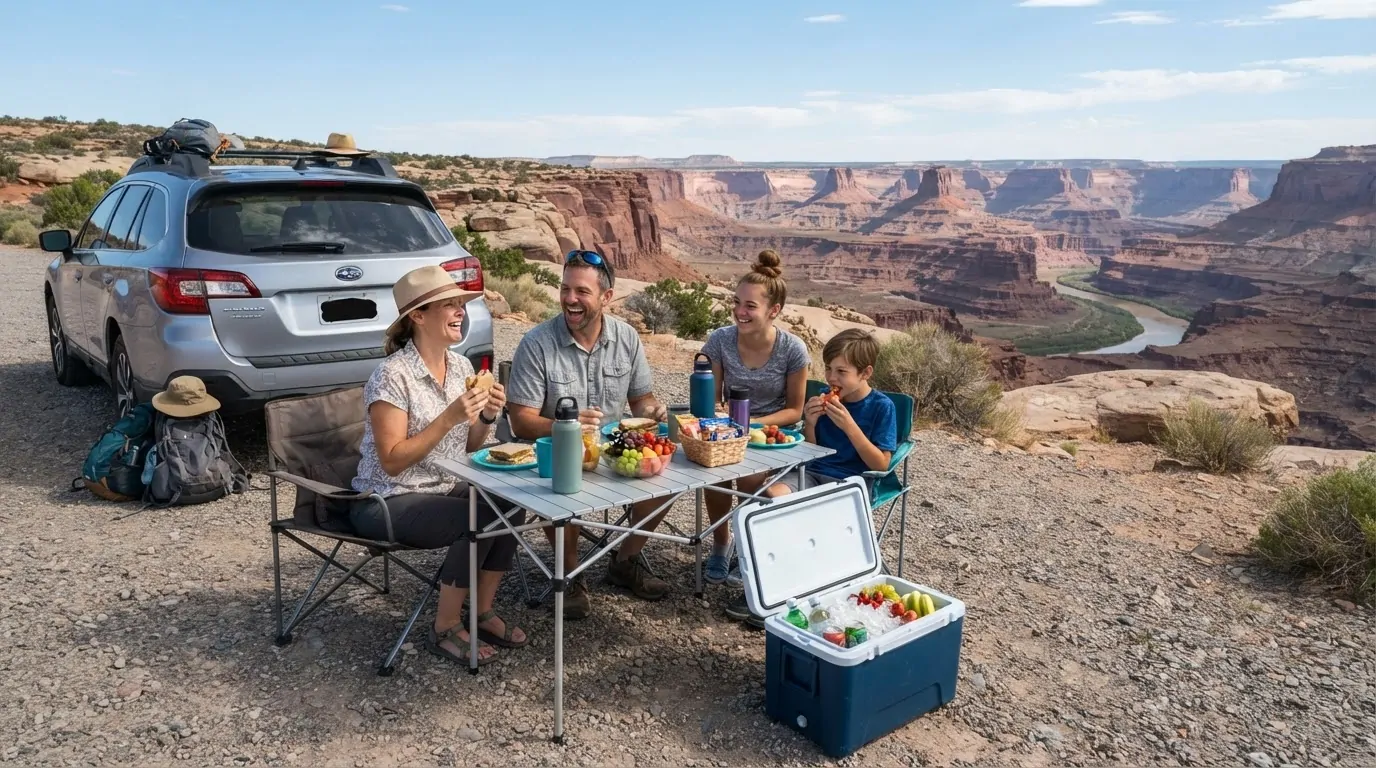
The parade fits into a cooler bought at the first supermarket. Breakfast in the room, picnic lunch in a park area, and a proper dinner in the evening: the food budget drops significantly, and the best lunches are often eaten overlooking a canyon rather than in a dining room.
The preparation schedule, month by month
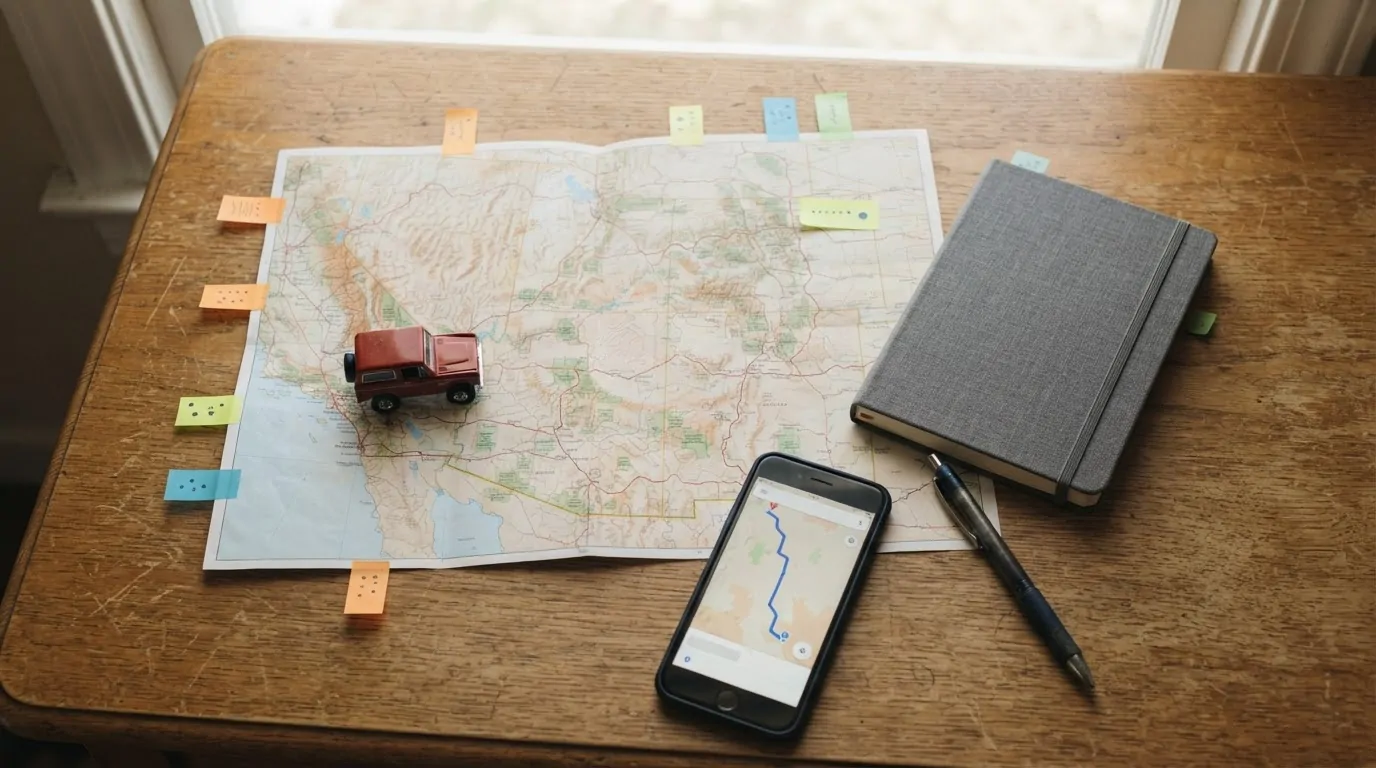
Once you've decided on the region and pace, all that's left is to book everything in the right order. Here's a schedule to help avoid any unpleasant surprises:
- 6 to 12 months in advance : itinerary fixed, flights booked, lodges in the parks and highly sought-after accommodations blocked.
- 4 to 5 months in advance : rental car booked, checking drop-off fees and included insurance.
- 2 to 3 months before : travel insurance purchased (medical costs are very high in the United States), international permit requested.
- 1 month before : ESTA application on the official website, purchase or location of the park pass, verification of entry slot reservations.
- The week of departure : offline maps downloaded, reservations saved on the phone, a little cash for tips.
A simple roadbook, in the form of a day-by-day table with the stage, distance and accommodation, is enough to keep everything in sight.
Combined with a paper road atlas, it also serves as a safety net when the mobile network disappears in the middle of the desert, which happens more often than you might think.
In summary
The perfect road trip in the USA is built in reverse of instinct: first a region and a pace, only then the tickets and reservations.
Three to four hour drive stages, a margin for detours and a budget that includes the $40 ESTA, the extra cost of parks and tips are enough to avoid most disappointments.
The rest is taken care of by the road itself.
Practical questions
What budget is needed for a road trip in the USA?
It depends mainly on the season, the region, and the number of travelers. Items to factor in include the flight, the car and its drop-off fees, fuel, accommodation, meals with taxes and tips, the ESTA at $40 per person, and, for a tour in the West, the non-resident parks pass at $250.
What is the best road trip in the United States?
There is no single best route. The American West remains the most popular for its national parks, the California coast is well-suited for a more relaxed first trip, and Florida is ideal for family holidays during the European winter.
Is it safe to go to the United States right now?
The situation may change, particularly regarding entry requirements. The travel advice section of the Ministry of Foreign Affairs website is the most important resource to consult a few days before departure, and registering with Ariane allows you to be notified in case of an alert.
Should you bring cash?
Credit cards are accepted almost everywhere, including at park entrances. A few $1 and $5 bills are still useful for tips to guides, porters, or cleaning staff, which cannot always be paid by card.
