

Organizing your time in the kitchen is often a real challenge: between preparing ingredients, cooking, tidying up and managing daily life, you can quickly feel overwhelmed.
Yet, professional chefs manage to work with fluidity, precision, and speed. How do they do it? And above all, how can their methods be replicated at home?
In this article, you will discover all the strategies to manage your time in the kitchen like a pro, gain efficiency and cook with pleasure, even on busy days.
The secrets of the chefs: a mastered organization
Chefs aren't fast by chance: they rely on a precise method. The goal is to avoid stress, optimize every minute, and transform the kitchen into a fluid and pleasant space.
Preparation is key: the “setup”
The first instinct for cooking faster is the famous mise en place. This principle consists of:
- Prepare all the ingredients before starting
- Peel, chop, weigh, season
- Take out the necessary utensils in advance
This step, often overlooked at home, helps avoid unnecessary back-and-forth trips. It also promotes smooth, quick, and stress-free cooking, as everything is already prepared when cooking begins.
Anticipate cooking times and lengthy preparations
Anticipation is a powerful tool for saving time. For example:
- Cook rice or pasta in advance
- Prepare sauces that will be used for several days
- Steam several vegetables together
- Turn on the oven while you prepare something else
Chefs also use an essential tool: time management. In this context, a chronograph watch becomes a true ally for precisely monitoring cooking times without having to constantly look at a wall clock.
Organizing your space to cook more efficiently
Clutter slows you down. The physical organization of your kitchen plays a vital role in saving time.
Having everything within easy reach
A good cook knows exactly where each utensil he is going to use is located.
Organize your kitchen by zone:
- Cutting area: knives, boards, bowls
- Cooking area: pots, pans, spatulas
- Spices section: salt, pepper, herbs, condiments
By organizing according to use, you limit unnecessary trips!
Make room to work better
A clear work surface equals faster cooking. Avoid cluttering your space with non-essential items. Even chefs constantlyto be able to move seamlessly from one step to the next without slowing down.
Use the right tools
Some tools can save several minutes on each preparation:
- Manual or electric meat grinder
- Mandolin
- Food processor
- Silicone spatulas
- High-quality non-stick pans
The goal: to do less effort for a faster result.
Time management: the heart of a professional kitchen
To become efficient, you need to know how to manage several tasks at the same time. This is called intelligent multitasking.
Prioritize tasks according to their duration
The managers mentally rank the tasks according to their level of priority:
- What takes the most time (long cooking time)
- What can be done in parallel
- What needs to be done at the last minute
A stew can simmer while you chop vegetables, the oven heats up, and you prepare a salad. This holistic approach is what distinguishes a home cook from a quick and easy one.
Precise timing: an essential
A chronograph watch can once again become a powerful tool for managing different cooking methods: eggs, pasta, meat, pastries…
It allows you to:
- To start multiple timers at once
- Avoid overcooked foods
- To control each step without stress
Precise time management = a better-prepared dish.
Learn to stop waiting unnecessarily
While food is cooking, don't just stand there watching it. Use the downtime to:
- Ranger
- Wash some utensils
- Prepare for what comes next
- Plate the dishes
- Set up the dessert
Every second spent = a dish finished faster.

Techniques for saving time on a daily basis
Even without being a chef, you can apply simple but incredibly effective techniques.
Batch cooking
Batch cooking involves cooking in large quantities:
- Meat already cooked
- Prepared vegetables
- Ready-to-use starchy foods
- Homemade sauces stored
- Soups, purées, aromatic bases
This system allows you to save several hours per week and eat a varied diet, even with a busy schedule.
Prepare the ingredients in advance
On Sundays, for example, you can:
- Cut vegetables
- Wash herbs
- Marinate meat
- Prepare a broth
- Blend a sauce
Your week in the kitchen then becomes smooth and quick.
Simplify the recipes
To go faster, choose:
- Recipes with 5 or 6 ingredients
- Quick cooking methods (wok, steam, grill)
- Simple techniques
Simplicity is the key to cooking better, faster, and without stress.
The importance of rhythm in cooking
Cooking efficiently also means adopting a good rhythm.
Adopting automatic gestures
By repeating certain movements, you will gain speed:
- Chop an onion
- Slice a vegetable
- Sear meat
- Deglaze a pan
The more natural your movements are, the more time you save.
Stay focused
Concentration prevents errors, oversights, and backtracking. Cutting out distractions (phone, unnecessary conversations) helps you work faster.
Keeping control of time
Once again, a tool like a chronograph watch can help you maintain a good pace in the kitchen, especially when cooking multiple dishes simultaneously. Good time management improves both quality and speed.
Managing your time in the kitchen when you have a family
With a family, organization becomes even more important!
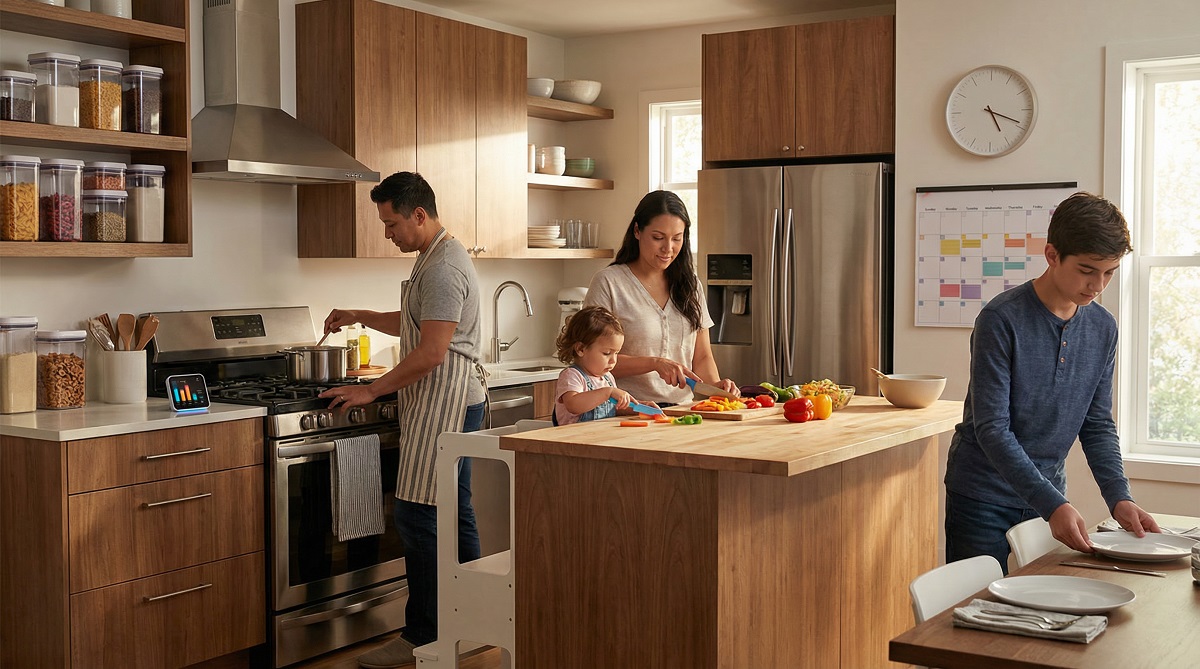
Involve the children
Children can:
- Set the table
- Mix a preparation
- Wash vegetables
- Put away some utensils
This speeds up preparation and creates a convivial moment.
Plan the menus
A weekly planner saves you time thinking about it every evening. Furthermore, it allows you to shop more efficiently and avoid waste.
Prepare the lunchboxes in advance
In the evening, take advantage of what you've prepared to cook a little more and fill the lunchboxes for the next day.
Time-Wasting Mistakes in the Kitchen
There are several common pitfalls to avoid if you want to cook like a pro.
Working without preparation
That's the number one problem! Without proper planning, you waste time, you get stressed, you make more of a mess, and you risk forgetting steps.
Let the mess accumulate
A cluttered work surface = guaranteed waste of time.
Do not anticipate cooking times
We end up waiting unnecessarily, instead of preparing something else in the meantime.
Choosing overly complex recipes
Dishes with too many steps increase the risk of error and lengthen the preparation time.
Conclusion
Managing your time well in the kitchen isn't magic. It's a combination of:
- Preparation
- Organization
- Anticipation
- Time management
- Good equipment
By applying these methods, you will gain efficiency, enjoyment, and peace of mind. You will be able to cook quickly, even with a busy schedule, and enjoy your meals more.
With good organization, a clean kitchen and real control of timing – why not aided by a Chronograph Watch– your culinary daily life will change completely.
Cooking like a pro isn't just about technique: it's primarily a way to optimize your time to better enjoy every moment!
This article was sponsored by a company or brand and does not reflect the editorial responsibility of the Simple & Bon website
