
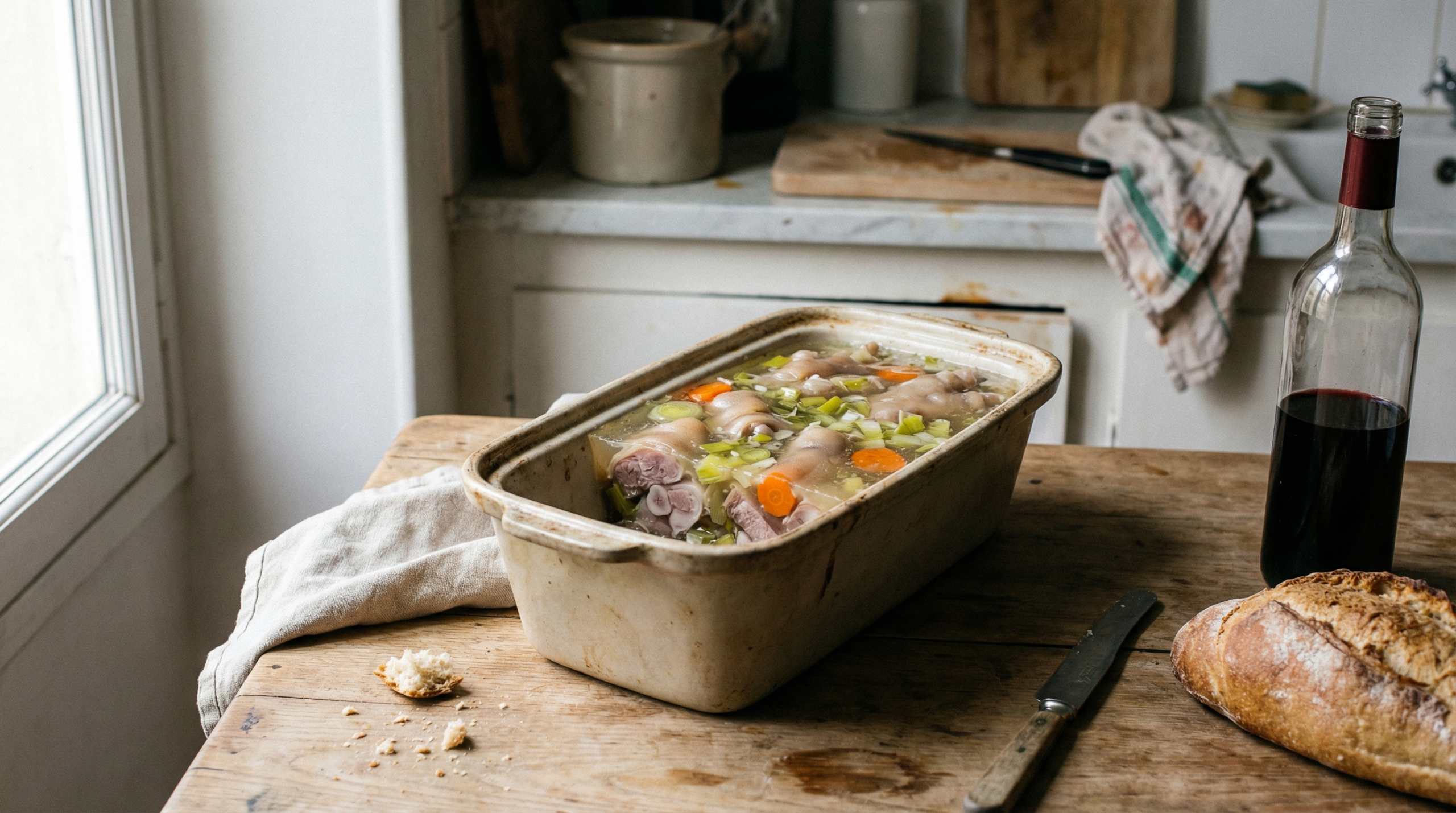
I have a weakness for pig's trotters in aspic: it's the kind of dish that looks rustic, but hides a real delicacy when the aspic is well-seasoned and set properly. The first time I made it at home, I understood the trick: it's all about a clear, slightly vinegary broth and gentle cooking that melts the collagen. The result: it holds its shape, it's glossy, and it melts in your mouth.
In this traditional version, I stick to the basics: well-cleaned pig's trotters, aromatic vegetables (onion, carrot, leek, celery), a bouquet garni, peppercorns, then deboning and pouring in the aspic. My little personal touch is to add a bit of wholegrain mustard when serving and to keep a few carrot slices from the broth in the molds: it's classic, pretty, and adds a touch of sweetness.
Technically, it's quite simple, but you do need to be organized: while it's cooking, you prepare the mussels, then carefully strain the broth and measure out the gelatin (or rely on natural gelatin if your broth is very rich). And yes, it's a cold dish: perfect for preparing the day before.
Nutritionally, it's a dish rich in protein and collagen, filling, and carbohydrate-free (apart from the vegetables in the broth). Serve it with a tangy salad, and you have a main course with real character.
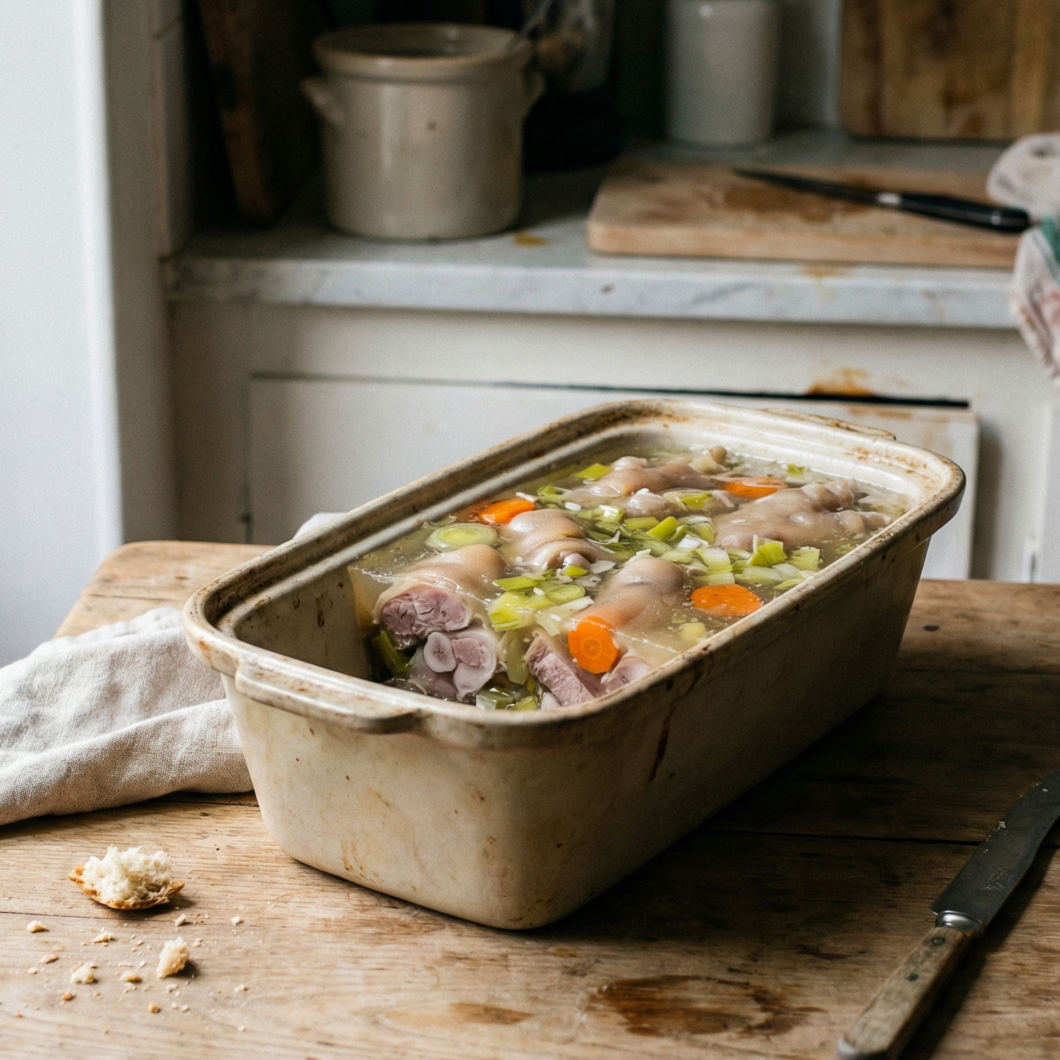

Pig's feet in aspic
4
portions30
minutes40
minutes300
kcal1
hour10
minutesTender pig's trotters, deboned and then set in a homemade aspic with a vinegary broth, with a touch of freshness from carrot and leek. A classic family charcuterie recipe, simple when you follow the steps.
Keep your device's screen on
Ingredients
4 semi-salted pig's feet (split, approximately 1.6 kg)
1 carrot (approx. 120 g)
1 leek (approx. 150 g)
1 celery stalk (approx. 60 g)
1 onion (approx. 120 g), studded with 2 cloves
2 garlic cloves
1 bouquet garni (thyme, bay leaf, parsley)
1 teaspoon of black peppercorns
2 tablespoons of white wine vinegar (30 ml)
1.2 L of water
6 gelatin sheets (12 g) or sachets of powdered gelatin (12 g)
Fine salt (with caution) and pepper
1 tablespoon of chopped flat-leaf parsley (optional, for the mussels)
Instructions
- Quickly remove the salt: rinse the pig's feet under cold water. If they are very salty, soak them for 10 minutes in a large basin of cold water, then drain.
- Start the broth: in a large pot, put the pig's feet, water (1.2 L), the carrot in rounds, the leek roughly chopped, the celery in pieces, the onion studded with cloves, the garlic, the bouquet garni and the peppercorns.
- Cooking: Bring to a gentle boil, skimming for 2 minutes if necessary, then reduce heat to maintain a simmer. Partially cover and cook for 30 minutes. The feet should be very tender and the flesh should easily flake off the bone.
- Prepare the gelatin: while cooking, soak the gelatin sheets in a large bowl of cold water for 10 minutes (or hydrate the powdered gelatin according to the package).
- Debone: Remove the feet from the pot and let them cool for 5 minutes. On a cutting board, remove the bones and any tough cartilage. Keep only the meat and the tender rind. Shred into large pieces (not crumbs).
- Strain and season the jelly: Strain the broth through a fine-mesh sieve (or colander and cheesecloth). Return the strained broth to a saucepan. Add the vinegar. Taste: Add salt very lightly if necessary, and pepper.
- Melt the gelatin: off the heat (hot but not boiling), squeeze out the excess water from the gelatin and whisk it in until completely dissolved. If using powdered gelatin, add it already hydrated and mix well.
- To mold: Divide the meat among 4 individual ramekins/terrines. Add a few carrot slices from the broth and some parsley if desired. Pour the hot aspic over the meat, just covering it. Tap the ramekins/terrines to release any air bubbles.
- Setting time: allow to cool to room temperature for 20 minutes, then refrigerate for at least 4 hours (ideally overnight) for a firm jelly.
- To serve: unmold quickly by dipping the bottom of the ramekins in hot water for 2 seconds, then invert. Serve chilled, with a green salad and wholegrain mustard.
📊 Nutritional Information
1 serving (approx. 330g)
| Nutrient | Value |
|---|---|
| Calories | 520 kcal |
| Proteins | 38g |
| Carbohydrates | 6g |
| including sugars | 3 g |
| Lipids | 38g |
| including saturated fatty acids | 14g |
| Fibers | 2g |
| Sodium | 980mg |
| Vitamins | |
| Vitamin B12 | 60% of the recommended daily allowance (RDA) |
| Vitamin B3 | 35% AJR |
| Vitamin A | 25% AJR |
| Minerals | |
| Iron | 18% AJR |
| Zinc | 22% AJR |
| Phosphorus | 30% AJR |
* RDA = Recommended Daily Allowance
📝 Notes
Total time = active time. Cold setting (4 hours to overnight) is not included in the 55 minutes, but it is essential for a true jelly.
💡 Chef's Tips
For a clear jelly, maintain a gentle simmer (not a rolling boil) and strain through a fine-mesh sieve. Use 12g of gelatin for a sliceable consistency. If your broth is already very gelatinous upon cooling, you can reduce the amount to 8g.
🔄 Variations
- Add 1 teaspoon of chopped gherkins to each ramekin for a punchier note (it's still very bistro-style).
- Replace some of the vinegar with lemon juice for a milder acidity.
