
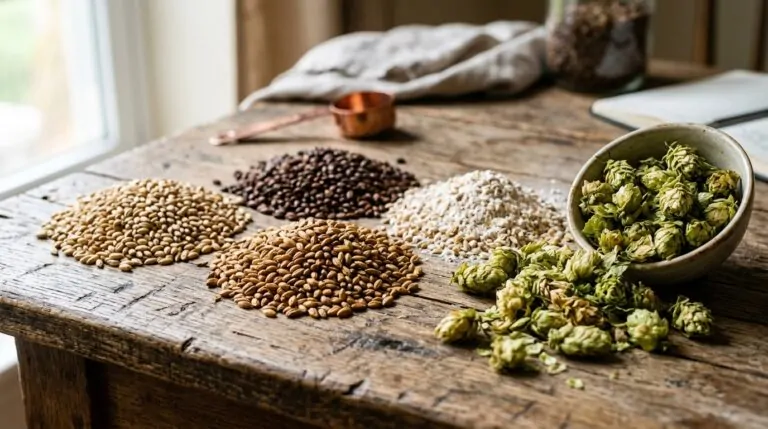
Brewing your own beer at home starts long before you light the fire under the brewing kettle. It all comes down to the choice of ingredients: a poorly selected malt, an unsuitable yeast, or hops that are too strong, and the recipe goes off the rails right from the start.
To guide you step by step through this process, here is what you need to know about the four pillars of craft brewing, and how to combine them to obtain the beer you envision.
How to choose the right ingredients for brewing your own beer at home?
Choosing your ingredientsis laying the foundations of your beer even before brewing begins, because each component plays a specific role in the brewing process, and none can be chosen at random.
The quality of the malt determines the richness of the wort, the hops define the character of the beer, the yeast controls the fermentation, and the water structures the whole.
For a brewer just starting out, the temptation is strong to turn to generic ingredients. Yet, even on a small scale, the selection makes all the difference between a bland beer and one that surprises.
Take the time to compare the available malts, read the hop profiles, and choose a yeast suited to the style you are aiming for.
To find all the necessary ingredients gathered in one place, note for example that the website autobrasseur.fr offers a range dedicated to amateur brewers, designed to facilitate your first brews as well as your most elaborate recipes.
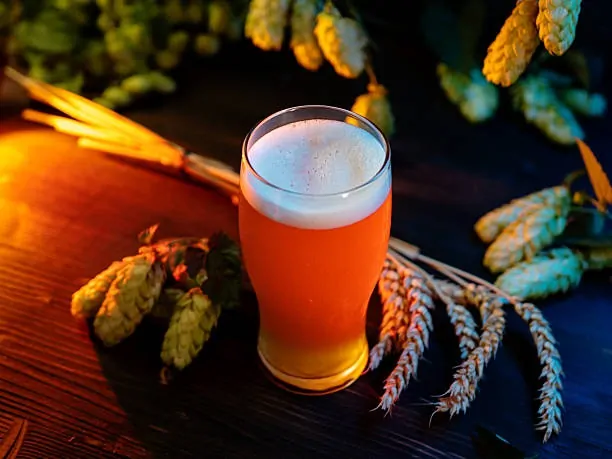
Malt, hops, yeast and water: understanding the role of each ingredient
These four ingredients form the basis of all brewing.
Malt is the source of fermentable sugars in wort. It is barley (or other cereals) that has germinated and then been dried.
This process activates enzymes capable of transforming starch into sugars, and without malt, no fermentation is possible, and therefore no beer.
Hops provide the bitterness that balances the sweetness of the malt, but also the floral, fruity or resinous aromas that characterize each style of beer.
Added at the beginning of boiling, it makes it bitter; added at the end, it adds flavor.
Some brewers even use it cold, after fermentation, to intensify aromas without adding extra bitterness.
Yeast is the fermentation agent that consumes the sugars in the wort and transforms them, producing what gives beer its final character.
Ale yeasts ferment at room temperature, producing fruity and complex profiles. Lager yeasts ferment at lower temperatures, resulting in cleaner, rounder beers.
Finally, water makes up almost the entire volume of your beer, so its mineral composition directly influences the taste of the wort and the expression of the other ingredients.
Water that is too hard can mask the aromas of hops; soft water will better highlight delicate malts.
Adapt your malts and hops according to the desired style of artisanal brewing
Each style of craft beer calls for a different combination of ingredients. This is what makes homebrewing so rich: the recipe changes, the malts change, the hops change.
For a light blonde beer, pale malt (or base malt) is sufficient to create a clear and subtle wort. It leaves plenty of room for the aromatic hops, often chosen for their floral or citrus notes.
A neutral yeast completes the mixture without interfering with the aromas.
For a dark beer or a beer with character, crystal and chocolate malts come into play:
- Crystal malt brings caramel notes and a certain roundness to the mouth.
- Chocolate malt, roasted more intensely, gives aromas of coffee and cocoa.
These special malts do not replace the base malt, they complement it, in varying proportions depending on the desired depth.
For an IPA, the brewer relies on hops with strong aromatic potential, often of American or New Zealand origin, with tropical or resinous profiles.
The base malt remains dominant so as not to compete with the hops, which are the star of the recipe here.
Three useful guidelines to help you make your choices according to the desired style:
- For light beers (blonde, white): pale malt or wheat, aromatic hops, neutral or wheat yeast.
- For amber and brown beers: crystal and chocolate malts in addition to the base malt, balanced hops.
- For heavily hopped beers (IPA, DIPA): predominant base malt, large quantities of aromatic hops, yeast that respects the aromas.
Mastering these combinations means understanding the logic behind each recipe, rather than blindly following it.
You then become able to adjust, substitute one ingredient for another, and confidently create your own craft beers
Homebrewing is based on a simple logic: each ingredient has a function, and their combination produces a unique result.
Malt, hops, yeast and water are not interchangeable, but they can be infinitely adjusted according to your recipe and the style of beer you wish to brew.
The more you understand their role, the more precise your manufacturing will become.
Our tip: start with simple recipes, observe what each ingredient brings to your wort, and adjust as you brew.
This is how the experience of a true craft brewer is built!
