
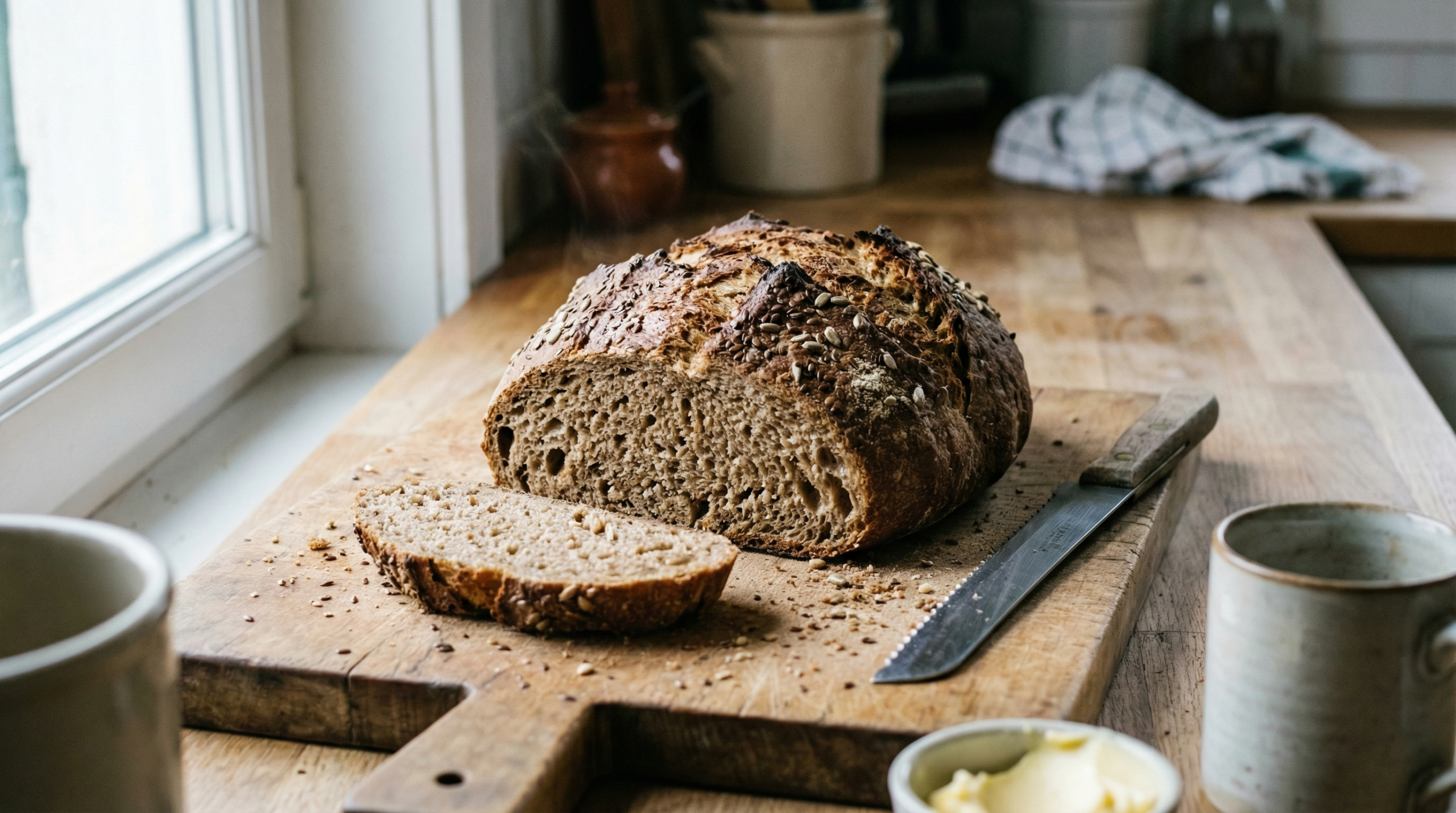
I have a soft spot for rustic breads, the kind that smell of grain, that slice well, and don't crumble as soon as you spread a little butter on them. Lumberjack bread is exactly that: a "country" bread, darker, more aromatic, with a very comforting quality. I've perfected it at home to keep it true to the traditional spirit (rye + whole wheat flour + seeds), while still being achievable without professional equipment.
The slight challenge is time: a classic loaf often requires long fermentations. Here, I maintain the structure and flavor of the lumberjack loaf, but I focus on a short and efficient rise, with a very hot oven and simple shaping.
The result: a beautiful crust, a tight but not compact crumb, and that slightly "nutty" taste typical of more wholemeal flours.
I also love the idea that this bread is perfect for the colder months: the squash provides natural moisture and a subtle softness (without being overly "pumpkin bread"), and the nuts/seeds add character. You can serve it with soup, cheese, a terrine, or simply with a good jam.
If you've never made bread before, this is a great place to start: no need for endless kneading, just clean movements and a little attention to the dough's texture. I'll guide you step by step, and you'll quickly get the hang of it.
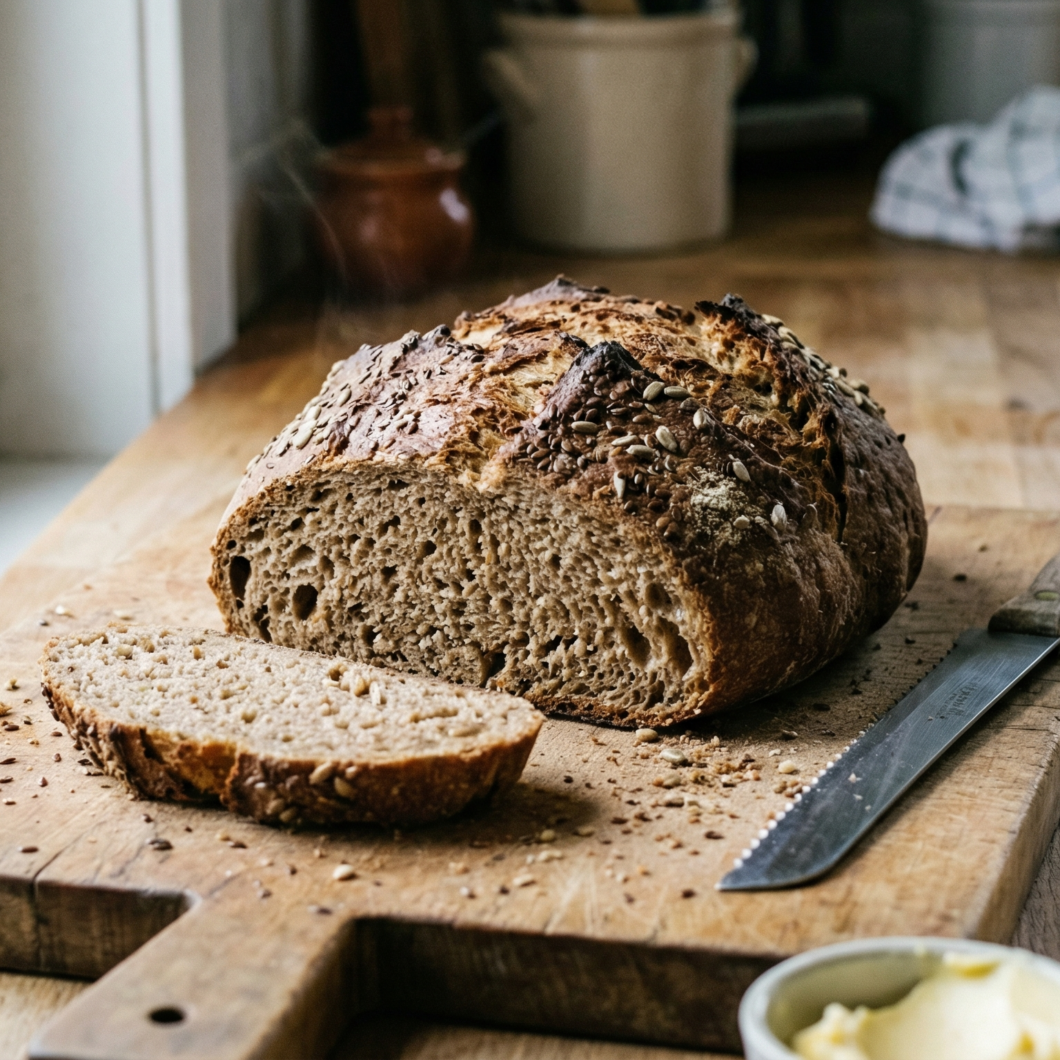

Homemade lumberjack bread
4
people22
minutes34
minutes396
kcal56
minutesA rustic, dense and soft bread with a beautifully crackling crust. Rye and wholemeal flour for flavor, seeds for crunch, and a crumb that holds bread perfectly.
Keep your device's screen on
Ingredients
220g of T65 wheat flour
180g of wholemeal flour (T110)
100g of rye flour
8 g of dried baker's yeast
10 g of fine salt
12 g of honey
320 g of lukewarm water
120g of well-drained pumpkin puree (butternut or kabocha squash)
30g of crushed walnuts
20g of sunflower seeds
15 g of flax seeds
1 tablespoon of oil (sunflower or rapeseed), for the salad bowl
1 tablespoon of flour (rye or wholemeal), for dusting
Preparation steps
- Prepare the squash puree if needed: grate 200 to 250g of squash, cook it for 6 to 8 minutes in a pan with 2 tablespoons of water, then mash and let it cool slightly. Drain well in a colander: it should be thick, not runny.
- In a large bowl, mix the flours (T65, wholemeal, rye). Add the dry yeast on one side and the salt on the other (avoid direct contact).
- Add the honey, warm water, and pumpkin puree. Mix with a wooden spoon, then by hand, until you have a smooth dough. It will still be a little sticky: this is normal with rye and pumpkin.
- Add the nuts and seeds. Knead for 4 minutes in the bowl: take the dough, fold it over itself, turn the bowl over, and repeat. The goal is to unify the dough, not to "strengthen" it.
- Lightly oil a clean bowl. Place the dough in the bowl and cover (with a tea towel or cling film). Let it rise for 25 minutes in a warm place: the dough should rise significantly, but not necessarily double in size.
- During the rising time, preheat the oven to 240°C (conventional setting if possible). Place an empty tray at the bottom of the oven (this will create steam).
- Flour your work surface. Gently turn the dough over. Fold it twice: first the top edge towards the center, then the bottom edge towards the center. Rotate the dough a quarter turn and repeat once. Shape into a tight ball or an oval (bâtard).
- Place the bread on a baking sheet lined with parchment paper. Lightly flour the top. Make incisions with a sharp blade or knife (1 large cut or 3 small ones).
- Let it rest for 10 minutes while the oven finishes heating: this mini sprout helps with the scoring (opening) in the oven.
- Place in the oven. Immediately pour a glass of water (approx. 150ml) onto the hot bottom tray to create steam, then quickly close the door.
- Bake for 12 minutes at 240°C, then reduce the temperature to 210°C and continue baking for 22 minutes. The bread is ready when the crust is a deep brown and it sounds hollow underneath.
- Allow to cool for at least 20 minutes on a wire rack before slicing: the crumb finishes to develop its structure during this time.
📊 Nutritional Information
1 serving (approx. 150g)
| Nutrient | Value |
|---|---|
| Calories | 396 kcal |
| Proteins | 12.1g |
| Carbohydrates | 70.4g |
| including sugars | 5.3g |
| Lipids | 8.6g |
| including saturated fatty acids | 1.2g |
| Fibers | 9.9g |
| Sodium | 982mg |
| Vitamins | |
| Vitamin B1 | 26% AJR |
| Vitamin B3 | 22% AJR |
| Vitamin E | 14% AJR |
| Minerals | |
| Magnesium | 28% AJR |
| Phosphorus | 27% AJR |
| Iron | 23% AJR |
* RDA = Recommended Daily Allowance
📝 Notes
If your lumberjack bread dough seems too dry (highly absorbent flours), add 10 to 20g of water while mixing. If it's too soft, lightly flour your hands and fold the dough more tightly when shaping it, rather than adding a lot of flour.
💡 Chef's Tips
For a truly rustic loaf with a thicker crust: bake for an additional 3 to 5 minutes at 210°C (410°F). For clean slices, wait until completely cool and use a serrated bread knife
🔄 Variations
- Lumberjack bread with seeds: replace the flax seeds with sesame seeds, keeping the same quantities.
- Nut-free recipe: replace the walnuts with crushed hazelnuts for a more toasty taste.

I tried the additional 3 to 5 minutes of baking at 210°C recommended for the crust, and the result is amazing – it's nice and crispy without the crumb drying out! However, I replaced the walnuts with crushed hazelnuts as suggested in the variation, and it really adds that extra toasty touch.
Hello Isabeau, I'm delighted that the longer crust bake at 210°C convinced you; it really is the little touch that makes all the difference in this lumberjack bread. Using chopped hazelnuts instead of walnuts is also my favorite variation; they add that toasty flavor without overpowering the pumpkin. That's exactly the spirit of this recipe: keeping the traditional base but allowing room for these small adjustments.