

Why your home valuation deserves your full attention
Taking out home insurance is much more than a simple administrative formality. Above all, it's about effectively protecting yourself against the unexpected events of daily life.
Yet, many people sign contracts without taking the time to properly assess their assets. The result? Uncomfortable situations that could have been avoided.
On the one hand, underinsurance is a real threat: you think you are covered, but on the day of the incident, the compensation only covers a fraction of the damage.
On the other hand, over-insurance makes you pay unnecessary sums each month for excessive coverage, and between these two pitfalls, there's a balance to be found. The goal? To pay the right price while sleeping soundly.
In this article, we'll guide you step by step to properly assess your home, take stock of your belongings, identify real risks, and make smart use of the tools at your disposal. Because good insurance starts with a good assessment!
The fundamentals of home insurance
What your insurance actually covers
Your home insurance covers you against the main risks: fire, water damage, theft, natural disasters and civil liability.
If you are a tenant, liability insurance is mandatory. As a homeowner, you retain the freedom to choose your level of coverage.
Contracts are generally available in basic or extended versions (multi-risk home insurance), with additional options such as legal protection or enhanced coverage for valuables.
Why everything is decided from the start
The personal property capital to be insured corresponds to the total value of what you own: furniture, household appliances, electronic equipment, personal effects.
The size, type, and location of your accommodation directly affect the calculation of your premium.
An inaccurate declaration exposes you to unpleasant surprises: either you pay too much for excessive guarantees, or you discover too late that your compensation will not cover your actual losses.
Needless to say, the initial assessment deserves close attention!
Create a detailed description of your accommodation
The characteristics that matter
To create a reliable profile of your home, several pieces of information are essential:
- Property type: detached house, apartment, studio, duplex
- The living area and that of the outbuildings (garage, cellar, attic)
- The number of main rooms and annexes
- Location: urban or rural area, floor level, immediate surroundings
Rely on your official documents (title deed, lease, property survey) rather than on rough estimates.
A look at your previous statements can also help you check the consistency of the data.
Game-changing equipment
Certain features influence your risk profile, and a remote monitoring system, an alarm, a reinforced door or smoke detectors work in your favor.
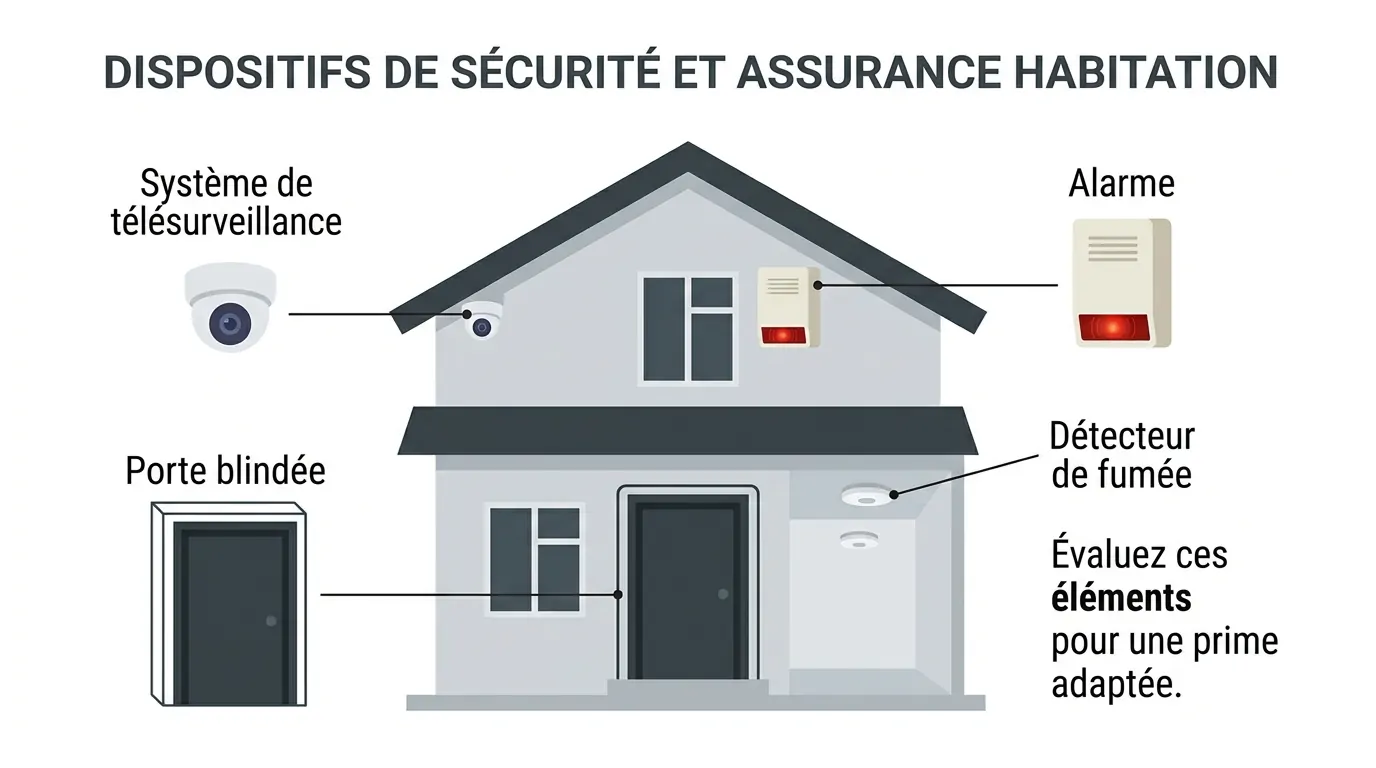
Conversely, remote outbuildings, a fireplace, photovoltaic panels or a swimming pool may require special guarantees.
Accurately mentioning these security features may allow you to obtain a better price.
Taking inventory of your belongings: a crucial step too often neglected
Take stock of your movable assets
Creating a complete inventory takes some time, but it's a worthwhile investment. Proceed methodically, room by room, classifying your belongings by category:
- Furniture (sofas, beds, tables, storage)
- Household appliances (refrigerator, washing machine, oven, microwave)
- Multimedia equipment (television, computers, consoles, speakers)
- Personal belongings and wardrobe
- Musical instruments, sports equipment, tools
Estimate the replacement value by referring to the new price or the use value according to your formula.
Keep the invoices, photos and bank statements of your important purchases safe: these proofs of purchase will be your best ally in the event of a claim.
Precious objects deserve special attention
Jewelry, works of art, collections: these exceptional items require specific treatment.
Carefully check the compensation limits provided in your basic contract because often optional guarantees are necessary to properly protect these treasures.
Do not underestimate their value through misplaced economy: you may bitterly regret it the day you need them.
Digital tools to support your assessment
How do online simulators work?
Home insurance simulators available on the internet are a valuable aid in refining your assessment.
Their principle is simple: you provide the characteristics of your accommodation (address, surface area, type of property, number of rooms, equipment) as well as your personal situation (occupant status, history of claims, estimated value of your belongings).
In return, you receive a premium estimate and several insurance proposals tailored to your profile.
To quickly get an initial idea of the cost and guarantees corresponding to your situation, you can carry out a home insurance simulation online.
These tools allow you to see in concrete terms how your declarations impact your level of protection and your budget.
Adjust your guarantees based on your assessment
Determining the right level of coverage
The assessment you have just completed should guide you in choosing between a basic policy and a more comprehensive multi-risk home insurance policy.
This is also the time to identify the optional guarantees that make sense for you: legal protection, assistance, enhanced coverage for valuables.
Take the time to carefully read the terms and conditions to fully understand the deductibles, compensation limits, and warranty exclusions.
The devil is often in the details!
Finding the right balance between budget and peace of mind
A rigorous assessment allows you to distinguish between essential and less essential guarantees, so adjust the insured movable capital as closely as possible to reality, without excess or deficiency.
Compare multiple offers using the same data to maintain consistency in your approach.
Remember to update your information regularly, especially after purchasing important goods or carrying out work: this will ensure your protection remains effective over time.
In summary: an approach worth pursuing
Properly assessing your home and belongings is the foundation of truly suitable home insurance.
Accurately describing your home, its equipment and the value of your personal property protects you from unpleasant surprises, whether it be under-insurance or over-insurance.
Online simulation tools greatly facilitate this process by allowing you to explore different scenarios and their impact on your budget.
Allow yourself sufficient time to gather your information before requesting a quote or using a simulator, and then keep an up-to-date inventory of your assets with the corresponding supporting documents.
If you have already signed a contract, take the opportunity to scrutinize it in light of these elements.
Do your insurance policies still reflect the true value of your assets? Is your budget realistic? This thoughtful approach guarantees lasting and well-deserved peace of mind.
