
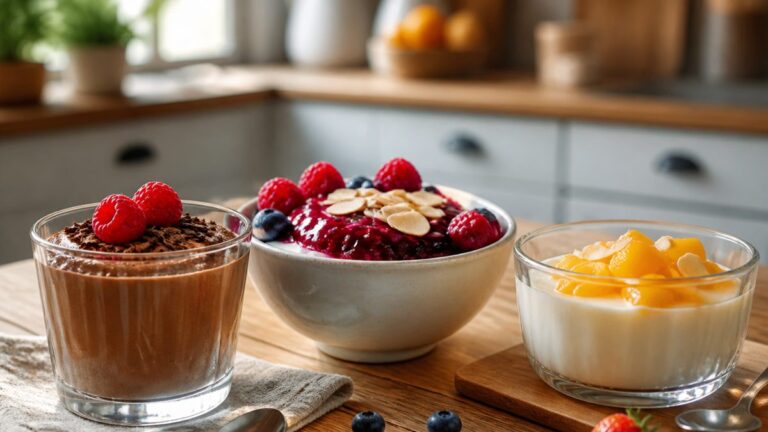
In short
A dessert labeled "sugar-free" or listed in a recipe doesn't necessarily mean what you think. The term is governed by specific regulations, and it actually contains far more carbohydrates than you might imagine.
For a diabetic profile, the question is therefore not only "does this dessert contain white sugar?" but rather "how much carbohydrate will it provide, and with what sweetener?".
This article sorts through what the label really says, which sweeteners to favor or watch out for, and dessert ideas by family to enjoy without navigating blindly.
"Sugar-free" desserts and diabetes: what the label really says
The phrase "no added sugars" corresponds to a precise legal definition, framed by the European regulation on nutrition claims.
A product can only bear this label if no mono- or disaccharides, honey, syrup, or any other ingredient with sweetening properties has been added during manufacturing; naturally occurring sugars remain permitted, provided they are declared on the label. The threshold of 0.5 g of sugars per 100 g applies to a separate claim: "sugar-free".
The problem is that a dessert can remain very high in carbohydrates without ever having a single spoonful of sugar added. A blended fruit compote, a mashed banana cake, or a honey pastry can be labeled "no added sugar" while still providing just as many carbohydrates as a regular version.
"Sugar-free," "no added sugars," "low GI," and "low in carbohydrates" are four different concepts. A dessert may meet one of these criteria but not the others: it's better to look at the complete ingredient list rather than just one word on the label.
This type of discrepancy between the label and the nutritional reality explains why many diabetics are returning to homemade recipes: a commercially available "sugar-free" flan can very well provide more carbohydrates than a homemade banana version, simply because of the amount of flour and milk used.
Which sweetener should I choose for a diabetic dessert?
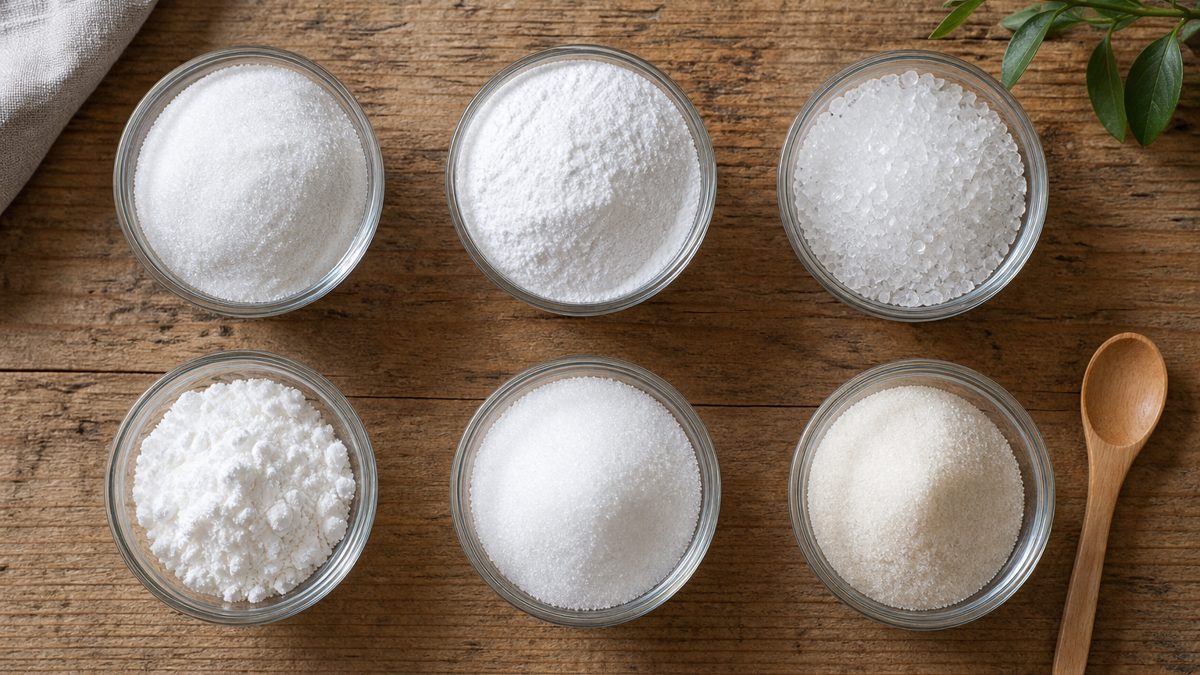
Not all sweeteners are created equal. Some have a glycemic index of zero, while others, like agave syrup, are still sugars in a nutritional sense, even if they have a name that sounds "natural".
| Sweetener | Glycemic index | Point of vigilance |
|---|---|---|
| Erythritol | 0 | Sweetening power of 60 to 70% compared to sugar; generally well tolerated up to approximately 35 g per day for a 70 kg adult (acceptable daily intake set by EFSA at 0.5 g/kg of body weight), beyond which digestive problems become more frequent |
| Xylitol | 7 to 13 according to the sources | Toxic to dogs, keep out of reach of pets |
| Stevia | 0 | A noticeable licorice aftertaste is present in large quantities; use gradually |
| Agave syrup / coconut sugar | Moderate to high | These are sugars in their own right, not substitutes with a zero glycemic index, despite their "natural" image |
A 2023 study published in Nature Medicine by the Cleveland Clinic linked high blood levels of erythritol to an increased risk of cardiovascular events in patients already being monitored for heart disease. While this link remains debated within the scientific community, it supports the importance of not exceeding recommended doses and alternating sweeteners rather than relying on a single one continuously.
Our sugar-free dessert ideas for diabetics
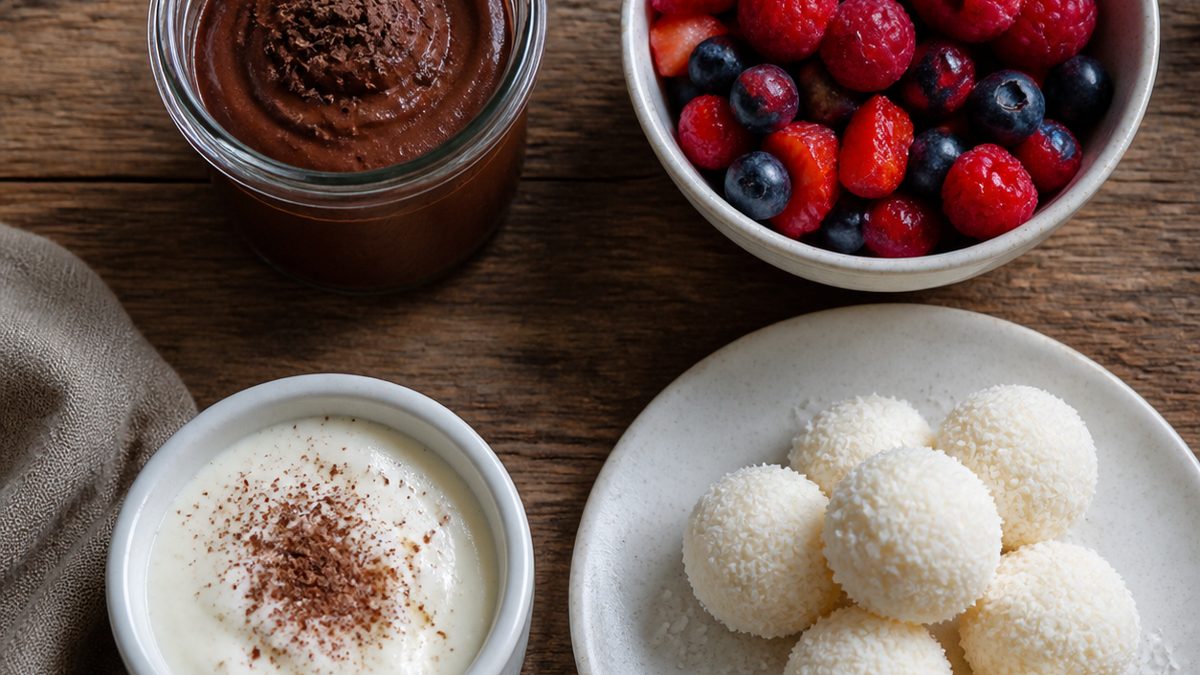
Rather than a fixed list, here are families of desserts without added sugar that lend themselves well to a diabetic version, with a concrete suggestion to try for each.
Chocolate desserts
chocolate with 85% cocoa naturally contains little added sugar and pairs well with erythritol for a mousse or fondant.
Almond flour , used instead of classic wheat flour, adds softness without raising the overall glycemic index of the recipe as much.
Fruit desserts
Red fruits ( raspberries, blueberries, strawberries) have a lower glycemic index than bananas or mangoes, making them an interesting base for a fruit salad or homemade compote.
However, be aware: even "without added sugar", applesauce remains rich in natural carbohydrates if the portion is generous.
Dairy desserts
Plain yogurt or cottage cheese, sweetened with stevia and accompanied by some red berries, remains one of the simplest options to measure.
A homemade dessert cream made with whole milk and erythritol allows you to achieve a delicious texture while maintaining control over the quantities.
No-bake desserts
A light Bavarian cream, a no-bake cheesecake with cream cheese and erythritol, or simple hand-shaped and chilled coconut balls can be prepared in minutes.
These recipes also avoid caramelization, which can raise the glycemic index of some ingredients when cooked.
- Total control of carbohydrate and sweetener quantities
- No hidden sugars in a long list of ingredients
- Adaptable to one's own tastes and allergies
- The label can sometimes be misleading regarding the actual carbohydrate content
- Price often higher than an equivalent homemade recipe
- Sweeteners and texturizers are sometimes combined without clear information
How many carbohydrates should I aim for in a suitable dessert?
There is no universal figure that applies to everyone. According to the French National Health Insurance (Assurance Maladie), the distribution of carbohydrates throughout the day depends on the treatment being followed, the level of physical activity, and the goals set with a doctor or dietician.
What matters is being able to estimate the amount of carbohydrates provided by a given dessert, in order to integrate it into the carbohydrate budget of the meal rather than simply enduring it.
Let's consider two concrete scenarios. For Julien, 45, who is on insulin and used to counting his carbohydrates meal by meal, a slice of almond flour chocolate cake (approximately 20 to 25 grams of carbohydrates) is easily included if he adjusts his dose accordingly. For Sophie, 68, a type 2 diabetic treated with pills that don't allow for real-time adjustments, a lighter dessert like two squares of dark chocolate or homemade compote without added sugar limits the risk of a post-meal spike.
Which dessert should you choose based on your carbohydrate budget?
Choose your target carbohydrate budget for this dessert (this is a guideline and should be adjusted with your healthcare professional):
Our tips for achieving the perfect sugar-free texture

Removing sugar from a recipe changes more than just the taste: it also plays a role in the moistness, colouring and preservation.
Add unsweetened compote or fruit puree to the cake batter: it replaces some of the liquid and fat while keeping it moist, without adding white sugar.
For a chocolate fondant, replace some of the butter with almond puree or blended avocado: the texture remains smooth, even without the caramelized look that sugar usually gives when baking.
Keep your desserts without added sugar in the refrigerator and for a shorter period than their classic equivalents: sugar also acts as a preservative, its absence reduces the shelf life.
Pitfalls to avoid with "diabetic-friendly" products
Before buying a product labeled "special for diabetics" or "sugar-free", a few simple checks can prevent unpleasant surprises.
- Look at the total carbohydrate content per 100g, not just the "sugars" line
- Check the list of sweeteners used and their relative quantity in the recipe
- Compare with an equivalent homemade version: the price and ingredient list are often more favorable
- Beware of marketing terms like "reduced-fat" or "light," which guarantee nothing about carbohydrates
These are objective criteria to check on the packaging, not a reason to systematically dismiss commercial products: some are perfectly honest, others much less so. The only way to know for sure is to read the entire label.
In summary
A sugar-free dessert for diabetics is first built by understanding what the label really says: "no added sugars" does not equal "no carbohydrates", and each sweetener has its own limits to respect.
Dark chocolate, red fruits, dairy desserts or no-bake recipes allow you to vary the pleasures without limiting yourself to a single category, provided that you adjust the portions to suit each person's profile.
The ideal amount of carbohydrates remains specific to each person: it is determined with a healthcare professional, this article is only intended to provide guidelines and ideas for cooking more serenely.
Practical questions
What is the best dessert for a diabetic?
There's no single "best" dessert: it depends on a person's carbohydrate budget and the time of day. A light dessert like dark chocolate or homemade compote without added sugar suits most people, but a slice of cake is still possible if it's included at the right time in the day's diet.
Which pastry is the least sweet for a diabetic?
Desserts made with dark chocolate of 85% or higher, or creams made with whole milk and erythritol without any other added carbohydrates, are among the lowest in sugar. A simple serving of plain cottage cheese with a few berries is also a safe bet.
Which dessert doesn't cause a spike in blood sugar?
No dessert is completely neutral on blood sugar, but some cause it to rise less than others: red fruits with a low glycemic index, dark chocolate with little sugar or desserts sweetened with erythritol generally limit the impact, especially in reasonable portions and at the end of a meal rather than on an empty stomach.
What can be used to replace sugar in a cake for diabetics?
Erythritol and xylitol replace sugar while maintaining a similar sweetening power, with a glycemic index of zero or very low. Stevia also works well, in small quantities, to avoid its characteristic aftertaste. These three options are preferable to agave syrup or coconut sugar, which are still sugars in their own right.
Is coconut sugar really better for a diabetic?
No, not fundamentally. Coconut sugar has a slightly lower glycemic index than white sugar, but it's still a sugar in its own right from a nutritional standpoint, with a real impact on blood sugar levels. Its "natural" image shouldn't make you forget to count its carbohydrates just like any other sugar.
