
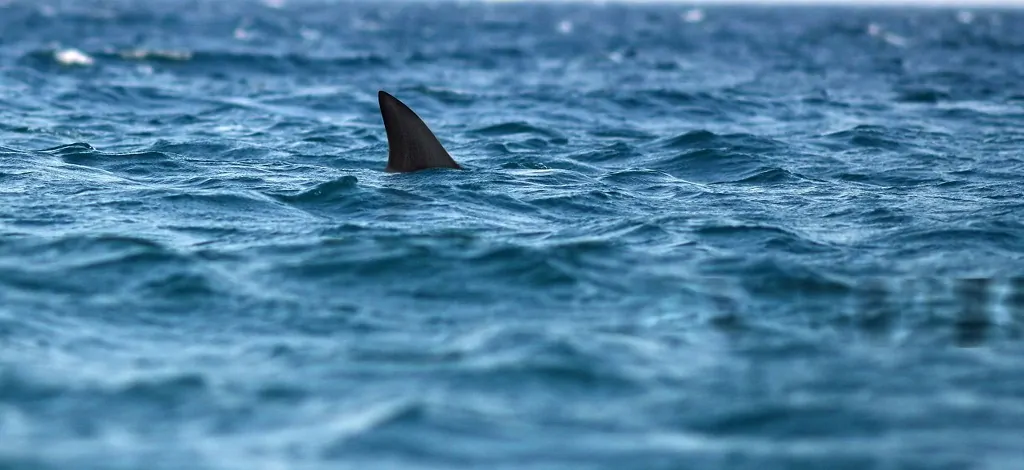
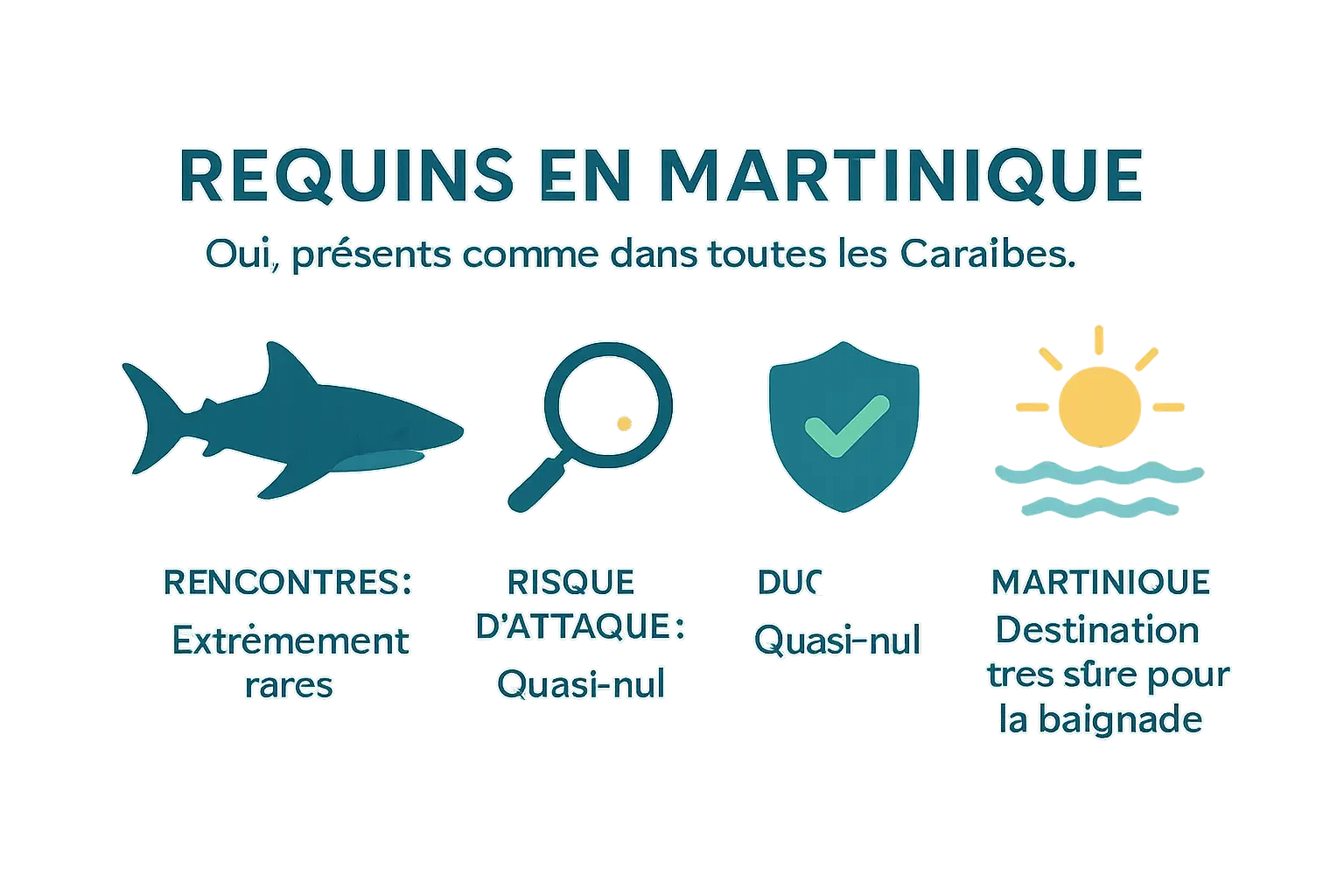
Planning your vacation in Martinique and worried about sharks? Rest assured! Sharks in Martinique pose no danger to swimmers. Even better, no attacks have been recorded for over a century!
This level of safety for swimming is quite exceptional and contrasts sharply with other tropical destinations.
Indeed, while Reunion Island has suffered 24 attacks since 2011 and Florida 16 incidents in 2023, Martinique boasts an exemplary record: 0 attacks in 275 years!
How can this peaceful coexistence be explained? It's quite simple… It stems from the numerous coral reefs that form a natural barrier protecting the beaches of Fort-de-France, Schoelcher, and Trois-Îlets. Predators thus prefer to remain in the deep waters offshore, far from frequented swimming areas.
Now that you know more, let's discover together why Martinique remains one of the safest beach destinations in the world, without falling into scary clichés like "Jaws" or other sensational films!
Browse the guide:
Sharks in Martinique: Should we really be worried?
The question that plagues travelers
Who hasn't wondered, upon arriving in Martinique, if a shark might be swimming near the beach? A legitimate concern, but unfounded. Sharks do inhabit these waters, but their presence on the coast is a myth.
A clear and reassuring answer
Several species, such as the lemon shark or the tiger shark, live in Martinique.
There have been no incidents since 1749!
Coral reefs form a natural barrier, keeping sharks away from swimming areas. These predators prefer deep, murky waters.
Sharks are essential to the marine ecosystem. To enjoy the sea safely, avoid remote areas at dusk.
In Martinique, the risk of encountering a shark is extremely low!
What species of sharks are present in the waters of Martinique?
A rich Caribbean ecosystem
Martinique, bathed by the Atlantic Ocean and the Caribbean Sea, is home to a balanced marine ecosystem.
Sharks, essential predators, regulate fish populations and eliminate weakened individuals. Despite their reputation, 98% of sharks are less than 2 meters long, and dangerous species avoid coastal areas.
The Martinique Marine Natural Park, which protects 48,900 km² of ecosystems (reefs, seagrass beds, mangroves), plays a key role in the preservation of these predators and their habitats.
The main sharks recorded in Martinique
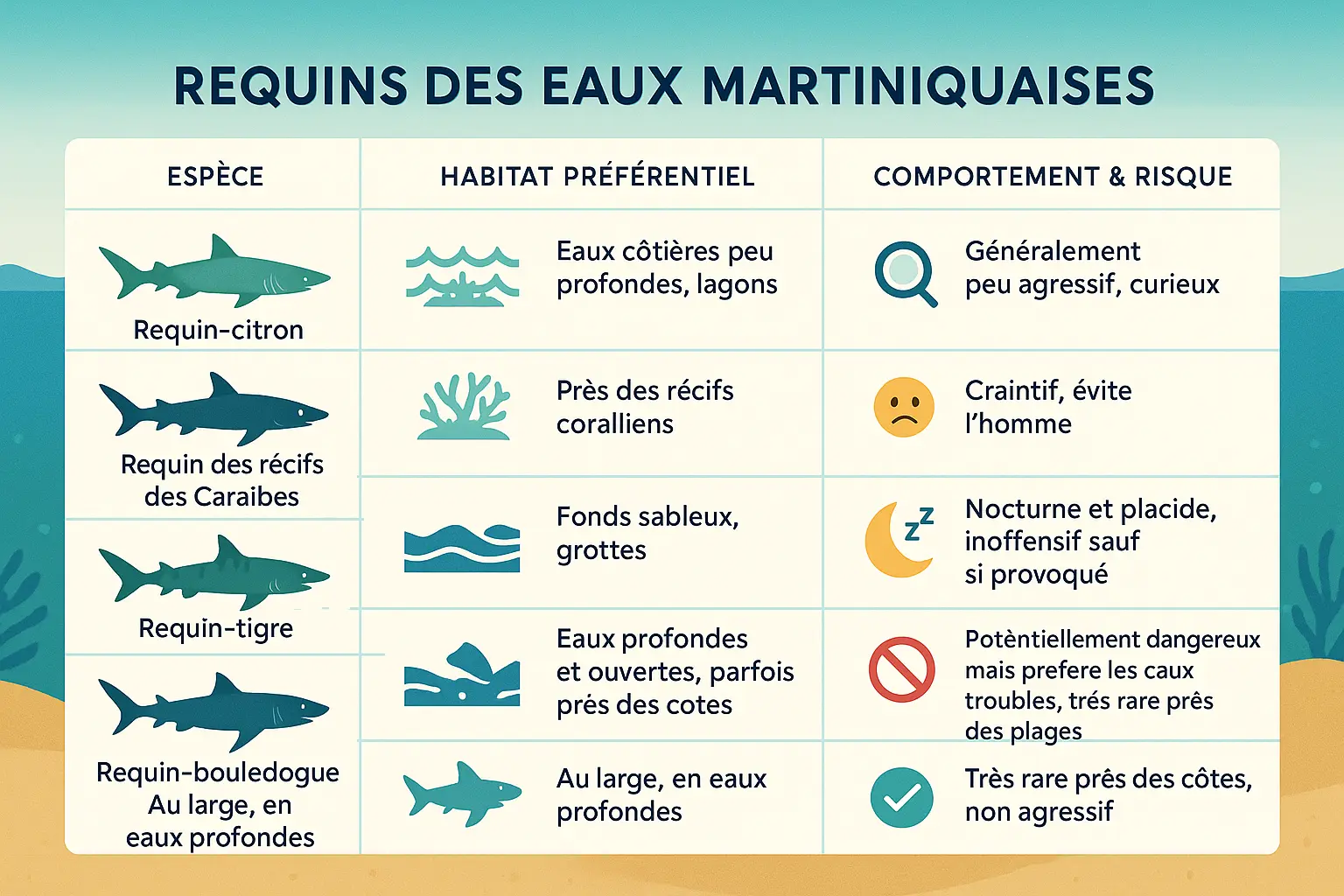
| Species | Preferred habitat | Behavior and risk to humans |
|---|---|---|
| Lemon shark | Shallow coastal waters, lagoons | Generally not very aggressive, curious but harmless without provocation |
| Caribbean reef shark | Near the coral reefs | Fearful, systematically avoids men |
| Nurse shark | Sandy bottom, caves | Nocturnal and placid, harmless unless provoked |
| Tiger shark | Deep, open waters, sometimes close to the coast | Rare near the coast, potentially dangerous but no attacks recorded in Martinique |
| Bull shark | Coastal waters and estuaries | Potentially dangerous but prefers murky waters, very rare near beaches |
| Hammerhead shark | Offshore, in deep waters | Very rare near the coast, non-aggressive |
Tiger sharks, bull sharks, and mako sharks avoid coastal areas. Their preference for deep, murky waters, combined with coral reefs, explains this absence.
No attacks have been recorded for over a century, making Martinique a safe seaside destination.
"In 30 years of professional diving around the island, I have only observed harmless lemon sharks, mainly in deep areas. Our clients can serenely enjoy the most beautiful beaches of the island such as Anse Mitan or Les Salines," testifies Jean-Pierre Delmas, certified diving guide in Fort-de-France.
The Kap Natirel project, using drones and citizen observations, monitors nursery areas to better understand their movements.
Hammerhead sharks, although rare, may approach Diamond Rock during regulated dives. By avoiding restricted areas and following local guidelines, the risk of interaction becomes statistically negligible.
Coral reefs, veritable natural shields, filter access to the beaches, reinforcing this safety.
Why is Martinique considered a safe destination?
A protective coastal geography
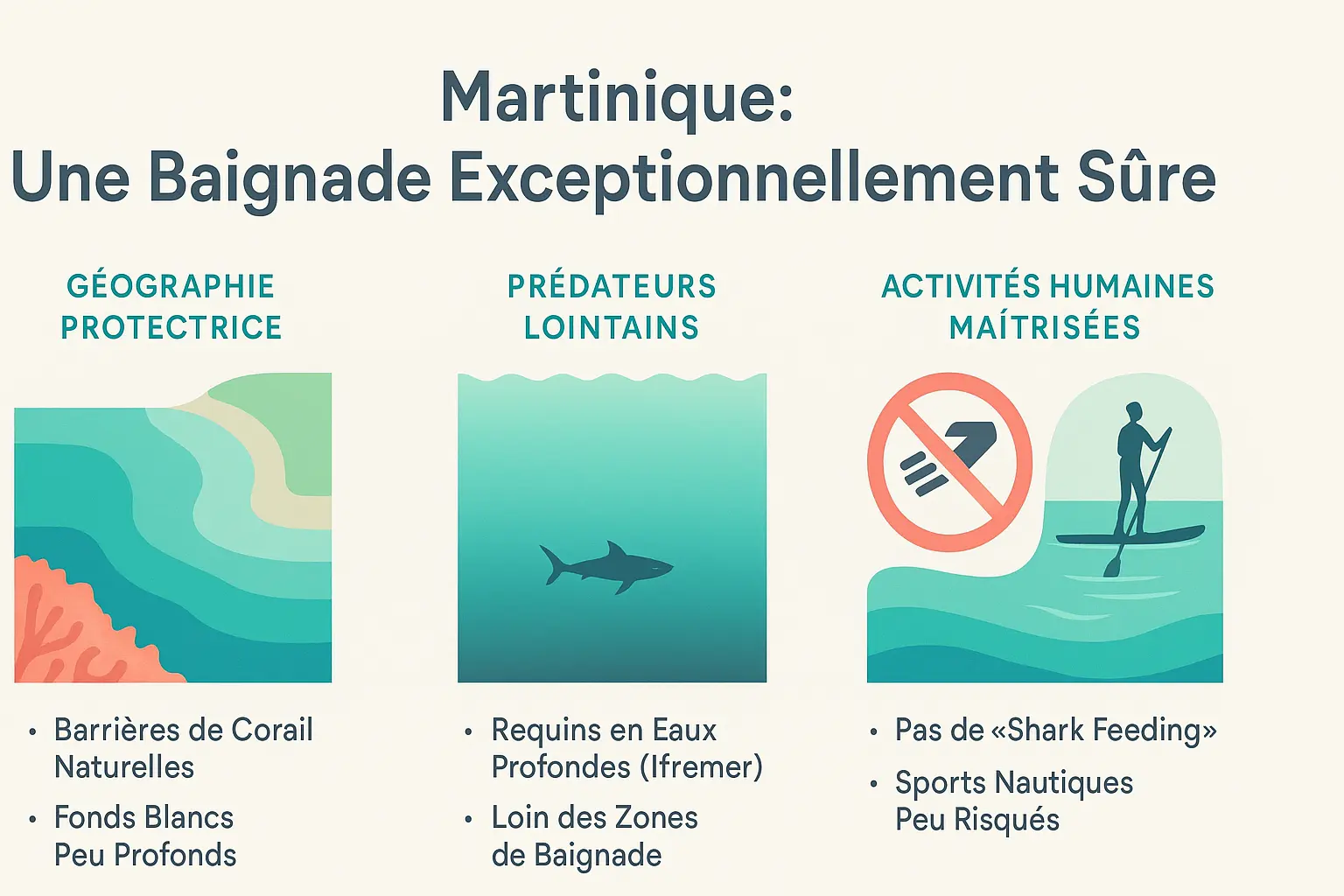
The coral reefs surrounding many beaches in Martinique form a natural barrier against sharks. These complex biological structures prevent large predators from approaching swimming areas.
Shallow, translucent waters, known as "white bottoms," do not correspond to the preferred hunting environments of sharks, which prefer darker, deeper waters.
Deep-sea predators
Sharks mainly frequent the open waters, at depths of up to 700 meters, on the island slope.
A study by Ifremer shows that these areas, rich in prey, attract tiger sharks, lemon sharks, and mako sharks. These species avoid coastal areas, which limits interactions with humans.
The combination of a protective coral reef and sharks' preference for open waters creates an exceptionally safe swimming along the Martinique coast.
The limited impact of human activities
Unlike other regions, Martinique does not practice "shark feeding", an activity that attracts sharks close to the coast.
Water sports, often associated with increased risks, remain relatively uncommon. This lack of human disturbance helps maintain a peaceful ecological balance.
Scientific data confirms that the low density of sharks in the Lesser Antilles reduces the risks. The species present, such as the nurse shark and the lemon shark, generally exhibit non-aggressive behavior, except in rare cases of provocation.
By respecting local recommendations—avoiding swimming at dawn or dusk, staying away from fishing areas, and not attracting sharks with bait—Martinique continues to prove that peaceful coexistence with these predators is possible.
This safety is explained by a combination of geographical, ecological and human factors, making the island exemplary in terms of marine risk management.
The Martinique Tourist Office regularly communicates with visitors about swimming safety in Martinique
“Marine monitoring data confirms that safe nautical activities in Martinique benefit from exceptional conditions. Our coral reefs act as a natural barrier,” explains Dr. Marie Lafleur, marine biologist at the University of the Antilles.
A virtually non-existent history of attacks: what do the facts say?
More than a century without a recorded attack
Historical data confirms that no shark attack, fatal or otherwise, has been officially documented in Martinique for over a century.
A record from the Florida Museum of Natural History mentions a single incident dating back to 1749, but the exact circumstances, location, and date remain unknown. This isolated case, occurring more than 275 years ago, cannot be interpreted as a recurring risk.
Scientific and local records do not attest to any other human-shark interaction in modern records, reinforcing the idea of a particularly safe marine environment.
Shared security in the Lesser Antilles
The total absence of recent incidents and the only mention of an isolated case more than two centuries ago make Martinique one of the safest tropical destinations in the world.
Martinique is not an isolated case: its neighbors such as Guadeloupe, Dominica or Saint Lucia have not experienced any attacks in the last 265 years.
This regional trend can be explained by environmental and behavioral factors. Coral reefs form a natural barrier, shallow and clear waters are not a preferred habitat for sharks, and the concentration of these predators remains much lower than in the Indian Ocean.
The numbers speak for themselves : Martinique 0 attacks in 275 years, vs Reunion 24 attacks since 2011, vs Australia 15 attacks in 2023, vs Florida 16 attacks in 2023.
In Saint-Martin, an isolated attack in 2020 remains linked to specific conditions, with deep waters close to the coast, unlike the topography of Martinique.
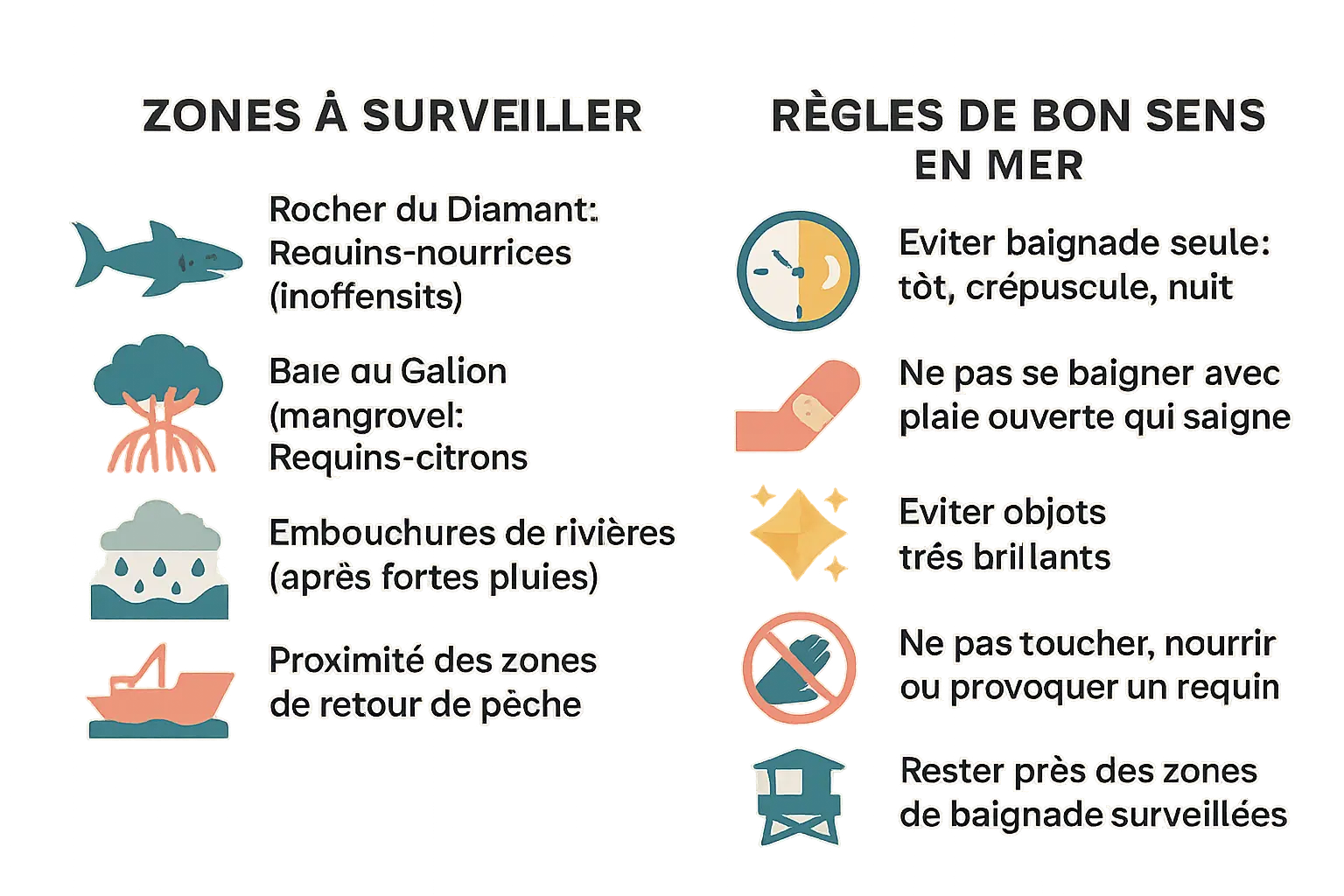
What precautions should be taken and what areas require vigilance?
Identify areas requiring more attention
While shark attacks remain exceptional in Martinique, some areas warrant increased vigilance.
Diamond Rock , a legendary diving site, is home to harmless nurse sharks, often observed by divers.
Galion Bay , with its mangroves, is frequented by lemon sharks because of their ecological role in these sensitive ecosystems.
River mouths after heavy rains constitute areas of temporary risk, as the murky water disrupts the visibility of predators.
Fishing return zones, where bait attracts fish, also increase accidental interactions. These areas serve as a reminder of the need to respect the natural behavior of sharks.
Common sense rules for enjoying the sea
For peaceful coexistence with marine wildlife, a few simple actions are all it takes. The key? Avoiding behaviors that might attract a shark.
Here are some important tips:
- Avoid swimming early in the morning, at dusk or at night, as these are periods of shark activity.
- Do not swim with an open wound, as this can confuse predators with its scent.
- Put away shiny jewelry or accessories that might resemble fish scales.
- Never attempt to touch, feed or provoke a shark that is spotted.
- Opt for supervised swimming areas to benefit from a safe environment.
These precautions, based on scientific observation of the behavior of the 11 species present in Martinique, make it possible to eliminate the few remaining risks.
The coral reef and the low density of dangerous sharks naturally enhance this safety.
By respecting these principles, swimming in Martinique remains an activity without major danger, as confirmed by the statistics of no attacks since 1749.
What should you do if you encounter a shark?
Actions to take (even if the situation is exceptional)
Although encounters are almost non-existent in Martinique, knowing the right reflexes can reassure even the most anxious:
- Remain calm and avoid sudden movements that might intrigue the animal.
- Maintain eye contact with the shark while slowly backing towards the shore.
- Never turn your back on the shark and avoid facing it directly.
- Use an object (board, mask) as a barrier if the shark approaches.
- Return to shore calmly without excessive splashing.
Useful contacts in Martinique
For your peace of mind, here are the emergency contacts:
- SAMU: 15
- Firefighters: 18
- CROSS Antilles-Guyane: 05 96 70 92 92 (sea rescue)
- Martinique Hyperbaric Center: 05 96 55 20 00 (diving)
This information remains theoretical: as no incidents have been recorded for over a century, these contacts serve more to reassure than to anticipate a real danger.
Latest observations 2024: a peaceful coexistence
The most recent monitoring data confirms the historical trend. In 2024, shark sightings in Martinique remain exceptional and limited to deep waters.
"Out of 200 fishing trips this year between Le Robert and Sainte-Anne, I only saw 3 lemon sharks offshore, never near the coast. This proves that our waters remain safe for swimming," says Marcel Tholozan, a professional fisherman for 25 years.
The shark: an essential but little-known player in the marine ecosystem
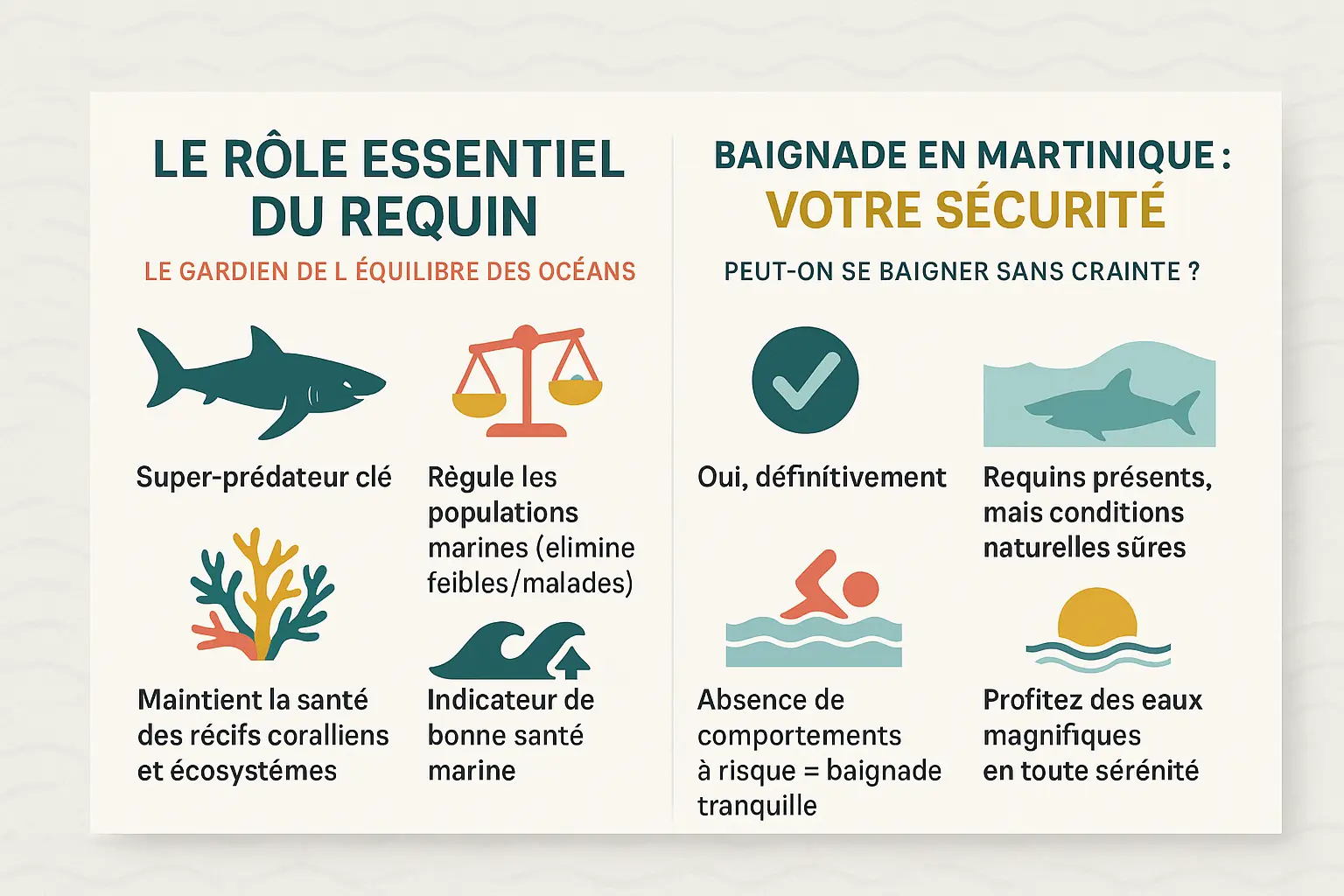
The guardian of the oceans' balance
Sharks regulate fish populations and eliminate vulnerable individuals, preserving the health of coral reefs. Their presence signifies a balanced ecosystem.
In Martinique, you can find lemon sharks or bull sharks, species that contribute to the fight against climate change: their bodies capture 10 to 15% of carbon, which is sequestered at the bottom of the oceans after their death.
So, is it safe to swim in Martinique?
Sharks are present, but Martinique remains a safe destination. No attacks have been recorded for over a century.
Coral reefs form a natural barrier, and the clear waters of the beaches are not their hunting grounds. By avoiding remote areas and twilight hours, swimming remains safe.
Ultimately, wouldn't the greatest risk be missing out on these crystal-clear waters?
Martinique: Harmless sharks in safe. No shark attacks have been recorded in Martinique since 1749! Protective reefs and safe human practices ensure this safety.
Their presence, a sign of a balanced ecosystem, argues for respectful coexistence. Reassured, visitors can serenely enjoy its magnificent beaches, where the greatest temptation remains exploring the rich underwater world of the Antilles.
Share your experience
Have you ever gone swimming or diving in Martinique? Share your experience about the safety of Martinique's waters or ask your questions about water sports in the comments. Your feedback can reassure other travelers!
Answers to your questions
What species of sharks are found in Martinique?
Martinique's waters are mainly home to the lemon shark (not very aggressive), the reef shark (timid), and the nurse shark (placid).
Tiger sharks and bull sharks remain very rare near beaches, preferring deep waters.
Which areas should be avoided to limit the risks?
Remain vigilant at Diamond Rock and Galion Bay (nursery areas), as well as at river mouths after rain and near active fishing areas. The main tourist beaches remain perfectly safe.
Have there ever been shark attacks in Martinique?
No documented attacks have occurred in over a century. Only one incident from 1749 is mentioned in the archives, but without reliable details. This complete absence of incidents makes Martinique one of the safest beach destinations.
Is it safe to swim in Martinique?
Absolutely! The coral reefs form a natural barrier, the clear waters deter sharks, and there haven't been any incidents in 275 years. Just avoid swimming at dusk and with open wounds.
What are the real marine risks in Martinique?
The main risks remain jellyfish stings, sea urchins on the reefs, and rays in sandy bottoms. Sharks statistically pose no danger to swimmers and divers.
Where should you avoid swimming in Martinique?
There is no formal ban on sharks. As a precaution, avoid murky waters after rain, areas of active fishing, and favor supervised beaches during normal daylight hours.
Does travel insurance cover marine incidents?
Most standard travel insurance policies cover beach activities in Martinique. Just check that scuba diving (if you plan to do it) is included in your policy. No " shark risk " supplement is necessary for this destination.
Also discover all our recommendations regarding the time difference in Martinique or places to avoid during your trip.