
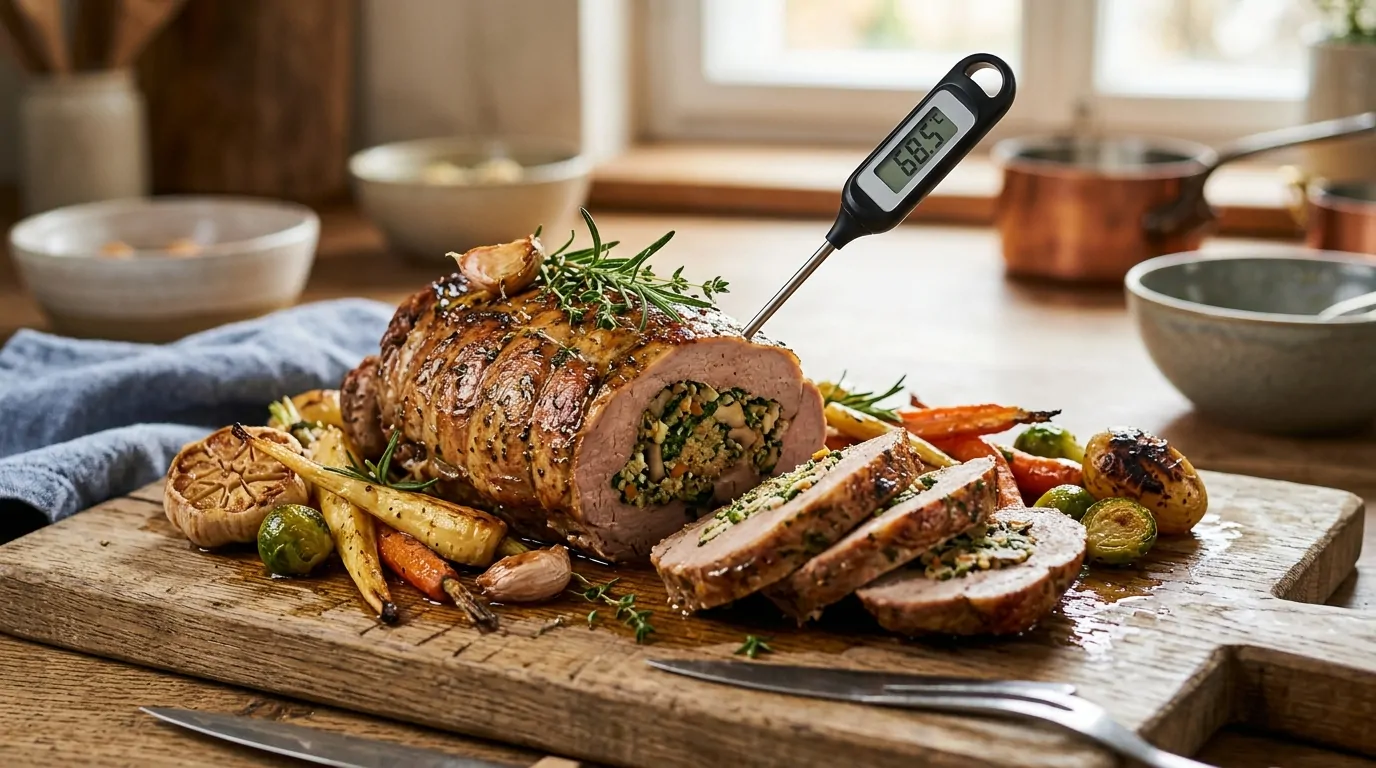
In short
A stuffed veal roast is an impressive dish, but it can also hold some unpleasant surprises.
If it's overcooked, the meat becomes dry. If it's undercooked, the stuffing stays cold in the center.
The cooking time for a stuffed veal roast depends on several factors: the weight, the stuffing, the oven temperature.
Our guide gives you all the keys to mastering cooking from A to Z, with a precise chart, the right temperatures and the right reflexes to adopt.
Cooking time for a stuffed veal roast according to weight
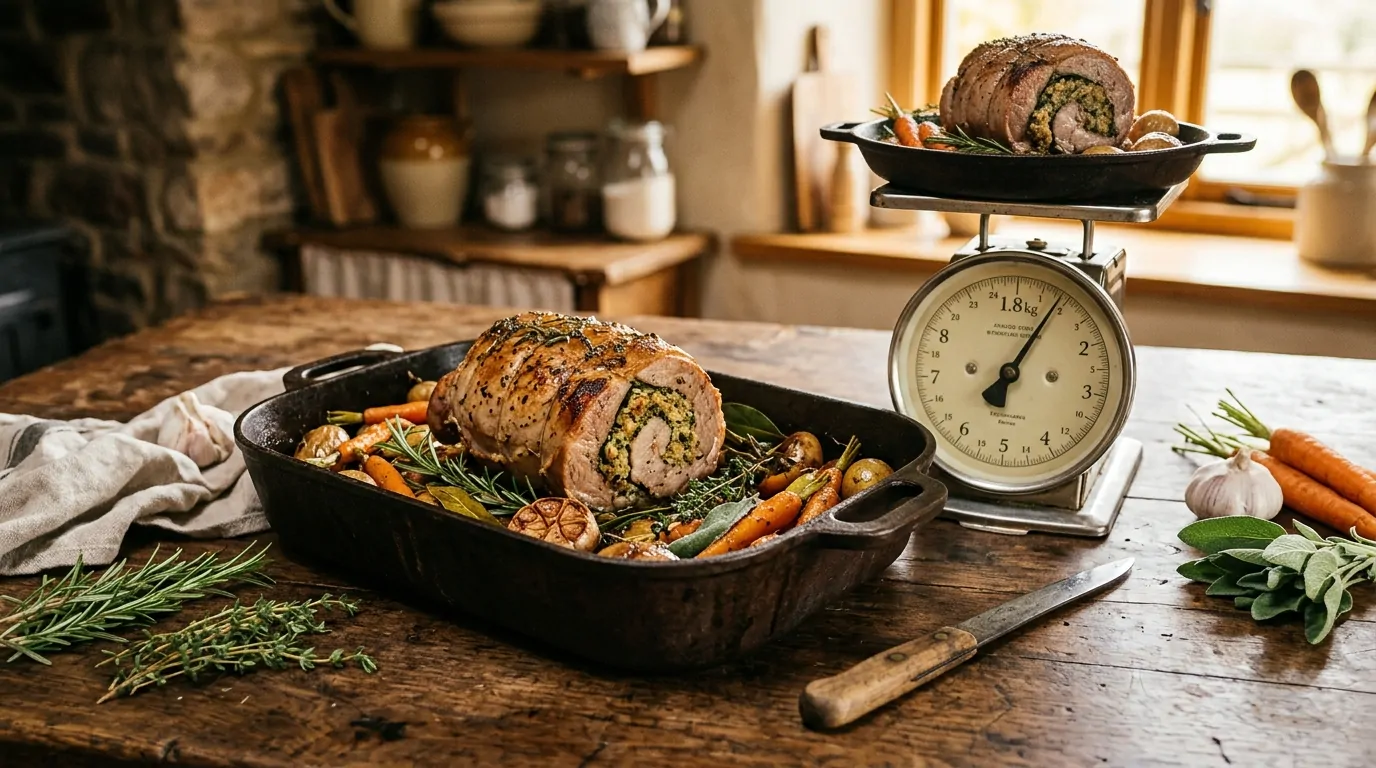
Weight is the first variable to consider. A stuffed roast cooks more slowly than a regular roast because the stuffing in the center takes longer to heat up.
The basic rule is: 20 to 25 minutes of cooking per 500g, oven preheated to 180°C.
This estimate remains a starting point. The cooking thermometer is the final arbiter.
Precise cooking chart based on the weight of the roast
Here is a reference table for the cooking time of stuffed veal roast in the oven at 180°C, using conventional cooking methods:
| Weight of the roast | Estimated duration | Target internal temperature |
|---|---|---|
| 500 g | 20 to 25 min | 65–70 °C |
| 1 kg | 40 to 50 min | 65–72 °C |
| 1.5 kg | 60 to 75 min | 68–75 °C |
| 2 kg | 80 to 95 min | 70–75 °C |
These times are valid for a fan-assisted oven. With a conventional oven, add approximately 10% more time.
Calculating the cooking time for a stuffed veal roast
To calculate the cooking time for your stuffed veal roast, multiply the weight in grams by 0.05. The result gives you the time in minutes (at 180°C).
Example: a 1.2 kg roast = 1200 × 0.05 = approximately 60 minutes. You can also use our kitchen conversion charts if you need to convert between units to weigh your item.
This formula remains a basic guideline. A roast stuffed with a dense preparation (sausage meat, vegetables) will always require a few extra minutes.
🍖 Cooking Calculator — Stuffed Veal Roast
Get the cooking time, temperature and tips tailored to your roast.
The ideal temperature for cooking a stuffed veal roast
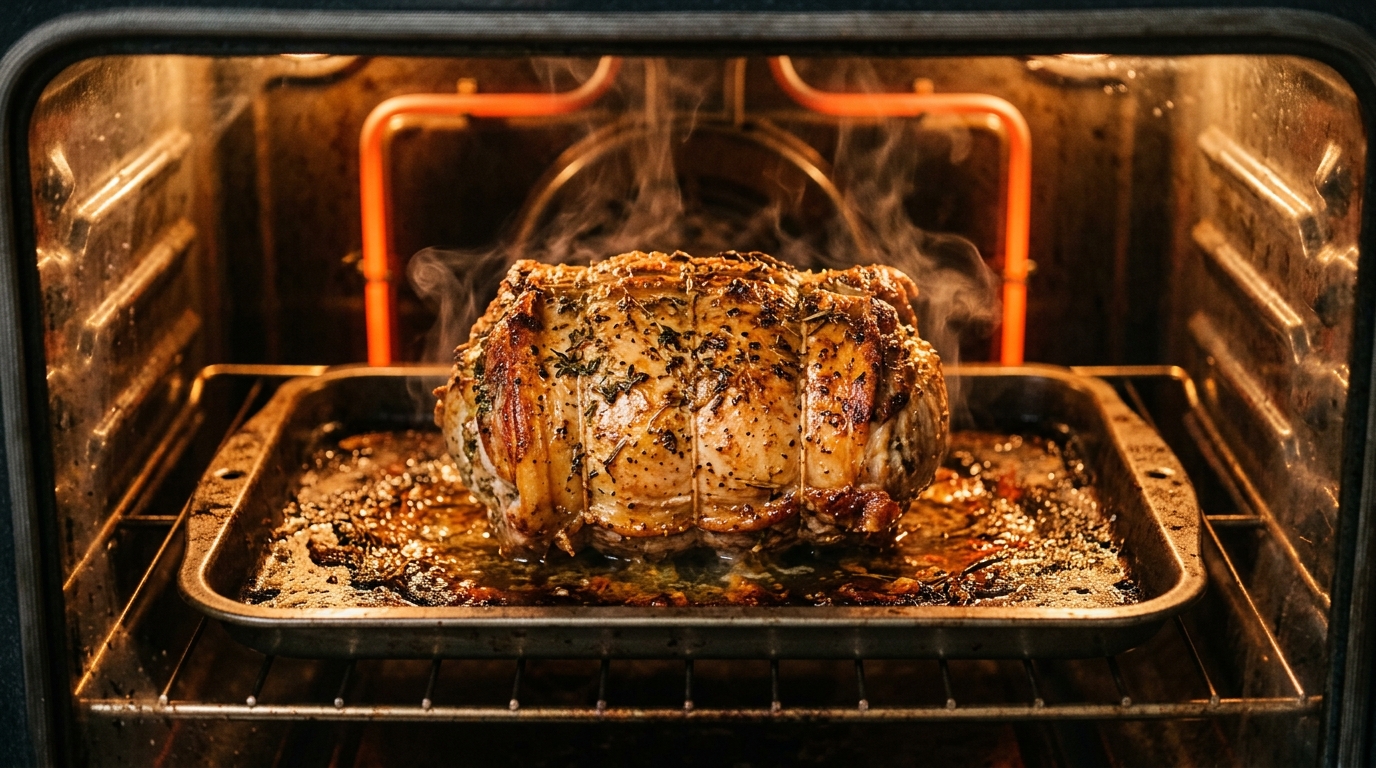
The oven temperature directly affects the final result. Too hot, and the meat dries out. Too low, and it takes too long to cook.
For a tender stuffed veal roast, you need to find the right balance from the start.
Oven temperature: starting hot or low temperature?
There are two approaches. The most common: preheat the oven to 220°C, put the roast in the oven for 10 minutes to sear it, then lower it to 170–180°C to finish cooking.
This seals in the juices and colors the meat.
The second option, low-temperature cooking, involves cooking at 130–150 °C for a much longer period.
The meat remains juicy, but you have to plan ahead, because a 1 kg roast can take almost 2 hours.
As with the cooking time of a filet mignon in the oven, the low temperature rewards being patient.
The target internal temperature depends on the desired cooking method
This is where the thermometer becomes your best friend.
The internal temperature of the stuffed veal roast varies depending on the desired result:
- Rare (stuffed veal roast cooked rare) : 63–65 °C at the core
- Perfected : 68–70 °C
- Cooked thoroughly : 72–75 °C
Note: Stuffed veal is not eaten rare like beef. The stuffing must always reach a minimum temperature of 65°C to be safe, even if the meat remains pink.
The cooking thermometer for a successful stuffed veal roast
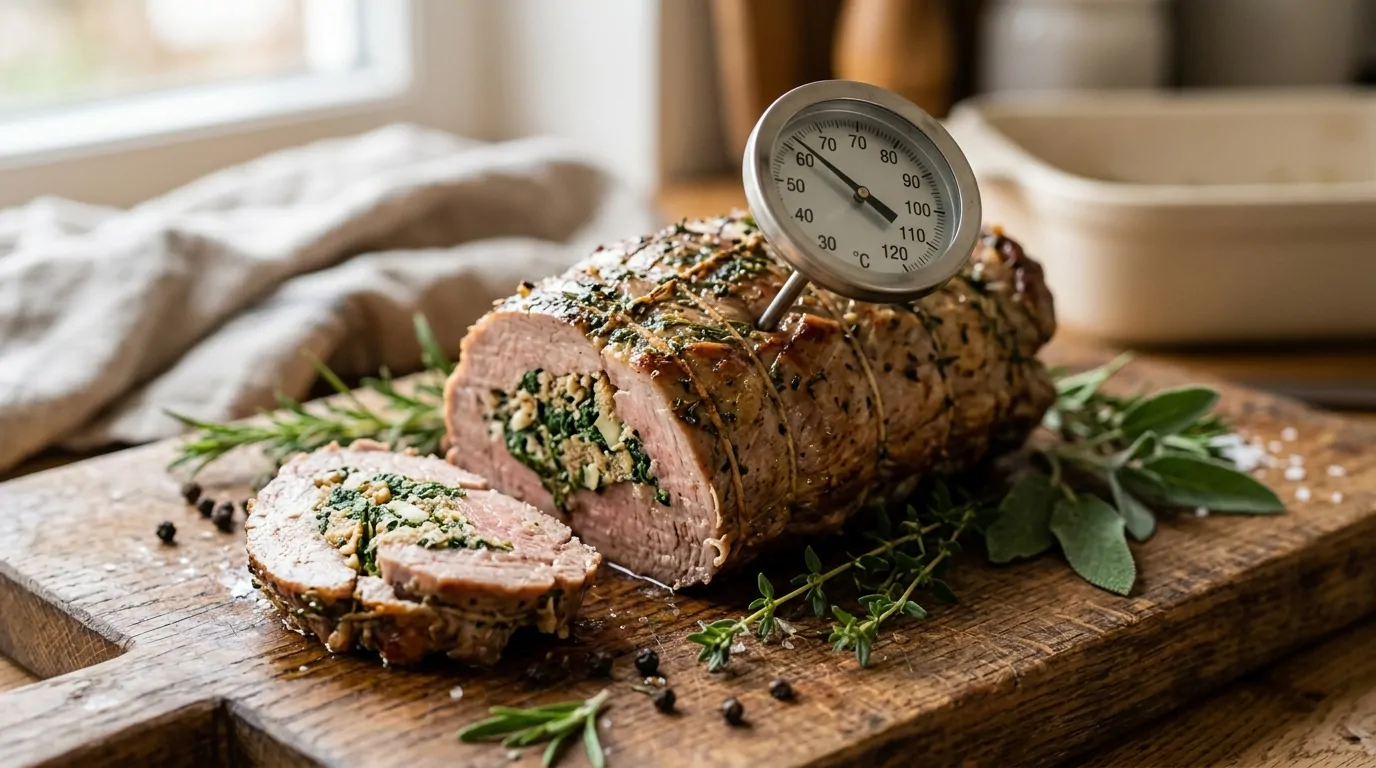
Monitoring the color or piercing the meat with a knife is a gamble.
A cooking thermometer used for a stuffed veal roast is the tool that eliminates doubt. It adapts to all ovens, all stuffings, and all weights!
- Precise result regardless of weight
- Avoid overcooking or undercooking
- Works for all pranks
- Usable with any oven
- Requires purchase if you don't already have one
- When positioned incorrectly, it gives a false measurement
- Basic models may lack precision
How do I place the thermometer in the stuffed roast?
The probe should be inserted into the center of the roast, that is, at the geometric center of the piece. It should not be too close to the surface, nor directly into the stuffing if it is concentrated on one side.
Insert the probe into the thickest part, tilting it slightly to reach the center.
Avoid touching the kitchen twine or a compact stuffing bag: this would distort the reading.
If your roast is long and thin, take the temperature in two different places. The lowest reading is the one that counts.
When is it cooked and what are the good indicators to watch for?
Internal temperature remains the primary criterion for determining when a stuffed veal roast is cooked correctly.
But other signs can confirm it, such as:
- The juices that flow out are clear or slightly pink, never red or bloody.
- The meat shrinks slightly around the string
- A wooden skewer that comes out hot to the touch after 5 seconds in the center of the roast
Oven roasting always follows the same logic: precision comes from measurement, not from an estimate by sight.
🍖 Are you an expert on cooking stuffed veal roast?
5 questions to check that you have everything you need to make this dish perfectly.
1. How long does it take, on average, to cook a 1 kg stuffed veal roast in the oven?
2. What oven temperature is generally recommended for cooking a stuffed veal roast?
3. What core temperature must a stuffed veal roast reach to be perfectly cooked and safe for consumption?
4. Why is it important to let the stuffed veal roast rest after cooking?
5. What impact does a stuffing containing raw pork have on the cooking time of a stuffed veal roast?
Resting and variations of the stuffing after cooking
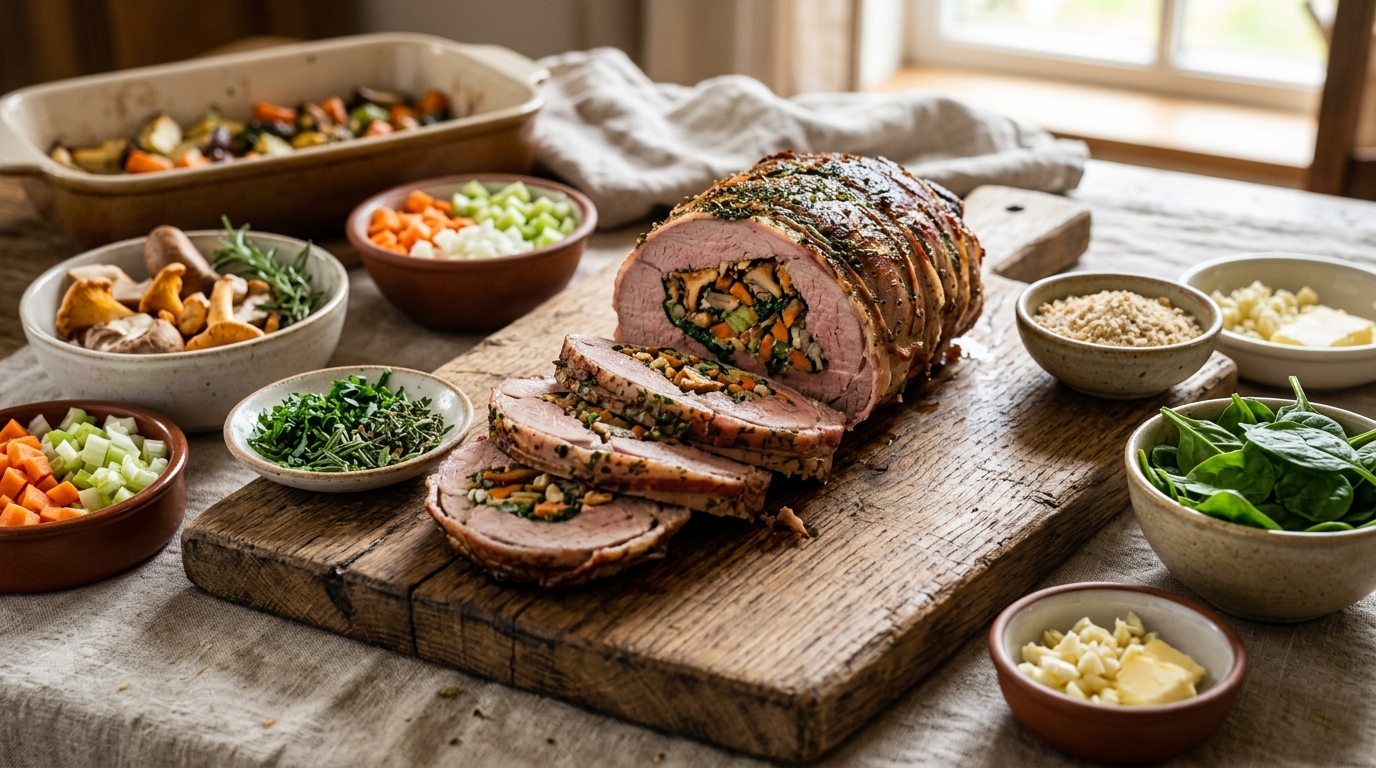
Be careful that the cooking doesn't stop when you turn off the oven! Also, the resting time and the composition of the stuffing play a direct role in the final result of your dish.
Why does resting time make roast meat more tender?
Taking the roast out of the oven and carving it immediately is the biggest mistake. When it comes out of the oven, the meat fibers contract from the heat. The juices are concentrated in the center.
Letting the roast rest for 10 to 15 minutes under a sheet of aluminum foilallows the fibers to relax and the juices to redistribute. The meat will be much more tender when sliced!
Use the resting time to prepare your sauce or deglaze the drip pan. Nothing goes to waste.
The influence of the type of stuffing on cooking time
Not all pranks behave the same way.
A stuffing made with sausage meat or minced veal (rich in protein) takes longer to heat up than a stuffing made with mushrooms or herbs.
Here are some practical guidelines:
- For stuffing with pork or minced veal : add 5 to 10 minutes to the basic cooking time
- Vegetable and herb stuffing : standard cooking time without addition
- Wet filling (ricotta, spinach) : may slightly lengthen cooking time, monitor internal temperature
If you like elaborate variations, our Orloff veal roast recipe is a great example of a stuffed roast with a filling layered between slices — a technique that also slightly alters the cooking time.
Practical questions
How long should you cook a 1 kg stuffed veal roast?
For a 1 kg stuffed veal roast, allow 40 to 50 minutes in a 180°C (350°F) convection oven. The internal temperature should reach 68 to 72°C (154 to 162°F) depending on the desired doneness. A meat thermometer remains the most reliable method.
What internal temperature should a stuffed veal roast reach to be cooked?
The internal temperature of a stuffed veal roast should be at least 65°C for rare, 68–70°C for medium, and 72–75°C for well-done. The stuffing, regardless of its composition, must always exceed 65°C for food safety reasons.
How can you tell if a stuffed veal roast is cooked without a thermometer?
Without a thermometer, pierce the center of the roast with a thin skewer: if it comes out hot after 5 seconds, the stuffing is cooked. The juices that run out should be clear or slightly pink. These are approximate indicators; a cooking thermometer is highly recommended for reliable results.
Can a stuffed veal roast be cooked at a low temperature?
Yes, low-temperature cooking (130–150 °C) produces a very tender and evenly cooked stuffed veal roast. Allow approximately 1.5 to 2 hours for a 1 kg roast. This method is more time-consuming but more forgiving of oversights.
Why is the stuffed veal roast dry after cooking?
A dry, stuffed veal roast is most often the result of overcooking (exceeding the internal temperature) or using an oven that is too hot without basting. Carving the meat without letting it rest also exacerbates the problem. To avoid this: respect the target internal temperature and always let it rest for 10 to 15 minutes under foil before slicing.
