
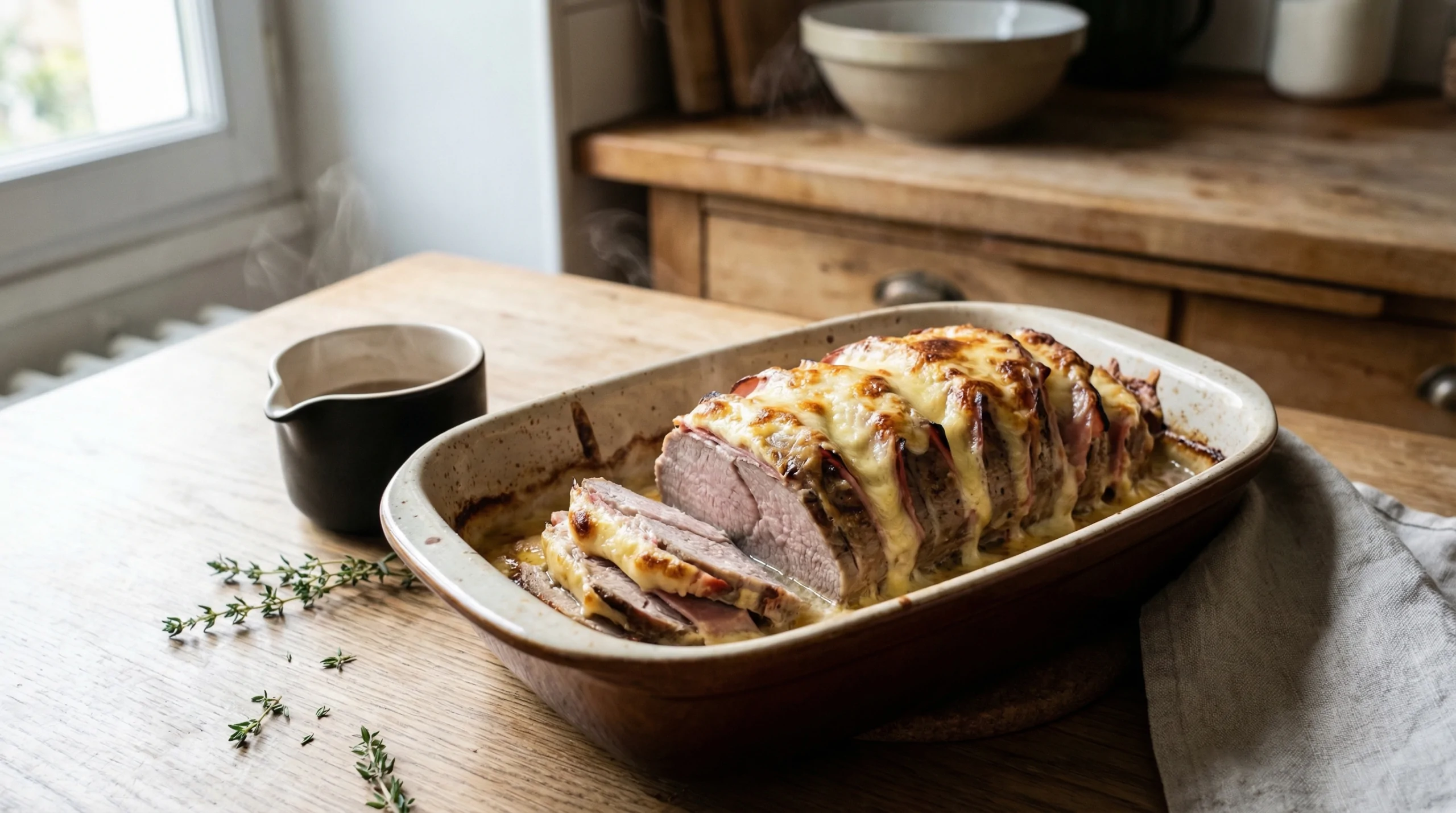
I have a soft spot for Orloff roast: it's the kind of "Sunday" dish that doesn't require complicated equipment, but immediately looks amazing when you slice it!
The first time I made it, I got the hang of it: it's not a joke, it's a roast sliced like an accordion, which you then stuff with ham and cheese. The result: the meat stays moist, the cheese melts and browns in the oven, and each slice arrives already "assembled".
In my traditional version, I stick to the basics: roast veal, cooked ham, Emmental (or Comté), a little mustard to add depth, and oven cooking with a base of white wine + stock.
The sauce practically makes itself: deglaze, scrape up the browned bits, let it reduce, and finish with a touch of cream. Nothing complicated, just the right techniques!
Since we are cooking for a fairly short time (to stay under an hour), I advise you to cook a roast that is not too big and especially not to cut all the way through: you have to keep the base intact so that everything holds together.
And to slip in a little "seasonal" touch without betraying the dish, I add mushrooms and a little onion to the dish: it perfumes the juice, it can be served on the side, and it makes an express side dish.
On the plate, you have a protein-rich dish, and if you serve it with green beans or a salad, the balance is perfect. And the next day, the cold leftovers in a sandwich… that's practically a bonus included in the recipe!
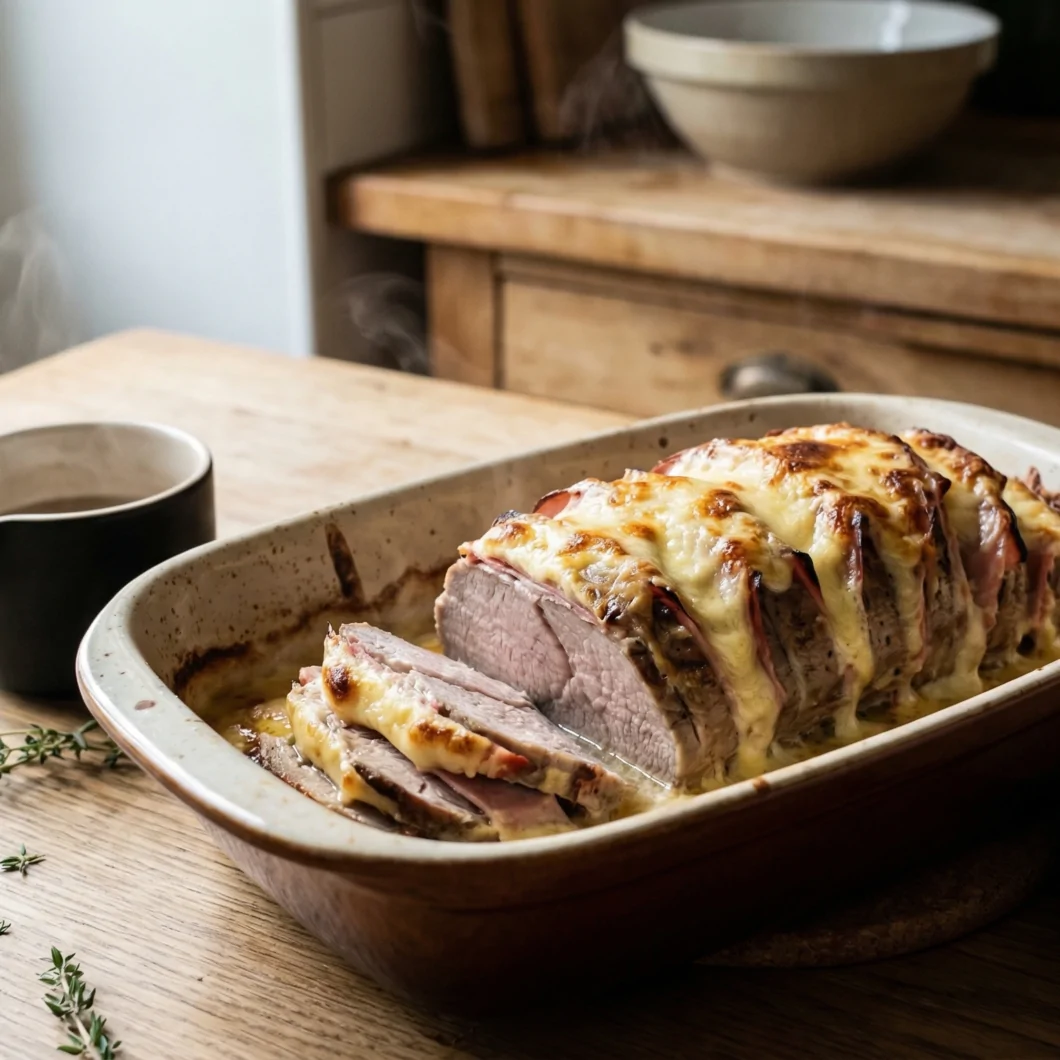

Orloff roast in the oven
4
people23
minutes35
minutes676
kcal58
minutesA recipe for Orloff roast veal , sliced accordion-style, stuffed with ham and cheese, then roasted in the oven with a light white wine sauce. It's meltingly tender, golden brown, and the way it's carved always makes a great impression at the table.
Keep your device's screen on
Ingredients
800g of veal roast (top round or sirloin tip, tied )
8 thin slices of cooked ham (approx. 20g per slice)
8 slices of Emmental cheese (approx. 20g per slice)
1 onion (approx. 120g each), sliced
200g of button mushrooms, sliced
2 garlic cloves, chopped
2 tablespoons of Dijon mustard (approx. 15g per tablespoon)
20g of butter
1 tablespoon of neutral oil (approx. 10g per tsp)
120 ml of dry white wine
120 ml of chicken stock
80 ml of whole cream (or thinned thick cream)
1 teaspoon of thyme (or 2 sprigs, multiply as needed)
Fine salt, freshly ground pepper
Preparation steps
- Preheat the oven to 200°C (fan oven if possible). Take the roast out of the refrigerator 10 minutes beforehand so that it is not glazed.
- With a long, sharp knife, make 1.5 to 2cm slices in the roast, without cutting all the way through: leave 1 to 2cm at the base so that the roast remains “accordion-style”.
- Lightly salt the outside (the ham and cheese are already salted), pepper, then brush the mustard into the slits and a little on top.
- Slide half a slice of folded ham into each notch, then a slice of cheese (adjust according to the thickness: the goal is for it to fill without forcing).
- Tie it lightly again if needed (one or two turns of string) to hold everything securely during cooking.
- In a Dutch oven (or roasting tin), heat the oil and butter. Sear the roast for 2 to 3 minutes per side to brown it well.
- Push the roast to the center, add the onion, mushrooms and garlic around it. Sauté for 3 minutes, stirring to coat them in the juices.
- Pour in the white wine and scrape the bottom with a spatula to loosen the browned bits. Add the stock and thyme.
- Bake for 25 minutes. Halfway through cooking, baste the roast with the pan juices.
- Take the dish out, add the cream to the juice, mix quickly, then put it back in the oven for 7 minutes so that it lightly coats and the top browns.
- Let the roast rest for 5 minutes outside the oven (important: the juices redistribute). Remove the string, slice along the cuts and serve with the mushroom sauce.
📊 Nutritional Information
1 serving (approx. 340g)
| Nutrient | Value |
|---|---|
| Calories | 676 kcal |
| Proteins | 72g |
| Carbohydrates | 9g |
| including sugars | 4g |
| Lipids | 36g |
| including saturated fatty acids | 17g |
| Fibers | 2g |
| Sodium | 1380mg |
| Vitamins | |
| Vitamin B12 | 120% of the recommended daily allowance (RDA) |
| Vitamin B3 | 85% of the recommended daily allowance (RDA) |
| Vitamin B2 | 40% AJR |
| Minerals | |
| Phosphorus | 75% of the recommended daily allowance (RDA) |
| Zinc | 55% AJR |
| Selenium | 70% of the recommended daily allowance (RDA) |
* RDA = Recommended Daily Allowance
📝 Notes
Allergens: milk (cheese, cream), mustard. To avoid the sauce on the Orloff roast being too salty, taste before adding more salt: between the ham, cheese and broth, it adds up quickly.
💡 Chef's Tips
For a clean Orloff when sliced, don't cut all the way to the board when you make the incision: leave a "hinge" of meat. And if the cheese threatens to escape, a little extra string tie will solve the problem.
🔄 Variations
For a stronger cheese recipe: replace the Emmental with Comté for a more pronounced taste, without changing the spirit of the roast.
- Orloff with a richer sauce: add 1 teaspoon of tomato paste when deglazing, just to round out the sauce.

I added an extra turn of string as advised to hold the cheese in place, but with a fairly thick roast it wasn't enough, some of it leaked into the dish at the end of cooking.
Hi Anne-Marie, that does happen when the roast is quite thick: the joint is under more stress in the oven, and a single turn of string isn't always enough to contain the melted cheese. The trick that makes all the difference is a tight double turn, both in the middle and on each slice, rather than a single turn all the way around. And even if a little cheese escapes, it caramelizes in the juices and is easily absorbed by the sauce, so nothing is wasted.
The double turn seems logical, but I'm afraid it will tighten the meat too much and prevent it from cooking properly through.