
Each year, hands are involved in nearly 30% of workplace accidents resulting in lost time in France (source: INRS). Yet, in the garage or in the garden, we grab the first gloves we find, or worse, we don't wear any at all!
Material, thickness, resistance level: here are the 4 concrete points to choose gloves suitable for your work and DIY projects, without getting lost in the standards.
follow the leader
1. For what tasks do you really need gloves?
It all depends on the actual risk. Light sanding doesn't require the same equipment as cutting with a utility knife or handling chemicals.
Three common situations at home:
- Gardening and pruning work : cuts on stems, thorns, sharp tools — moderate to high mechanical risk
- DIY (furniture assembly, screwing, drilling): abrasion, heat, sharp edges — low to moderate risk
- Painting or wood treatment work : prolonged contact with solvents, stains, glues — a chemical risk not to be underestimated
In each of these cases, the right glove isn't necessarily the thickest; it's the one that preserves dexterity while providing adequate protection. A glove that's too stiff is guaranteed to be removed after ten minutes!
2. Actual risks and what the standards say
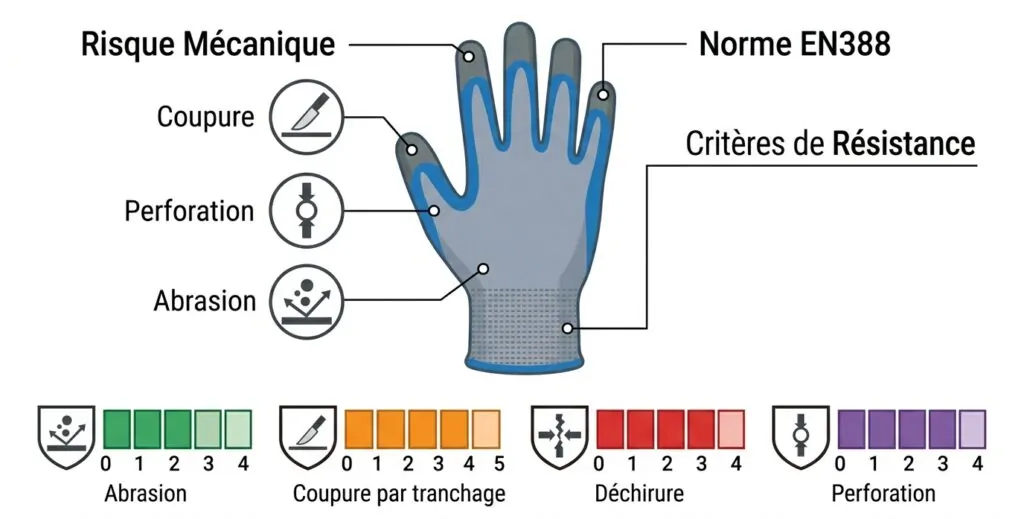
Mechanical risks – cuts, punctures, abrasions – are the most common in DIY projects . They are addressed by the EN388 standard, which tests gloves on four criteria rated from 0 to 4: abrasion resistance, blade cut resistance, tear resistance, and puncture resistance.
For work involving aggressive household products (drain cleaners, strippers), the EN374 standard comes into play: it qualifies the resistance to penetration and permeation of chemical agents.
In the workplace, the French Labor Code (article R.4321-4) requires employers to provide appropriate personal protective equipment (PPE). For the DIY enthusiast, this is simply common sense and a way to prevent cuts.
3. The consequences of poor equipment
An ill-fitting glove is often worse than a false economy!
In France, accidents involving the hands account for approximately 1 in 3 work accidents resulting in lost time, according to INRS data, with consequences ranging from simple cuts to tendon ruptures.
On a human level: pain, inactivity, sometimes lengthy rehabilitation. On an economic level for a professional or tradesperson: lost days, medical care, potential liability issues.
And at home? Accidents avoided thanks to proper equipment don't make the statistics, but they represent fewer stitches, fewer emergencies and fewer weeks of discomfort.
4. How to choose: the right criteria in the right order
Here's a simple method to avoid making a mistake:
What you need to check
- The type of risk: Mechanical, chemical, thermal, or mixed
- Applicable standards: EN388 (mechanical), EN374 (chemical), EN407 (thermal)
- Materials: Nitrile (chemical + mechanical), leather (abrasion), latex (lightness), Kevlar (cut-resistant), etc.
- The index level: Read the pictogram + the numbers on the glove label
- The precision of the work: Thickness and tactile sensitivity according to the required accuracy
For versatile DIY tasks, a textile glove coated with nitrile or latex covers the majority of common uses.
For cutting or handling sharp materials, opt for cut-resistant gloves with a level C or D rating (new EN388:2016). For handling chemicals, nitrile gloves offer a broad spectrum of protection.
In summary: the best glove is the one you keep!
Choosing protective gloves for your work and DIY projects means first identifying the risk, then finding the balance between protection and comfort. A glove that is removed due to discomfort no longer protects anyone.
A practical tip often overlooked: check the size, because a glove that's too big will slip and reduce dexterity; one that's too tight will tire your hand and cause cramps. Most brands offer sizes S to XL, so take the time to choose.
And if you have to remember one thing: the EN388 standard is your compass for any mechanical risk. The rest is a matter of use and construction experience.
Do you know what risk you are most underestimating in your workshop?
