
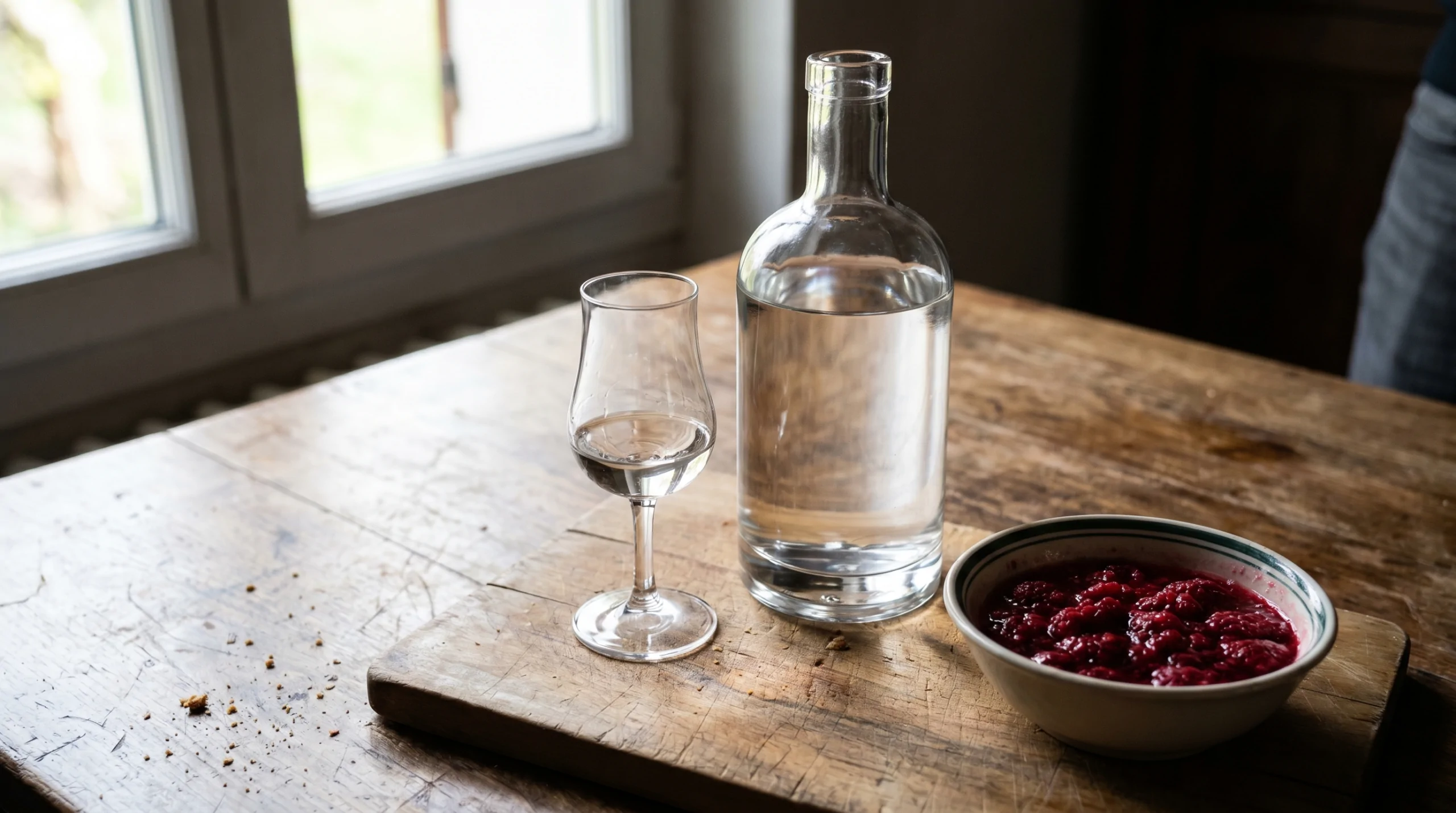
The first time I smelled a real raspberry eau-de-vie, I understood why it's sometimes called the "spirit" of the fruit. It's lively, precise, almost floral, and it has nothing to do with a sweet liqueur.
In this traditional recipe, you start with ripe raspberries, let them macerate for a while, then distill them, making clean cuts (heads, hearts, stems). This is what gives the spirit a clean, pure alcohol, without any solvent notes or heaviness.
Here's a simple, family-made method. The key is patience and attention to detail: a good jar, quality neutral alcohol for extracting the aromas, and then a gentle distillation. Above all, the reduction (adding water) is done slowly, in small increments, so as not to "break" the fragrance.
As for seasonality, here's a classic tip: lightly flavor with a little lemon zest and a touch of vanilla. It shouldn't overpower the other flavors, just round them out and add some depth. If you prefer bolder eaux-de-vie, use a light hand.
One last important point: distilling alcohol is regulated and may be prohibited without a permit depending on your country/region. I describe the traditional recipe for culinary and cultural purposes; check local laws before you begin.
If distillation is not possible for you, maceration alone already gives a very fragrant base, but it will no longer be a brandy in the strict sense!

Raspberry brandy
4
people22
minutes34
minutes116
kcal56
minutesA recipe for an old-fashioned, fragrant, and clean raspberry brandy , obtained through maceration and then distillation. Here, I explain the traditional method and the steps that produce a pure brandy, without any "cooked" taste or bitterness.
Keep your device's screen on
Ingredients
800g of very ripe raspberries
70 cl of 96° neutral alcohol (fruit alcohol, food grade, in accordance with regulations)
250 ml of spring water (for the reduction, adjust as needed)
1 Organic lemon (thinly peeled, without the white pith)
1/2 vanilla pod
1 pinch of fine salt (optional, to round it out)
Preparation steps
- Sort the raspberries: remove any damaged fruit. Do not wash them under water (this will dilute the flavor); if necessary, dry them gently.
- Roughly crush the raspberries in a large, clean jar (1.5 to 2L). The goal is not to make a smooth puree, just to break up the fruit.
- Add the very finely grated lemon zest (without the white pith) and the split vanilla bean. Pour in the neutral alcohol. Close.
- Let it macerate for 7 to 14 days away from light, at room temperature. Gently shake the jar once a day for the first 3 days, then leave it alone. You should smell a clear raspberry aroma, without any jammy notes. Remove the vanilla after 48 hours to prevent it from becoming overpowering.
- Filter first through a chinois sieve, then a second time through a coffee filter or cheesecloth. Take your time: the clearer the liquid, the cleaner the distillation will be.
- Distillation (if legally permitted): Pour the filtered maceration into a clean still. Heat gently. Discard the "heads" (the first few milliliters): they smell of solvent and are unsuitable. Keep the "heart" as long as the aroma remains clear and fruity. When it becomes heavier, vegetal, or the alcohol content drops significantly, you've reached the "tails": stop collecting the heart.
- Let the distillate (the heart) rest for 24 hours, with the stopper in place but not airtight if possible, to allow the most volatile notes to dissipate.
- Reduction: Measure the degree if you can. Add the spring water in small amounts (for example, 20–30 ml at a time), stirring, until you reach approximately 45° (or 40° if you prefer it softer). A pinch of fine salt can round it out, but be subtle.
- Bottling: Bottle in a clean bottle. Let it "marry" for at least 2 weeks (ideally 1 to 2 months) before tasting. Serve chilled, in a small glass, or use in cooking (baba, fruit salad, flambé).
📊 Nutritional Information
1 serving (approx. 50ml)
| Nutrient | Value |
|---|---|
| Calories | 116 kcal |
| Proteins | 0g |
| Carbohydrates | 0.4g |
| including sugars | 0.4g |
| Lipids | 0g |
| including saturated fatty acids | 0g |
| Fibers | 0g |
| Sodium | 1mg |
| Vitamins | |
| Vitamin C | 1% AJR |
| Vitamin B9 | 0% AJR |
| Vitamin E | 0% AJR |
| Minerals | |
| Potassium | 0% AJR |
| Magnesium | 0% AJR |
| Iron | 0% AJR |
* RDA = Recommended Daily Allowance
📝 Notes
Safety/Legality: Distilling alcohol may be strictly regulated or prohibited without authorization. Be informed and respect the law. Tasting: This is a strong spirit; serve in small quantities. Excessive alcohol consumption is dangerous to your health.
💡 Chef's Tips
For a purer flavor, use very ripe, but not crushed, raspberries for your liqueur. The lemon zest should be microscopic: too much zest and it will overpower the citrus flavor.
When reducing, proceed slowly: adding water too quickly can cloud and "close off" the aromas.
🔄 Variations
- No variations: this is the traditional raspberry brandy recipe (maceration followed by distillation and reduction), and you can embellish it afterward. But, you don't mess with the family jewels 🙂

I left my raspberries to macerate for six weeks without distilling them, due to the lack of a still at home, and the aroma was already close to the real product even if the alcohol is obviously lighter.
Hello Odilia, six weeks is indeed a good amount of time to properly extract the raspberry aroma. Without distillation, you retain the strength of the original alcohol, making it milder than true brandy, but the fruity aroma you describe is exactly what we're looking for at this stage. It's a lovely way to enjoy the recipe even without a still.