
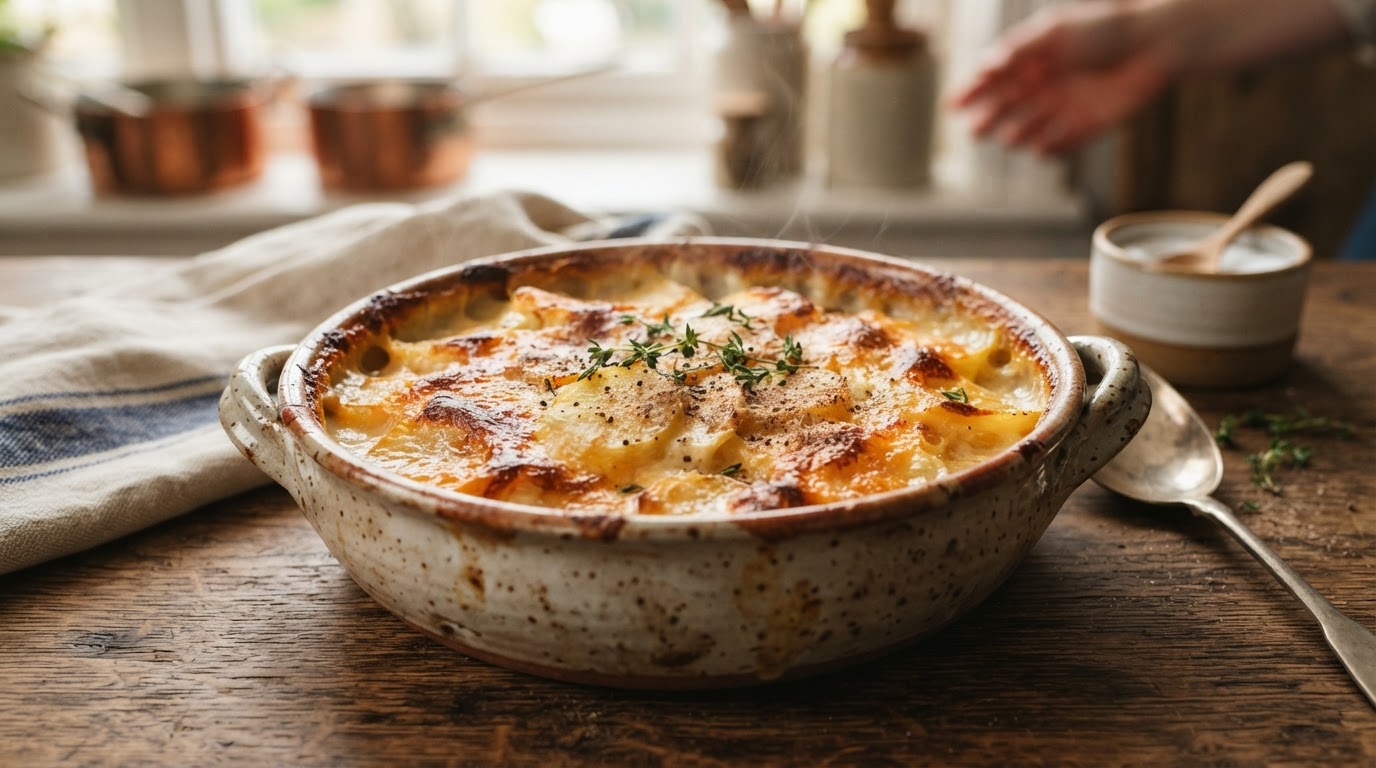
A true old-fashioned gratin dauphinois is made with potatoes, whole milk, cream, garlic and a little butter, without cheese or egg, cooked gently in the oven, around 160°C for 1 hour 30 minutes, with a final pass at 180°C to brown the top.
Everyone knows gratin dauphinois, but not all online recipes respect the original version. Some add Gruyère cheese, eggs, or béchamel sauce, and the dish loses what makes it unique: a creamy coating, melting potatoes, and a barely golden top.
Here's the complete method, with quantities for 4 to 6 people, potato selection tips, and techniques to avoid a runny or dry gratin. The recipes consulted don't always agree: we explain why, and what to remember.
What distinguishes a traditional gratin dauphinois from modern versions
The base is short. According to 24matins (June 14, 2026), the recipe consists of a few ingredients: potatoes, cream, garlic, salt and pepper, with butter and a little nutmeg as an option.
Cheese and eggs have no place in it. According to Consoglobe (November 2024), there are actually two distinct recipes: the traditional gratin (milk, cream, butter) and a version with eggs and 180g of grated cheese, which makes a different dish.
This fundamental difference explains the taste. Without cheese to mask the cream, everything relies on the quality of the potatoes and the slow cooking time.
Ingredients and quantities for 4 to 6 people
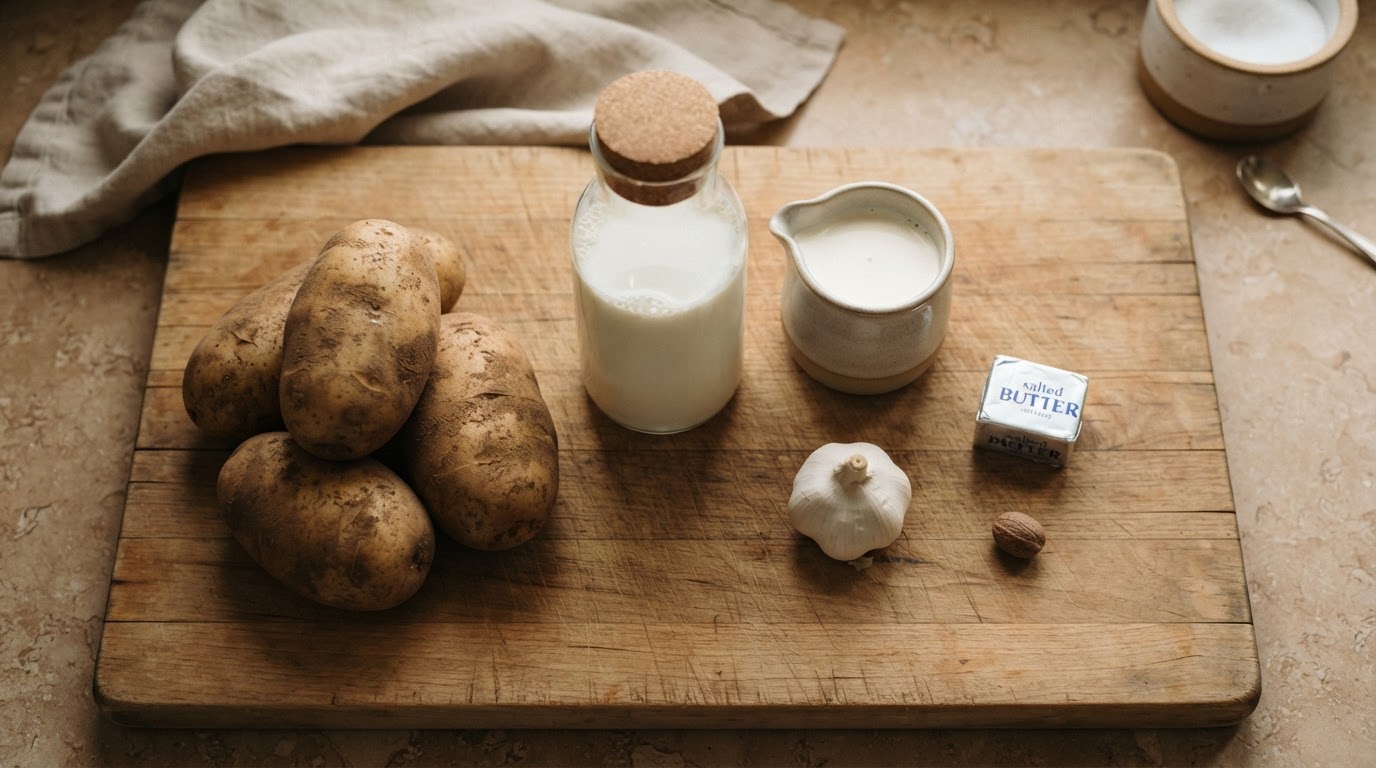
Here are the proportions used, based on recipes closest to the traditional version:
- 1 kg of potatoes
- 50 cl of whole milk
- 50 cl of full liquid cream
- 1 clove of garlic
- 20g of butter for the dish
- salt, pepper and, if you like, a pinch of nutmeg
These quantities remain close to those of Cuisine Culinaire (February 2021), which suggests 1.2 kg of potatoes for 500 ml of milk and 500 ml of cream, and of Mon séjour en montagne (September 2023, reprinted from Dauphiné Libéré), which uses 800 g of potatoes with equal parts of whole milk and cream.
Be sure to use whole milk: according to Marie Food Tips (April 2023), semi-skimmed milk makes the gratin watery. The same logic applies to the cream; choose whole rather than light.
Which potatoes should I choose?
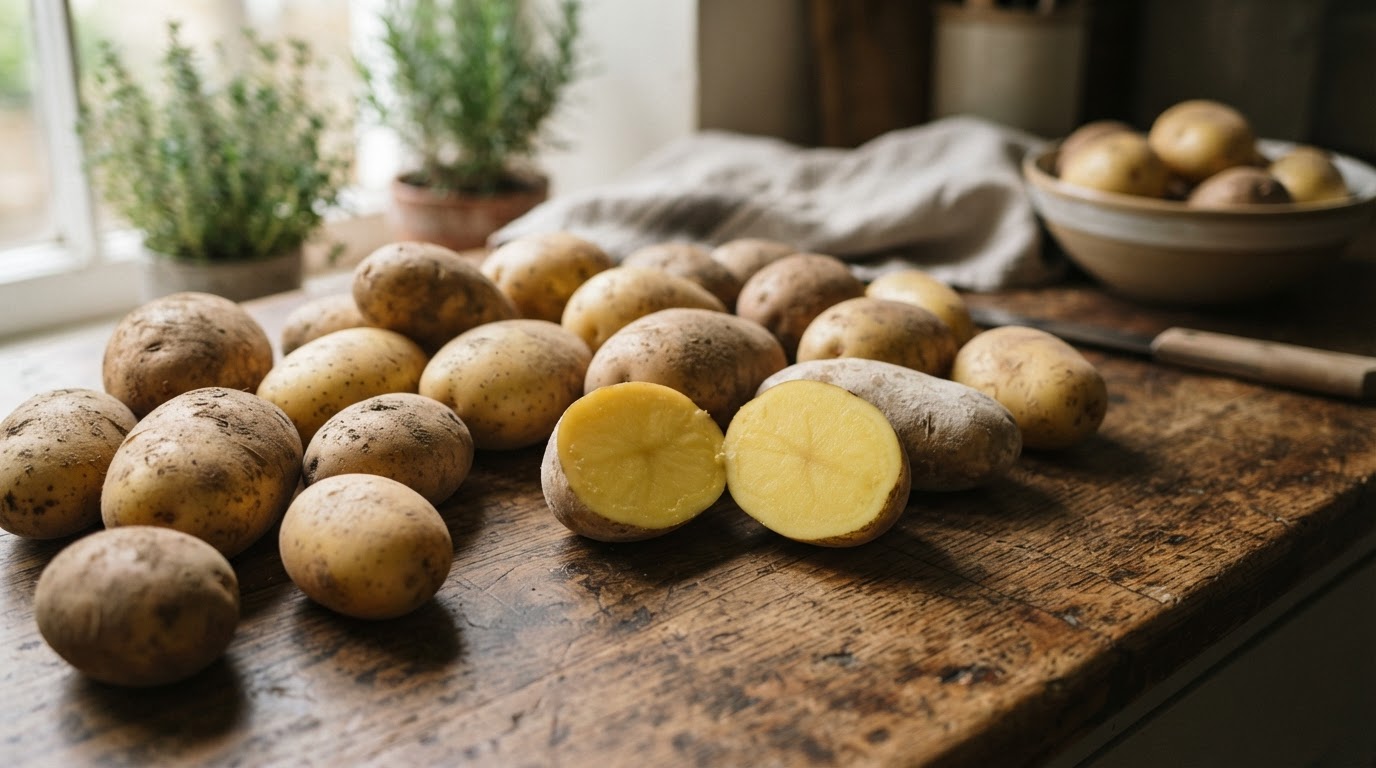
The flesh needs to hold its shape during cooking while releasing enough starch to bind the cream. For 24matins (June 14, 2026), it's best to choose varieties that are both firm and melt-in-your-mouth (Charlotte, Roseval, Belle de Fontenay, Amandine, Pompadour).
Cuisine Culinaire (February 2021) distinguishes between two families: floury potatoes like Bintje, which thicken cream, and yellow-fleshed potatoes like Charlotte, Ratte, or Agata, which are more flavorful. Marie Food Tips (April 2023) also features Belle de Fontenay and Amandine.
Do not rinse the slices after cutting them: the surface starch thickens the cream.
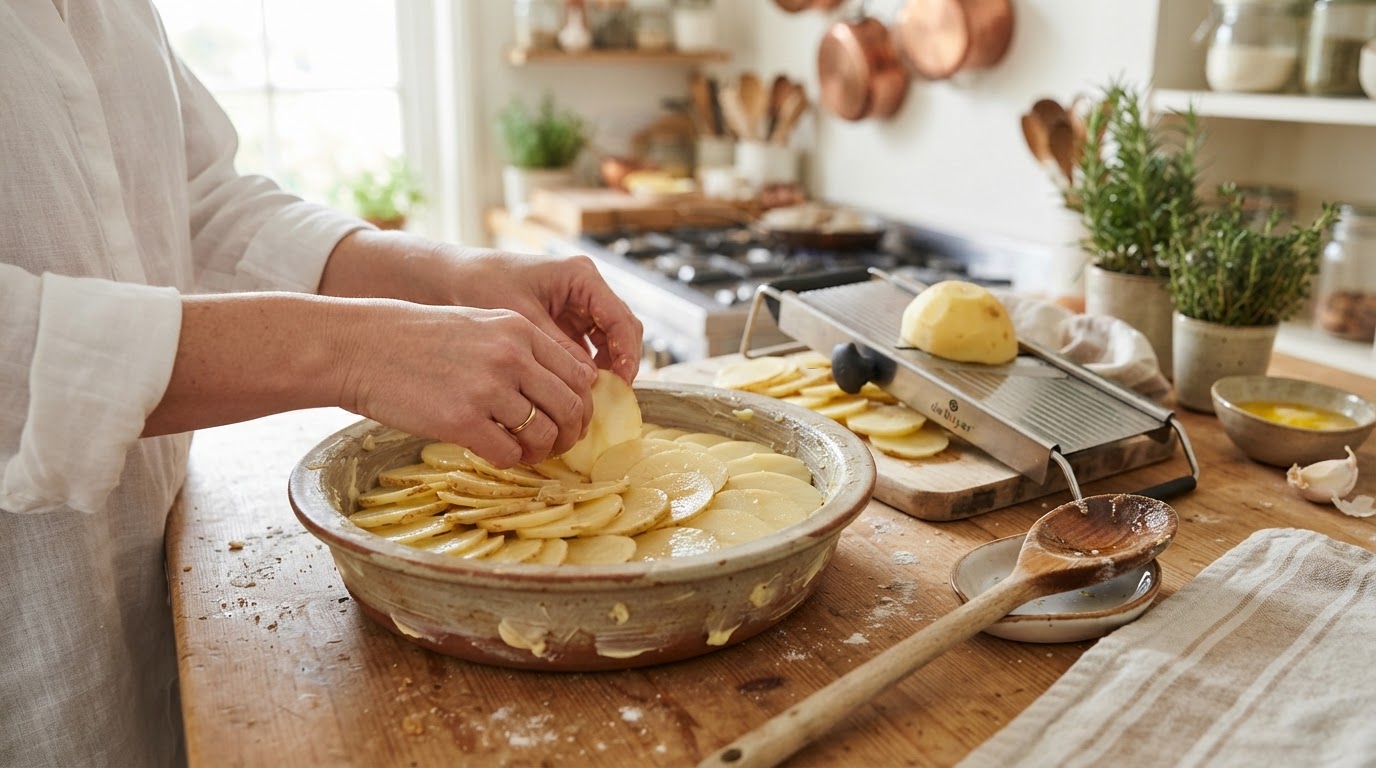
Slice them into rounds 2 to 3 mm thick, preferably using a mandoline. Irregular slices cook unevenly and may leave pieces still firm when they come out of the oven.
The step-by-step recipe
- Preheat the oven to 160°C using the fan setting.
- Rub the dish with the garlic clove, then butter it generously.
- Peel the potatoes and cut them into 2-3 mm slices, without rinsing them.
- Mix the milk and cream with the salt, pepper and, if you wish, the nutmeg.
- Arrange the slices in tight layers in the dish, then pour the mixture over them until it reaches the top.
- Bake for 1 hour 30 minutes. After one hour, cover with aluminum foil if the top is browning too quickly.
- Increase the temperature to 180°C for the last half hour to brown the surface.
- Check with the tip of a knife: it should slide in easily. Let it rest for 5 minutes before serving.
This procedure follows the method of Marie Food Tips (April 2023) (160°C then 180°C at the end of cooking). The 5-minute resting time comes from Cuisine Culinaire (February 2021).
Typical example: in a 33 x 23 cm dish, 1 kg of potatoes forms three to four layers. In a narrow, deep dish, the same weight quickly exceeds 5 cm in thickness, and the center of the gratin cooks much more slowly than the edges.
Pre-cook or not, what temperature: why do recipes contradict each other?
When comparing several reputable recipes, the differences are clear. The table below summarizes them so you can make an informed choice.
| Source | Quantities | Oven | Pre-cooking |
|---|---|---|---|
| 24matins (June 2026) | 1 kg, 50 cl of cream | 190 to 200 °C, 45 min covered then 30 min | Optional, in milk |
| Marie Food Tips (April 2023) | 500 g, 350 g of milk, 100 g of cream | 160°C for 1 hour 30 minutes, then 180°C for 30 minutes | No |
| Culinary Cuisine (February 2021) | 1.2 kg, 500 ml of milk, 500 ml of cream | 180 °C, 45 min | 5 to 10 minutes in the cream, or not |
| Consoglobe (November 2024) | 1 kg, 60 cl of milk, 20 cl of cream | 180°C, minimum 50 minutes | 10 minutes in boiling milk |
This is no surprise: a 200°C oven and a 160°C oven don't require the same cooking time, and 2mm slices don't cook the same way as 4mm slices. The best guide is the tip of a knife, not the timer.
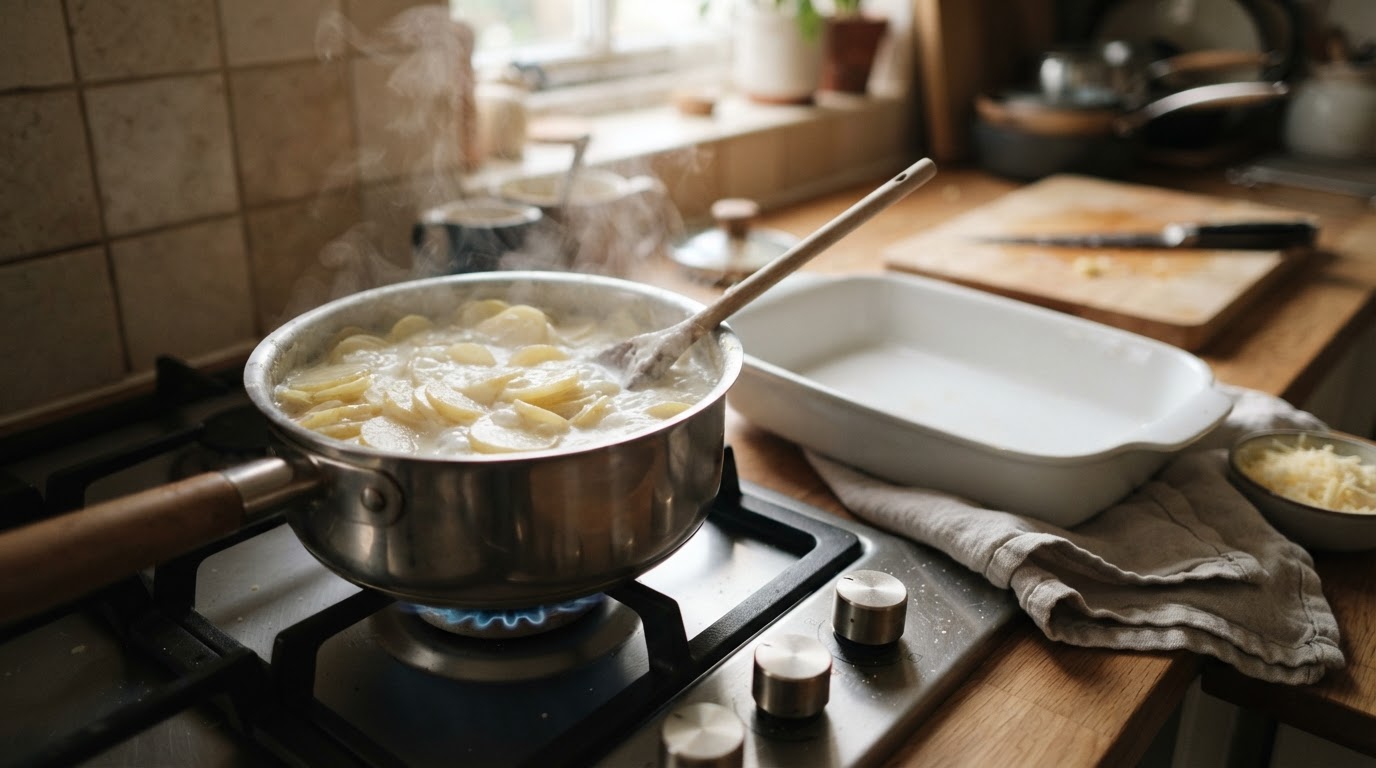
Pre -cooking in milk shortens the baking time and reduces the risk of firm potatoes. Baking them entirely in the oven, while longer, results in a cream that sets slowly.
With pre-cooking
- Shorter oven cooking time
- Less risk of a closed heart
- One more pot to wash
No pre-cooking required
- Only one dish to watch out for
- Cream that sets slowly
- Bake for approximately 1 hour 30 minutes at 160°C
Gravy that's too runny, too dry, or too dark: how to fix it?
A runny gratin often comes from using semi-skimmed milk or light cream, as Marie Food Tips points out. Return it to the oven for about fifteen minutes, uncovered, to allow the liquid to reduce.
⚠ Warning: If the dish is too large, the liquid will evaporate before the potatoes are cooked, and the gratin will dry out. In this case, add a splash of warm cream and cover with aluminum foil.
A top that's too dark can be corrected by loosely covering it with aluminum foil. Conversely, a pale top can be corrected at the end of cooking, either under the broiler or in a 180°C oven, while keeping a close eye on it.
For the slices to remain firm, continue cooking covered for 10 to 15 minutes before browning again.
Prepare in advance, reheat and serve
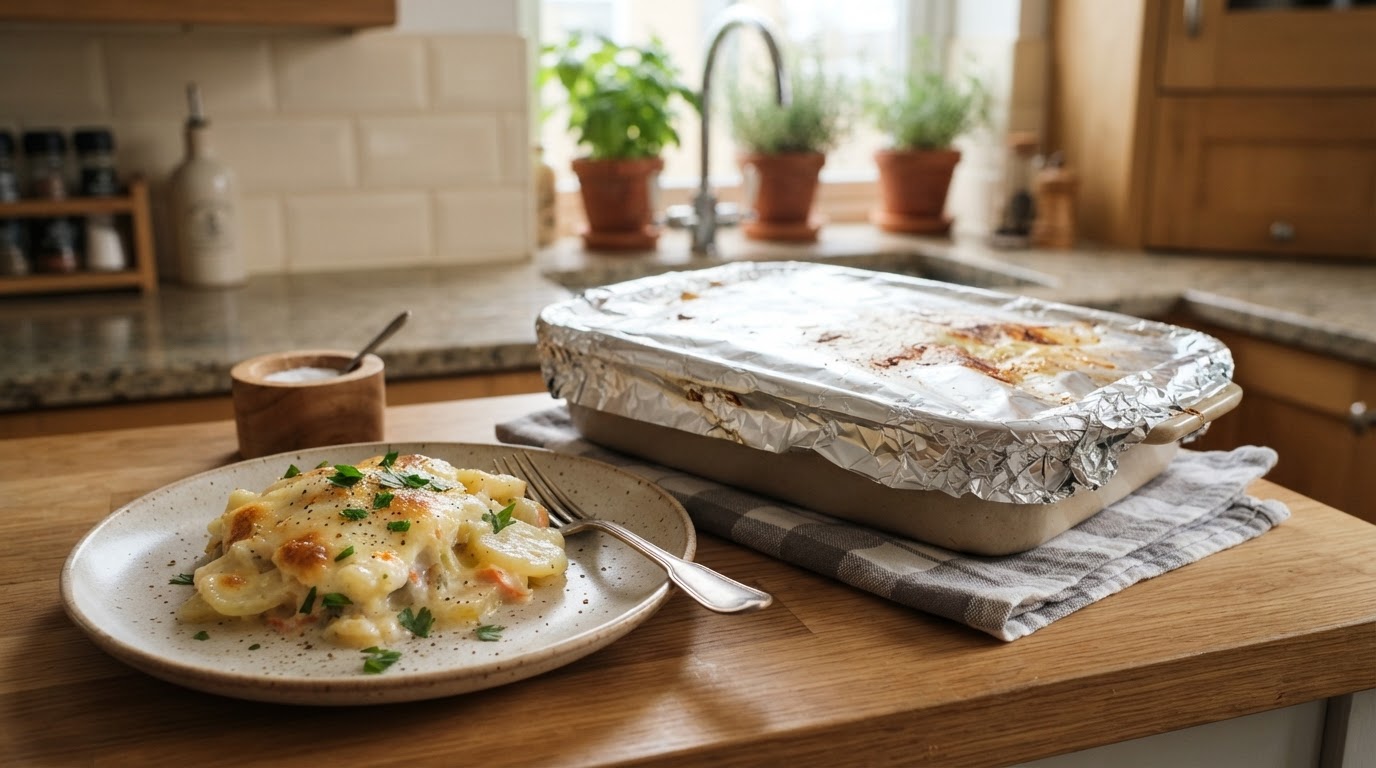
Preparing in advance works well. Marie Food Tips advises assembling the dish without the butter on top, covering it, and keeping it refrigerated until the next day.
The cooked gratin can be kept for 1 to 2 days in the refrigerator, and can also be frozen in portions according to the same source.
To reheat it, Cuisine Culinaire (February 2021) recommends 150°C for 15 to 20 minutes. Cover the dish to prevent the cream from drying out.
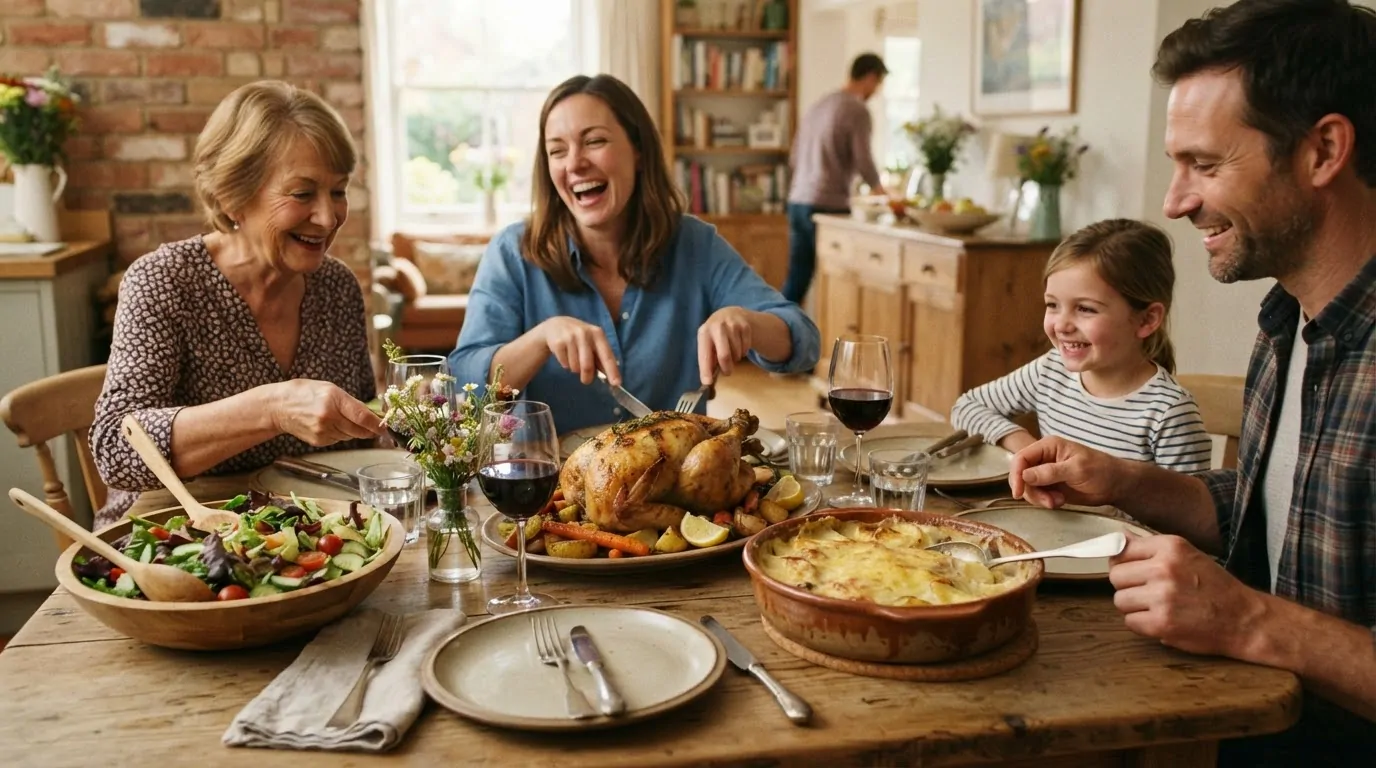
As for serving, it pairs very well with roast meat or a simple green salad, as suggested by 24matins. Since the gratin is rich, a dish of crisp vegetables or fresh herbs balances it nicely.

In summary
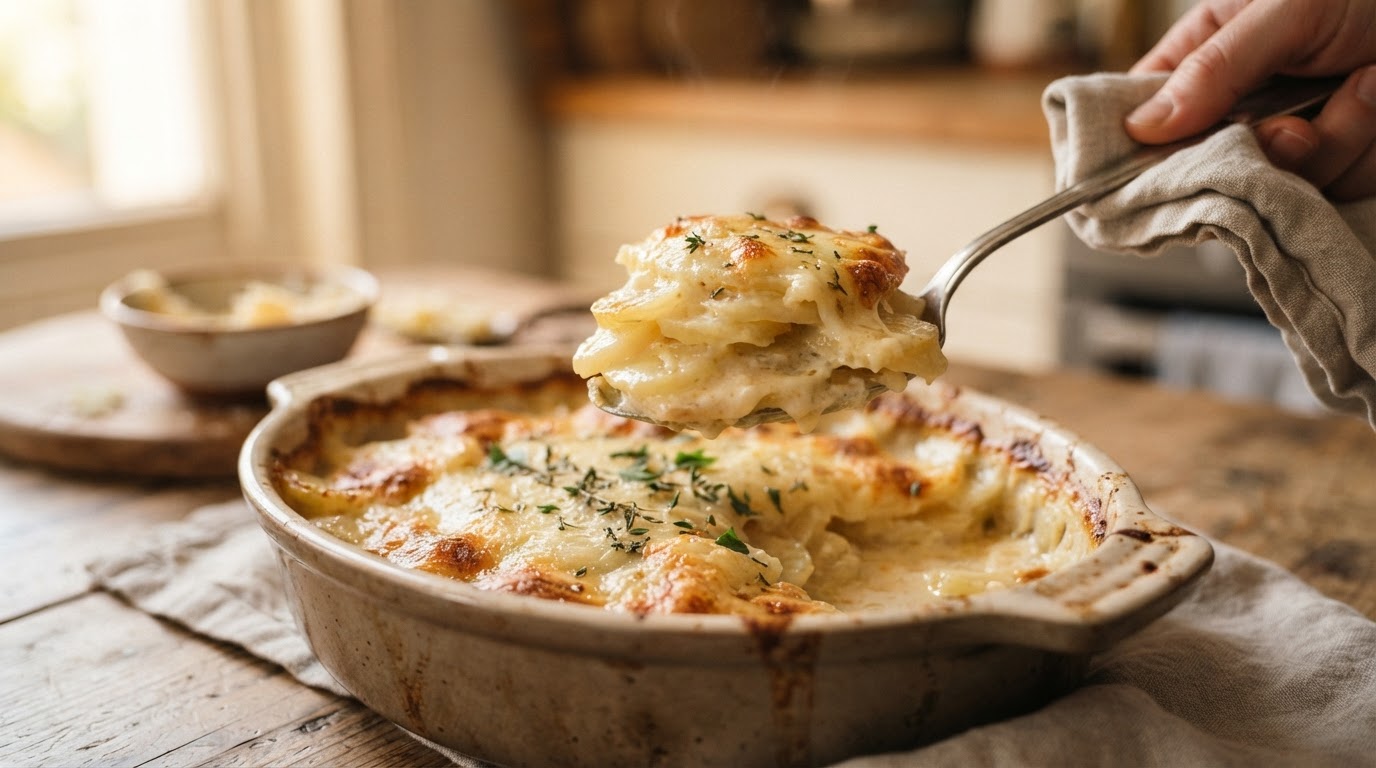
A true gratin dauphinois is simply made with unrinsed potatoes, whole milk, cream, garlic, and butter. No cheese, no eggs.
Slow cooking, around 160°C, creates the texture, and the tip of a knife is better than a timer.
Practical questions
Why is it called gratin dauphinois?
The dish is linked to the Dauphiné. According to Mon séjour en montagne (September 2023, reprinted from Dauphiné Libéré), it is often associated with a banquet given in Grenoble on July 12, 1788, but the menu of this meal simply mentions "a gratin", without saying dauphinois: the exact origin therefore remains debated.
What is the difference with Savoyard gratin?
Gratin Savoyard is generally prepared with broth and cheese, whereas gratin dauphinois relies on milk and cream. Recipes vary from family to family.
Can this gratin be made without lactose?
Yes. Marie Food Tips suggests replacing milk, cream and butter with their lactose-free or plant-based versions, while keeping the same method.
