
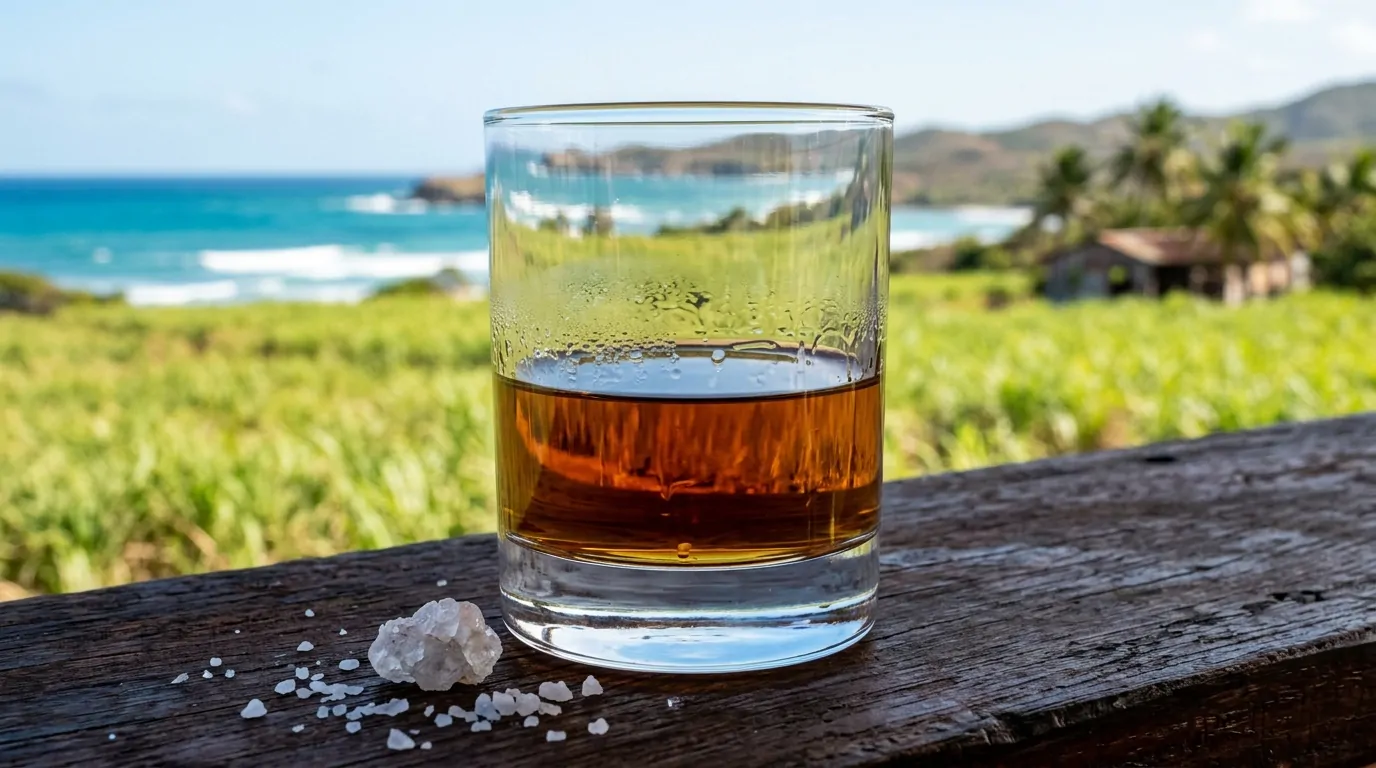
Marie-Galante is nicknamed the Big Pancake because of its round, flat shape resting on the ocean. But beneath this peaceful silhouette lies a soil that gives the agricultural rum a signature impossible to reproduce elsewhere in Guadeloupe.
Limestone, saline, marked by the sea spray that crosses the island from end to end, this terroir shapes the sugar cane long before it enters the distillery.
Understanding this alchemy between geology and vegetation means understanding why some Caribbean rums possess that extra something that enthusiasts are so looking for.
How does the saline soil of Marie-Galante shape the character of agricultural rum?
The soil of Marie-Galante rests on an ancient limestone base, formed by ancient coral reefs brought up over the course of geological movements.
This mineral base, combined with the constant proximity of the sea, imparts a subtle but very real salinity to the groundwater.
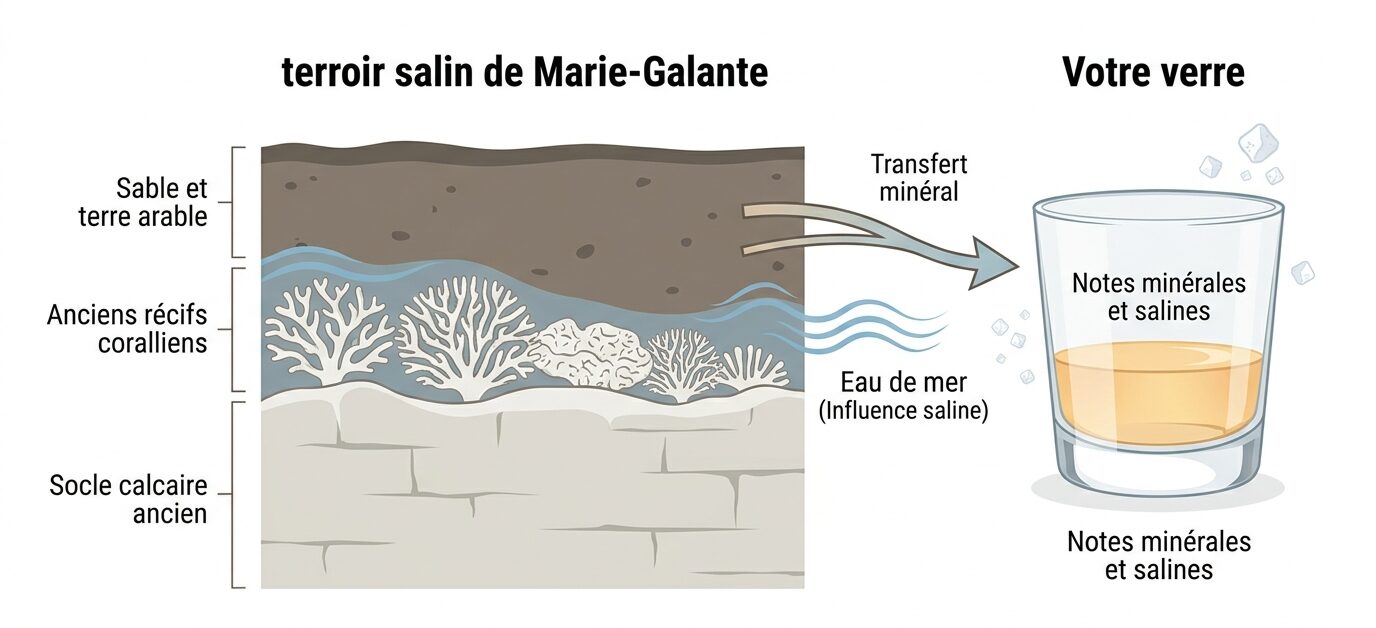
Sugarcane, a particularly absorbent plant, captures these elements in its roots and transmits them to its juice.
This is not an anecdotal detail: this minerality is then found in the vesou, this freshly pressed juice which serves as the basis for rhum agricole, unlike traditional rhum made from molasses.
In the glass, this imprint translates into a light, almost iodine-like saline substance, which balances the natural sweet roundness of the cane.
You will often find a slightly oilier texture, distinct vegetal notes and a length on the palate that discreetly evokes the sea air.
This signature clearly distinguishes the rums of Marie-Galante from those produced on mainland Guadeloupe, where the volcanic soils of Basse-Terre give smokier and heavier profiles.
To give you a concrete idea of this expression, Bielle rum for enthusiasts is, for example, one of the references often cited by connoisseurs wishing to explore this saline terroir in all its precision.
Why does Guadeloupe sugarcane express such a unique terroir?
To understand what makes the Guadeloupean cane so expressive, one must look at all the conditions surrounding it.
The archipelago benefits from strong and regular sunshine all year round, combined with high humidity which accelerates plant growth without ever drying it out.
The trade winds, for their part, play a role that is often underestimated: they cool the plots, limit certain fungal diseases and, on coastal lands like those of Marie-Galante, fill the air with sea spray which further enriches the soil.
Each production area brings its own variation on this common theme. Local cane varieties, selected and adapted over generations, react differently depending on whether they grow on the volcanic slopes of Basse-Terre or on the limestone plateaus of Marie-Galante.
This diversity of soils within the same Caribbean territory explains why Guadeloupe remains a reference for observing, almost in a full-scale laboratory, how an island terroir shapes a spirit.
France itself is looking more and more closely at this production, as rhum agricole gains recognition on tables and in competitions.
What connoisseurs look for in an exceptional island rum
An informed connoisseur never judges a rum solely on its alcohol content, seeking an aromatic complexity that unfolds in stages, a bold attack followed by development in the mouth, and then a length that persists without becoming aggressive.
Island typicity counts just as much: recognizing, from the first sips, the mark of a specific terroir is part of the pleasure of tasting, a bit like identifying a wine vintage blind.
The vintage also plays an increasing role in this quest for exceptional quality. As with wine, a given sugarcane harvest, influenced by a particular climate, produces a rum with unique characteristics that cannot be reproduced the following year.
This terroir-based approach, long reserved for the wine industry, is now fully established in the culture of Caribbean spirits.
Several criteria allow us to identify this distinctive characteristic:
- the specific plot of origin of the sugarcane, sometimes indicated on the label
- the freshness of the vesou, pressed and distilled quickly after harvesting
- Aromatic persistence, a sign of quality raw materials
This new requirement transforms the perception of rhum agricole, once considered a simple regional product, into a true object of tasting comparable to the greatest spirits in the world.
Behind each bottle of Marie-Galante lies much more than a distillation recipe, and the island's limestone and saline soil, combined with the sunshine and trade winds that sweep across the Guadeloupe archipelago, shapes an aromatic profile that is recognizable among thousands.
This concept of terroir, borrowed from the world of wine, finally gives agricultural rum from the Antilles the recognition it deserves.
For those who wish to understand what the soil tells us in a glass, Marie-Galante remains an essential gateway to this very particular island expression.
Excessive alcohol consumption is dangerous for your health. This drink should be consumed in moderation.
