
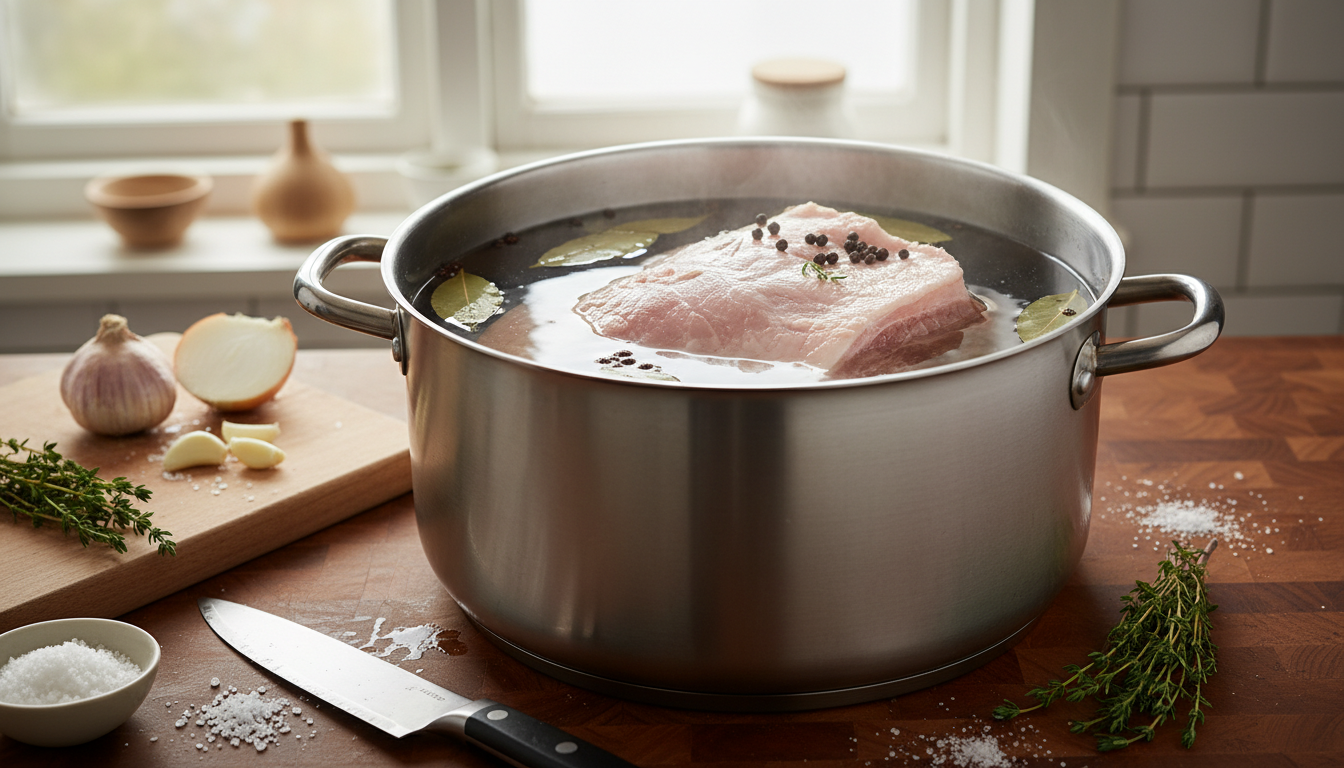
The semi-salted shoulder is one of the most generous cuts of traditional charcuterie. This salted and semi-preserved pork deserves to be better known, as it yields a tender and flavorful meat when properly prepared, especially when boiled.
Unlike fresh meats, semi-cured shoulder requires a specific approach to fully reveal its flavor. The preservation process using salt gives it a unique taste, but also suggests certain precautions before cooking it.
Mastering cooking time is therefore essential to guarantee optimal results. Indeed, undercooked meat will remain firm and difficult to chew, while overcooking will result in dry, stringy meat.
Boiling anage-old and still preferred method, allows the fibers to be tenderized gradually while preserving the natural tenderness of the meat.
This simple method of preparation mainly requires patience and a few precise guidelines to transform this substantial piece into a melting dish that will delight your guests.
The preparatory steps, the choice of water volume, the cooking temperature and the control tips will therefore make all the difference between a successful palette and a culinary disappointment.
Let's discover these tips together right now!
Understanding the semi-salted ham and preparing it for cooking
The semi-salted shoulder comes from the pork shoulder, a muscular area rich in collagen. This anatomical characteristic explains why this meat requires long, slow cooking.
The salting process, which gives the cut its name, involves rubbing the meat with coarse salt mixed with herbs, then letting it rest for several days. This treatment allows for prolonged preservation while developing specific aromas.
The term "half-salted" indicates that the salting remains moderate, unlike fully salted pieces intended for even longer preservation.
Before any cooking, the desalting stage deserves your attention. Commercially available shoulder hams are generally less salty than in the past, but some artisanal pieces retain a significant salt content.
To assess the need for desalting, examine the origin of your semi-salted pork shoulder. If it comes from a traditional charcuterie artisan, soaking it for two to three hours in cold water is necessary.
Place the meat in a large container, cover it completely with fresh water and change this water at least once during soaking.
This simple action allows excess salt to be extracted without altering the characteristic taste of salted meat.
Pallets from large retailers rarely require prolonged desalting. You can simply rinse them under cold water before cooking.
This difference is explained by industrial salting methods, which are more controlled and gentler than artisanal techniques.
To check if your pork shoulder needs soaking, follow the seller's instructions or taste the broth after thirty minutes of cooking. Broth that is too salty indicates that you need to drain some of the water and replace it with fresh water.
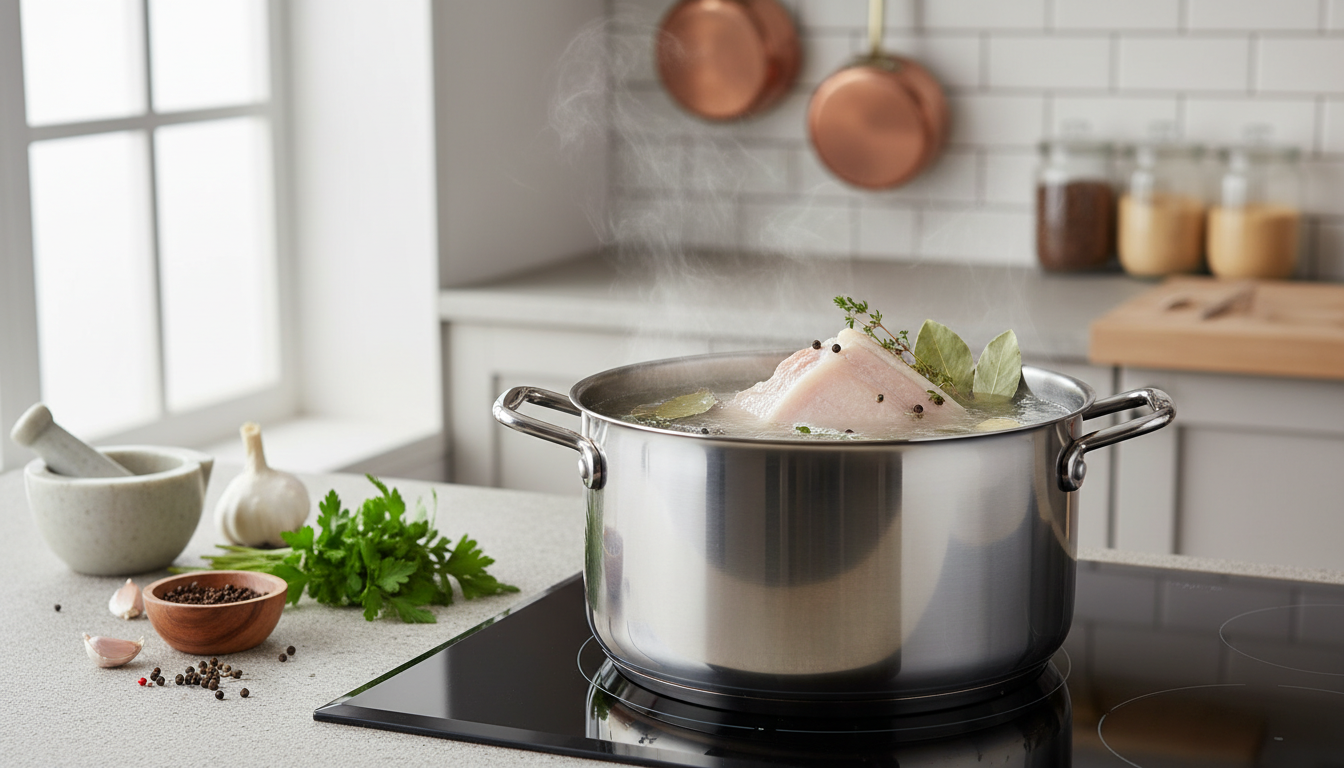
Preparing semi-salted pork shoulder also involves gathering the right ingredients to enrich the cooking process.
Use enough water to completely submerge the meat, approximately three liters for a one-kilogram shoulder. This generous amount ensures optimal heat circulation and prevents the meat from sticking to the bottom of the container.
Choose a casserole dish or Dutch oven large enough to allow the shoulder of lamb to rest flat without being compressed. This ensures even cooking across the entire surface of the meat.
Aromatics transform a simple dish into a true gastronomic creation. A bouquet garni composed of thyme, bay leaf, and dried parsley adds subtle herbaceous notes.
Add an onion studded with two or three cloves for a characteristic spicy dimension. A few unpeeled garlic cloves, simply crushed with the palm of your hand, will release their aroma without overpowering the other flavors.
A few grains of black pepper, about ten are enough, discreetly enhance the palette preparation.
These aromatic ingredients cost almost nothing but greatly enhance the taste of the final result.
Choose and prepare the side vegetables
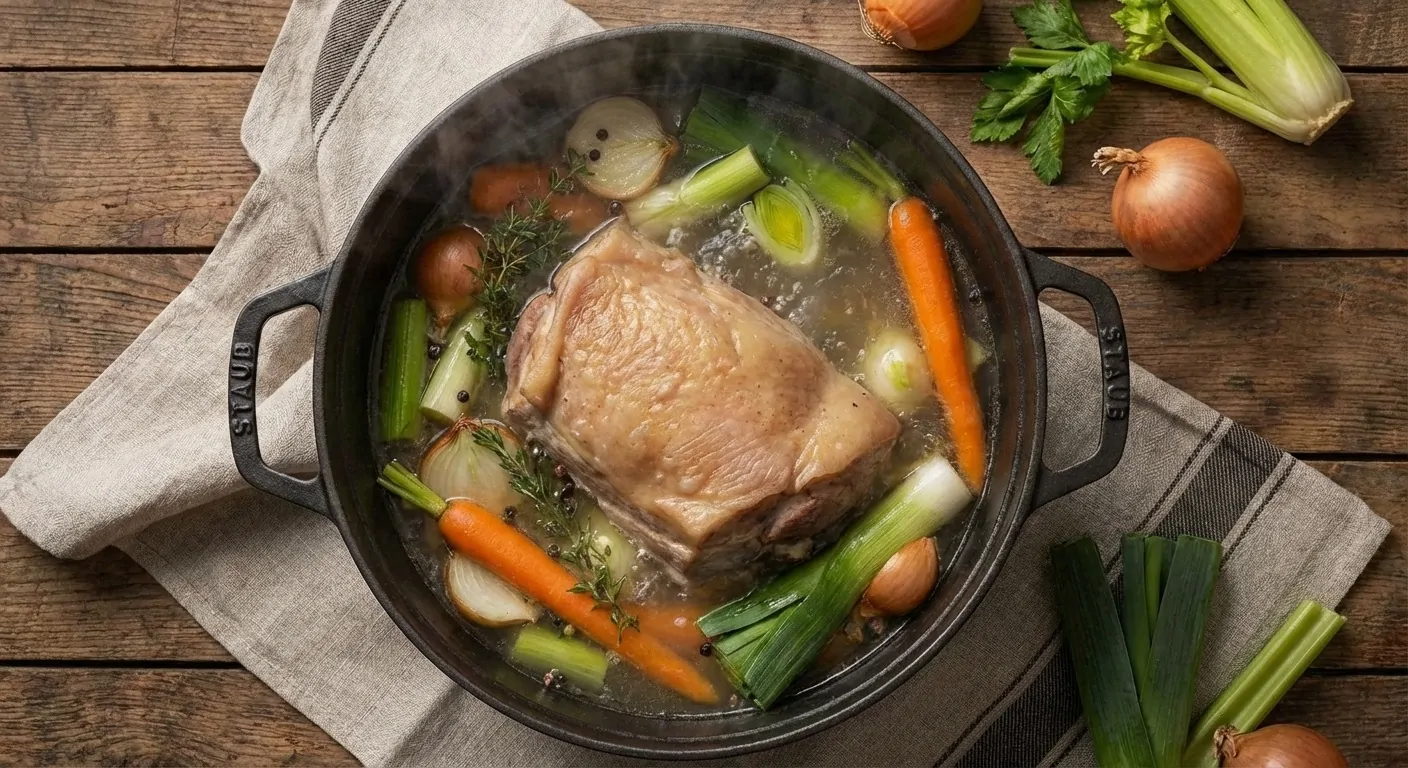
Slow-cooking semi-salted pork shoulder lends itself wonderfully to the addition of vegetables, which benefit from the fragrant broth to develop their flavors.
Carrots remain the most classic choice: peel them and cut them into pieces about five centimeters long. Their slight sweetness balances the saltiness of the meat.
Turnips, often overlooked, deserve your consideration.
Their subtle taste and melting texture after cooking make them ideal companions for salted meat preparation.
Potatoes are the quintessential traditional side dish. Choose firm-fleshed varieties that hold up well to prolonged cooking, such as Charlotte or Amandine. You can leave them whole if they are small, or cut them in half if they are medium-sized.
Avoid cutting them into small pieces that would disintegrate in the broth.
Leeks add a touch of finesse: clean them carefully to remove any soil residue between the leaves, then cut them into seven-eight centimeter pieces.
Staggering the addition times ensures that each vegetable retains its optimal texture.
The firmer carrots and turnips are added to the pot after the shoulder of lamb has cooked for an hour. The potatoes follow twenty minutes later. The delicate leeks only require ten to fifteen minutes of cooking and are added at the very end.
This organization requires a minimum of vigilance, but it transforms your preparation into a complete dish where each element retains its integrity.
The classic method of boiling the semi-salted shoulder
Slow cooking in water is the fundamental technique for tenderizing semi-salted pork shoulder.
This age-old method is based on a simple principle: a gentle and constant temperature allows the collagen present in the meat to gradually transform into gelatin, giving it that much sought-after melt-in-your-mouth texture.
Always start by placing your shoulder of lamb in a sufficiently large pot, then cover it with cold water. This cold start allows for a gradual temperature increase, promoting even cooking from the center outwards.
Place your casserole dish over medium heat and carefully monitor the temperature rise. As soon as the first bubbles appear on the surface, immediately reduce the heat.
The goal is to maintain a slight simmer, recognizable by these small bubbles that rise regularly without violent agitation.
Boiling too vigorously contracts the muscle fibers and makes the meat rubbery. Conversely, a temperature that is too low unnecessarily prolongs the cooking time without improving the result.
The first few minutes of cooking produce a greyish foam on the surface of the broth. This foam consists of coagulated proteins and impurities that must be removed to obtain a clear and flavorful broth.
Use a skimmer or a large spoon to gently collect this foam and discard it.
Repeat the operation two or three times during the first fifteen minutes, until the surface of the liquid remains clean.
This simple step will significantly improve the visual and taste quality of your dish.
The cooking time for your semi-salted shoulder will vary depending on the weight of your piece.
For a one-kilogram piece, allow approximately one and a half hours after the first stirring. A one-and-a-half-kilogram pallet requires closer to two full hours.
These durations prove to be reliable guidelines, but each piece has its own particularities related to the age of the animal, the salting time and the quality of the meat.
Therefore, monitoring is still necessary to adjust the cooking time in water according to the specific characteristics of your pallet.
Throughout the cooking process, keep the lid slightly ajar on your casserole dish. This allows steam to escape gradually, stabilizing the temperature and preventing sudden changes.
Also check the liquid level regularly, especially after the first hour. The shoulder must remain constantly submerged to cook evenly.
If necessary, add hot water from your kettle, never cold water which would break the cooking process by abruptly lowering the temperature.
Approximate cooking times depending on weight
| Pallet weight | Minimum cooking time | Maximum cooking time | Type of fire |
|---|---|---|---|
| 800 g to 1 kg | 1 hour 15 minutes | 1 hour 30 minutes | slight shiver |
| 1 kg to 1.5 kg | 1 hour 30 minutes | 2 hours | slight shiver |
| 1.5 kg to 2 kg | 2 hours | 2:30 | slight shiver |
| 2 kg to 2.5 kg | 2:30 | 3 hours | slight shiver |
The herbs are added after the first fifteen minutes of cooking, once the foam has been removed.
Gently slide your bouquet garni, the onion studded with cloves, the crushed garlic cloves and the peppercorns into the broth.
These ingredients release their aromas throughout the simmering process, imbuing the savory preparation with their subtle notes.
Avoid adding salt at this stage: the meat gradually releases its own salt during cooking, and you risk unbalancing the seasoning.
Some tips for controlling cooking
The fork test is the most reliable method to check if your semi-salted pork shoulder is cooked.
After an hour and a half of cooking for a one-kilogram piece, insert the tines of a fork into the thickest part of the meat. If the fork penetrates easily and the meat begins to fall apart slightly, your shoulder is ready!
A noticeable resistance indicates that the cooking time should be extended by fifteen to thirty additional minutes, always maintaining the gentle simmer that characterizes the traditional palette recipe.
Observing the bone provides another valuable indicator. Using a spoon or tongs, gently pry the shoulder bone open. If it moves easily within the meat, it means the collagen has broken down sufficiently and the meat is cooked through.
Color also serves as a visual indicator: a well-cooked semi-salted scallop has a uniform pinkish hue across its entire surface, without any grayish areas that would indicate incomplete cooking. This characteristic coloration comes from the nitrite salts used during the brining process.
Some experienced cooks use the cooking thermometer technique to eliminate any uncertainty.
Insert the probe into the center of the thickest part, avoiding the bone which would give a false reading. An internal temperature of seventy-five degrees Celsius guarantees thorough and safe cooking.
This objective method reassures novice cooks and helps avoid guesswork. However, the fork test remains the most reliable way to assess the desired tenderness in a meltingly soft shoulder of lamb!
Optimize the flavor and avoid common mistakes
The success of a semi-salted palette depends as much on what to do as on what to avoid.
The first mistake, probably the most common, is cooking the meat over too high a heat. This haste causes a violent boiling that abruptly contracts the muscle fibers.
The result is meat that is dry on the surface and hard to chew, whereas the desired goal is precisely that melting texture that almost falls apart on its own.
Take your time: slow cooking often transforms a modest piece into a choice cut!
Adding salt to the broth at the beginning of cooking is another common mistake. The shoulder of the pig gradually releases its salt during cooking, and the broth becomes naturally seasoned over the course of several hours.
Adding salt from the start risks creating an unpleasant imbalance, with meat that is too salty and a broth that is unusable.
If you absolutely must adjust the seasoning, do so only at the end of cooking, after tasting the broth and the meat.
In most cases, no addition is necessary!
Adding vegetables at the wrong time often ruins an otherwise well-prepared dish. Adding all the vegetables at once results in overcooked, mushy carrots, exploding potatoes, and leeks reduced to mush.
Carefully follow the order of addition according to the firmness of each vegetable. This organization requires some attention during cooking, but it ensures that each element retains its own texture and contributes harmoniously to the overall dish.
Mistakes to avoid
- Cooking over too high a heat results in tough, dry meat instead of tender, juicy flesh.
- Adding salt to the broth at the beginning of cooking risks completely unbalancing the final seasoning.
- Add all the vegetables at once: some will be overcooked while others will remain firm.
- Forgetting to skim the first few minutes results in a cloudy and less flavorful broth
- Leaving the palette uncovered causes excessive evaporation and concentrates the salt too much.
- Constantly piercing the meat causes the juices to escape and dries out the flesh unnecessarily.
- Adding cold water during cooking disrupts the thermal process and prolongs the cooking time.
- Carve the shoulder immediately after cooking: the juices will escape instead of soaking into the meat.
Letting the meat rest after cooking is an often neglected but crucial step!
When your shoulder of lamb is perfectly cooked, carefully remove it from the pot using two wide spatulas to prevent it from breaking. Place it on a serving platter and let it rest for five to ten minutes before carving.
This resting time allows the juices to distribute evenly throughout all the fibers of the meat, guaranteeing juicy and flavorful slices.
Lightly cover the dish with aluminum foil to retain heat without creating excessive condensation.
The slicing also requires a minimum of technique to present appetizing slices.
Use a sharp knife with a long, thin blade, then slice perpendicular to the meat fibers, using smooth, even movements without applying excessive pressure.
The ideal thickness is around one centimeter, thick enough to retain softness, thin enough to facilitate eating.
If you encounter the bone, go around it rather than forcing it; you will recover the attached meat at the end of the cutting process.
Make the most of the broth and leftovers
The cooking broth (a type of bone broth) is known to be a culinary treasure that would be a shame to waste!
Once the ham and vegetables have been removed, strain the fragrant liquid through a fine sieve or chinois. Let it cool, then refrigerate for a few hours.
The grease will naturally rise to the surface and solidify, forming a white layer that is easy to remove with a skimmer.
This defatted broth will become an exceptional base for a lentil soup, a vegetable stew or even a risotto that could well surprise your guests with its aromatic depth.
Leftover semi-salted pork shoulder lends itself to many preparations.
Diced, the meat enriches a mixed salad with warm potatoes, pickles and a mustard vinaigrette.
Finely sliced, it makes a great filling for generous sandwiches served with semi-salted butter and crisp salad…
You can also gently reheat it in its broth for a simple meal the next day, without losing any flavor or tenderness.
This salted meat can be kept for three to four days in the refrigerator, wrapped in cling film or placed in an airtight container.
For those who appreciate elaborate preparations, leftover shoulder of lamb transforms wonderfully into a shepherd's pie!
Roughly chop the meat, mix it with some sautéed onion and reduced stock, then cover everything with a thick layer of mashed potatoes.
A quick turn in the oven to brown the surface, and you have a comforting dish that does justice to leftovers without giving the impression of simply reheating leftovers from the previous meal.
Ready to treat yourself to this lesser-known cut of meat, and share your experiences with us? Any practical tips for our readers? Feel free to share them in the comments!
Practical questions
Is it absolutely necessary to desalinate a semi-salted ham hock before cooking?
Desalting is not always necessary. Modern hams sold in supermarkets are generally lightly salted and only require a simple rinse. For handcrafted hams, soaking them for two hours in cold water, changed once, is sufficient. Test the broth after thirty minutes of cooking to assess the salt level.
How long exactly should a 1.2 kg semi-salted pork shoulder be cooked?
For a 1.2 kg shoulder of lamb, allow 1 hour 30 minutes to 1 hour 45 minutes of gentle simmering after the water comes to a boil. The fork test remains the best indicator: if it easily pierces the thickest part and the meat flakes slightly, it's perfectly cooked.
Can the semi-salted pork shoulder be cooked with all the vegetables from the start?
No, that's a common mistake. Vegetables have different cooking times. Add the carrots and turnips after the meat has cooked for an hour, the potatoes 20 minutes later, and the leeks only 10 to 15 minutes before the end. This staggered method ensures that each vegetable retains its optimal texture.
What should I do if the broth becomes too salty during cooking?
If after 30 minutes of cooking you find the broth is too salty, drain about half of the liquid and replace it with hot water. Then continue cooking as usual. This technique dilutes the excess salt without compromising the final tenderness of the meat.
How can you be sure that the shoulder of lamb is cooked properly?
Three reliable indicators exist: the fork test, which should pierce the meat without resistance; the bone, which should move easily within the flesh; and the meat's uniform pink color. For greater accuracy, use a cooking thermometer: the internal temperature should reach 75°C ( 167°F) at the center of the thickest part.
