
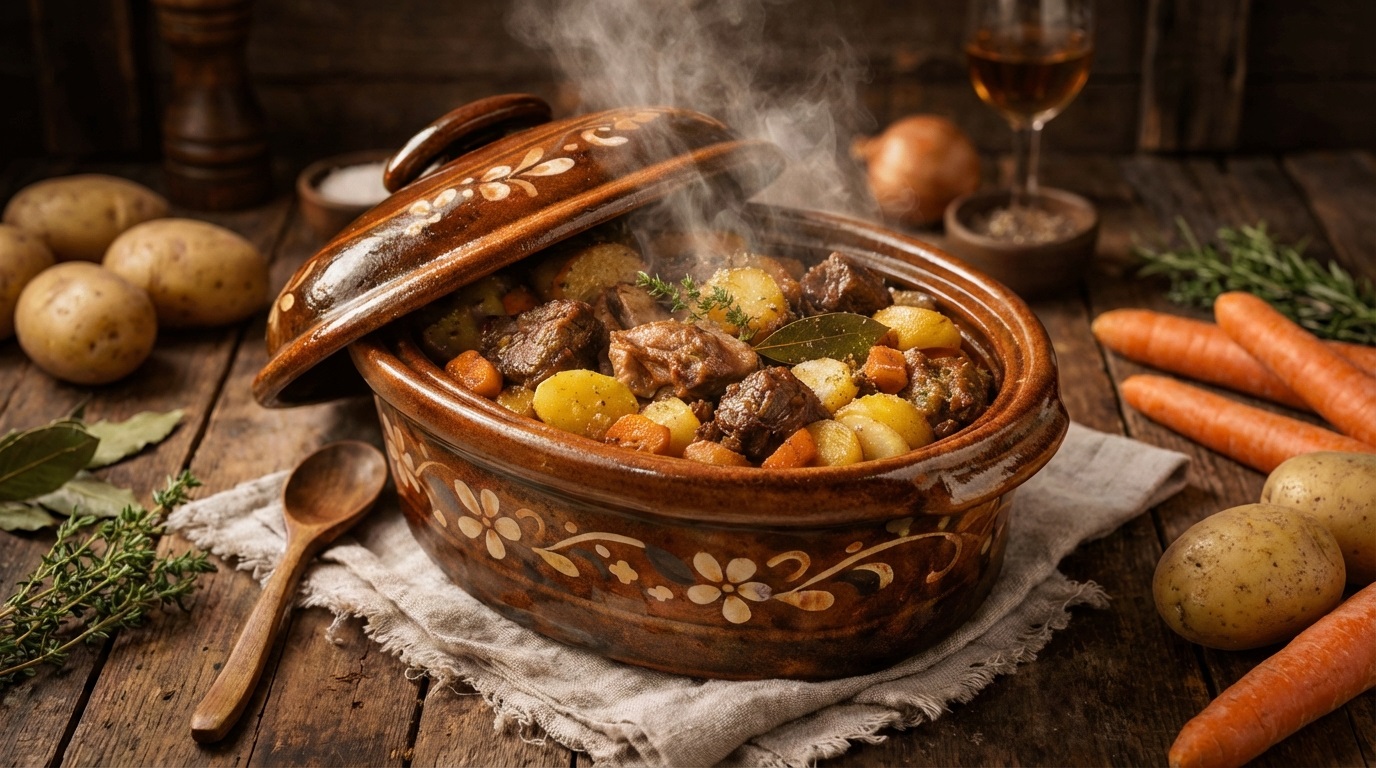
There are dishes that tell the story of an entire region from the first bite. Alsatian baeckeoffe is one of them.
Behind this Germanic-sounding name lies a generous stew, simmered for a long time in a sealed earthenware terrine, where three meats marinated in white wine blend with potatoes and garden vegetables.
A dish of sharing, patience and character, just like Alsace itself!
Whether you are a novice in regional cuisine or an informed amateur, this Alsatian baeckeoffe recipe will guide you step by step to obtain meltingly tender meat, concentrated flavors and a result worthy of the best tables in Strasbourg.
Baeckeoffe: what this name means
In Alsatian, Baeckeoffe literally means "the baker's oven". The spelling varies depending on the village and the family: it is also found written bäckeoffe, baeckaoffa or bäckaofa, all these forms refer to the same emblematic dish.
Its history dates back to the 19th century, when domestic ovens were rare. On Sunday mornings, before going to mass, Alsatian housewives would leave their earthenware bowl with the village baker. The oven, still warm after baking the bread, would then take over for the two to three hours of the service.
As soon as they left the church, the dish was ready, steaming and fragrant. On Mondays, laundry day—a busy day that left little time to watch over the stove—the same ritual was repeated. An ingenious domestic organization that has endured through the centuries.
This dish is also a shared culinary heritage: it is said to be inspired by Hamin, a preparation of Alsatian Jewish origin cooked slowly during Shabbat.
Some historians place its origin in Colmar, others in Strasbourg. But one thing is unanimous: baeckeoffe is Alsace in its most authentic expression.
The ingredients of the traditional Alsatian baeckeoffe recipe
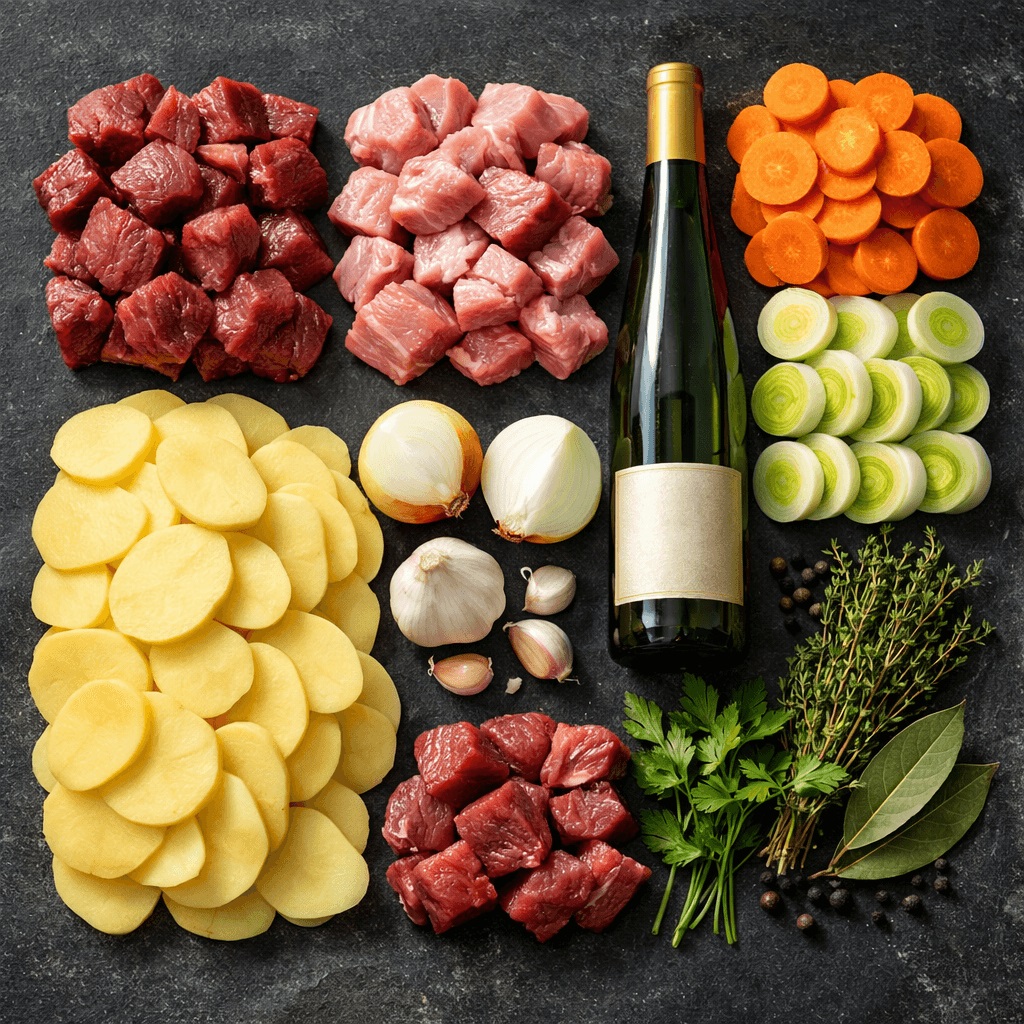
The richness of baeckeoffe lies in the combination of three different meats, each bringing its own texture and taste.
Here are the ingredients for 6 to 8 people:
The three meats
- 600g of beef shoulder (chuck or shin)
- 600g of pork shoulder (loin or shoulder)
- 600g boneless lamb shoulder
Ask your butcher to cut the pieces into 4-5 cm cubes. These are meats that require slow cooking to reveal their tenderness, like a shoulder cooked for a long time in the oven, where patience transforms a firm piece into something irresistibly melting.
Vegetables and herbs
- 2 kg of firm-fleshed potatoes (such as Bintje or Monalisa)
- 200g of sliced onions
- 200g of sliced carrots
- 250g of leek whites, cut into pieces
- 2 cloves of garlic (germ removed)
- 3 bay leaves, a few sprigs of thyme
- 6 juniper berries, 2 cloves, a few peppercorns
For the marinade and the sealant paste
- 75 cl of dry Alsatian white wine (ideally Riesling, Pinot Blanc as a substitute)
- 400g of flour + 25cl of water (for the sealing paste)
- Salt, pepper
Marinating: an essential step for tender meat
This is where it all begins, and without exception, the day before. The white wine marinade tenderizes the meat fibers and infuses them with the aromas of the spices. No baeckeoffe is complete without this cold marinating step.
- Cut the three meats into large cubes and place them in a large container.
- Add the carrots, leek, garlic and all the herbs (bay leaf, thyme, juniper, cloves, peppercorns).
- Pour the Alsatian white wine over everything and mix.
- Cover with film and place in the refrigerator for a minimum of 24 hours (up to 36 hours without any problem).
The longer the marinating time, the deeper the flavors. Don't try to shorten this time: it's what makes the difference between a simply good dish and a baeckeoffe that your guests will still be talking about the next day.
Assembling the terrine and sealing the dough: the heart of the technique
The earthenware terrine is the heart of the dish. The best ones come from Soufflenheim, a village in the Bas-Rhin region renowned for its hand-decorated pottery, a tradition passed down through generations.
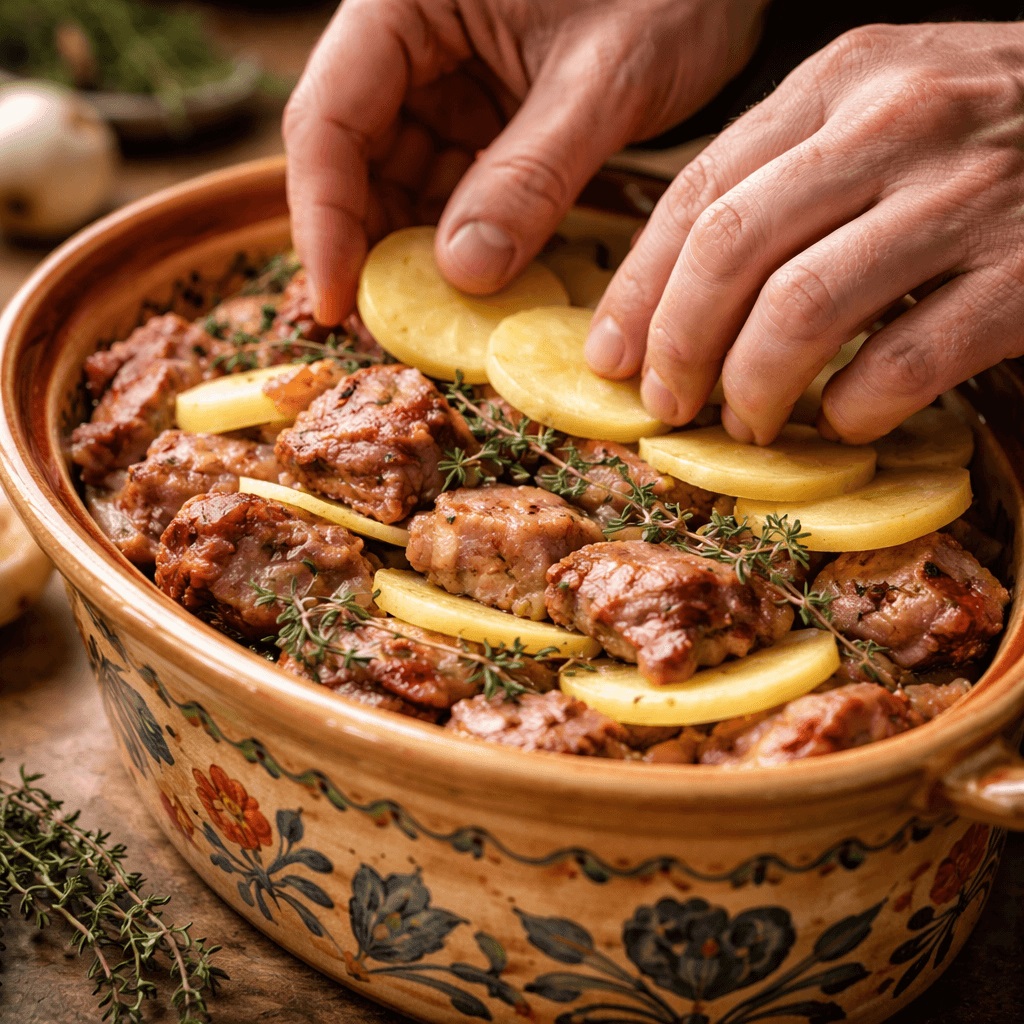
Alternatively, a cast iron casserole dish will do, provided that the lid is oven-safe.
How to assemble the baeckeoffe in layers
- Peel and slice the potatoes into 4 mm thick rounds.
- Finely chop the onions.
- Place a layer of potatoes and onions at the bottom of the terrine. Season with salt and pepper.
- Drain the meat and vegetables from the marinade. Arrange half of it on top of the potatoes.
- Repeat the process: layer of potatoes, layer of meat and vegetables.
- Finish with a layer of potatoes.
- Pour the strained marinade into the container, filling it two-thirds full. Top up with white wine if necessary.
Sealing paste: sealing for better simmering
It is the technical skill that distinguishes a true baeckeoffe from a simple stew. The paste used to seal the pot creates an airtight seal that traps the vapors and concentrates the aromas throughout the cooking process.
- Mix 400g of flour with 25cl of water until you obtain a soft and homogeneous dough.
- Form a long roll and place it around the edge of the terrine.
- Place the lid on and press firmly to seal.
Tip: Don't break the crust before you're at the table. That moment, the cracking of the seal in front of your guests and the aroma that escapes, is part of the experience.
Oven baking: time, temperature and patience
Preheat your oven to 180°C (conventional heat preferred). Place the sealed terrine in the oven for a minimum of 3 hours.
Some Alsatian families go up at 3:30 am, or even 4 am for the larger terrines.
- Do not open the oven during cooking
- Never break the seal before use
- Let it rest for 10 to 15 minutes outside the oven before opening
Good news: baeckeoffe reheats perfectly. If you prepared it the day before, bake it for 45 minutes at 150°C without opening the terrine.
Many Alsatians even admit that it is better this way, as the flavors have had time to blend and concentrate.
Wine pairings and accompaniments
The service is simple: the terrine placed in the center of the table, a green salad with a mustard vinaigrette on the side, and an Alsatian wine in the glasses.
What wines should I choose with baeckeoffe?
- Riesling: the classic pairing. Its acidity and minerality contrast with the richness of the meats.
- Sylvaner: more discreet, fresh, perfect if you prefer a light wine.
- Pinot Blanc: fruity and round, a nice accessible option.
- Pinot Noir from Alsace: for those who prefer red wine, its supple tannins pair well with lamb.
The wine you used for the marinade is often the best choice for the table, a consistency that never fails.
Variations of the Alsatian baker's stew
Baeckeoffe is a living dish, which adapts. There is no recipe set in stone: every Alsatian family has its own.
- Baeckeoffe with fish: pike-perch, pike and trout replace the meats, with fresh cream and a more generous Riesling.
- Baeckeoffe with duck or goose: a more refined version, ideal for the holidays.
- Two-meat version: beef and pork only, no lamb, for a milder taste.
- Vegetarian version: mushrooms, lentils and root vegetables, with vegetable broth instead of wine.
Storage and practical advice
- Baeckeoffe can be kept for 3 to 4 days in the refrigerator in its closed terrine.
- Recommended reheating time: 45 minutes at 150°C, with the terrine closed.
- It freezes very well, in individual portions.
- If you don't have a terracotta terrine, a covered cast iron casserole dish works very well: simply omit the sealing.
Conclusion
Alsatian baeckeoffe is not a quick weeknight recipe. It's a weekend dish, for celebrations and sharing. It requires planning (marinating the day before), a bit of technique (sealing the pastry), and above all, patience (three hours in the oven without being touched).
But when you break the crust at the table, facing your guests dazzled by the aromas escaping from it, you will understand why this dish has survived the centuries without aging a bit.
If you like slow-cooked regional dishes, also check out our articles on Alsatian specialties to enjoy with family and our tips for choosing the right flammekueche dough.
See also our article on Alsatian sausage to learn more about the culinary specialties of this region.
Practical questions
Can you make a baeckeoffe without a terracotta terrine?
Yes. A cast-iron casserole dish with a tight-fitting lid works very well. The cooking will be slightly different (more even, less crust), but the result is still excellent. Just avoid dishes with shallow sides.
How long should meats be marinated for?
24 hours is the minimum. You can easily go up to 36 hours. Less than 12 hours, and the meat won't have enough time to absorb the flavors.
Can baeckeoffe be prepared the day before?
Absolutely, and it's even recommended. Cook it the day before and reheat it the next day at 150°C for 45 minutes, with the terrine covered. The flavors will be even better.
What wine should I use if I don't have Riesling?
Any dry, fruity white wine will do: Pinot Blanc from Alsace, dry Muscat, or even a Bourgogne Aligoté. Avoid wines that are too oaky or overly aromatic, as these would overpower the spices.
How many people does this recipe serve?
With 600g of each meat (1.8kg total), this recipe comfortably serves 6 to 8 people. For 4 people, halve the quantities and reduce the cooking time to 2 hours 30 minutes.
How can you tell if the baeckeoffe is cooked?
After 3 hours at 180°C, the meat should be tender and the potatoes fully cooked. If you have a thermometer, the internal temperature should exceed 85°C.
In the absence of a thermometer, rely on the time and the smell coming from the terrine.

I wasn't familiar with this terrine recipe. I tried it out using the method, and frankly, it was a success!
My guests enjoyed it so much that they took some home to eat cold on Sunday evening.