
Coconut oil: a beauty remedy and a kitchen ally — But which brand deserves a place in your dishes or in your skincare kit?
Good coconut oil makes all the difference. Whether you're stir-frying vegetables, making a hair mask, or moisturizing your skin, the quality of the product makes all the difference.
If you are looking for a virgin, organic, cold-pressed oil that can withstand cooking or effectively nourishes your hair, here are five clear choices, with glass formats, economical options, and products perfect for heavy use.
Our Top 5: Find the best organic coconut oils


Discover each coconut oil in more detail
The Simple & Bon team has tested and studied in detail the customer reviews of each of these coconut oils for cooking or beauty and gives you its verdict product by product.
CocoNativo — Organic Extra Virgin Coconut Oil 1L

Benefits
- Large 1L size, economical for families
- Extra virgin, unrefined and additive-free
- Good resistance to high temperatures
Disadvantages
- Larger packaging to store
- Initially more expensive than small pots
Presentation
CocoNativo offers an organic, extra-virgin, cold-pressed coconut oil in a large one-liter bottle. It is intended for users who cook regularly or who want a single product for both cooking and body care.
Why choose her
- 1000 ml format suitable for frequent use and for families.
- Unrefined product, without deodorants or preservatives: you retain the natural taste and beneficial fatty acids.
- Suitable for short, high-temperature frying and for recipes requiring stable oil.
You can use it for cooking and baking as a binder, as a massage oil, or as a supplement in animal feed if you wish. Many users appreciate its strong scent and versatility around the house.
Our tips
- Large format requires storage away from light and heat to prevent deterioration.
- If you are unsure about cosmetic use, start by testing on a small area of skin.
Tip: To save money, transfer a small amount into a smaller bottle for daily use and keep the rest refrigerated.
La Tourangelle — Virgin Coconut Oil 314ml

Benefits
- 100% organic and cold-pressed
- Eco-friendly and practical glass jar
- Fresh coconut scent, great taste in cooking
- Versatile: kitchen, hair and skin
Disadvantages
- The 314ml size is a bit small for intensive use
- Can solidify at low temperatures
Presentation
Before you is a virgin, organic, cold-pressed coconut oil packaged in a glass jar. It comes from the Philippines and is designed for versatile use: light cooking, baking, makeup removal, or hair care. Its strength lies in its excellent balance between quality and price.
Features and benefits
- 100% organic, first cold pressing, natural coconut flavor.
- Glass bottle that preserves the product and reduces plastic.
- Good for gentle cooking and for replacing butter in recipes.
You'll appreciate its natural scent, which subtly perfumes your dishes or skincare products. In cosmetics, it nourishes skin and hair without undesirable ingredients. In cooking, it adds an exotic touch to smoothies, stir-fries, or pastries.
Information and practical advice
- It turns into a solid below about 25°C: rub it between your hands to melt it.
- The 314ml jar may seem small if you use it a lot for cooking or for the whole house — consider buying several if needed.
User tip: For a hair mask, heat a small amount in a double boiler, apply to the lengths of your hair, and leave on for 30 minutes before shampooing. For cooking, use it as a fat over medium heat rather than for deep frying.
Jardin BiO étic — Organic coconut oil, 2 x 200ml pack

Benefits
- AB certification and controlled origin
- Good lauric acid content, stable during cooking
- Convenient multipack format for testing or sharing
Disadvantages
- Limited total quantity (2 x 200 ml)
- Perhaps more expensive per liter than some larger formats
Presentation
This virgin coconut oil is from Jardin BiO étic and is certified organic (AB). It comes from Sri Lanka and is cold-pressed to preserve its natural qualities. The product is often sold in packs of two 200ml jars, which is convenient if you're testing the oil or using it for multiple purposes.
Key advantages
- Recognized organic standard (AB) and respectful production method.
- Soft texture and fragrance, suitable for massages, hair oil baths and cooking.
- Good stability thanks to its lauric acid content, useful for cooking at medium temperature.
You can use it as a repairing treatment for dry ends, for massaging the skin, or for light culinary applications. The format allows you to store some without risk of oxidation if you alternate uses.
Limitations and practical advice
- If you cook a lot, the small size may require you to buy more often.
- Keep the jars away from sunlight to preserve the aroma and nutrients.
Tip: For an effective hair mask, apply a few spoonfuls to damp hair, leave on for 20 to 40 minutes, then rinse and shampoo with a gentle shampoo.
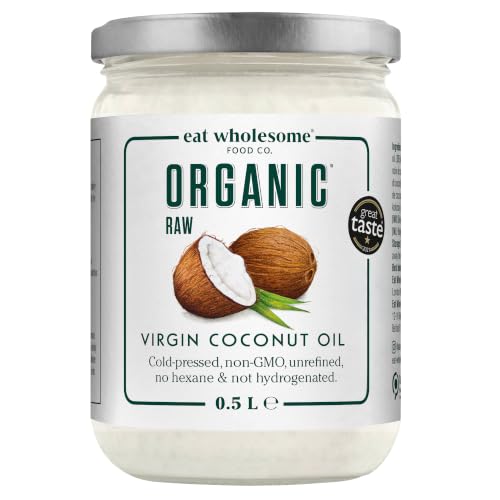
Eat Wholesome — Organic coconut oil 500ml glass jar
Benefits
- Certified organic, cold-pressed and raw
- Recyclable glass jar, a good eco-friendly choice
- Versatile: cooking, skin and hair care
Disadvantages
- Can liquefy at warm temperatures
- Aroma sometimes more pronounced depending on the batch
Presentation
Eat Wholesome offers virgin, raw, cold-pressed coconut oil in a glass jar. This vegan and non-GMO product is suitable for cooking and natural skincare routines.
Advantages and practical uses
- Recyclable glass jar and lid, which limits plastic.
- Suitable for smoothies, gentle cooking, and as a skin and hair care oil.
- Simple formulation: unrefined, unbleached, suitable for vegan diets.
You can use it to hydrate dry areas, as a hair mask, or to add energy to culinary preparations. Some users combine it with essential oils (e.g., tea tree) to treat localized problems.
Precautions for use and advice
- Like all virgin coconut oils, it melts at temperatures above 25°C: store it in a cool place.
- The taste may vary slightly depending on the harvest; if you are sensitive to the aroma, test a small amount first.
Tip: For intimate or local care, mix a small amount with a few drops of suitable essential oil and test on a small area before regular use.
Planète au Naturel — Organic Coconut Oil 500ml

Benefits
- Cost-effective 500ml large format
- Delicate coconut flavor
- Pure and suitable for cooking and smoothies
Disadvantages
- Packaging may vary depending on the batch
- Less information on packaging for cosmetic use
Presentation
This 500ml bottle of organic coconut oil emphasizes volume and simplicity. It is described as virgin, cold-pressed, and organically grown. It's ideal for those who want a product for everyday cooking and a simple beauty routine.
Practical highlights
- Generous volume which reduces the price per liter.
- Pleasant texture and authentic coconut scent.
- Suitable for cooking, baking, smoothies, and body care.
You can use it to replace other fats in cooking, or as a nourishing oil for the skin. Its origin (Sri Lanka, according to the information) makes it appealing to those seeking reasonable traceability.
The tips
- Some instructions on the packaging are brief; check storage and traceability if this matters to you.
- For long frying times, it is preferable to check the high-temperature stability according to your recipes.
Tip: Keep it away from heat to prevent it from becoming liquid and pour it into a warm spoon for easy measuring.
Simple & Bon's review
Choose the CocoNativo brand in 1L extra virgin organic coconut oil if you cook often or use a lot of oil for body care.
Its rating is 9.5/10 — 1L format, pure and unrefined, ideal for high-temperature cooking, light frying, and for preparing balms or massage oils. Its traceability and quality make it the best choice for intensive use.
Opt for the La Tourangelle brand in Virgin Coconut Oil 314ml if you want a versatile and easy-to-adopt option for everyday use.
Its rating is 8.9/10 — glass bottle, mild taste, perfect for baking, salad dressings, and hair and skin care. It's the best compromise for those seeking quality, practicality, and aesthetics.
Our Buyer's Guide to Virgin and Organic Coconut Oils
Coconut oil in cooking: a buyer's guide to help you choose the best
Faced with shelves of coconut oils, the choice seems simple. However, between virgin, refined and extra virgin versions, culinary uses differ radically.
This guide helps you identify the coconut oil that meets your cooking needs, avoiding unsuitable purchases and taste disappointments.
Define your culinary needs before buying
Before choosing, ask yourself these essential questions: Do you often cook at high temperatures? Do you enjoy the taste of coconut in your dishes? Do you regularly prepare desserts or exotic dishes?
For deep frying and high-heat cooking : opt for refined coconut oil. Its high smoke point (232°C) and neutral taste make it ideal for cooking without compromising on flavor.
For baking and tropical flavors : virgin coconut oil provides that sought-after aromatic signature in desserts and exotic dishes. Its lower smoke point (177°C) makes it suitable for gentle cooking methods.
For versatile use : having both types allows you to adapt the oil to each preparation without constraint.
Understanding labels and certifications
The information on the labels reveals the manufacturing process and guides your choice.
"Virgin" or "Extra Virgin" indicates cold extraction without chemical treatment. These oils retain their pronounced flavor and natural aromas. The difference between virgin and extra virgin lies in the minimum degree of refining.
term "refined" or the absence of any mention indicates treatments that neutralize the flavor. This version is suitable for cooks who dislike the taste of coconut.
Organic certifications : guarantee the absence of pesticides and GMOs, but do not directly influence culinary properties.
| Criteria | Refined oil | Virgin oil | Our recommendation |
|---|---|---|---|
| Average price (500ml) | 8-12€ | 12-20€ | Start with the refined |
| Shelf life | 18-24 months | 18-24 months | Equivalent, excellent |
| Culinary versatility | +++ | ++ | Refined for beginners |
| Ease of use | +++ | ++ | Refined, less restrictive |
Where to buy and at what price?
Supermarkets : basic but affordable selection. Choose well-known brands and check expiration dates. Prices are generally more attractive for beginners.
Organic stores : wider ranges of certified products. Advisors can guide you based on your needs. Expect to pay 20 to 30% more than in supermarkets.
Asian grocery stores : often the best virgin coconut oils, traditionally used. Generally competitive prices, authentic quality.
Buying online offers a wide selection and easy comparison. Pay attention to storage and shipping conditions, especially in summer when the oil becomes liquid.
Practical selection criteria
Format and packaging
500ml jars are the optimal size for beginners. Smaller jars are likely to run out quickly. Larger jars may cause the oil to degrade before being fully used by occasional users.
Opt for glass containers, which are more neutral than plastic and allow you to see the condition of the product.
Visual appearance and texture
At room temperature (20-25°C), coconut oil fluctuates between solid and liquid. This characteristic is not a defect but rather its inherent nature. High-quality oil is white to transparent, without any brownish tinges.
Geographical origin
The Philippines, Indonesia, Thailand, and Sri Lanka dominate production. Origin has little influence on the final quality, unlike extraction methods. Prioritize clear traceability over a specific provenance.
Common mistakes when buying
Buying solely based on price : very cheap oils often undergo intensive processing that alters their culinary properties.
Don't confuse coconut oil with copra oil : the latter, extracted from dried pulp, has different characteristics and a less refined taste profile.
Neglecting storage conditions : an oil exposed to light or excessive heat loses its qualities, even in a closed package.
Overestimating your needs : it's better to buy more regularly than to have an oil that ages poorly.
Our balanced nutritional approach
Coconut oil contains 90% saturated fatty acids, a high proportion that divides nutritionists. Health institutions recommend moderate consumption, while some studies highlight the specific properties of the lauric acid it contains.
The wisest approach is to incorporate it sparingly into a varied diet, alternating with other fats depending on the preparation.
Quick summary
- Beginner: Refined coconut oil 500ml, versatile use without taste restrictions
- Lovers of exotic flavors: Organic virgin coconut oil, for desserts and Asian dishes
- Intensive cook: Both types, refined for frying, virgin for pastries
- On a tight budget: Refined oil from the supermarket, effective and affordable
- Seeking quality: Virgin oil from an organic store or specialty grocery store
- Occasional use: Small 250ml size for testing without waste
- Optimal storage: Dry, dark cupboard, stable temperature 18-22°C
- Maximum storage: Reseal tightly to prevent cross-contamination
At a glance
Quick question: is coconut oil comedogenic for the face? I have combination skin and I'm worried about getting breakouts 😬
I have combination skin: coconut oil gave me some breakouts. Now I only use it on my body and hair. A must-try!
Emma, coconut oil is often classified as comedogenic for combination to oily skin. For the face, it's best to test it on a small area first or opt for non-comedogenic oils like jojoba oil, or jojoba oil mixed with a few drops of coconut oil if you want to use it.
The Tourangelle glass bottle tempts me (good score 8.8), but I'm worried it might break easily in the kitchen. Has anyone received theirs broken? And does it melt quickly in winter?
Received intact at home, packaging was fine. And for solidification: I place it on the radiator (not very eco-friendly) or I immerse the jar in hot water for a few minutes, it works very quickly.
Good question, Luc. The glass bottle is quite sturdy but can break if the package is subjected to a significant impact; always check recent Amazon reviews regarding the packaging. As for solidification, yes, the oil solidifies below approximately 24°C (75°F). Simply run the jar under warm water to thaw it without damaging it.
Helpful article, thank you! I'd like to emphasize the sustainability aspect: I prefer glass jars (less plastic), so Eat Wholesome and La Tourangelle appeal to me more. Also, do these brands offer refill or bulk options to further reduce single-use glass?
I can confirm: I found a zero-waste shop that sells coconut oil in bulk; you can fill your jar. Otherwise, use glass.
Very good point, Nathalie. Information about carbon footprint isn't always available on Amazon, but some brands do communicate about their sustainable practices. La Tourangelle, for example, uses glass and makes efforts to ensure traceability. Refills are rare but possible through local organic stores—worth looking into.
Thanks for the tip, Océane. We'll try to add a section on sustainability and bulk alternatives in the next update of the article.
Ah, the famous coconut oil, the miracle cure of 2018 that just won't go away 😂 Seriously, I saw the Eat Wholesome 500ml rated 8.4, does anyone know if it's better for skin or for cooking? I have doubts about its value for money compared to the other products in the comparison.
Antoine is a true multi-purpose classic. Eat Wholesome is well-balanced: neutral enough for cooking and pure enough for skin and hair. If you want intensive cosmetic use, look for certified products and glass packaging (less flavor transfer).
For skin: it moisturizes well but can be slightly comedogenic depending on skin type. For cooking: it's fine up to medium temperature; for prolonged frying, I prefer CocoNativo (1L size) mentioned in the article.
I bought the Jardin BiO étic set (200ml x2) to try before investing in a larger jar. I'm applying it to my baby's skin for minor dry patches and so far, so good. I like the idea of the small size for testing.
However, I would need confirmation on the AB certification: does it truly guarantee the absence of pesticides and traceability? And is the glass jar airtight? Sorry for all the questions, I'm being careful for the baby 😊
One more thing: if you want to avoid any risks, test it for 48 hours and stop if redness develops. And keep the jar away from light.
PS: The 200ml size is perfect for travel, not bulky at all. 😉
I can confirm that the AB certification is more reliable than no indication at all. My baby has never had any irritation with this brand, but always do a small test on the forearm first.
Good thinking, Sophie. The AB certification in France means the product meets organic standards (no GMOs, restrictions on pesticides, etc.). This doesn't completely rule out all possible traces, but it's a solid guarantee. As for the jar, most Jardin BiO batches have a tightly screwed lid; it's best to check it upon delivery and keep it refrigerated after opening.
I ordered CocoNativo after seeing the 9/10 rating. I often cook at high temperatures (stir-fry). It holds its shape well, and I like the 1L size for the price. The only downside: sometimes it smells a bit too much like coconut for some savory dishes.
Thanks Julien. The smell can vary from batch to batch; it's often a sign of truly virgin oil. If it's too strong, store it away from heat to limit oxidation.
Pleasant testimonial. For strong odors, I leave the jar open for a while (not ideal but it works) or I use a smaller jar.
Good idea Mathilde, I'll transfer some of it into another container.
I tried the "Organic Coconut Oil - 500 ml" listed last. The price is attractive, but the description on Amazon was unclear ("first cold pressing," perhaps a typo?). The product seems okay, but I wish the description had been clearer before purchase.
Thanks Claire, very relevant. Mistakes in the product description can be a red flag; it's best to check the labels and ask the seller. Transparency regarding origin and testing is indeed a criterion to consider.
PS: To spot reliable products, look for recognized organic labels (AB, Ecocert) and the words 'first cold pressing' without fail 😉
The 'frois' mistake made me laugh, but I also point out: contact seller on Amazon, sometimes they reply and clarify the origin.
I completely agree. If the brand doesn't specify the country of origin, I'll pass. It might seem annoying, but it avoids unpleasant surprises.
Thanks for the feedback, I'll contact the seller and see what they say. If it's unclear, I'll get La Tourangelle next time.
I've been using CocoNativo Organic Coconut Oil 1000ml for 6 months now for cooking and on my hair, and I absolutely love it. It has a light coconut scent, but not overpowering, and it holds up well to heat when I'm cooking in a pan, without smoking or smelling burnt.
Hi Marie, I replaced the butter with CocoNativo in my brownies, and the result was fantastic—more moist and with a subtle flavor. Try it on a test batch, as the admin suggested.
Just a quick note: if you prefer a milder flavor, go for the deodorized version (but then you lose the 'extra virgin' quality). I personally like the natural taste, but to each their own 😄
Thanks Marie, I'm so glad CocoNativo works for you! In baking, it adds a subtle coconut note but doesn't always overpower the recipe. For cookies, I recommend starting with half the amount (mixing oil and a little butter, for example) before going all-coconut if you like the result.