
In short
The Camargue is difficult to explore in a single day. Between the salt marshes, the ponds and the fortified villages, each stop deserves a proper pause.
This road trip is structured around three key locations: Saintes-Maries-de-la-Mer, Aigues-Mortes, and the nature reserve that separates them. Whether you choose a rental car or a campervan, the route remains the same; only the pace changes.
Here is the step-by-step itinerary, with actual distances, a costed budget, and mistakes to avoid on site.
How many days should I plan for a road trip in the Camargue?

It all depends on what you want to see. A weekend allows you to cover Saintes-Maries-de-la-Mer and Aigues-Mortes without rushing, but leaves out the nature reserve.
Over 3 to 5 days, the Pont de Gau bird sanctuary and the Vaccarès lagoon naturally fit into the itinerary. A full week allows for the addition of Salin-de-Giraud, Beauduc beach, and a stop in Arles.
| Duration | Total distance | Realistic steps |
|---|---|---|
| Weekend (2-3 days) | 120 to 150 km | Saintes-Maries-de-la-Mer, Aigues-Mortes |
| 3 to 5 days | 200 to 250 km | + Pont de Gau bird park, Vaccarès pond |
| 5 to 7 days | 300 to 350 km | + Salin de Giraud, Arles, Beauduc beach |
A couple leaving from Marseille for a simple weekend necessarily limits the circuit to Saintes-Maries-de-la-Mer and Aigues-Mortes, without going as far as Salin de Giraud: the coastal road is already enough to fill two days.
A family of four in a campervan, who have been away for a full week from Nîmes, can instead enjoy the bird park, a horseback ride near Mas de la Cure and an evening in Salin de Giraud without rushing.
Autumn sometimes brings intense rainfall to the Rhône delta, with a real risk of road closures near the salt marshes. Check the weather forecast the day before each leg of your journey if you are traveling between October and December.
The step-by-step itinerary, between Arles and the nature reserve
Arles serves as a logical gateway: the city concentrates car rental, restaurants and a first glimpse of Provençal architecture before plunging into the delta.
Saintes-Maries-de-la-Mer, the gateway to the Camargue
From Arles, it takes approximately 40 minutes to drive to Saintes-Maries-de-la-Mer. The village has the majority of shops and accommodations in the area.
The bullring, the fortified church and the beach which stretches for several kilometers justify a good half-day on site, not to mention the horse riding excursions offered in the neighboring ranches.
The Pont de Gau ornithological park
Located about ten minutes north of Saintes-Maries-de-la-Mer, this park remains the best place to observe flamingos up close. Entry costs €8.50 for an adult and €5 for a child aged 4 to 12.
Self-guided visits generally last 1.5 to 2 hours on marked trails, with no reservation required except for twilight walks.
Aigues-Mortes and its ramparts
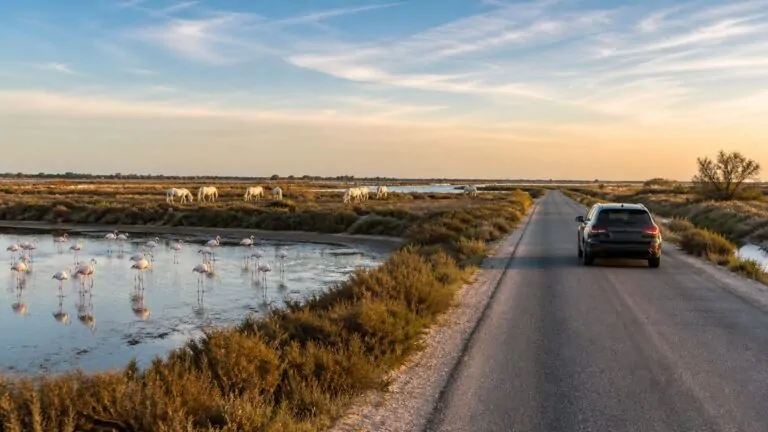
On the road between Saintes-Maries-de-la-Mer and Aigues-Mortes, the D38 runs alongside the lagoon and salt marshes, while the D570 inland takes a shorter route but offers less scenery. The choice is between an extra 20 minutes of travel and the chance to see flamingos along the way.
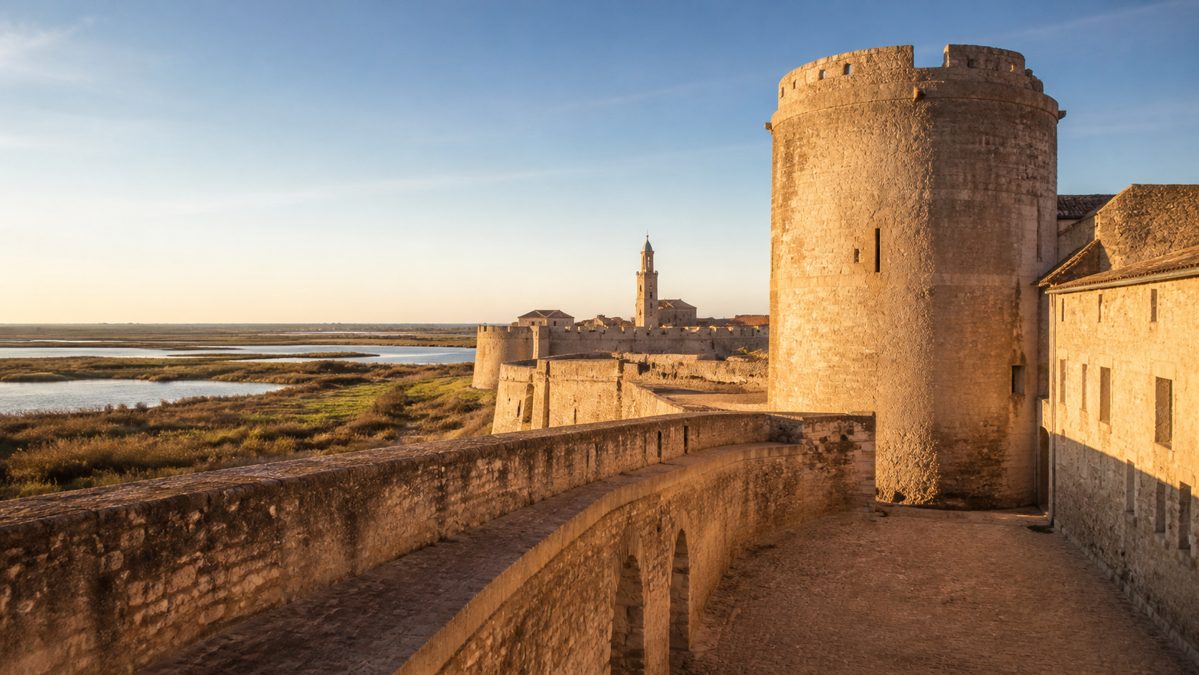
Aigues-Mortes itself can be visited on foot in half a day: the tour of the ramparts, the Place Saint-Louis and the nearby salt marshes, visible from the rampart walk, are enough to occupy the afternoon.
Vaccarès Lagoon and Salin de Giraud, the wild Camargue
For tours of 5 days or more, the Vaccarès lagoon and the hamlet of Salin de Giraud extend the route to the east. The tracks there are narrower, sometimes unpaved, which significantly increases travel times compared to the map.
Download an offline map before driving around Salin de Giraud: the mobile network is unreliable there, especially near the salt marshes.
Car or campervan: which option to choose, and for what budget?

a car remains easier in villages, especially in Saintes-Maries-de-la-Mer where spaces are scarce during peak season. A campervan eliminates the need for accommodation but requires finding suitable campsites.
- No accommodation bookings to manage every night
- Complete freedom regarding departure times
- Sleeping is possible as close as possible to the observation sites
- Higher fuel consumption
- Overnight parking is regulated on part of the coastline
- Access to the narrow streets of Aigues-Mortes is more difficult
On the budget front, diesel prices fluctuate rapidly from week to week: it's best to check the updated national average before setting off rather than relying on a fixed figure. On routes within the Camargue, tolls remain limited since most of the circuit uses toll-free departmental roads.
Parking is mainly charged in Arles, around €5 per day along the Rhône, and occasionally in Saintes-Maries-de-la-Mer during the high season.
Simulator: Estimate the road budget for your trip
The maximum blood alcohol limit remains at 0.5 g/l, as throughout France. On the narrow departmental roads running alongside the salt marshes, vigilance is more important than on a typical motorway.
When to go: the best time for a road trip in the Camargue?

Temperatures fluctuate around 12°C in winter, 20°C in April and up to 30°C in July-August, with summer mornings already close to 19°C at dawn.
Summer brings the peak tourist season and the influx of mosquitoes, which are particularly prevalent around the ponds after sunset. Spring and early autumn offer a more comfortable compromise for long walks on the trails of the bird park.
The low spring light on the salt marshes remains, for many amateur photographers, the real reason to prefer April to July in the Camargue.
Book your horseback riding or carriage ride slot as early as spring if you are aiming for a weekend in May or June: the ranches are fully booked several weeks in advance during this period.
Municipal decrees sometimes temporarily lower speed limits in the summer on certain coastal sections, particularly around Saintes-Maries-de-la-Mer. A temporary sign may therefore contradict the usual 80 km/h limit outside built-up areas.
In summary
A road trip in the Camargue is built first around the available time: a weekend is enough for Saintes-Maries-de-la-Mer and Aigues-Mortes, a week allows you to add the nature reserve and Salin de Giraud without rushing.
The choice between a car and a campervan depends mainly on the accommodation budget and tolerance for parking constraints, rather than on a real difference in the route itself.
Spring and early autumn remain the most comfortable times for long walks, away from mosquitoes and summer crowds, without sacrificing pleasant weather.
Practical questions
How long does it take to visit the Camargue in a van?
Allow at least 3 to 4 days to cover Saintes-Maries-de-la-Mer, the Pont de Gau bird sanctuary, and Aigues-Mortes without rain. A full week allows you to add Salin-de-Giraud and the Vaccarès lagoon.
Is it possible to visit the Camargue in one day?
Technically yes, if we limit ourselves to Saintes-Maries-de-la-Mer and the Pont de Gau bird park, but this leaves out Aigues-Mortes and the eastern part of the nature reserve.
Where can I park for free in the Camargue with a campervan?
Several parking areas exist on the outskirts of villages, often listed by community apps like Park4night. However, overnight parking remains prohibited or regulated along much of the protected coastline.
What is the best season for a road trip in the Camargue?
Spring and early autumn offer the best compromise between pleasant weather, low crowds and absence of mosquitoes, unlike summer which combines heat, crowds and insects around the ponds.
Should you book your accommodation in advance in the Camargue?
Yes, from spring onwards for the weekends of May and June, and absolutely in July-August: the accommodation supply remains limited around Saintes-Maries-de-la-Mer compared to the tourist traffic in the area.
