
Raspberry wine is the kind of bottle you open and suddenly everyone gathers around the glass. I discovered it at friends' place in the countryside: a ruby-red drink, very fragrant, not heavy, with that little "family cellar" feel that makes you want to go back and pick the fruit from the garden.
My version stays true to tradition: ripe raspberries, sugar, water, yeast (or a small starter culture), then patience. The trick is to maintain two simple things: impeccable hygiene (to avoid strange flavors) and fermentation at a consistent temperature. After that, it does all the work!
In terms of taste, you get something distinctly raspberry, with a hint of tartness. If you prefer less sweet drinks, you can adjust the sweetness at the final stage, but I'm giving you a classic base here that works very well.
Yes, it takes time on the calendar… but in a fast-paced kitchen, the steps are simple and quick. You macerate, you press, you let it ferment, you rack it, and you let it age peacefully.
If you're the type who enjoys "jar and bottle" projects, raspberry wine will delight you!
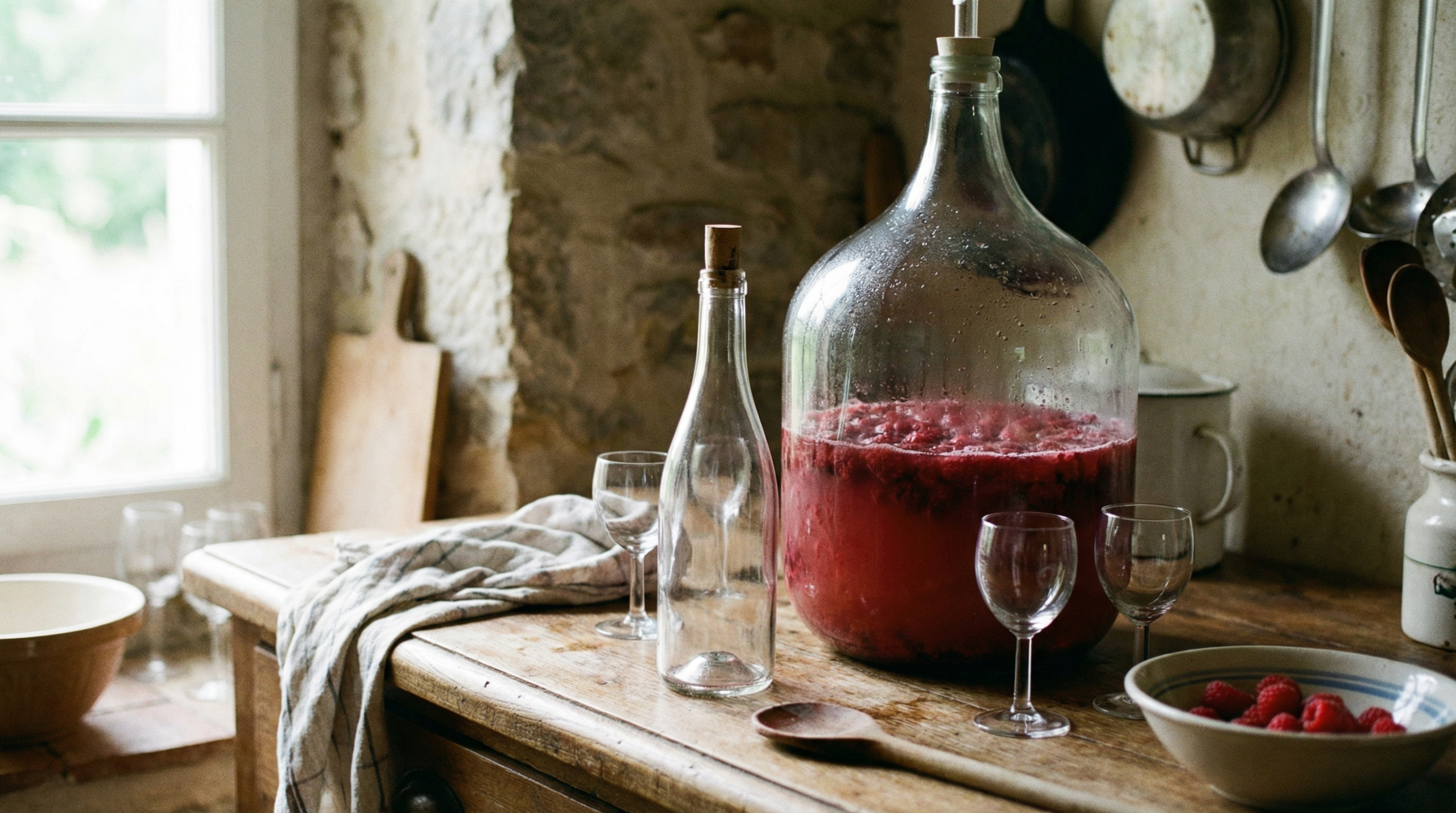

Raspberry wine
150
centiliters20
minutes300
kcalA homemade raspberry wine, fruity and fragrant, made using a combination of maceration and gentle fermentation. Perfect served chilled as an aperitif or with a red fruit dessert.
Keep your device's screen on
Ingredients
1 kg of raspberries (fresh or frozen, unsweetened)
1 L of water
600 g of sugar
2g of oenological yeast (bayanus type) or 20g of fresh baker's yeast
1 finely grated lemon zest (without the white pith)
1 pinch of cinnamon (optional but traditional in some families)
Preparation steps
- Clean and prepare: thoroughly wash all equipment (large jar or food-grade bucket, spoon, strainer, cheesecloth/muslin, bottle). If possible, boil them and then let them air dry. This is truly the key to a clean wine.
- Crush the raspberries: put the raspberries in a large bowl and roughly crush them (using a potato masher or your clean hands). You want to release the juice, not make a smooth puree.
- Make the syrup (quick): in a saucepan, heat 300ml of water with 300g of sugar just enough to dissolve (no need to boil for long). Let it cool slightly.
- Start the maceration: pour the warm syrup over the raspberries. Add the remaining water (700ml), the lemon zest and, if you like, a pinch of cinnamon. Mix.
- Inoculate: add the yeast. If you are using wine yeast, first rehydrate it for 10 minutes in a little lukewarm water (according to the instructions), then add it. Mix well.
- Primary fermentation (5 to 7 days): Cover with a clean cloth (or a non-airtight lid). Leave at 20–24°C. Stir once a day with a clean spoon to push down the fruit cap. You will see bubbles and a very fruity smell: this is normal.
- Filter and press: after 5 to 7 days, filter through a sieve and then through a cheesecloth. Press gently to extract as much juice as possible without forcing it too much (otherwise, you'll get vegetal flavors).
- Secondary fermentation (3 to 4 weeks): Pour the filtered liquid into a demijohn (or jar), filling it to the top to minimize air. Use an airlock if you have one; otherwise, use a glove with a small hole. Let it ferment at a stable temperature until it barely bubbles.
- Pour: Gently transfer (without stirring the sediment) into a clean container. Taste. Add the remaining 300g of sugar (or adjust to your taste) by dissolving it in a small glass of raspberry wine, then pouring everything back in.
- Bottling and resting: Bottle in clean bottles. Let rest in a cool, dark place for at least 1 month (2 to 3 months is even better). Serve chilled.
📊 Nutritional Information
1 serving (approx. 150ml)
| Nutrient | Value |
|---|---|
| Calories | 231 kcal |
| Proteins | 1.1g |
| Carbohydrates | 58.5g |
| including sugars | 56.0g |
| Lipids | 0.4g |
| including saturated fatty acids | 0.0g |
| Fibers | 4.0g |
| Sodium | 2mg |
| Vitamins | |
| Vitamin C | 35% AJR |
| Vitamin K | 13% AJR |
| Vitamin E | 5% AJR |
| Minerals | |
| Manganese | 0% AJR |
| Potassium | 7% AJR |
| Magnesium | 4% AJR |
* RDA = Recommended Daily Allowance
📝 Notes
Safety: If you add too much sugar and bottle too early while it's still fermenting, you risk over-pressurization. Wait until the activity drops significantly, and store the bottles in a cool place. For a more stable result, an airlock and clean racking make all the difference. This beverage should be consumed in moderation, of course!
💡 Chef's Tips
Hygiene and air quality: everything must be clean, and during secondary fermentation, fill the container to the maximum to prevent oxidation. If you have an airlock, use it; it's really handy. For clearer filtration, let it rest for 48 hours in a cool place, then rack it again before bottling.
🔄 Variations
- Sweetness adjustment: reduce the final sugar to 150–200g if you prefer a drier wine (be aware that it will keep for a slightly shorter time).
- For a more aromatic version: add 1 small clove during the maceration of the raspberry wine, then remove it when filtering.
