

In short
- ✓ First define the context: guests, time, place, duration and level of formality.
- ✓ Choose the type of buffet according to the time: lunch, dinner, cold or breakfast.
- ✓ Allow approximately 10 to 14 savory pieces per person for a cocktail dinner.
- ✓ Always provide vegetarian, gluten-free and alcohol-free options.
- ✓ A reverse schedule and a good caterer ensure the entire organization runs smoothly.
Do you need to organize a meal for your colleagues or clients and you don't know where to start?
Organizing a corporate buffet relies on a few simple decisions: the number of guests, the format, the menu, and the budget. Because when well-planned, this event strengthens team cohesion and makes a seminar, product launch, or client meeting a truly memorable occasion.
This practical article reviews every aspect of the catering process, from the quantities to plan to choosing a caterer, to help you avoid shortages, waste, and last-minute stress!
Define the context of your company buffet

Before thinking about the menu, lay the groundwork.
Indeed, the context conditions all the choices that follow: type of buffet, quantities, budget and logistics, then a team lunch of 15 people has nothing to do with a client cocktail of 120 guests.
The earlier you define these parameters, the smoother the rest of the organization of the corporate buffet will become, and this is also what caterers will ask you first when providing a quote.
In large cities, a variety of specialized service providers (such as catering buffets in Paris or its suburbs) offer turnkey solutions. This eliminates the need to organize all the logistics!
The number of guests, time, location and duration
Start by estimating the number of guests with a reasonable margin, e.g. with an internal registration system which will help to make this figure more reliable.
Note the precise time, the expected duration, and the exact location.
A meeting room, an open space or a terrace do not impose the same constraints in terms of access, electricity or circulation.
The duration directly influences the quantities: a one-hour cocktail party is managed differently from a three-hour open buffet.
The format and level of formality of the event
A relaxed after-work event does not call for the same presentation as an official client reception, so define the level of formality above all: it guides the style of the dishes, the tableware and the service.
For a standing format such as finger food, opt for pieces that are easy to grab; however, for a seated or semi-seated meal, provide plates and a suitable space.
The format thus determines the staffing requirements in the dining room.
Clearly define the objective of the professional buffet
A buffet is never just about food, because it serves a purpose: to unite a team, thank clients, celebrate a result or facilitate networking.
Clarifying this goal will help you arbitrate, and to encourage interaction, a standing format with multiple circulation points works better than a static seated meal.
To enhance the company's image, quality and presentation take precedence over quantity, and this objective will guide every subsequent decision.
Choosing the right type of buffet for the occasion
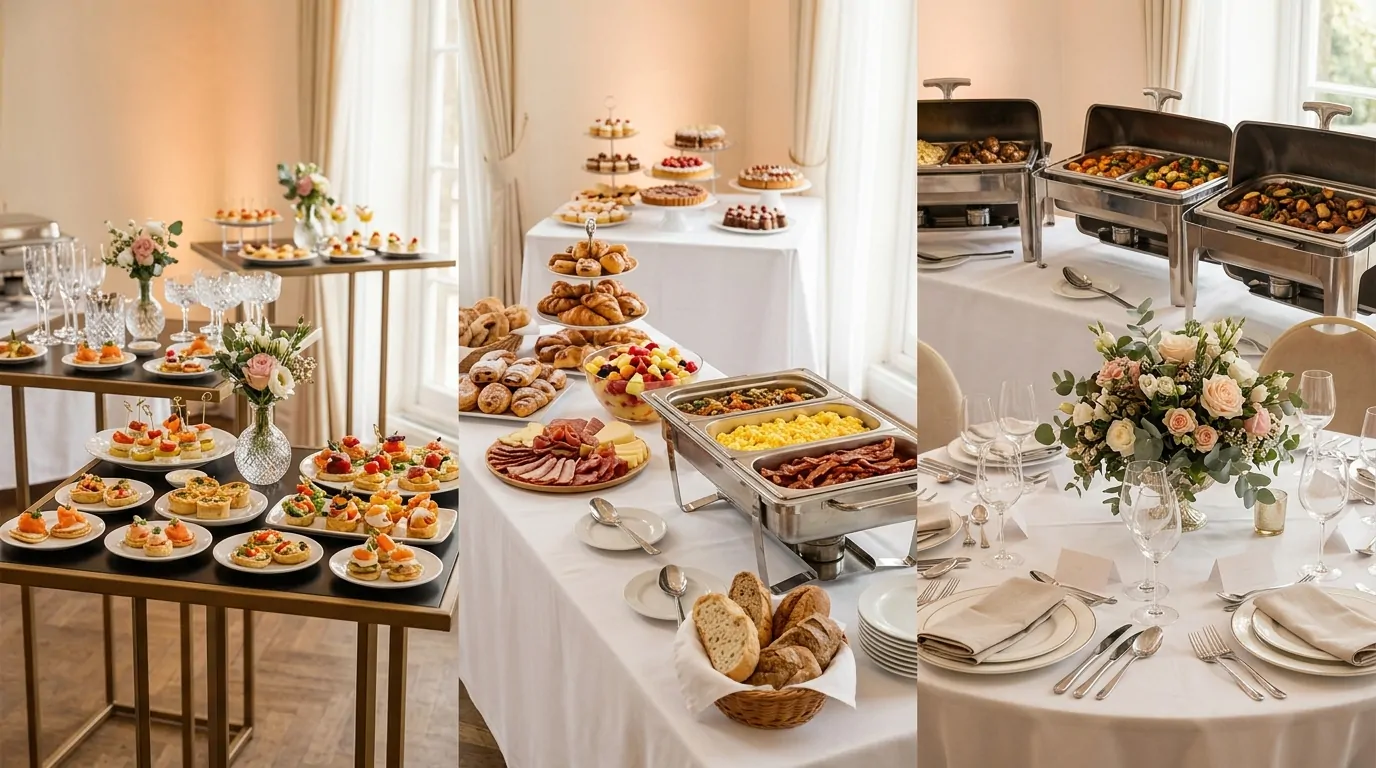
The right format depends on the time of day and the nature of the event.
Here is a quick comparison to help you get your bearings before going into detail.
| Buffet type | Perfect moment | Occasion |
|---|---|---|
| Breakfast | Morning | Meeting, kick-off, training |
| Lunch | Noon | Long meeting, workshop |
| Dinner | Evening | Seminar, client evening |
| Cold buffet | Variable | Event without on-site catering |
The company lunch buffet
A buffet lunch in a company setting replaces the traditional lunch during a meeting that lasts all day. It combines substantial savory dishes, salads, and a dessert.
This format allows participants to serve themselves at their own pace without interrupting the work, so plan for nourishing items: quiches, wraps, composed salads.
It's a practical solution for workshops and training sessions where time is limited.
The dinner buffet for a seminar
The dinner buffet for a seminar is enjoyed standing up, in the evening, in a more convivial atmosphere, and it consists of many varied small pieces, both hot and cold.
This format encourages interaction and networking.
Plan for more pieces than a cocktail reception, as it serves as a full dinner, plus the hot bites provide comfort at the end of the day, after the conferences.
🧮 Quantity calculator for your company buffet
Cold buffet for a corporate event
A cold buffet for a corporate event is the ideal solution when no kitchen is available on site. Everything is prepared in advance and delivered ready to serve.
Charcuterie platters, salads, verrines, gourmet sandwiches: this format simplifies logistics.
It limits the constraints of keeping things warm and remains safe from a health perspective if the cold chain is respected, which is ideal for atypical or outdoor locations.
Breakfast and mixed meal deals at the office
For a morning kick-off meeting or training session, breakfast is a welcome option: pastries, fresh fruit, juice, and hot drinks. Easy to organize, it sets a relaxed atmosphere right from the start.
Mixed packages combine several elements, for example a welcome breakfast followed by a lunch buffet, but an individual corporate meal box can also complement the offer when participants are dispersed or mobile…
Our menu ideas for a friendly buffet
Here are some menu ideas for a company buffet that will appeal to a wide range of people. The golden rule: vary the flavors, textures, and colors for a balanced and enjoyable office buffet menu.
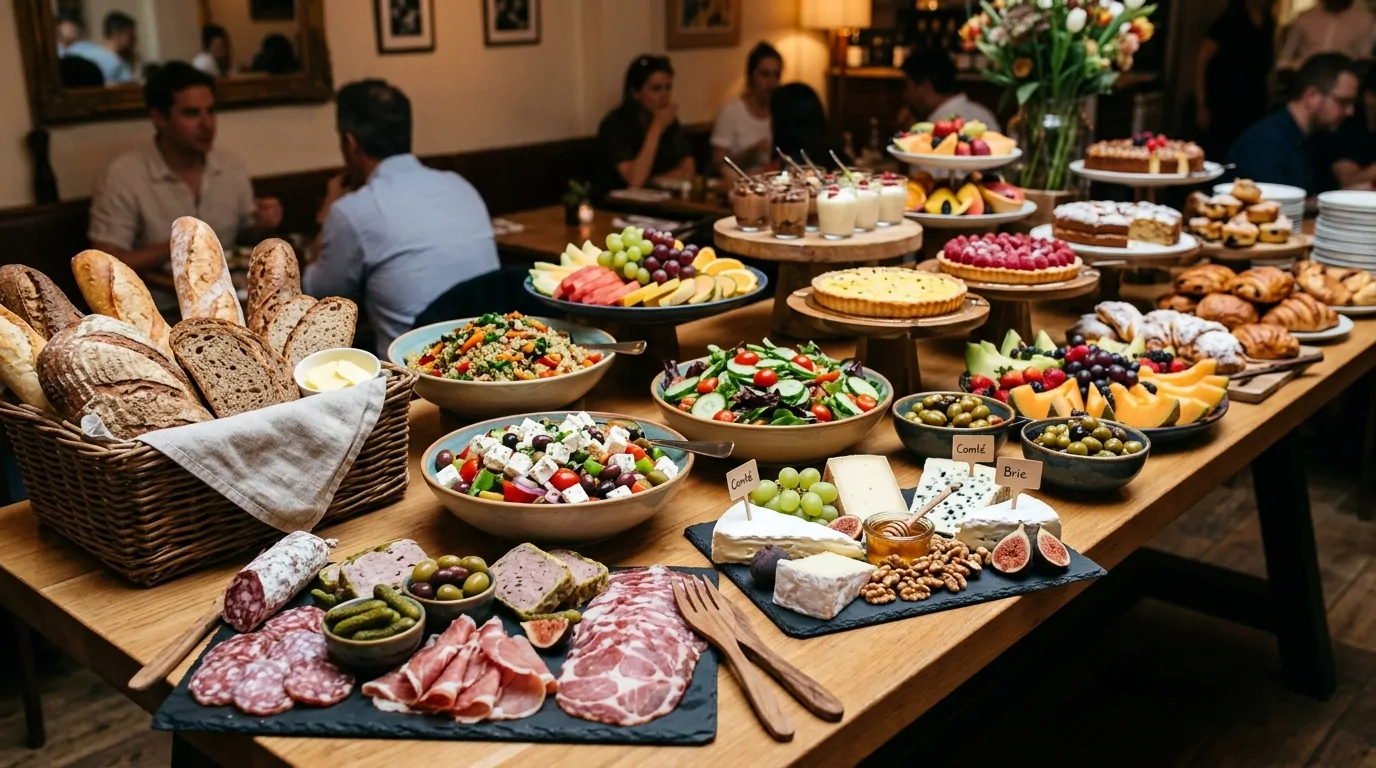
Remember to balance the hot and cold items, and the sweet and savory options, depending on the format chosen, because diversity is just as important as quantity.
Savory dishes, platters, and salads to plan for
The heart of the buffet lies in the savory items, so you will need to focus on variety to satisfy all tastes.
- Mini sandwiches, wraps and gourmet club sandwiches
- Cold verrines (salmon, vegetables, cream cheese)
- Charcuterie and cheese platters
- Mixed salads (tabbouleh, quinoa, pasta, Caesar)
- Hot appetizers: mini quiches, samosas, kebabs
To calibrate a charcuterie platter, our few guidelines on the quantity of charcuterie for your guests will give you a reliable basis.
Vegetarian and gluten-free options
Never treat vegetarian and gluten-free options as a minor detail. Some of your guests depend on them, and an inclusive buffet projects a polished image.
Offer vegetable verrines, hummus, falafels, legume salads and vegetarian wraps.
For gluten-free options, opt for raw vegetables, rice or quinoa salads and clearly labeled snacks, remembering to keep these preparations separate to avoid any cross-contamination.
Indulgent desserts to end the meal
A sweet touch always nicely concludes the meal, but opt for small pieces that are easy to eat standing up.
- Mini pastries and macarons
- Fresh fruit verrines
- Fruit skewers
- Cookies, financiers and madeleines
Also consider a less sweet option, such as a fruit salad, for those watching their diet. Two to three sweet treats per person are usually sufficient.
Non-alcoholic drinks and alternatives
Drinks deserve as much attention as food! So don't hesitate to provide plenty of still and sparkling water, fruit juices and soft drinks.
Alcohol-free alternatives are not optional: non-alcoholic cocktails, artisanal lemonades, iced tea, and for a daytime event, coffee and tea are still expected.
If alcohol is served, stay sober (wine, beer) and limit the volumes, the professional setting requires it.
What quantities should I allow per person?

The question of how much food to prepare for a company buffet is the one that generates the most anxiety. Too much is wasteful; too little will be embarrassing in front of the guests.
Here are some concrete guidelines to help you aim accurately, which can be adjusted according to your audience and the duration of the event.
| Moment | Savory dishes / pers. | Sweet treats / pers. |
|---|---|---|
| Breakfast | 2 to 3 pastries | 1 piece of fruit + 1 sweet treat |
| Lunch | 8 to 10 | 2 to 3 |
| Aperitif cocktail | 6 to 8 | 1 to 2 |
| Full dinner | 12 to 14 | 2 to 3 |
Reference quantities according to the time of day
The time of day changes everything, because it is obvious that a one-hour cocktail reception requires fewer items than a dinner buffet intended to replace dinner.
Allow approximately 10 to 14 savory pieces per person for a full dinner, compared to 6 to 8 for a simple aperitif, and for drinks, plan 3 to 4 glasses per person for an evening.
For rice-based dishes like paella, our guidelines on rice quantities per person might be helpful.
Adjust portion sizes according to the number of participants
The larger the group, the more you can smooth out the margins, since over 100 people, individual differences statistically cancel each other out.
For a small group of 10 to 15 people, it's better to have a slightly larger margin to avoid running out.
Consider the profile: a young audience or field teams often eat more than a mid-morning management meeting.
A safety margin of 5 to 10% on the number of guests avoids the unpleasant surprise of last-minute registrations, without turning into waste.
Avoid shortages and limit waste
Food waste is a real issue, including in the workplace.
In its various recommendations, ADEME highlights the scale of food waste in France and the importance of better sizing orders.
To limit waste, measure as precisely as possible, provide containers for leftovers and discuss with your caterer an adjustable delivery.
Professionals recommend restocking gradually rather than buying everything at once!
Don't put out all the dishes at once. Gradual replenishment keeps the buffet appetizing and reduces waste at the end of the event.
Managing dietary restrictions and practical aspects
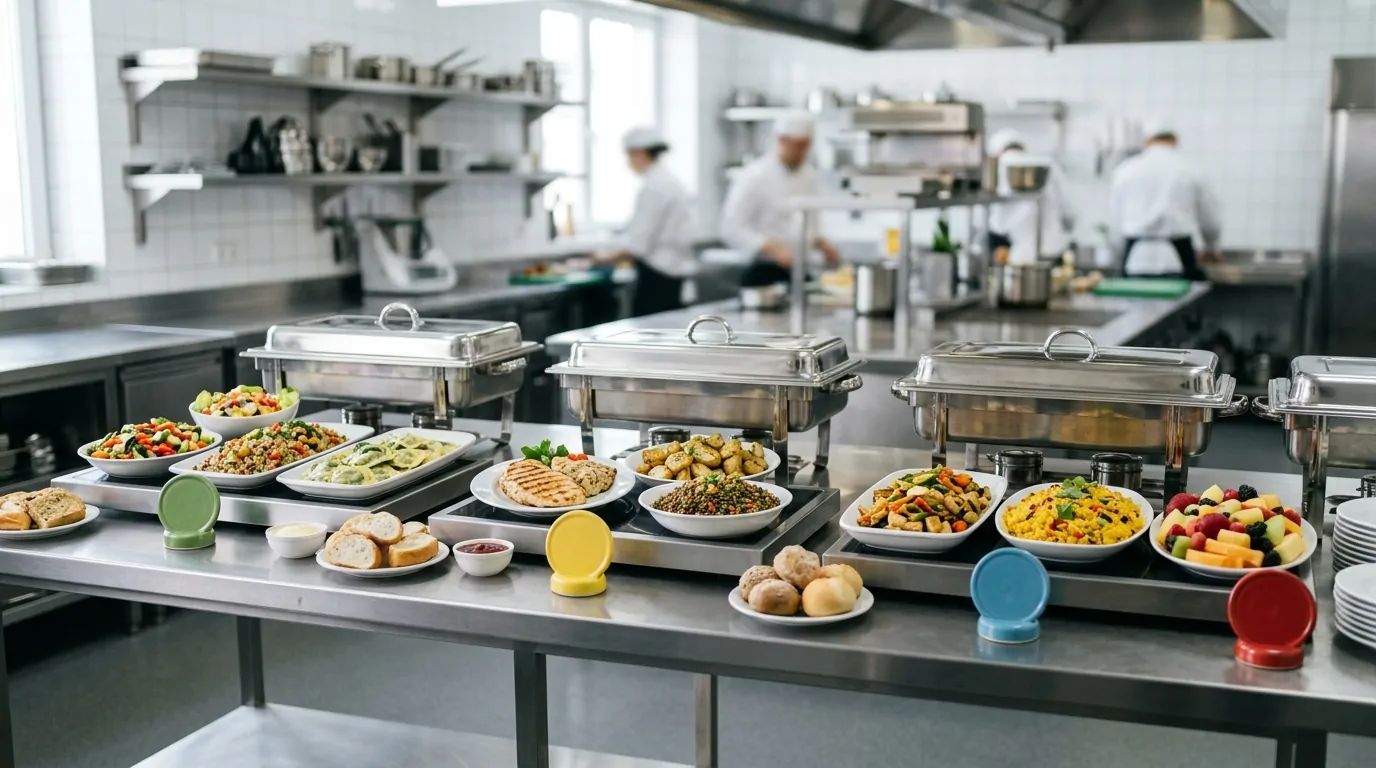
A successful buffet anticipates constraints, such as allergies, diets and service logistics, which are an integral part of the organization, not details to be dealt with on the day.
These aspects protect your guests and the company's image. It's best to discuss them with your service provider beforehand.
Allergies, special diets and labelling
List any allergies and specific dietary requirements using the registration form. Gluten, nuts, lactose, as well as halal, kosher, or vegan are frequently mentioned.
Allergen labeling is regulated, and the official allergen information framework of the DGCCRF details the 14 allergens to be reported.
In this context, remember to ask your caterer for clear labels on each dish.
The tableware, access and movement around the buffet
Consider the traffic around the buffet with a table accessible from both sides, which will double the throughput and avoid queues.
Provide dishes, napkins, cutlery and drop-off points for used plates.
Also check the access for delivery: elevator, floor, carrying distance. This is always important.
Using a tablecloth and a clear seating plan will make both serving and cleaning up easier.
Keeping food fresh and warm
Food safety is non-negotiable! Therefore, cold dishes must absolutely remain below 4°C and hot dishes above 63°C.
Use chilled containers for verrines and charcuterie, chafing dishes or bain-maries for hot items.
Do not leave the food at room temperature for more than two hours. Logically, a cold buffet will naturally limit these risks.
Collect dietary restrictions at least one week before the event and provide them to the caterer along with the final number of guests.
Properly organize and budget your company buffet

The organization distinguishes between a smooth buffet and a chaotic event. Therefore, method, anticipation, and a good service provider will make all the difference.
Here's how you can structure your preparation and keep costs under control, step by step.
Building an effective reverse timeline
A reverse timeline helps prevent oversights. Start with the date of the event and work backwards.
- 3 to 4 weeks before : define the format, send out invitations, request quotes
- Two weeks before departure : confirm the caterer and the menu
- One week before departure : confirm the number of guests and any restrictions
- Two days to go : prepare the venue and logistics
- D-Day : reception, setup, service
Choosing the best caterer for your buffet
Choosing a caterer for a company buffet determines the overall quality, so compare several quotes, check references and the ability to handle your volume.
User feedback shows that delivery, adherence to schedules, and flexibility on diets are just as important as taste.
If you are in Île-de-France for example, you will find very good artisans, and you can easily order the right catering buffet in Paris which will simplify your logistics thanks to its turnkey delivery.
Also remember to ask if the dishes and the removal of the equipment are included.
Controlling your corporate buffet budget
The budget for a company buffet is estimated by the cost per person, and you should expect to pay on average €10 to €20 per person for a simple format, and €25 to €45 for an elaborate dinner.
- Friendliness and team cohesion
- Flexible format, everyone helps themselves freely
- Suitable for all budgets
- Neat image with clients
- Logistics to anticipate
- Risk of waste if incorrectly calibrated
- Health restrictions to be observed
- Cost varies depending on the service provider
The setup, presentation and storage
The setup begins with a coherent seating plan: starters on one side, main courses in the center, desserts and drinks off to the side to facilitate the flow of people.
Pay attention to presentation with varying heights and a clean tablecloth. Plan the cleanup phase from the start: bin bags, containers for leftovers, return of equipment to the caterer.
These principles also apply to organizing a birthday buffet at home, or any other event of this type.
Liven up and personalize your professional buffet
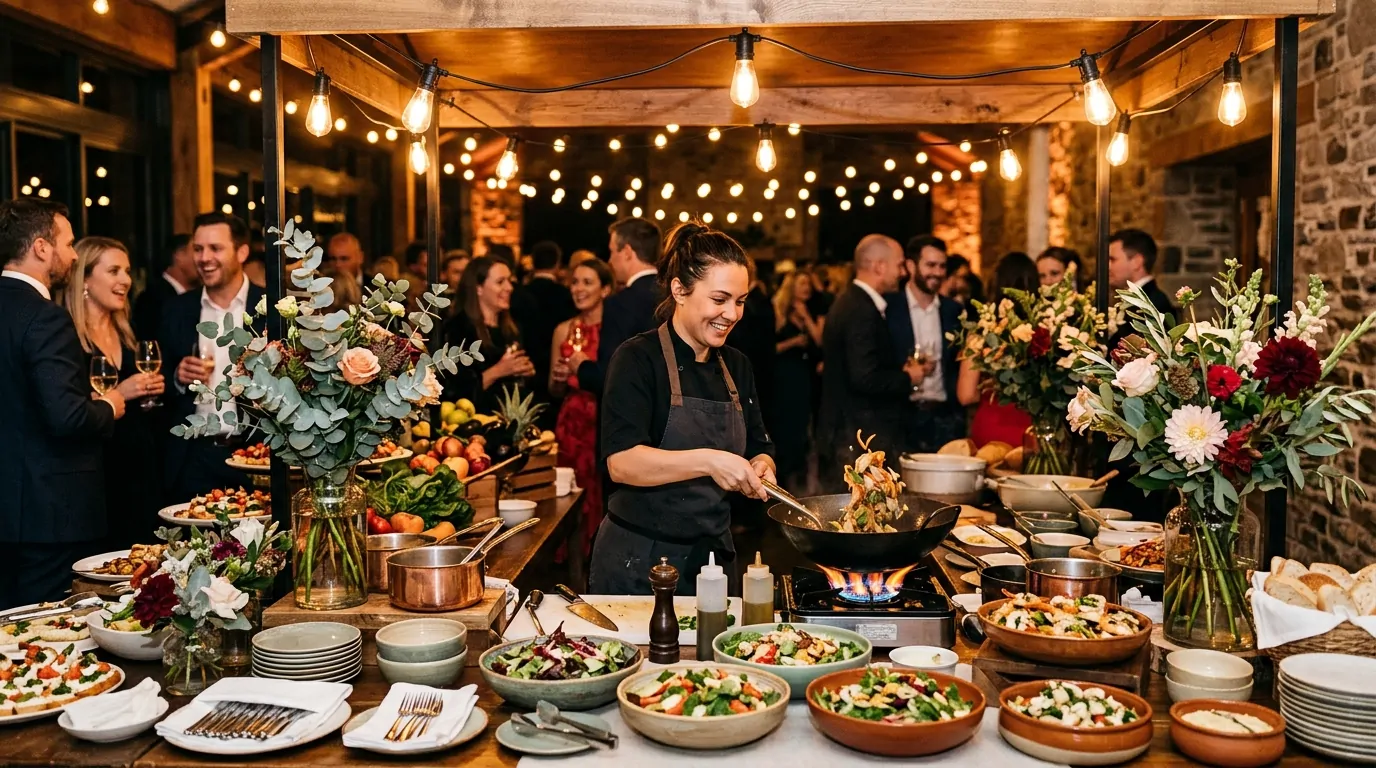
Beyond the meal itself, a few touches can transform a decent buffet into a memorable moment, and personalization often helps to reinforce the company's message.
Here's how to make your professional buffet more lively and convivial.
Culinary demonstrations for a professional event
entertainment at a professional event creates interaction and surprise, as it energizes a cocktail party or seminar.
Here are some ideas:
- The carving bar (ham, salmon)
- The live cooking stand (woks, griddle)
- The alcohol-free mixology workshop
- The customizable dessert bar
These stands will attract guests, they will set the rhythm of the evening and provide a natural topic of conversation.
Pay close attention to presentation and creating a welcoming atmosphere
The presentation sends a message even before the first bite; moreover, a beautiful table setting enhances the brand image.
Play with the supports (slates, wooden trays, transparent glass containers), the colors and careful lighting.
A few touches of the company colors, without being excessive, reinforce the identity. Also, a friendly atmosphere arises from a space where people can move around and talk easily.
An easy-to-organize corporate buffet
a successful corporate buffet can be summed up in three words: planning ahead, a good caterer, and clear guidelines. By following a reverse timeline and carefully planning quantities, you'll avoid most of the pitfalls.
Our advice for a successful professional buffet can be summed up as listening to your guests, taking care of dietary restrictions and delegating the logistics to a reliable caterer.
The rest is just about having a good time!
Keep a summary sheet of each buffet (number of guests, quantities, returns) to refine your orders for future events.
Practical questions
How many pieces should be allowed per person for a buffet?
It depends on the format. For a cocktail reception, allow 6 to 8 pieces per person. For a buffet dinner that replaces the main meal, plan for 12 to 14 pieces. Adjust according to the duration and the guests' preferences.
What is the difference between a lunch buffet and a dinner buffet?
The lunch buffet is served at midday and offers more substantial dishes to serve as a lunch. The dinner buffet is enjoyed standing up in the evening, with many varied small bites, and serves as a full dinner during a seminar.
How to manage food allergies at a company buffet?
Record allergies through registration, pass this information on to the caterer, and require clear labeling for each dish. All 14 major allergens must be listed. Keep gluten-free and vegetarian options separate to prevent cross-contamination.
What budget should be allocated per person for a company buffet?
The budget for a company buffet is generally between €10 and €20 per person for a simple option, and between €25 and €45 for a more elaborate dinner. The price varies depending on the caterer, the menu, the service, and whether or not tableware is included.
How far in advance should you order a buffet for a business event?
It is advisable to request quotes three to four weeks before the event and to confirm the caterer approximately two weeks prior. The final number of guests and any dietary restrictions should ideally be confirmed one week before the event.
