Explore Switzerland
1 destination to discover
Everything about Switzerland
Traveling to Switzerland means stepping into a country where the landscape itself feels almost too perfect — glaciated peaks, mirror-still lakes, and medieval town centers that have barely changed in centuries.
This small Alpine nation packs extraordinary variety into just 41,285 km². Four official languages, twenty-six cantons, and dramatically different regions make every visit feel like crossing multiple borders without ever showing a passport.
Visiting Switzerland rewards those who pay attention to the details: the cowbells echoing across high pastures, the precise timing of Swiss trains, the way a cheese fondue tastes different on either side of the Rösti Divide.
Why travel to Switzerland?
What sets Switzerland apart from other destinations
Switzerland runs with a kind of quiet confidence. Infrastructure is world-class, nature is protected and accessible, and even the smallest villages feel genuinely cared for.
The country sits at the crossroads of Germanic, French, and Italian cultures. That cultural layering produces a destination that resists easy categorization — and rewards return visits.
The Swiss Alps draw skiers, hikers, and climbers from every continent. Yet mountain scenery is only one layer of what Switzerland has to give travelers.
Switzerland at a glance
Switzerland has a population of approximately 8.9 million people spread across 41,285 km². It borders France, Germany, Austria, Liechtenstein, and Italy.
The country has four national languages: German (spoken by roughly 63%), French (23%), Italian (8%), and Romansh (less than 1%).
Berne is the federal capital. Zürich is the financial hub, Geneva the diplomatic center. The currency is the Swiss franc (CHF), one of the world's most stable.
Regions and cities to explore
The main regions of Switzerland
German-speaking Switzerland covers the north and center of the country. It includes Zürich, Lucerne, and the dramatic Bernese Oberland, home to the Eiger, Mönch, and Jungfrau peaks.
French-speaking Romandy stretches along Lake Geneva and Lake Neuchâtel. Geneva, Lausanne, and the Lavaux wine terraces define this region's elegant, Francophone character.
Italian-speaking Ticino in the south feels like a different country entirely — palm trees, lake promenades, and Italianate architecture under a distinctly Mediterranean light.
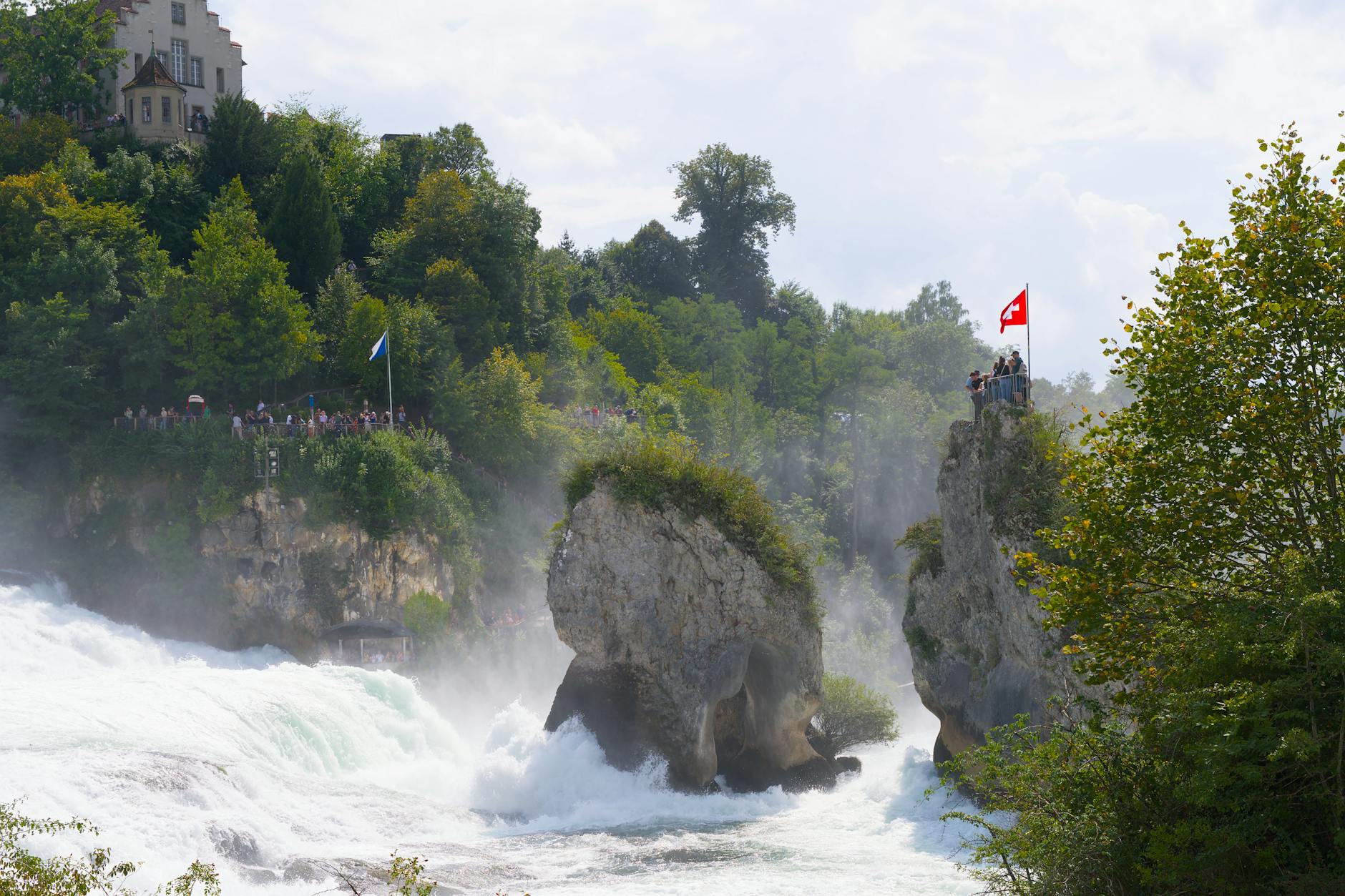
The Graubünden region in the east is Switzerland's largest canton and its most multilingual. Davos, St. Moritz, and the Engadine Valley sit here, along with Romansh-speaking villages that date back centuries.
Which cities should you visit?
Berne, the federal capital, surprises visitors with its six kilometers of sandstone arcades and its slow, confident pace. The medieval old town is a UNESCO World Heritage Site.
Basel (Bâle) punches well above its size in cultural terms. It hosts Art Basel, the world's leading contemporary art fair, and has more museums per capita than almost any other European city.
Geneva operates as a genuinely international city — home to the United Nations European headquarters and the International Red Cross. The Jet d'Eau fountain shoots water 140 meters above Lake Geneva.
Lausanne climbs steeply above Lake Geneva in terraced layers. It hosts the International Olympic Committee and has one of Switzerland's most vibrant student populations.
Interlaken sits between Lake Thun and Lake Brienz, perfectly positioned as the gateway to Jungfrau Region. Paragliding, canyoning, and skydiving operators line its main street.
Davos is known internationally for its annual World Economic Forum, but it also ranks among Europe's highest-altitude ski resorts at 1,560 meters, connected to the vast Parsenn ski area.
Culture, traditions and way of life
Swiss culture is not a single thing. It shifts noticeably as you travel from canton to canton, from language region to language region.
The Rösti Divide — the informal cultural border between German and French Switzerland — shapes everything from political attitudes to meal times and architectural styles.
Civic life matters deeply here. Switzerland uses direct democracy more extensively than any other country, with citizens regularly voting on national referendums. Local guides note that this system produces a population genuinely engaged with governance.
Traditional festivals remain alive and unselfconscious. The Fasnacht carnival in Basel draws 20,000 participants in elaborate masks and costumes for three days of lantern-lit processions starting at 4 a.m.
Alphorn performances, flag throwing, and Schwingen (Swiss wrestling) continue as living traditions rather than tourist performances, particularly in rural cantons during summer festivals.
Punctuality is a genuine cultural value. Trains depart to the second. Meetings start exactly on time. Visitor reviews consistently confirm that this precision extends to daily life in a way that feels effortless rather than rigid.
Art and architecture flourish alongside tradition. Swiss designers, from Le Corbusier to contemporary architects like Peter Zumthor, have shaped global visual culture far beyond the country's modest size.
Food: the flavors of Switzerland
Swiss food is hearty, seasonal, and deeply regional. What the locals eat in Zürich differs significantly from what appears on tables in Lugano or Geneva.
Fondue and raclette are the most internationally recognized dishes — melted cheese served communally, best eaten in a mountain hut after a cold afternoon of hiking or skiing.
Rösti, a crispy pan-fried potato cake, comes from the German-speaking region and appears as a side dish across the country. In Ticino, polenta replaces potatoes entirely.
Zürcher Geschnetzeltes — thin-sliced veal in a cream and white wine sauce — represents the refined, Germanic side of Swiss cooking. It is traditionally served with rösti.
Swiss chocolate is world-famous for good reason. Lindt, Toblerone, and Läderach all come from here, but local guides recommend seeking out small confiseries in Berne or Basel for single-origin bars and hand-rolled truffles.
Swiss wine remains largely unknown outside the country because almost all production is consumed domestically. The Lavaux terraced vineyards above Lake Geneva produce exceptional Chasselas whites, best tasted in a local cave (wine cellar).
Expect meals to run expensive by European standards. A restaurant lunch in Geneva or Zürich averages CHF 25–40 per person before drinks. Market halls and boulangeries provide more affordable options in every city.
Practical information
Visa and entry requirements
Switzerland is part of the Schengen Area. Citizens of EU countries, the UK, USA, Canada, Australia, and many other nations can enter visa-free for stays up to 90 days within a 180-day period.
Travelers from countries outside the Schengen visa-waiver list must apply for a Schengen visa before arrival. Always verify entry requirements with the Swiss embassy in your home country, as rules update regularly.
From 2025, ETIAS (European Travel Information and Authorization System) will be required for visa-exempt non-EU visitors. Check current implementation dates before booking.
Budget and cost of living
Switzerland consistently ranks among the most expensive countries in the world. Budget travelers spending carefully should plan for at least CHF 150–200 per day, covering a hostel bed, transit, and modest meals.
Mid-range travelers typically spend CHF 300–500 per day for a comfortable hotel, restaurant meals, and activity entry fees. Mountain transport — cable cars, cogwheel trains — adds up quickly and should be budgeted separately.
The Swiss Travel Pass grants unlimited travel on trains, buses, and boats across the national network. It pays for itself quickly for travelers covering multiple cities, with prices starting around CHF 244 for three days.
Getting around
Swiss public transport is arguably the finest network in the world. Trains connect virtually every town, run on time with near-perfect reliability, and pass through scenery that makes the journey itself worthwhile.
The Glacier Express between Zermatt and St. Moritz and the Bernina Express between Chur and Tirano are two panoramic rail journeys that traveler reviews consistently place among Europe's best.
Renting a car makes sense for exploring Graubünden's mountain valleys or the quieter corners of Ticino. Mountain roads are well-maintained but require a motorway vignette sticker (around CHF 40) for highway use.
When to visit Switzerland?
Switzerland genuinely works as a year-round destination. Each season delivers a distinct and compelling version of the country.
Winter (December–March) is prime ski season. Resorts like Davos, Verbier, Zermatt, and St. Moritz draw international visitors seeking reliable snow above 1,500 meters. Expect peak prices and advance booking.
Spring (April–May) brings wildflowers to Alpine meadows and fewer crowds to major sites. Some high mountain passes remain closed until late May, but valley walks and cities are at their most pleasant.
Summer (June–August) is the most popular season. Hiking trails open fully above 2,000 meters, lakes warm enough for swimming, and mountain festivals fill village squares every weekend. Temperatures in lowland cities reach 25–30°C.
Autumn (September–October) is arguably the finest time to visit. Crowds thin dramatically after late August, grape harvests color the vineyard slopes, and the air carries unusual clarity. Local guides often call September their favorite month.
Avoid visiting major resorts like Interlaken or Lucerne during Chinese Golden Week (early October) and major European school holiday periods if quieter experiences are the priority. Shoulder seasons consistently reward those who plan ahead.
Frequently Asked Questions about Switzerland
Similar Destinations
Explore more destinations in the same region of the world.
Krakow
Krakow, Poland's medieval capital, draws travelers with the royal grandeur of Wawel Castle, the vast beauty…
DiscoverVienna
Vienna, Austria reigns across Europe's grand capitals, from the gilded halls of Schönbrunn Palace to the…
DiscoverPrague
Prague, Czech Republic, casts Gothic spires, Baroque domes and riverside views around Charles Bridge, with…
Discover