Nice

Everything about Nice
What if one of Europe's most glamorous coastlines was also genuinely affordable? Visiting Nice rewards travelers who look past the yacht-dotted harbor and discover a city that lives and breathes at street level.
Tucked between the Alps and the Mediterranean, Nice sits at a crossroads of French and Italian culture. The result is a city with its own dialect, its own cuisine, and its own stubborn personality.
From baroque churches painted in saffron and terracotta to a seafront that stretches for nearly 7 kilometers, Nice packs a remarkable amount of variety into a compact, walkable space.
Why visit Nice?
What makes Nice unique
Nice is not just another French Riviera stop. It was an independent city-state for centuries and only became part of France in 1860, which explains its distinct Niçois identity.
The layered history of Nice shows up in unexpected ways: street signs still appear in both French and Niçard, a local Occitan dialect spoken by a small but proud community.
The light here is famously different. Painters like Matisse and Chagall relocated to Nice for a reason: the quality of Mediterranean sunlight that bounces off white limestone and pale blue water is simply unlike anywhere else in France.
Nice at a glance
Nice is the fifth-largest city in France, with a population of around 340,000. It anchors the Alpes-Maritimes department and serves as the unofficial capital of the French Riviera.
The compact city center makes it ideal for visitors who prefer walking over relying on taxis. Most major highlights sit within 30 minutes of each other on foot.
The city runs a modern tram network, has a major international airport just 6 kilometers from the center, and hosts millions of visitors annually without feeling overwhelmed outside peak summer weeks.
What to see and do in Nice?
Promenade des Anglais
The Promenade des Anglais stretches along the Bay of Angels for nearly 7 kilometers, lined with palm trees, grand Belle Époque hotels, and the pebble beach that defines Nice's waterfront identity.
The name traces back to the early 19th century, when English aristocrats wintering in the city funded the construction of this coastal walkway. That history remains visible in the architecture along its length.
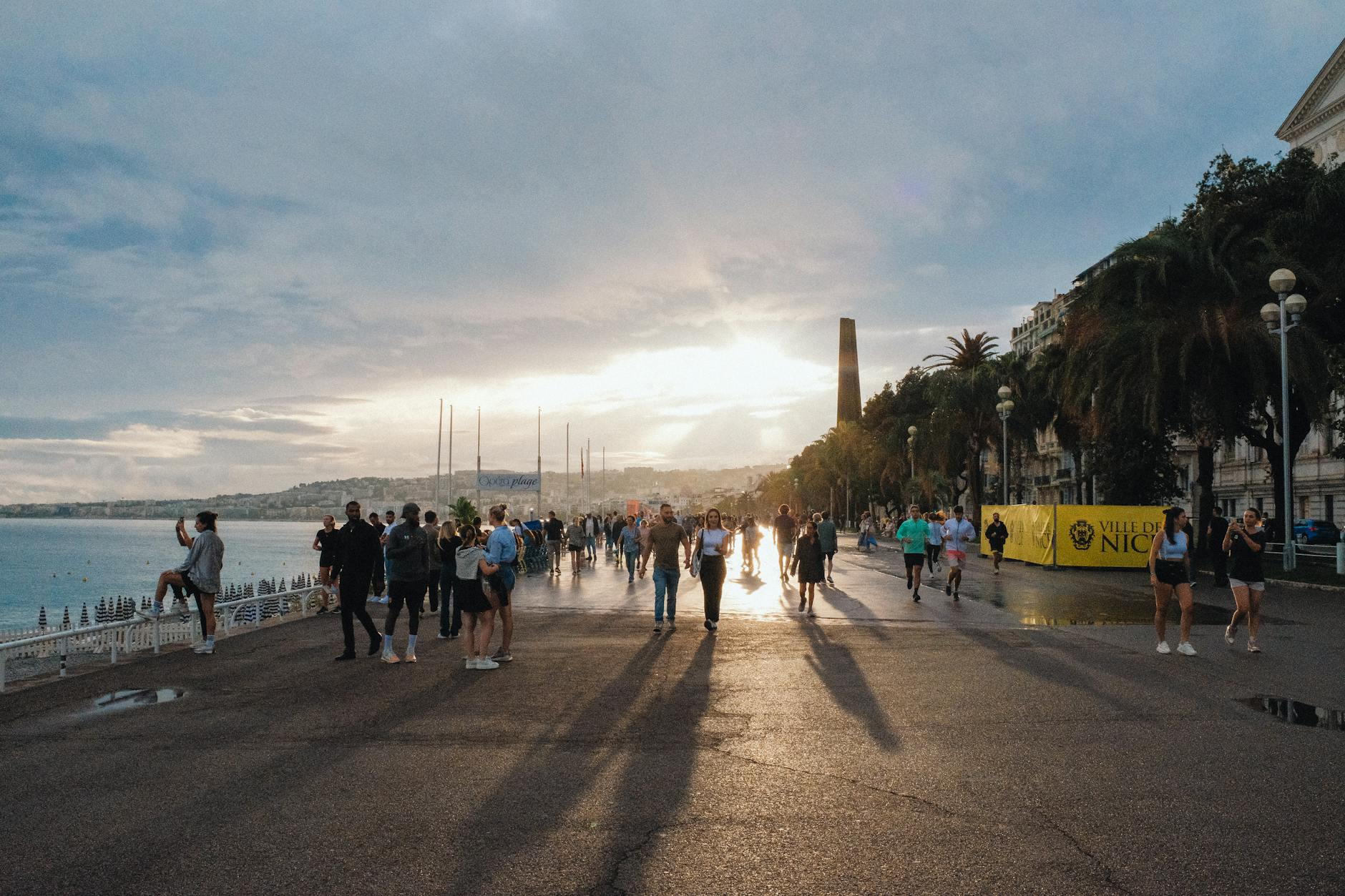
Mornings on the Promenade belong to joggers and cyclists. By afternoon, the beach fills with sunbathers renting cushioned loungers from private beach clubs or spreading towels on the public sections at no cost.
The iconic blue chairs placed along the seafront are a beloved local detail. They invite visitors to simply sit, face the sea, and watch the light shift across the water. No agenda required.
Old Town (Vieux-Nice)
Vieux-Nice is a tightly packed labyrinth of narrow streets, Baroque churches, and facades painted in deep ochre, burnt sienna, and faded rose. It looks more like Liguria than mainland France, which is entirely the point.
The Baroque cathedral of Sainte-Réparate, completed in 1699, anchors the old quarter's main square. Its ornate interior rewards a quiet five-minute visit even for travelers with little interest in religious architecture.
Local guides recommend arriving before 9am to see the neighborhood before the tourist foot traffic builds. The light on the narrow alleys at that hour is genuinely spectacular.
Street food is abundant here. Socca, a chickpea flour pancake cooked in a wood-fired oven, is sold from market stalls and tiny windows throughout the quarter. It costs a few euros and tastes unmistakably local.
Castle Hill
Castle Hill (Colline du Château) rises 92 meters above the seafront and rewards the climb with panoramic views stretching across the Bay of Angels to the west and the port of Nice to the east.
Despite the name, no castle remains standing. The fortifications were demolished by Louis XIV in 1706. What survives is a well-maintained public park, a waterfall, several viewpoint terraces, and a quiet cemetery of remarkable beauty.
Visitor reviews consistently flag this as one of the best free experiences in the city. An elevator runs from the seafront near the eastern end of the Promenade, making the ascent accessible for all fitness levels.
Sunset from the upper terraces turns the terracotta rooftops of Vieux-Nice into something close to cinematic. Local guides recommend arriving at least 45 minutes before dusk to secure a spot on the main panoramic terrace.
Cours Saleya Market
The Cours Saleya flower and food market runs every morning except Monday in the heart of Vieux-Nice. It is one of the most vibrant open-air markets in all of southern France, and locals actually use it rather than treating it as a tourist attraction.
Flower stalls give way to produce vendors selling fat tomatoes, zucchini blossoms, basil by the bunch, and olives from barrels. The color and smell hit simultaneously the moment you round the corner into the square.
Monday mornings bring an antique and flea market to the same space, worth browsing for vintage ceramics and old postcards. Traders arrive early and the best pieces move fast.
Several small cafes line the edges of the square. Sitting with a coffee while the market sets up around you, just before 8am, is one of those experiences that traveler reviews describe as quietly unforgettable.
Food and local cuisine in Nice
Niçois cuisine is a category of its own, shaped by proximity to Italy and centuries of independent identity. It does not simply imitate Provençal cooking.
Socca is the street food anchor of the city: a thin, crispy pancake made from chickpea flour, olive oil, and black pepper. It is baked in large copper pans and served hot, usually eaten standing up near the market.
Salade niçoise in its authentic form bears little resemblance to the international version. The local interpretation uses raw vegetables, hard-boiled eggs, anchovies, and tuna but never cooked green beans or boiled potatoes. Locals are firm on this distinction.
Pan bagnat is the city's iconic sandwich: a round bread roll soaked in olive oil and packed with the same ingredients as a salade niçoise. It travels well and costs around three to four euros from market stalls.
For a sit-down meal, daube niçoise (a slow-braised beef stew with olives and herbs) appears on most traditional restaurant menus. Paired with a glass of local Bellet wine from the hills above the city, it makes a deeply satisfying dinner.
Budget-conscious travelers note that lunch is the smart meal to eat in restaurants. Many establishments run fixed-price lunch menus at 14 to 18 euros for two courses, representing considerably better value than evening dining.
Getting to Nice and getting around
Getting there
Nice Côte d'Azur Airport is the second busiest in France after Paris, with direct connections from dozens of European cities and several transatlantic routes. Budget carriers including easyJet and Ryanair serve it year-round.
The airport sits just 6 kilometers from the city center. Tram Line 2 connects the airport directly to the city in around 30 minutes for a flat fare of 1.70 euros, making it one of the most practical airport connections in France.
High-speed TGV trains link Nice to Paris in roughly 5 hours and 30 minutes. The regional rail network connects easily to Monaco (25 minutes) and Cannes (40 minutes), making Nice a natural base for day trips along the Riviera.
Getting around
Nice operates two tram lines that cross the city center efficiently. A single ticket costs 1.70 euros and covers 74 minutes of unlimited transfers. A 24-hour pass runs 5 euros and suits most visitor itineraries.
The historic center is best navigated on foot. Distances between the Promenade, Vieux-Nice, and Castle Hill are short enough that walking saves both time and money compared to any other option.
The Vélo Bleu bike-sharing scheme provides another practical option for covering longer distances along the seafront or heading inland toward the Cimiez neighborhood, where the Matisse Museum is located.
Budget and practical tips
How much to budget for Nice
Nice earns its reputation as an economical destination by French Riviera standards. A traveler staying in a budget hotel or hostel, eating lunch at market stalls and dinner at local bistros, can manage comfortably on 80 to 100 euros per day.
Many of the city's best experiences cost nothing at all. Castle Hill, the Promenade, the Matisse Museum (free on the first Sunday of each month), and the Cours Saleya market are all accessible without spending significantly.
Accommodation costs vary sharply by season. Booking in May or September rather than July or August can cut hotel prices by 30 to 40 percent while still delivering excellent weather conditions.
- Budget meal at a market stall: 3 to 6 euros
- Fixed-price lunch menu at a bistro: 14 to 18 euros
- Tram single ticket: 1.70 euros
- Museum pass (Nice City Pass, 24 hours): 28 euros, covering 60 sites
- Budget hotel per night (mid-season): 60 to 100 euros
Best time to visit: April to October
The period from April to October covers every mood the city has to offer. April brings mild temperatures around 16 to 19 degrees Celsius, far fewer crowds than summer, and the Cours Saleya market at its most relaxed and local.
July and August deliver peak beach weather but also peak prices and peak visitors. Travelers who prefer a calmer version of Nice consistently recommend late May, early June, or September as the sweet spot.
October remains surprisingly warm, often reaching 20 degrees Celsius. The light turns golden, the summer visitors depart, and the city quietly returns to its own rhythm. Visitor reviews describe October in Nice as one of the most pleasurable months on the entire French Riviera.
Frequently Asked Questions about Nice
Similar Destinations
Paris
In Paris, France, the Eiffel Tower sparks twilight strolls, the Louvre Museum pulls art lovers into vast…
DiscoverFunchal
In Funchal, Portugal (Madère), the colourful Lavradores Market bursts with orchids, tropical fruit and fresh…
DiscoverChicago
Chicago, Illinois, hits hard from the first glance: the Cloud Gate in Millennium Park, the Art Institute's…
Discover